

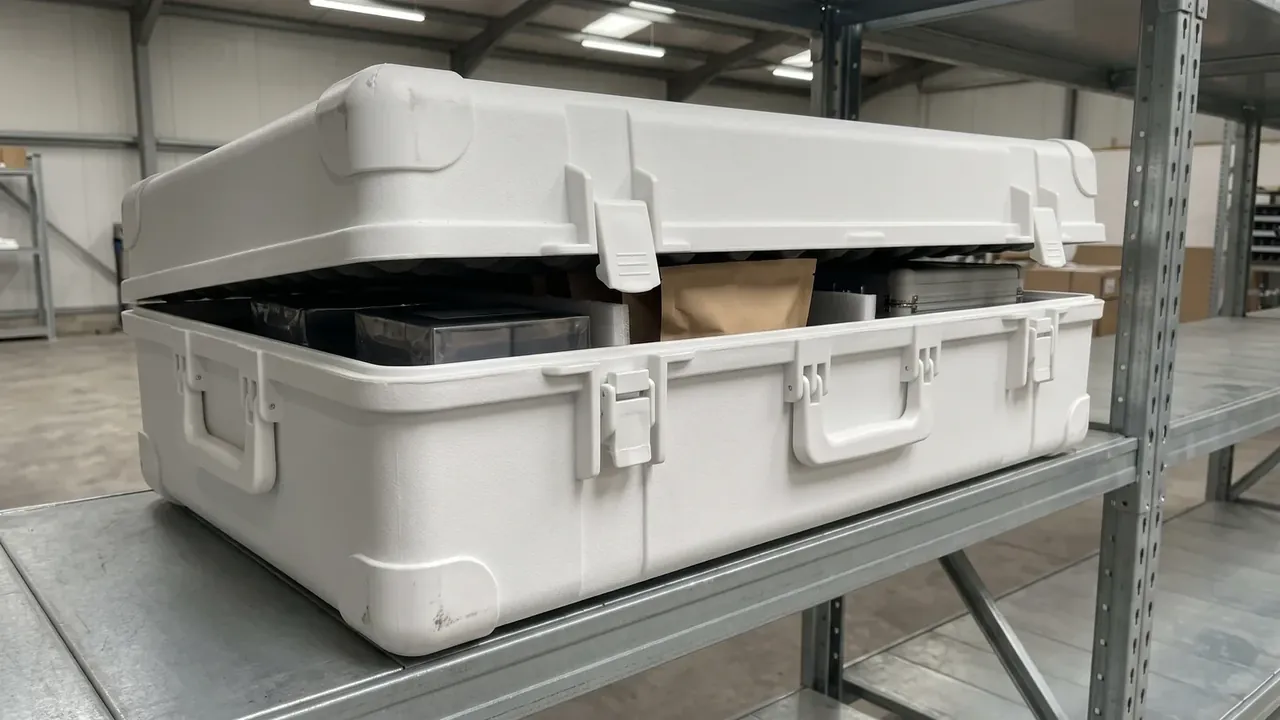
Quick answer: A glass-filled PP case trades impact for stiffness: 20% glass lifts tensile strength from 28 to 48 MPa and flexural modulus from 1.4 to 3.2 GPa. At 30% glass the figures reach 58 MPa and 4.6 GPa, while notched impact falls from 8 to 4.5 kJ/m² and a gloss surface stops being possible.
Table of contents
- How glass-filled PP steps up in strength
- Modulus and heat deflection
- Cost one: impact and weld lines
- Cost two: read-through and finish
- Tool wear and mould life
- Screening: when to go glass-filled
- FAQ
1. How glass-filled PP steps up in strength
Glass-filled PP gains strength in steps, not on a straight line: 28 MPa unfilled, 48 MPa at 20% short glass, 58 MPa at 30%, gains of 71% and 107%. Values follow GB/T 1040.2 on 1A bars at 50 mm/min.
Stiffness climbs faster in glass-filled PP: flexural modulus runs 1.4, 3.2 and 4.6 GPa, so the 30% grade is 3.3 times unfilled, because short fibres above 20:1 build the skeleton that carries bending load.
Heat deflection at 1.82 MPa tracks the same steps: 100 °C unfilled, 122 °C at 20% glass, 135 °C at 30%. At the 75 °C a closed vehicle reaches in summer, the unfilled grade softens while 30% glass keeps 60 K of margin.
| Property | Unfilled | 20% glass | 30% glass |
|---|---|---|---|
| Tensile MPa | 28 | 48 | 58 |
| Flexural modulus GPa | 1.4 | 3.2 | 4.6 |
| Heat deflection °C | 100 | 122 | 135 |
| Notched impact kJ/m² | 8 | 5.5 | 4.5 |
| Density g/cm³ | 0.91 | 1.04 | 1.12 |
| Shrinkage % | 1.5 | 0.6 | 0.4 |
Shrinkage must be read with direction: 0.4% along flow and 0.8% across it, which turns into warp on long parts.
2. Modulus and heat deflection
Lid sag makes modulus visible. A 600 mm × 400 mm cover, 3 mm walls, 60 kg spread evenly at 25 °C, sags 2.6 mm unfilled, 1.2 mm at 20% glass and 0.85 mm at 30%.
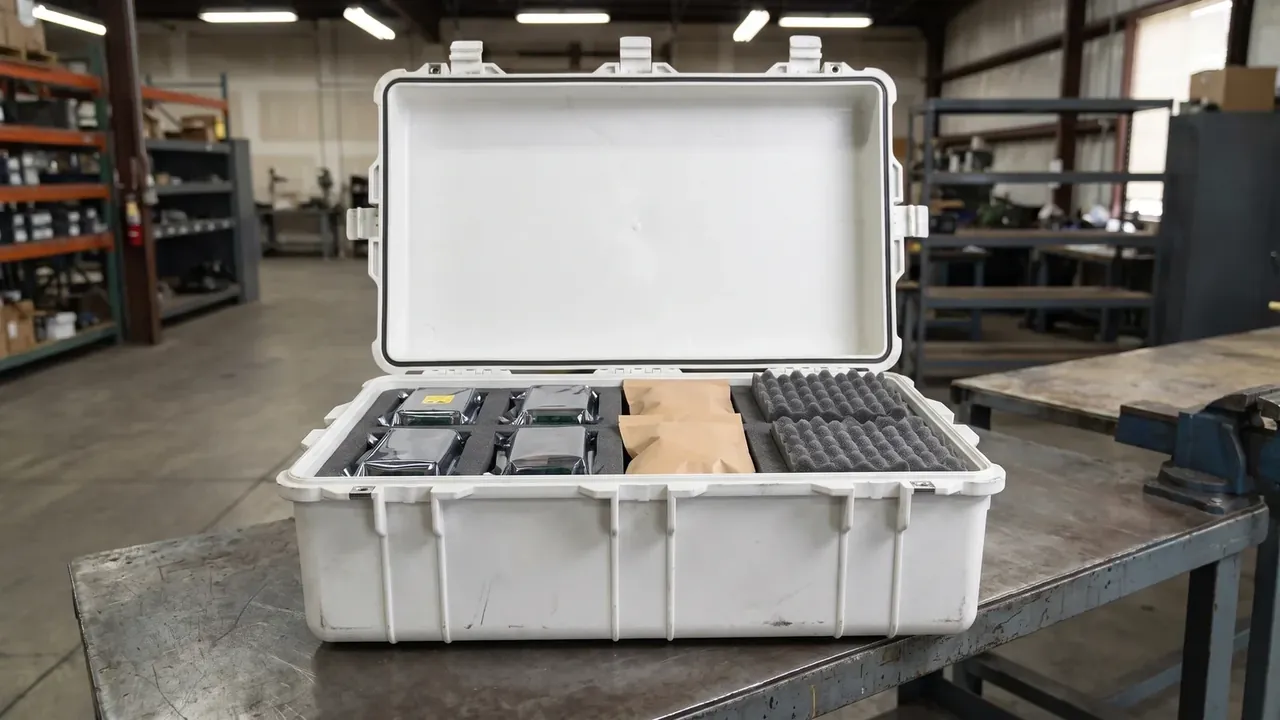
Creep converges the same way. At 40 °C with 20 kg for 24 h the unfilled cover deflects 3.0 mm against 1.4 and 1.1 mm for the glass grades, and recovery after 2 h runs 78%, 85% and 88%. Four cases stacked for 30 days leave 5.5 mm of permanent set unfilled and 1.8 mm at 30% glass.
Only the 135 °C grade can sit within 300 mm of an exhaust; compound steps by 1.7 and 3.1 CNY/kg, or 7 and 14 CNY on a 4.5 kg case. Growing unfilled walls 3 to 4 mm raises stiffness 2.4 times and mass 33%, while 30% glass gives 4.6 GPa at 3 mm for 23% more mass.
3. Cost one: impact and weld lines
In glass-filled PP, notched impact falls from 8 to 5.5 and 4.5 kJ/m², losses of 31% and 44%; at -20 °C it drops from 6.2 to 3.4 and 2.6. Fibre ends are stress raisers, so a crack joins the next within tens of microns.
Weld lines are the bill most often missed. Where two melt fronts meet, fibres align along the interface and strength keeps 40%–60% of bulk: 29 MPa at 20% glass, 23 MPa at 30%.
| Position | Bulk MPa | Weld line MPa | Retention |
|---|---|---|---|
| 20% glass | 48 | 29 | 60% |
| 30% glass | 58 | 23 | 40% |
Weld lines must stay 30 mm clear of latch seats, hinge bosses and handle roots; otherwise move the gate to the base centre, which on a 48 L case cuts weld length from 380 mm to 210 mm. A 5 kg/1 m drop dents the 20% grade 4 mm with no crack and the 30% grade 3 mm with a 6 mm hairline; chilled to -10 °C, the same drop opens 11 mm and 22 mm.
4. Cost two: read-through and finish
Read-through is built into glass-filled PP: fibres float to the surface at the flow front and leave pale streaks 0.05–0.15 mm deep, and sanding drags more up. Running the mould at 80–90 °C, melt at 230–245 °C and medium speed keeps depth under 0.05 mm.
A gloss route does not exist: unfilled PP polishes to Ra 0.4 μm, but every fibre cross-section then shows. Texture at Ra 1.6–3.2 μm, deeper than the 13 μm fibre diameter, is the workable route.
Colour suffers as well. Glass carries a beige cast, so light shades land at ΔE 1.5–2.5 and dark shades stay inside ΔE 1.0; holding ΔE ≤1.0 on a light part needs 8 CNY of paint and one more day.
5. Tool wear and mould life
Glass-filled PP wears the tool in proportion to loading. Against P20, 20% glass abrades about 6 times faster than unfilled compound and 30% glass about 9 times; gates and vent slots groove first, and 0.02 mm already prints on the part. Inserts run at HRC 48–52 or carry 0.02 mm of hard chrome, which holds life past 200,000 shots, while untreated P20 flashes at 80,000. The press changes too: bimetal screw and non-return valve, barrel 2 flights longer, 15% cushion. Without them shot weight scatters from ±1.5% to ±4%. Tooling runs 80,000 CNY unfilled against 120,000 at 30% glass, or 2 CNY per case over 20,000 shots plus 0.8 CNY upkeep.
6. Screening: when to go glass-filled
The question is whether the case carries load, not whether it should be harder.
| Duty | System | Wall mm | Surface |
|---|---|---|---|
| Structural, stacked 4 high | 30% glass | 3.0 | texture Ra 2.4 μm |
| Load-bearing, drop critical | 20% glass | 3.0–3.5 | texture Ra 3.0 μm |
| Visible face, light gloss | unfilled copolymer | 3.5–4.0 | polished |
| Handled below -20 °C | unfilled or 20% glass | 3.5 | texture Ra 3.2 μm |
Compound runs 10.8 CNY/kg unfilled, 12.5 at 20% glass and 13.9 at 30%, so a 4.5 kg case carries 49, 56 or 63 CNY; running 0.5 mm thinner saves 0.6 kg and pulls 7 CNY back. After 1000 h of xenon to GB/T 16422.3, modulus retains 92% on glass and 85% unfilled, but with impact at 2.6 kJ/m² the drop height must fall from 1.2 m to 0.9 m.
Conclusion
The value of a glass-filled PP case is not that it is stronger; it is that stiffness, heat deflection and dimensional stability arrive together: 4.6 GPa and 135 °C at 3 mm walls, paid for with 4.5 kJ/m² of impact, 40% weld-line retention and a surface that can only be textured. Screen in this order: can the weld line clear the latch and hinge, what is the lowest service temperature, then how much strength is needed. JUNZHIJIA fixes gate position, glass loading and texture roughness on one drawing.
This article discusses only the container (case body) side of specifications and design intent, and does not cover any handling, loading or use of the contents.
Related Reading
- ABS versus PP protective cases
- Case raw material comparison
- Injection-moulded protective case explained
- Mould life and maintenance
Related Products
- 8 Series — Gun Cases; Military Equipment Cases; Camera Equipment Cases; Drone Cases; Watch Cases; Knife Cases; First Aid Cases; Electronics Equipment Cases
- WL8-2812 PP Gun Case — model WL8-2812
- All protective cases and toolboxes: 7 series, 158 models