

Quick answer: A golden sample stays valid for 12 months or until one mould overhaul; ΔE above 1.5 or a 0.3 mm size drift voids it and forces a re-sign.
Table of contents
- A Golden Sample Is a State Record, Not a Box
- Twelve Months, or One Mould Overhaul
- Five Conditions That Void the Sample
- Re-signing: Retire the Old Card First
- Storage, Loans and Destruction
- FAQ
1. A Golden Sample Is a State Record, Not a Box
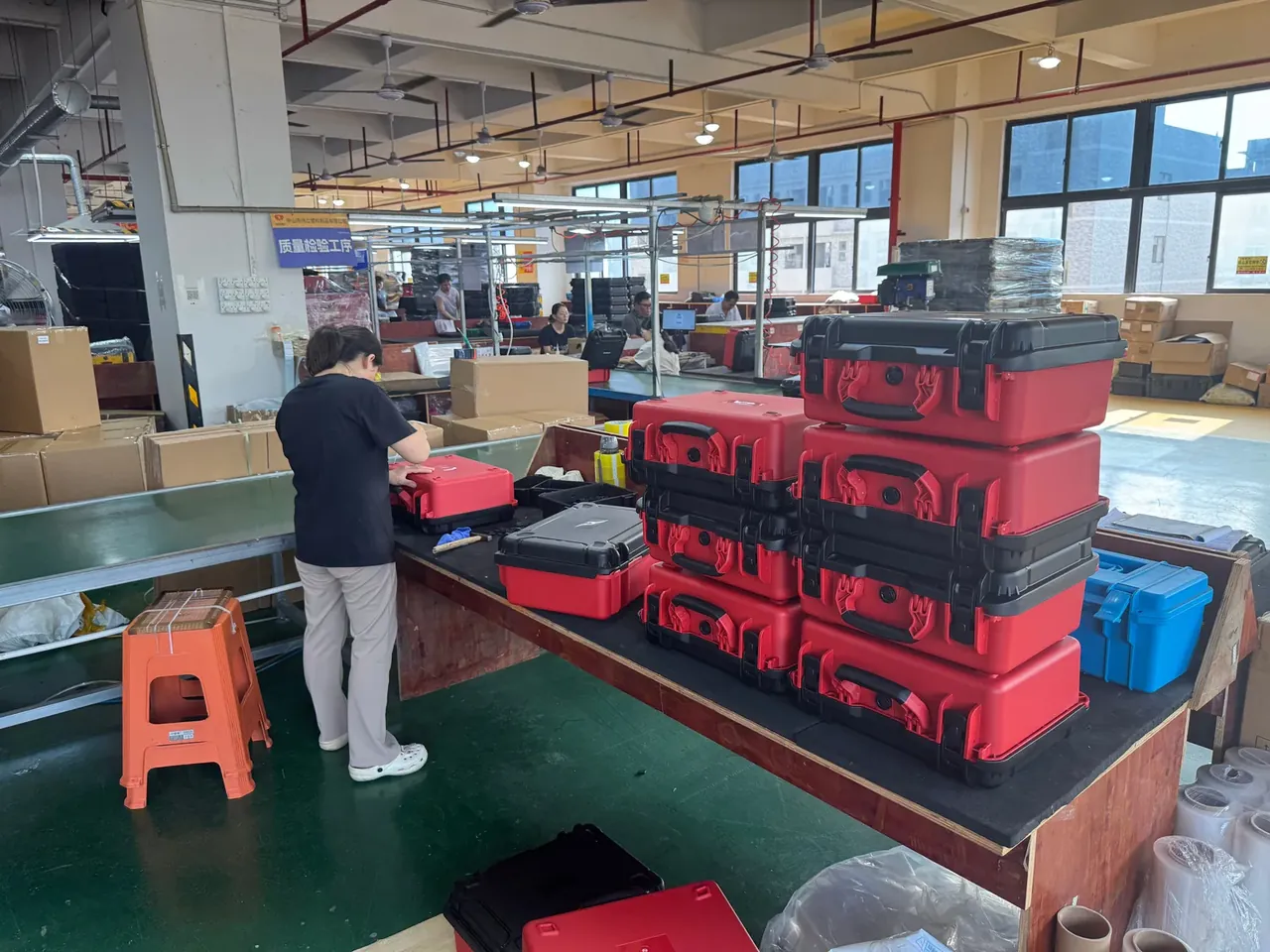
Two copies, three signatures, one expiry date. Yet most surface disputes trace back to a bench sample nobody had declared void. A red case of 480 × 360 × 215 mm signed in April 2024 still judged shipments in March 2026, after 2 mould overhauls and 1 insert change moved the corner texture by 0.15 mm.
A golden sample carries 3 states: effective, observation and void. One applies at a time, shown twice, on the information card and on the seal colour. When the two disagree, the golden sample is void until someone re-signs it.
| State | Trigger | Permitted use | Review |
|---|---|---|---|
| Effective · first signature | 3 signatures on the card | Accept or reject lots | Every 6 months |
| Effective · re-verified | Colour and size in limits | Same as above | Every 6 months |
| Observation | ΔE between 1.0 and 1.5 | Trend reference | Monthly |
| Void · pending destruction | Any of the 5 conditions | None | None |
| Void · archived | Photographed, then cut | Traceability | None |
Observation is where control slips. Such a sample may sit beside a shipment to discuss colour drift, but the verdict column stays empty. One result written against an observation sample bypasses the state machine.
2. Twelve Months, or One Mould Overhaul
The clock starts on the signature date, not the first production run. Twelve months is the ceiling, and a mould overhaul ends validity earlier if it comes first. The original surface is fixed the day of signing; a production date drifts 3 to 6 weeks with scheduling and stretches the period.
An overhaul is defined in advance. Cavity welding, insert replacement and parting-line remilling each count as 1, and any of the 3 stops the clock. No extension is allowed: 2 new samples are signed and the old pair stamped void that day.
Observation is a buffer, not an amnesty. A reading of ΔE 1.0 to 1.5, or a deviation of 0.2 to 0.3 mm, moves the state to observation for 3 months. It returns to effective once 3 consecutive lots fall back inside the limits; drift beyond 3 months means void.
The expiry date triggers a reminder 30 days ahead, and review must be booked within 7 working days. Past that window the golden sample drops to observation on its own; most expired samples have no named owner.
3. Five Conditions That Void the Sample
Colour first: ΔE above 1.5, read under D65 at 45/0 geometry with an 8 mm aperture, 5 points per case, highest taken. Size second: 3 interior dimensions and 4 wall points, any side above 0.3 mm, thickness averaged over 3 ultrasonic readings.
Material third: a new grade, a new masterbatch supplier, or a melt flow rate moving over 8% from the original lot. Mould fourth: overhaul, plant transfer, or cavities going from 1 to 2. Customer fifth: approval cancelled or drawing revised.
| Trigger | Reading | Who confirms | Deadline |
|---|---|---|---|
| Colour | ΔE > 1.5, 5 points | Customer quality | 3 working days |
| Key dimensions | Side > 0.3 mm | Factory quality | 3 working days |
| Material change | Melt index > 8% | Both quality teams | 5 working days |
| Mould change | Overhaul, transfer | Mould owner | Same day |
| Customer withdrawal | Approval or drawing | Customer quality | Day of notice |
The third condition hides. The grade stays, only the masterbatch supplier changes, and the first 2 lots look acceptable. Yellowing shows in lot 3, when the sample no longer qualifies but is still filed as effective, expiry blank.
4. Re-signing: Retire the Old Card First
Order matters more than paperwork. Stamp the old sample void, move it out of the comparison area, log it into the archive, then arrange signatures. Two live versions are hardest to find: inspectors hold one each, reach opposite verdicts, and a trace takes 2 days to establish authority.

Three parties sign: customer quality, factory quality, and the moulding or tooling owner. Their dates go on 1 card with 6 fields, code, signature date, model and drawing revision, grade and colour code, 3 signatures, expiry date. One missing field voids the card.
A 9-digit code reads on sight: 2 for the year, 2 for the month, 2 for the plant, 3 for the running number. It appears twice, on the card and inside the handle recess.
5. Storage, Loans and Destruction
The cabinet sits inside the inspection area, away from daylight. Air stays at 23±3 °C and 50±10% RH, illuminance at or below 300 lux, the cabinet 300 mm off the floor in 6 tiers sorted by model. Temperature and humidity are logged daily; 7 days out of range send stored samples back to review.
| Location | Environment | Maximum stay | Record |
|---|---|---|---|
| In cabinet | 23±3 °C, ≤300 lux | Indefinite | Daily log |
| On loan | Shaded, flat | 7 days | 5-field entry |
| Pending destruction | Locked tier | 30 days | 4 photographs |
A loan entry carries 5 fields: borrower, purpose, date out, agreed return, and confirmation. Returns are checked within 24 h and the seal inspected; a broken seal sends the golden sample to void.
Annual review runs once a year, 1 person from quality and 1 from engineering, re-measuring colour and 3 dimensions, records kept 3 years. Destruction follows within 30 days of voiding: the cut goes through the wall, never a latch.
Conclusion
Control of a golden sample is a question of state, not storage. Fix validity at 12 months or 1 overhaul, tie the void to 5 readable conditions, and make re-signing a retire-then-sign sequence. A sample with a live status settles a colour argument in minutes; a case without one defers it to the claim stage.
This article covers case-side specifications only and does not address any handling, loading or use of the contents.
Related Reading
- Sampling approval from drawing to signed sample
- How to weight a sample scorecard
- Three tests and two dimensions in sample evaluation
- Which three sizes to sample first
Related Products
- 8 Series — Gun Cases; Military Equipment Cases; Camera Equipment Cases; Drone Cases; Watch Cases; Knife Cases; First Aid Cases; Electronics Equipment Cases
- WL8-2812 PP Gun Case — model WL8-2812
- All protective cases and toolboxes: 7 series, 158 models