

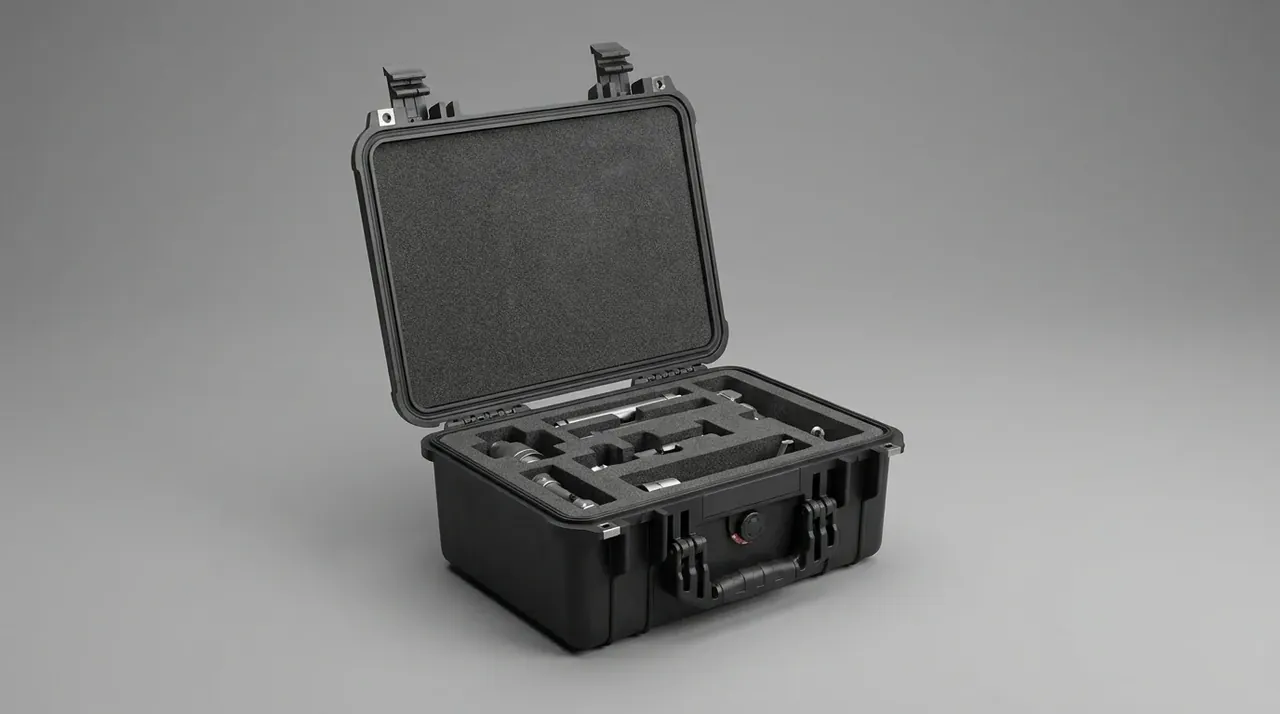
Quick answer: Set the gost case climate class first: -60 °C for UHL1 and HL1, -40 °C for U2 under a canopy, then 10 mm Cyrillic letters and a 1.2 m corner drop.
Table of contents
- Climate Class Sets the Resin, the Marking Follows
- Eight Cyrillic Fields, One Cap Height
- Five Transport Marks and a 40 mm Barcode
- Cold Drop: Four Hours at -40 °C, Then 1.2 m
- Stacking Three High, Measuring at 20 °C
- FAQ
1. Climate Class Sets the Resin, the Marking Follows
A 400 × 300 × 200 mm case measures 400.0 mm at 23 °C and 394 mm at -60 °C. The 6 mm gap is a 100 K span times 0.00015 per kelvin, the linear expansion of polypropylene, and on a gost case it decides resin grade and wall thickness before any wording is chosen.
| Climate class | Siting | Design low | Design high | Case-side focus |
|---|---|---|---|---|
| UHL1 | Open air, unsheltered | -60 °C | +40 °C | Impact plus 1000 h UV |
| U2 | Under canopy | -40 °C | +40 °C | Impact only, no UV item |
| HL1 | Open air, long cold season | -60 °C | +40 °C | Cold brittleness over 5 months |
UHL1 and HL1 both quote -60 °C, which looks redundant. The difference is duration: an open-air shell in a cold band sits below -40 °C for five to six months, while a temperate site sees -60 °C for a few hours and is back at -20 °C by noon.
Homopolymer PP notched Charpy impact is 4 kJ/m² at -60 °C; 8% ethylene-octene copolymer lifts it to 9 kJ/m² and drops tensile strength from 28 MPa to 24 MPa. The 3.5 mm side stays, the corner goes to 5.2 mm where drop cracks start.
2. Eight Cyrillic Fields, One Cap Height
The receiver measures letter height with a tape before reading anything. Under 10 mm blurs at 1.5 m and the sheet reads «marking illegible».
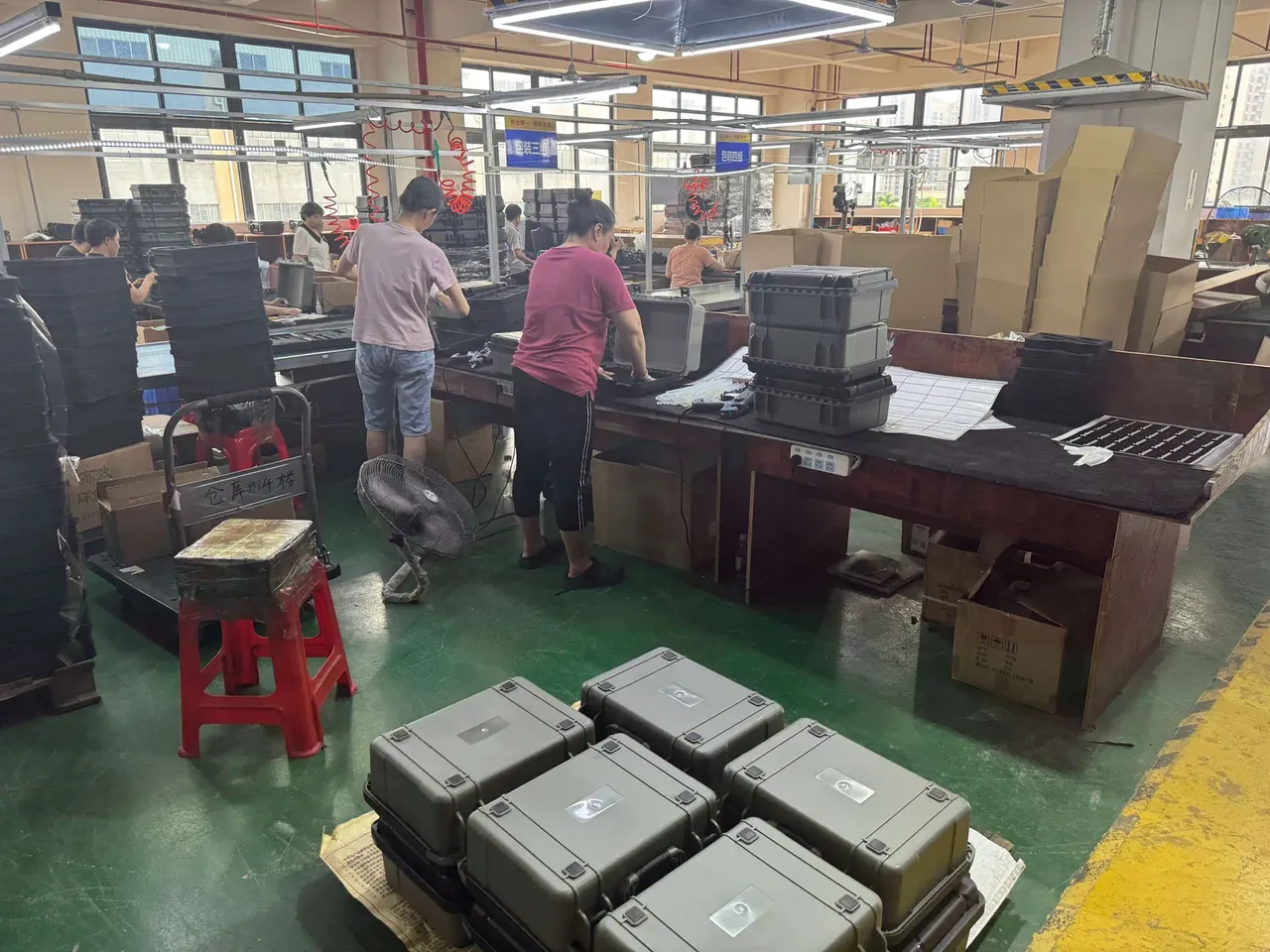
Eight fields: product name, model, external dimensions, gross mass, shell material, manufacturer, country of origin, batch number. The first four let the box be sorted, the last four decide who gets called.
Russian writes with 33 Cyrillic letters, upper case only, and the dots over Ё are usually dropped. Latin letters in a model code stay. At 0.2 m of reading distance per 1 mm of cap height, 10 mm letters cover 2 m.
Ink is judged by cross-cut: 1 mm spacing, a 6 × 6 grid, tape peeled at 60°, area loss under 5% is grade 3, retested after 24 h at -60 °C. Reserve 180 × 90 mm, top right of the front face.
3. Five Transport Marks and a 40 mm Barcode
Transport marks are read by logistics, product marking by the consignee. GOST 14192 marking rests on five fields: consignee code, piece against total, gross and net mass, external dimensions, handling symbols. One line reads 3/12, 12.4 kg and 10.8 kg, 40 × 30 × 20 cm.
| Code | Field | Height or size | Position |
|---|---|---|---|
| М1 | Consignee code | 10 mm cap | Front, upper left |
| М2 | Piece and total | 10 mm cap | Front, under М1 |
| М3 | Gross and net mass | 7 mm cap | Front, lower right |
| М4 | External dimensions | 7 mm cap | Front, under М3 |
| М5 | Handling symbols | 15 mm square | One set per adjacent face |
A 40 mm barcode width is a floor. A 12-digit part number in Code 128 at 40 mm gives a 0.25 mm module, 3 dots at 300 dpi; at 30 mm the module falls to 2 dots and first-read rate at 30 cm drops from 95% to 70%. Keep a 2.5 mm quiet zone.
4. Cold Drop: Four Hours at -40 °C, Then 1.2 m
Cold drop runs freeze first, drop second. A sample spends 4 h at -40 °C before the core of a 5.2 mm corner reaches -38 °C. At 2 h the corner is still at -20 °C and the crack count halves.

Keep chamber-to-impact under 30 s: a -40 °C sample left 3 min in a 23 °C room is back to -15 °C and regains roughly 40% of its impact value.
| Drop attitude | Pre-conditioning | Drop height | Pass criterion |
|---|---|---|---|
| Flat on base | -40 °C / 4 h | 1.0 m | No through crack in the base |
| Long edge | -40 °C / 4 h | 1.1 m | Edge line stays closed |
| Short edge | -40 °C / 4 h | 0.9 m | No crack on the short edge |
| Corner | -40 °C / 4 h | 1.2 m | No radial crack over 3 mm, latch shut |
Judgement looks at cracks, not deflection: a radial crack over 3 mm, a latch that opens by hand, a gasket shifted over 1 mm — any one fails. All 3 must pass; a failure sends wall thickness and corner radius back.
5. Stacking Three High, Measuring at 20 °C
Stacking is calculated at 3 high. With a 12 kg gross mass the bottom case carries 24 kg, and a factor of 3 raises the load to 72 kg for 24 h, lid deflection capped at 2 mm.
Dimensional checks belong at 20 °C. A 100 K swing moves the 400 mm dimension by 6 mm, so a case measured at -20 °C reads 396 mm; cut a mould to that and it is 4 mm oversize in summer. Sit the sample 4 h at 20 °C and take the median of 3 readings.
Mould shrinkage is set at 1.6%, with separate compensation for the 3.5 mm side and the 5.2 mm corner. Cycling ten times from -60 °C to +40 °C leaves a 0.4 mm mismatch and opening force climbs from 180 N to 260 N.
Conclusion
A gost case is specified in one order: climate class, then marking, then test values. Split the class, carry separate resins for UHL1 and HL1, and lock the eight fields, the 10 mm cap height and the 40 mm barcode before the first run. Freeze 4 h at -40 °C, drop 1.2 m on a corner, stack 3 high at 72 kg.
This article covers case-side specifications only and does not address any handling, loading or use of the contents.
Related Reading
- EAC route for Russian exports
- How transport marks are laid out
- Sea, air and courier mark differences
- Brittleness testing at low temperature
- Layout rules for English case labels
Related Products
- 8 Series — Gun Cases; Military Equipment Cases; Camera Equipment Cases; Drone Cases; Watch Cases; Knife Cases; First Aid Cases; Electronics Equipment Cases
- WL8-2812 PP Gun Case — model WL8-2812
- All protective cases and toolboxes: 7 series, 158 models