

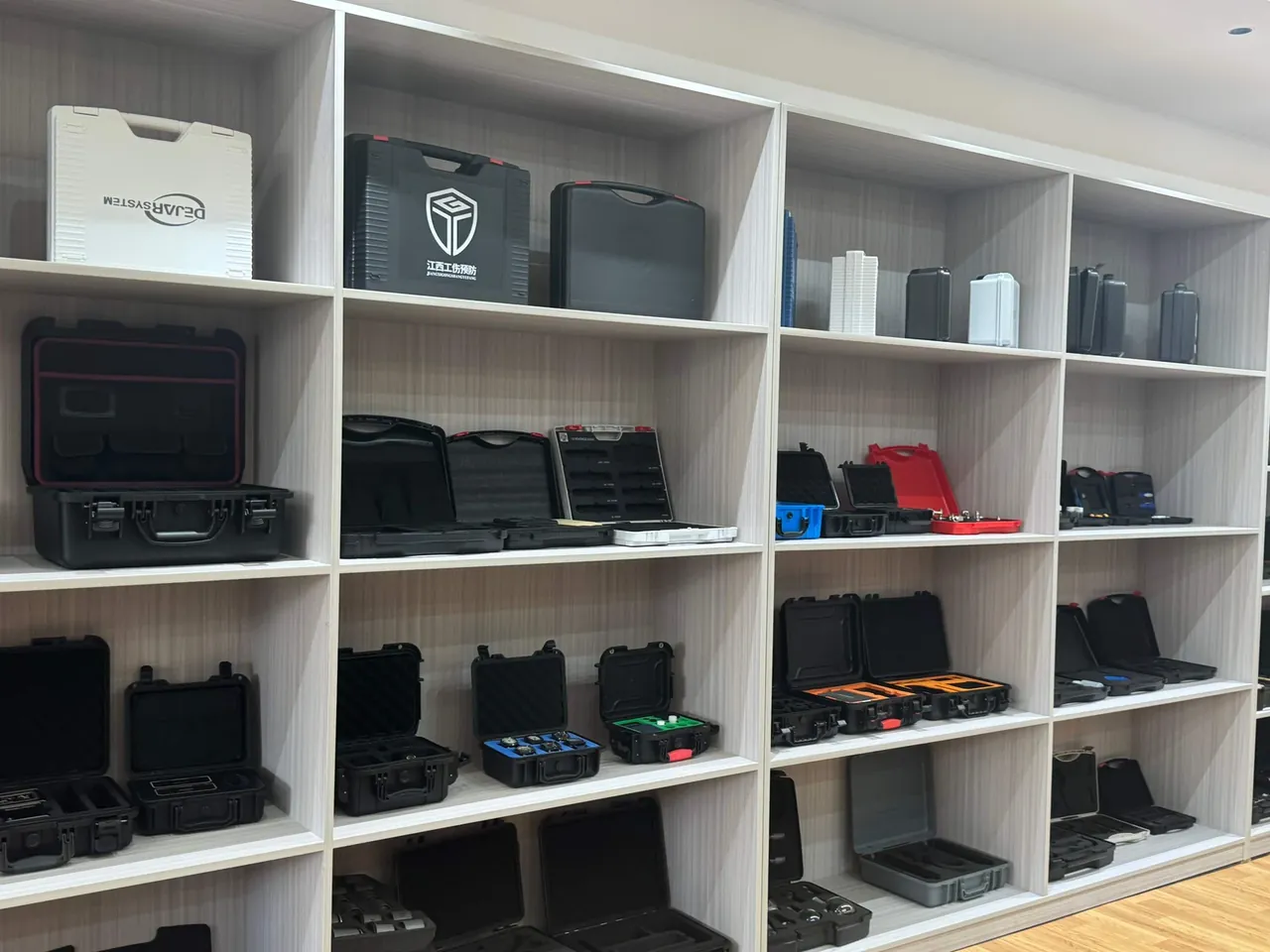
Quick answer: Five decisions shape a grenade transport case: body layering, injection molding versus rotomolding, latch and hinge load paths, sealing and venting, and the tests that prove a batch. Skip one and the failure appears later as a cracked rib or a leaking rim.
Table of contents
- How the Case Body Is Layered
- Injection Molding or Rotomolding
- Load Path Through Latches and Hinges
- Sealing and Pressure Equalization
- Factory Validation Before Shipment
- FAQ
1. How the Case Body Is Layered
A grenade transport case does not resist impact with one thick wall. It divides the work: the panel stops puncture, the rib grid controls deflection, the rim frame takes latch pull, and the bottom spreads stacking weight. Each layer carries one task, so wall thickness stays moderate.
The rim frame is the layer most often undercut. Every latch pulls on it, so a rim half as thick as the panel bows into a wave along the opening, and the gasket is then compressed unevenly. Rib fillets below a 2 mm radius concentrate stress at the rib root.
| Layer | Thickness | Job |
|---|---|---|
| Outer panel | 3.4 mm | Resists point impact |
| Rib grid | 12 mm at 85 mm pitch | Limits bulging |
| Rim frame | 6 mm | Spreads latch pull |
2. Injection Molding or Rotomolding
The route for a grenade transport case is not about precision but batch size and footprint. Injection molding runs on 650 to 1300 tonne presses with a cycle near 190 seconds, about 35 of them cooling. Ribs reach 12 mm deep, and the economic batch starts around 3,000 units.
Rotomolding swings a powder-filled mold in a 260 °C oven for 16 minutes, then water-cools for 12 minutes. Walls of 5 to 8 mm are normal, and shells above 900 mm or batches under 800 fit this route.
| Item | Injection | Rotomolding |
|---|---|---|
| Cycle | About 190 s | About 45 min |
| Wall | 3.2–4.5 mm | 5–8 mm |
| Batch | Above 3,000 | Below 800 |
| Tolerance | ±0.5% | ±1.5% |
3. Load Path Through Latches and Hinges
Latch tension on a grenade transport case should be even, not maximal. With two tight latches and two loose ones, the lid lifts on one side first and the gasket keeps a permanent set.
A 6 mm bearing step under each latch seat passes the pull into the rim instead of hanging it on two screws. Space screws more than 45 mm apart and the latch body rotates, wearing the hole oval. Holding force is quoted at 800 to 1000 N.
The hinge side asks for the opposite. It must let the lid swing to 180 degrees without tearing the stop rib: a 6 mm pin in a nylon bush, validated over 5,000 cycles, with 0.5 mm clearance.
4. Sealing and Pressure Equalization
Sealing depends on compression ratio, not on clamping the lid hard. The gasket sits in a rim groove and should end at 25 to 30 percent compression. Under 20 percent water climbs the groove; over 35 percent the cord loses its rebound and stays flat once cold.
Groove and gasket section are designed as a pair. A 4.5 mm wide, 5.5 mm deep groove with a 6 mm EPDM cord gives about 78 percent fill. Corners must be rounded, or the cord creases into a leak path.
Venting is the step most often deleted. Across a 40 °C swing the pressure difference can reach 6 kPa, so without a vent the lid sucks down when opened. A 0.8 mm channel inside the lid balances it within about 30 seconds.
5. Factory Validation Before Shipment
Whether the process behind a grenade transport case is stable can only be shown by test data: appearance is an entry requirement, drop, stacking, thermal cycling and salt spray decide consistency.
Drop testing runs from 1.2 m onto six faces, three edges and one corner, ten drops per sample. Stacking holds 5 layers for 72 hours at 180 kg. Thermal cycling sits at -40 °C and +60 °C for 4 hours each.
| Test | Parameters | Pass line |
|---|---|---|
| Drop | 1.2 m, 10 drops | No cracks |
| Stacking | 5 layers, 72 h, 180 kg | ≤2 mm |
| Salt spray | 96 h neutral | Rust ≤5% |
Conclusion
Most quality differences in a grenade transport case can be read off a drawing before molding: whether layers are separated by job, whether the route matches the batch, whether latches land on bearing steps, and whether sealing and venting are designed as a pair. A grenade transport case that lasts is one where each layer carries only its own load.
This article discusses only the container (case body) side of specifications and design intent, and does not cover any handling, loading or use of the contents.
Related Reading
- Dimensions, compartments and cushioning of a grenade transport case
- How a grenade transport case differs from alternatives
- Material comparison for grenade transport shells
- How internal dividers are built
Related Products
- 8 Series — Gun Cases; Military Equipment Cases; Camera Equipment Cases; Drone Cases; Watch Cases; Knife Cases; First Aid Cases; Electronics Equipment Cases
- WL8-2812 PP Gun Case — model WL8-2812
- All protective cases and toolboxes: 7 series, 158 models