

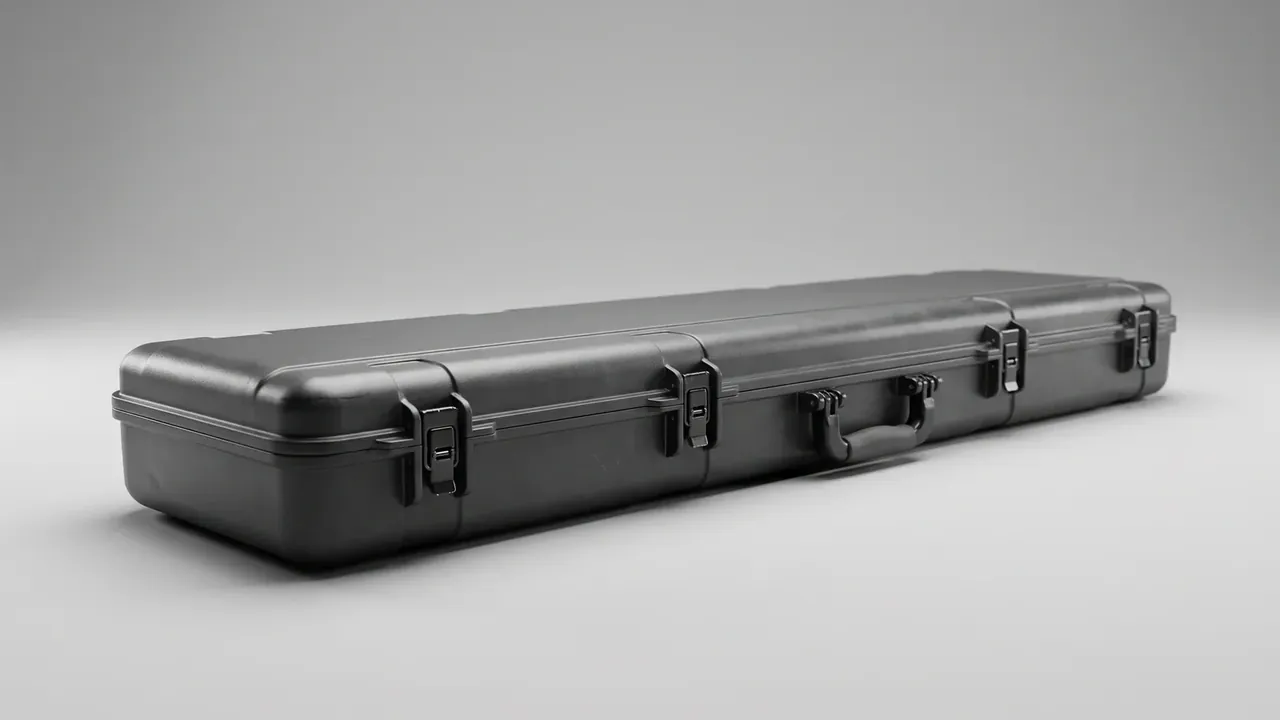
Quick answer: Judge Gun Case Production by six numbers you can re-measure: wall spread, lid clearance, latch force, salt spray hours, base flatness and a cold drop. Write the limits into the enquiry and the floor answers for itself.
Table of contents
- Judging Gun Case Production by Numbers
- Three Questions About Mould and Process
- Six Measurable Checks on the Floor
- Comparing Samples: Three Actions
- Matching Use Conditions to Production Grade
- When Capacity Does Not Meet Demand
- FAQ
1. Judging Gun Case Production by Numbers
Every showroom sample looks good; the difference sits on the floor. Same outline, different wall distribution, different hardware plating, different behaviour at -25°C.
| Dimension | Measure | Limit | Tool |
|---|---|---|---|
| Wall evenness | Six calliper points | Spread ≤ 0.3 mm | Digital calliper |
| Lid clearance | Lid-to-body gap | 0.5–0.8 mm | 0.05 mm feeler |
| Latch force | Release load | 90 N or less | Force gauge |
| Hardware | Neutral salt spray | 240 hours | Report and batch |
| Base flatness | Corner lift | 0.5 mm feeler refused | Plate and feeler |
| Cold impact | -25°C for 2 h, 1.5 m corner drop | No crack, no pop | Freezer and rig |
All six survive third-party retesting, which is why they settle arguments that adjectives cannot. A plant that cannot do them talks about feel; one that can hands you the gauge.
2. Three Questions About Mould and Process
First, who owns the mould: a new tool cut for you, or a house tool recoloured. A house tool means someone else set the shape and the wall distribution.
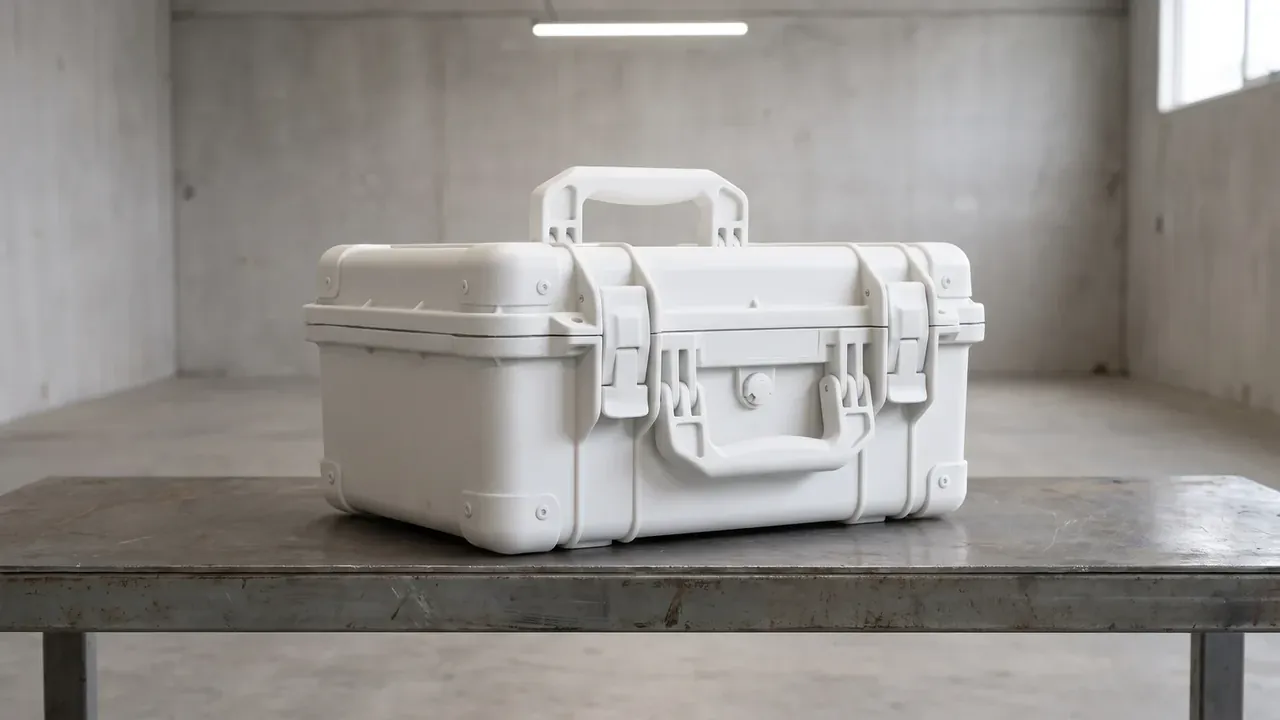
Second, heating and arms. A hot-air oven on a three-arm rocker carries material into the corners; a single-arm machine on a 1,200 mm case often leaves the far end 0.6 mm thin, which no photo reveals.
Third, what that tool has already run: colour changes, resin grades, regrind ratio. Plants with a mould file answer in seconds; plants without one invent figures.
3. Six Measurable Checks on the Floor
Do these where the machine stands, not from a report sent later.
- Six wall points, base corners plus mid-sidewall, spread within 0.3 mm; a 0.5 mm spread marks uneven mould temperature and a weak spot.
- Lid clearance: run a 0.05 mm feeler around the closed seam; anything admitting 0.9 mm leaks in rain.
- Latch force with a gauge on the handle: it should release under 90 N; past 120 N a gloved hand cannot open it.
- Salt spray: ask for 240 hours neutral, then match the batch number on the report to the hardware delivered.
- Base flatness: empty case on a plate, 0.5 mm feeler at each corner; if it enters, the base domes and stacks rock.
- Cold drop: two hours at -25°C, then a 1.5 m corner drop loaded, checking corners and latch seats.
Check five is the one most often skipped, because an empty case hides it until the load goes in.
4. Comparing Samples: Three Actions
Samples are not a looks contest. Three actions rank Gun Case Production quickly.
| Action | Method | Pass | Typical failure |
|---|---|---|---|
| Loaded side rest | 80% load, on its side, 24 h | Seam closed, lid true | 0.6 mm gap after a day |
| Cycle test | 50 open-close cycles | Even feel, no binding | One latch loosens by 30 |
| Strip a latch | Cut section at the thread | Even plating | Dark bore |
Two hours of this beats ten pages of process description. The loaded rest exposes uneven walls fastest: the thin face domes first, and a finger along the seam finds it.
5. Matching Use Conditions to Production Grade
Grade is a match, not a maximum. State the duty and the grade follows.
| Duty | Grade | Key limit |
|---|---|---|
| Under 10 trips a year, room storage | Standard wall, single seal | Spread ≤ 0.4 mm |
| Monthly transport, -10°C to 45°C | Thicker wall, twin seal, 240 h hardware | Spread ≤ 0.3 mm |
| Weekly transport, sea freight | Ribbed wall, pressure valve, immersion | 30-minute immersion dry |
| Air freight, frequent handling | Light structure, heavy corners, 1.5 m drop | No distortion after drop |
Over-specifying adds weight and price together; under-specifying shows up in the first transfer. Gun Case Production grades exist to convert trip frequency into structural margin, so ask with quantities attached.
6. When Capacity Does Not Meet Demand
One rocker on this size runs 12 cycles a day at two pieces, roughly 24 a day, 600 a month. A quarterly need of 1,500 therefore needs a machine count, not a promise.
- Ask the machine count first: three rockers make 1,500 a quarter plausible; one makes the date slip.
- Ask cavity count next: four cavities double daily output but demand a fresh wall-evenness check.
- Ask for split deliveries: 500 at a time relieves scheduling and holds one price band.
- If none lands, change plant rather than push price.
Capacity and Gun Case Production quality are separate questions: a good plant may not take a rush order, and a plant that takes it may not hold the tolerance.
Conclusion
Judging Gun Case Production ends on six re-measurable numbers: 0.3 mm wall spread, 0.8 mm lid clearance, 90 N latch force, 240 hours of salt spray, a 0.5 mm feeler refused at the base, and no crack after a 1.5 m drop at -25°C. Put them in the enquiry and the adjectives disappear. Then match the grade to duty, and cost capacity separately.
This article discusses only the container (case body) side of specifications and design intent, and does not cover any handling, loading or use of the contents.
Related Reading
- What a gun case production audit covers
- How gun case production works
- Choosing a gun case: judgement points
- How to read case line capacity
- Gun case versus alternative options
Related Products
- 8 Series — Gun Cases; Military Equipment Cases; Camera Equipment Cases; Drone Cases; Watch Cases; Knife Cases; First Aid Cases; Electronics Equipment Cases
- WL8-2812 PP Gun Case — model WL8-2812
- All protective cases and toolboxes: 7 series, 158 models