

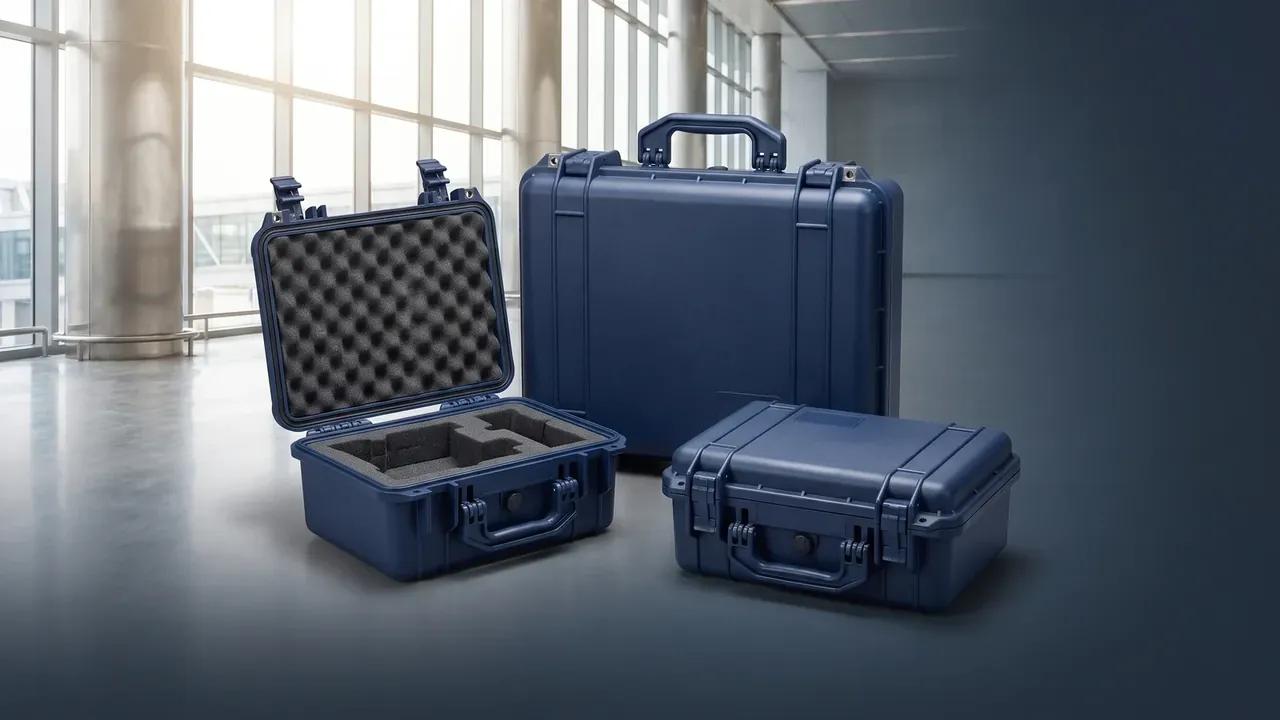
Quick answer: A hand carry hard case is accepted in four groups: first article and appearance, dimensions and handle fit, hinge and latch life, then cold drop and stacking. Load 22 kg, condition at -25 °C for four hours, drop 1.2 m on six faces; one through-crack sends the lot back.
Table of contents
- Four Inspection Groups and Reject Levels
- First Article and Appearance: Colour, Parting Line, Rim Flatness
- Handle Static Load: 60 kg for 60 Seconds
- Hinge and Latch Cycles, Opening Force
- Cold Drop, Stacking and Conditioning
- FAQ
1. Four Inspection Groups and Reject Levels
Arguments on an inspection floor are rarely about strictness; they are about whose number counts. A hand carry hard case needs one sheet fixing the groups, the sample size and the signature, and the order never varies: no signature, no start.
Defects run in three levels. A through-crack, a broken latch hook or a wall below 3.2 mm is critical: one piece rejects the lot. Colour drift or a rim out of flat is major: tighten sampling and retest. Scuffs are minor: sort and rework.
| Group | Main items | Equipment | Level |
|---|---|---|---|
| Appearance | Sealed sample, colour, parting line, rim | Spectrophotometer, feeler, plate | Major |
| Dimensions | Internal size, wall, handle holes, torque | Calipers, gauge, torque wrench | Critical |
| Hinge and latch | Cycles, opening force, pin clearance | Cycle rig, push-pull gauge | Major |
| Drop and stack | Conditioning, six faces, deflection | Chamber, drop rig, load blocks | Critical |
Sampling follows batch size, drawn across pallets and cavities.
2. First Article and Appearance: Colour, Parting Line, Rim Flatness
A first article is not the best-looking case in the run. Take one from every cavity over three consecutive shots and measure internal size, wall thickness and handle holes.
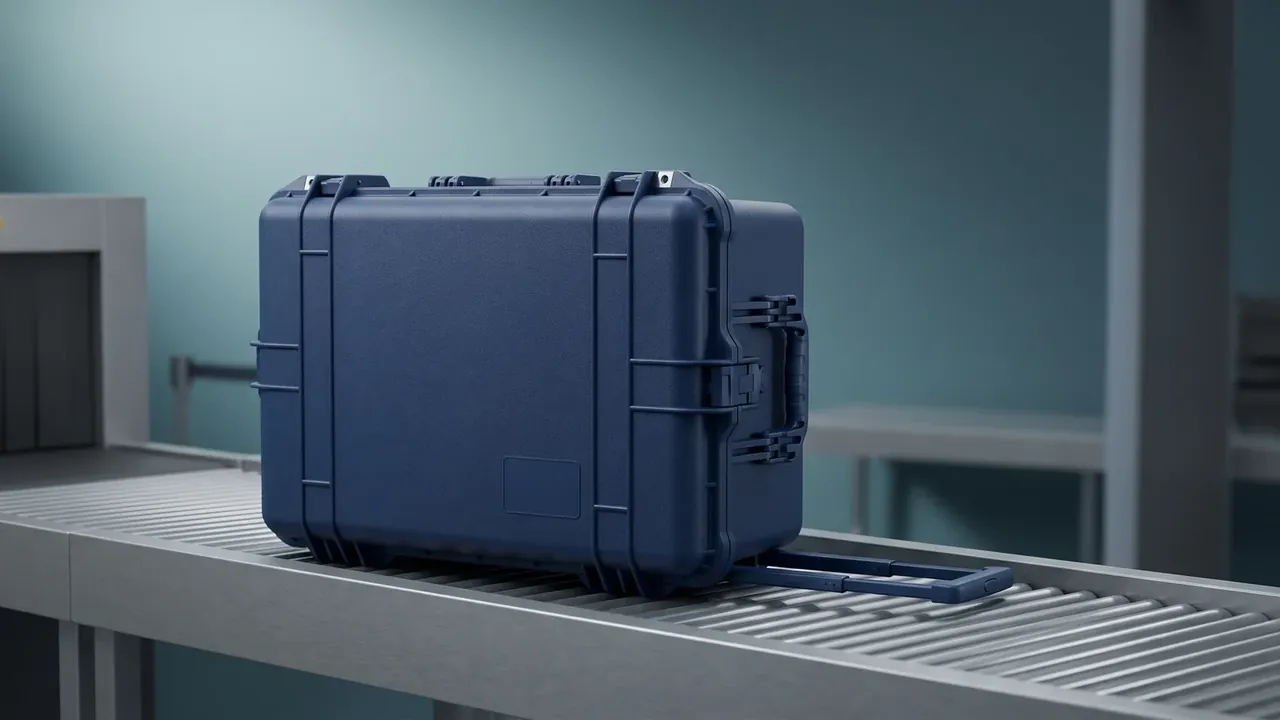
Colour on a hand carry hard case is read at three points: lid face, body side, handle. Keep ΔE within 1.0 of the sealed sample. A fingernail that catches a parting-line ridge above 0.2 mm marks a major defect.
Rim flatness decides sealing. Turn the case on a plate and run a 0.05 mm feeler around the rim: no gap above 0.6 mm.
3. Handle Static Load: 60 kg for 60 Seconds
The handle is the only part of a hand carry hard case under repeated dynamic load. Static load is 2.7 times working weight: 60 kg on a 22 kg case, held 60 seconds, measured after ten minutes. Residual deflection under 0.8 mm passes.
An M5 bolt into a 34 mm boss takes 2.5 N·m. Too little and the handle works loose; too much and the boss creeps.
Six checks settle a handle assembly:
- 60 kg for 60 seconds, no crack
- residual deflection under 0.8 mm
- boss at least 34 mm, radius R2.5
- torque 2.5 N·m, witness mark aligned
- sag under 1.2 mm on a 140 mm span
- folded handle within 0.5 mm of the lid
4. Hinge and Latch Cycles, Opening Force
On a hand carry hard case, hinge acceptance is about looseness rather than breakage. After 8000 cycles the lid sags no more than 3 mm and pin clearance stays under 0.3 mm, which is two and a half years at eight openings a day.
Latches run 5000 cycles, with opening force logged every 500. Between 60 N and 110 N is normal. Below 60 N the hook releases itself in transit; above 110 N crews pry with a screwdriver and distort it.
Salt spray applies to metal only: 96 hours, no red rust, nickel at 8 µm or above.
| Item | Condition | Pass line | On failure |
|---|---|---|---|
| Hinge | 8000 cycles at 20 per minute | Sag under 3 mm | Double the sample |
| Latch | 5000 cycles | 60 to 110 N | Retest a new lot |
| Pin clearance | Plug gauge | Under 0.3 mm | Reject the piece |
| Salt spray | 96 hours | No red rust | Return the lot |
5. Cold Drop, Stacking and Conditioning
Drop at the worst temperature. Load a hand carry hard case with 22 kg, condition it at -25 °C for four hours, then finish the first drop within 30 seconds. Use a fresh sample for each face.
Six faces plus one bottom edge, 1.2 m onto 50 mm steel. No through-crack, no latch release, lid offset under 2 mm.
An empty case weighs 3.4 kg. Stack five high with 180 kg for 24 hours and the side wall bulges under 3 mm. Repeat at 55 °C, where polypropylene loses 30% of its modulus.
Conclusion
Acceptance of a hand carry hard case comes down to four numbers: first-article dimensions, 60 kg on the handle, 5000 latch cycles, and 1.2 m at -25 °C. Put the levels and sample sizes in the contract annex, and a hand carry hard case is judged on data rather than mood.
This article discusses only the container (case body) side of specifications and design intent, and does not cover any handling, loading or use of the contents.
Related Reading
- Where load enters a hand carry hard case
- What a hand carry hard case carries
- Airdrop case acceptance items
- Mould and storage acceptance
Related Products
- 8 Series — Gun Cases; Military Equipment Cases; Camera Equipment Cases; Drone Cases; Watch Cases; Knife Cases; First Aid Cases; Electronics Equipment Cases
- WL8-2812 PP Gun Case — model WL8-2812
- All protective cases and toolboxes: 7 series, 158 models