

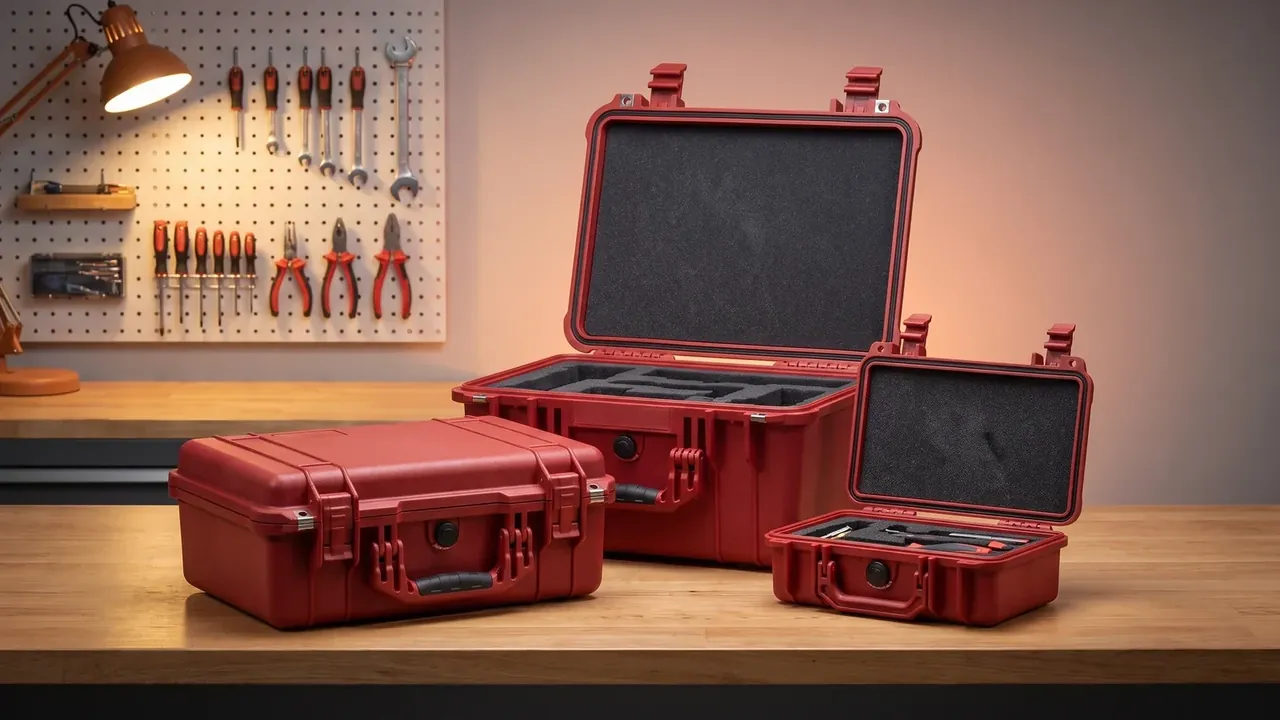
Quick answer: A hand tools case trades space for counting speed, and it only pays off when tools are managed by the piece, counted daily and carried by hand. Four situations follow where a tote, a soft bag or a metal box is cheaper.
Table of contents
- When a hand tools case is not the answer
- Against a stackable tote
- Against a soft bag: the 1.8 kg question
- Against a metal tool box
- Four situations and what to swap in
- Three-year cost: where the gap goes
- FAQ
1. When a hand tools case is not the answer
Most teams buy a case because tools are messy. Mess is rarely a storage problem but an ownership one, and no case fixes that. What a hand tools case delivers is visibility: a missing item leaves an empty pocket anyone can see.
That visibility has a fixed price. Every pocket suits one tool, so a new long-handled ratchet means a new foam block, and a fresh liner costs close to half a case. Sites that change models twice a year cannot keep up.
Shared tools make it worse: three shifts on one wrench set can tell something is gone, never who lost it.
2. Against a stackable tote
The plastic tote is the direct rival: cheap, stackable, shelf-friendly.
| Item | Hand tools case | Plastic tote |
|---|---|---|
| Full crew count | 40 seconds, scan pockets | 6 minutes, dig item by item |
| Load per unit volume | 60 to 70 percent | Over 90 percent |
| Stacking | Two high, lid deforms | Four high, 120 kg bearing |
| Empty weight | 3.0 kg | 1.4 kg |
| Forklift, conveyor | Poor, bumpers protrude | Standard 600 × 400 × 230 mm feet |
| Changeover | New liner | Add a divider |
A loaded tote weighs about 18 kg, so four high reaches 72 kg and a shelf takes it. A hand tools case stacked three high sinks in the middle of the lid, because its structure serves one hand, not bearing load.
3. Against a soft bag: the 1.8 kg question
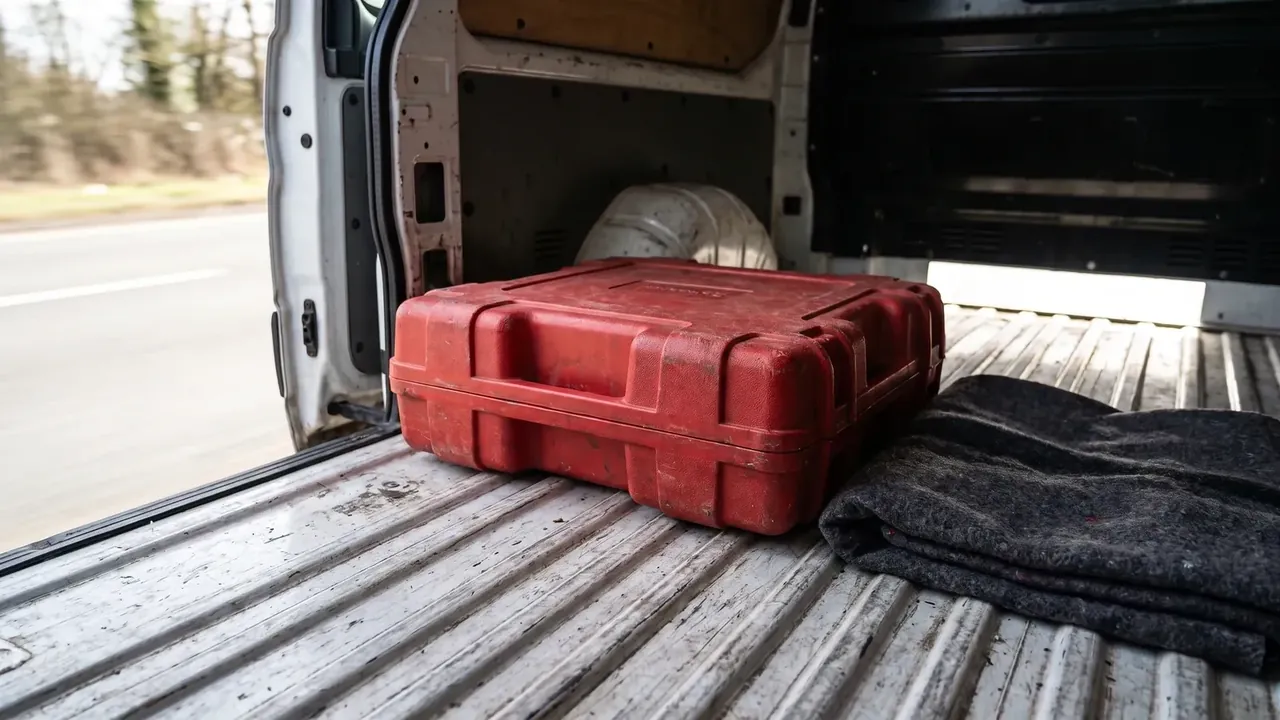
A soft bag weighs 1.2 kg empty; a hard case of the same volume weighs 3.0 kg, a gap of 1.8 kg. Once is nothing. Six lifts a day over 250 working days is about 2.7 tonnes a year.
The bag loses on protection. Dropped one metre onto gravel, it lets tools shift and edges collide; a hard case holds each item in its pocket. The hard case loses on volume: twenty tools fit a bag that slides into a backpack pocket.
So the question is how the route looks. Stairs, buses and server rooms favour the bag; loading docks, vehicles and site cabins favour the case.
4. Against a metal tool box
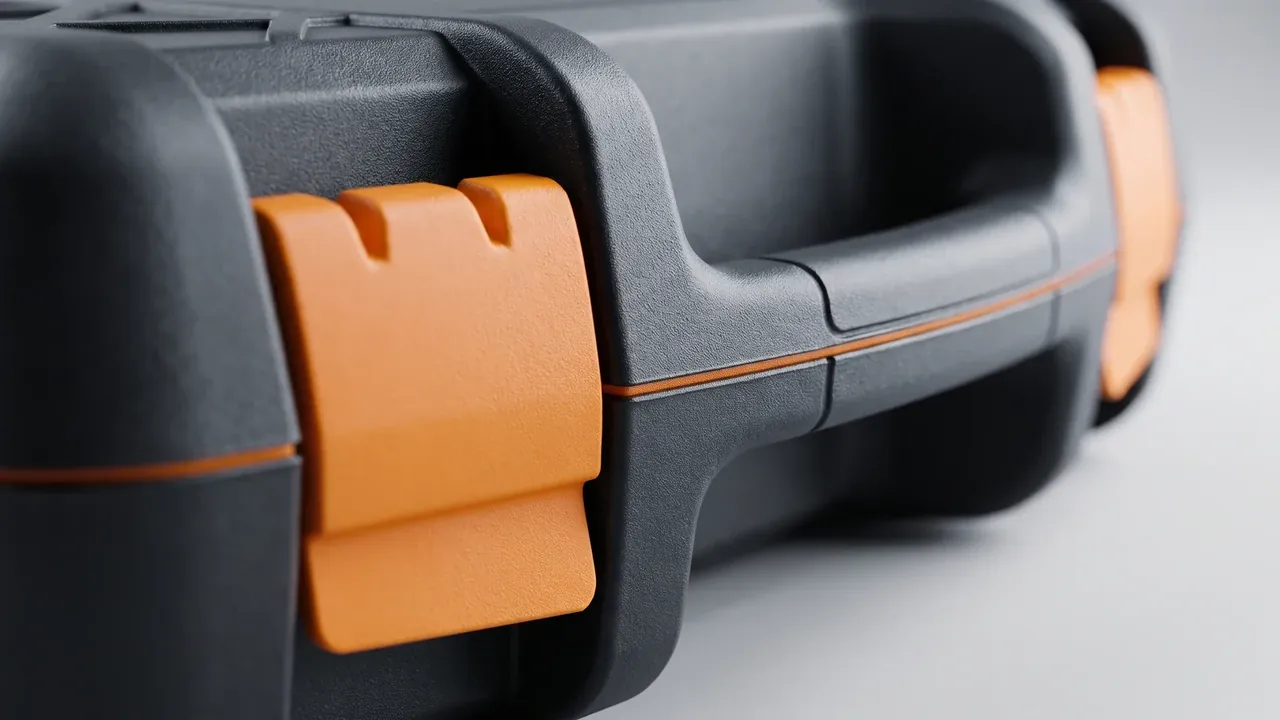
The metal box can be repaired: a dent hammers out, a broken catch welds, ten years is unremarkable. Its price is weight and rust — 4.8 kg against 3.0 kg at equal volume, with rust spots after 24 hours of salt spray, sooner offshore.
A plastic case shows no red rust after 72 hours of salt spray, and its gasket is moulded in one piece, so dust and moisture stay out; a crack, though, cannot be repaired. Fixed bench, heavy parts, someone who welds: metal. Sea freight, wet shops, no maintenance staff: plastic. A metal frame with plastic panels sits between at 3.6 kg and roughly forty percent more than an all-plastic body.
5. Four situations and what to swap in
- Shared tools, one count a day: a tote with dividers, checked against a list
- One technician, six flights a day: a soft bag, weight first
- Fixed bench, heavy parts, repair skills on site: a metal tool box
- Forklift, conveyor or pallet racking: a standard tote on the pallet module
Two edge cases sit outside it. Air or sea freight needing a seal keeps a hard case, but with a flat lid rather than a ribbed one. Storage-only work needs a pegboard and a shelf, no case at all.
The first three cover most sites; the rest should not be forced into a case.
6. Three-year cost: where the gap goes
Purchase price is the worst basis. Over three years:
| Option | Unit price | Replacements | Total |
|---|---|---|---|
| Plastic tote | 46 | 3 units | 138 |
| Soft bag | 68 | 2 units | 136 |
| Hand tools case | 280 | 1 unit | 280 |
| Case with a new liner | 280 | 1 unit plus 180 | 460 |
A gap of 300 looks like a loss. Add counting time and it flips. A full count takes 40 seconds with the case and 6 minutes with the tote — 5 minutes 20 seconds a day, 22 hours across 250 working days, near 660 a year and 2,000 over three years at 30 per hour. Count daily and the case wins back its price several times. Count weekly and the 2,000 never appears.
The real criterion is count frequency multiplied by labour rate, not unit price. That is why precision cells keep a case while rough assembly keeps totes.
Conclusion
A hand tools case is not a default: it trades space for time, buying counting speed at the cost of load density. Count three things — tools managed by the piece, a daily count, carrying by hand. Where all three hold it earns its price; where one is missing, a tote or a bag beats a hand tools case.
This article discusses only the container (case body) side of specifications and design intent, and does not cover any handling, loading or use of the contents.
Related Reading
- How a hand tools case is put together
- Hand tools case versus the alternatives
- Cartridge box materials compared
- Tool box lid materials compared
- How industry requirements differ for cases
Related Products
- 8 Series — Gun Cases; Military Equipment Cases; Camera Equipment Cases; Drone Cases; Watch Cases; Knife Cases; First Aid Cases; Electronics Equipment Cases
- WL8-2812 PP Gun Case — model WL8-2812
- All protective cases and toolboxes: 7 series, 158 models