

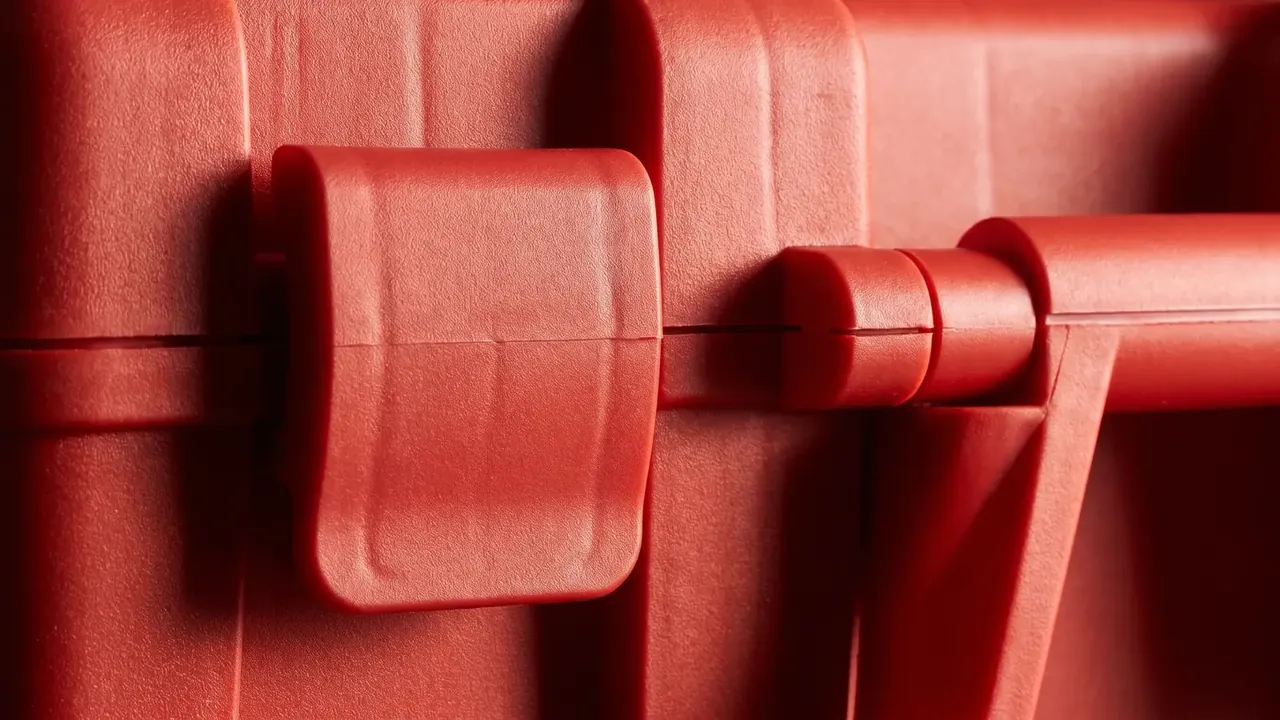
Quick answer: A hand tools case rarely reveals its weak points in a showroom. Five checks settle most of it on site — outline-to-cavity gap, latch seam, hinge play, liner pull force and handle sag — each taking seconds with a steel rule and two hands.
Table of contents
- Five checks a hand tools case has to pass
- Outline and cavity: three numbers first
- Latch and hinge: judged by hand
- Liner and handle: pull once, press once
- Turning the checks into a scorecard
- FAQ
1. Five checks a hand tools case has to pass
A steel rule, two hands and twenty seconds of pressing expose the differences that matter.
| Check | Action | Pass line | Failure |
|---|---|---|---|
| Outline to cavity | Rule on the same edge | 14 mm or more per side | Thin wall, corners crack first |
| Latch seam | Feeler gauge or card | 0.5 mm or less | Lid rocks when carried |
| Hinge play | Twist the lid both ways | 0.3 mm or less | Lid shifts, gasket stops sealing |
| Liner pull | Pull the heaviest tool | 15 to 35 N | Tools jump, or need two hands |
| Handle sag | Load to rating, wait 10 minutes | 2 mm or less | Root whitens, then cracks |
The first three belong to the moulding, the last two to assembly. Bodies stay consistent within a batch; variation sits on assembly, where liner fit and screw torque drift first.
2. Outline and cavity: three numbers first
The outline of a hand tools case is printed on every quotation; the cavity is what holds tools, and the gap between them is wall plus rib. A 455 × 335 × 150 mm outline with a 415 × 295 × 120 mm cavity leaves 20 mm per side and marks a reinforced body, while 425 × 305 × 133 mm leaves 15 mm and marks a light-duty one.
Depth is the second number. A 120 mm cavity loses 30 mm to foam, leaving 90 mm usable: screwdrivers stand upright, socket wrenches must lie flat. Measure your tallest tool and keep 10 mm of headroom.
Weight is the third: a 2.6 kg empty case becomes 22.6 kg with 20 kg of tools, and 800 g is felt on the stairs.
3. Latch and hinge: judged by hand
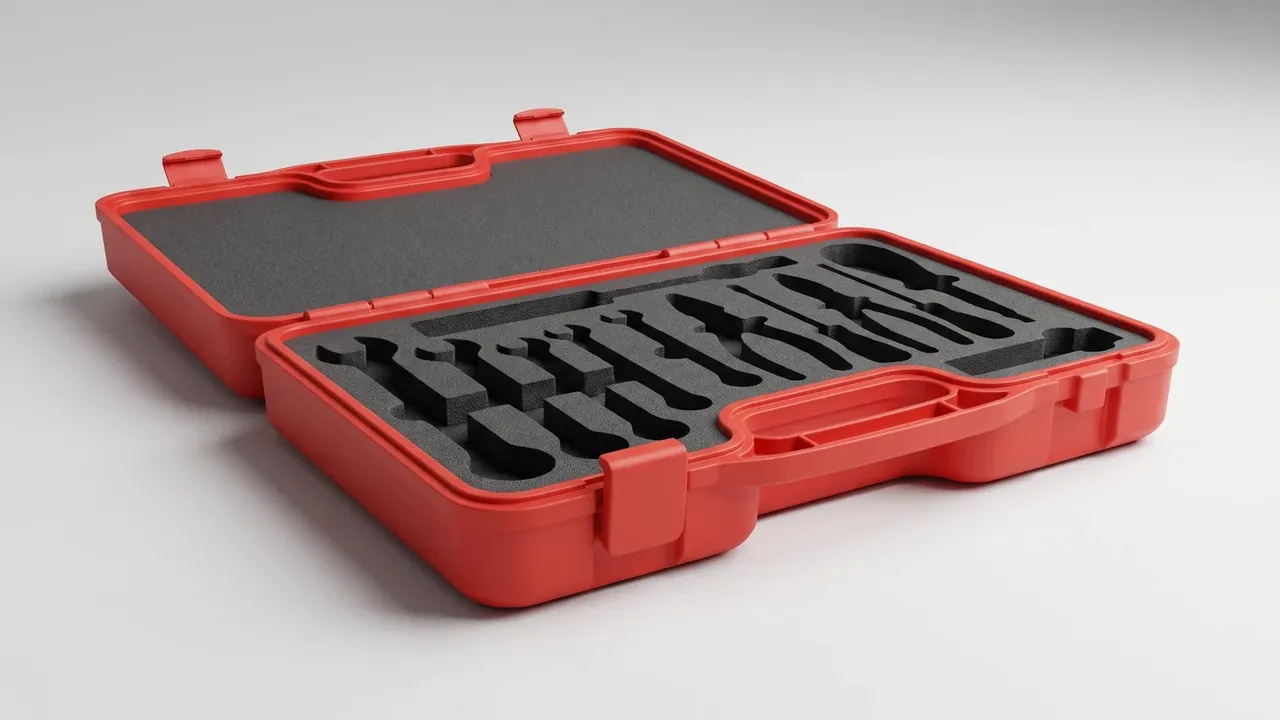
The latch is the only part of a hand tools case that holds both halves together. Close it, push the lid rim inward: movement means a loose fit. Lift the case by the handle and shake it; relative movement between lid and base means a short stroke. A sound latch has an over-centre feel across the last 8 mm and opens at about 45 N.
The hinge hides at the back and only announces itself once the lid has shifted. Two tests cover it. Open the lid to 90 degrees and release: if it stays, there is a stop or damper. Then twist both ends of the lid in opposite directions; play above 0.3 mm gives a faint click. Factory play is 0.1 mm, 0.4 mm after 5,000 cycles is normal wear, and past 0.8 mm the case should be replaced, because the lid no longer compresses the gasket. One detail is easy to miss: whether the pin is metal. All-plastic hinges go brittle in cold, and at minus 20 °C the pin snaps before the knuckle does. A 4 mm steel pin in a nylon bush is the usual specification on durable models.
4. Liner and handle: pull once, press once
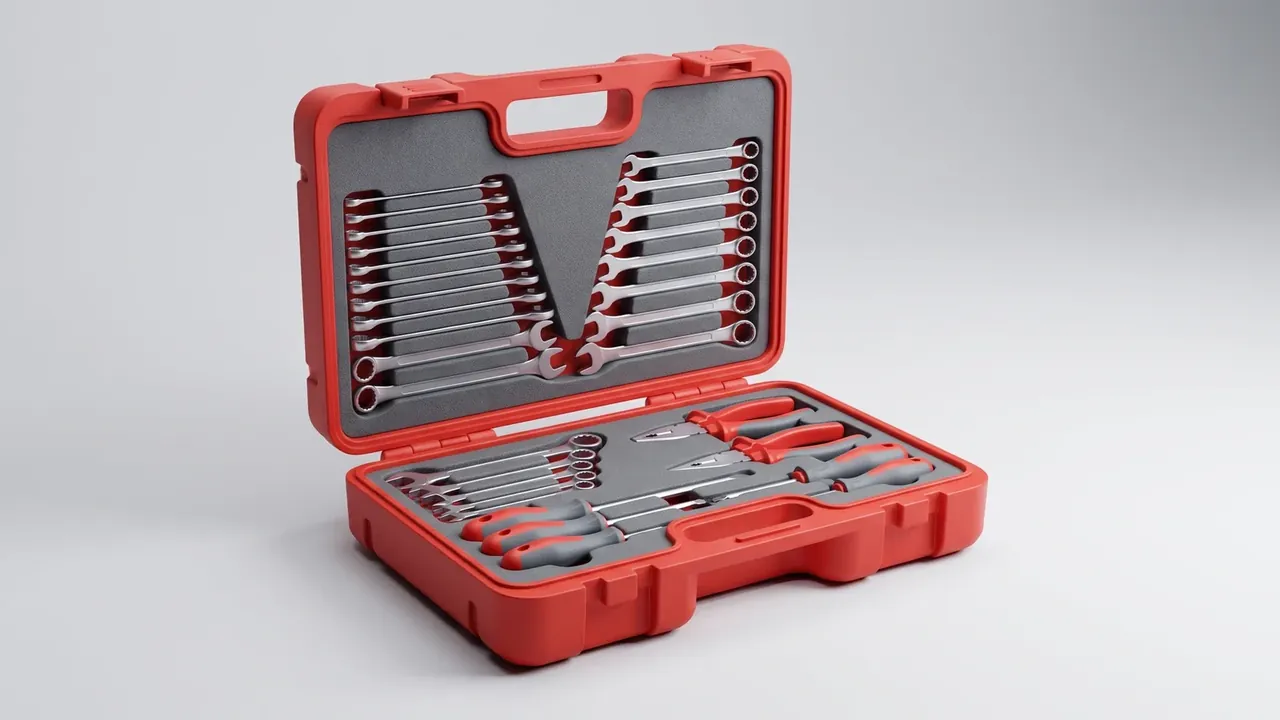
One action judges the liner: pull out the heaviest tool. Between 15 and 35 N is right. Below 15 N tools jump their pockets in transit, above 35 N every pick-up needs both hands.
| Material | Foam thickness | Pocket depth | Typical tools |
|---|---|---|---|
| High-density polyethylene | 30 mm | 70 percent | Wrenches, sockets |
| Ethylene-vinyl acetate | 20 mm | 80 percent | Instruments, gauges |
Judge the handle at its root: load the case to rating, wait 10 minutes, measure the sag of the handle centre; more than 2 mm means thin ribs. Polypropylene softens near 60 °C, sag grows, and a whitening root is the warning.
5. Turning the checks into a scorecard
One sheet, a tick per check, unequal weights:
- Cavity shallow but within tolerance: minus one, long tools lie flat
- Hinge play above 0.3 mm: minus two, repair is certain within six months
- Liner pull below 15 N: minus one, straps become necessary
- Handle sag above 2 mm: minus two, fail outright
Any minus-two ends the comparison, because repair will absorb the price difference. If all five pass and only the feel differs, take the cheaper one. The sheet replaces gut feel with a number: 0.6 mm short on check three.
Conclusion
Judging a hand tools case on site means replacing it feels solid with five numbers: per-side outline gap, latch seam, hinge play, liner pull and handle sag. A 300 mm rule and two hands are enough, and one pass takes twenty seconds. What separates two quotations by thirty percent is usually a single item on that sheet. Find which item it is, and the other nine quotes for a hand tools case stop mattering.
This article discusses only the container (case body) side of specifications and design intent, and does not cover any handling, loading or use of the contents.
Related Reading
- How a hand tools case is put together
- Hand tools case versus the alternatives
- Handle, hinge and latch on a hard carry case
- What to look at during a case showroom visit
Related Products
- 8 Series — Gun Cases; Military Equipment Cases; Camera Equipment Cases; Drone Cases; Watch Cases; Knife Cases; First Aid Cases; Electronics Equipment Cases
- WL8-2812 PP Gun Case — model WL8-2812
- All protective cases and toolboxes: 7 series, 158 models