

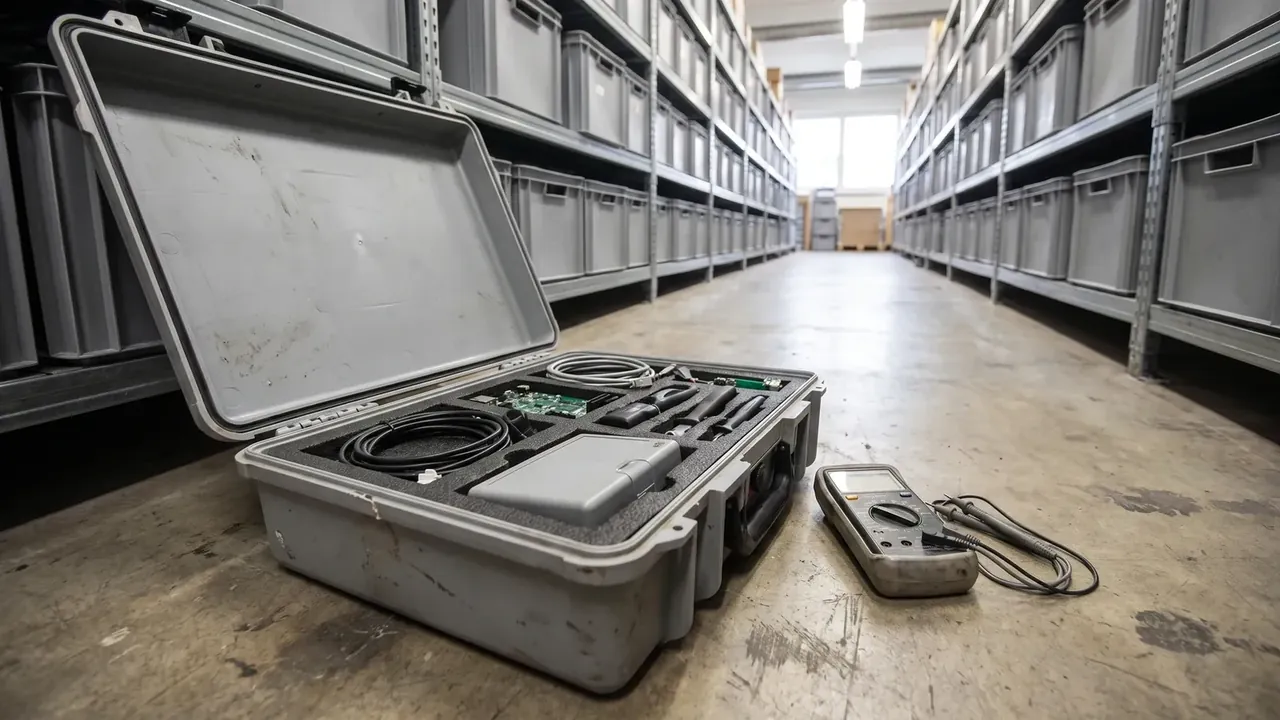
Quick answer: On a 1,200-piece order, a hard plastic case manufacturer quoting 7 RMB less is usually reusing a mould rather than running a better process. Check tonnage, pieces per cycle and shifts per day, then price the rework: 1.8% against 4% costs 1,196 RMB more, before 12,000 RMB of air freight.
Table of contents
- Where the unit cost sits across three stages
- Capacity check: tonnage, cavitation and monthly output
- Mould ownership and modification cost: five clauses
- Process capability: four defects and their rework cost
- FAQ
1. Where the unit cost sits across three stages
The order is 1,200 pieces, the body 12.6 kg with 8 mm ±0.8 mm walls. Two hard plastic case manufacturer quotes came in at 268 and 261 RMB. Seven RMB across 1,200 pieces is 8,400 RMB. Strip it down and the gap sits in mould amortisation and part weight.
| Stage | Share of unit cost | Control point | How to check |
|---|---|---|---|
| Rotomoulding | 52% | 8 mm ±0.8 mm wall, 12.6 kg part | Oven logs and six thickness points |
| Hardware assembly | 21% | Latch pull strength, 720 h salt spray | Plating batch report and pull test sheet |
| Insert and packing | 14% | EVA density, die serial number | First article and die register |
The last 13% is mould amortisation and energy. An 86,000 RMB steel mould over 1,200 pieces adds 72 RMB per unit, a quarter of the price. The 261 RMB quote reuses a public mould, which is exactly what it saves, and thins the wall from 8 mm to 7.2 mm to drop 0.9 kg per piece.
That is where a hard plastic case manufacturer's discount comes from, and where the loss comes from too.
2. Capacity check: tonnage, cavitation and monthly output
Capacity is an equipment register, not a monthly promise. Rotomoulding and injection follow different arithmetic.
| Equipment | Per cycle | Cycle time | Daily output | Monthly output |
|---|---|---|---|---|
| Three-arm rotomoulding machine | 6 pieces per oven | 34 minutes | 210 pieces | 5,460 pieces |
| 1,200-tonne injection press | One cavity | 68 seconds | 1,050 pieces | 27,300 pieces |
A 1,200-piece order takes 22% of that month, so it gets slotted between larger runs. Ask three figures on site: machine tonnage, pieces per oven, shifts per day. If those three disagree with the log, the delivery promise is decoration.
At this volume the rotomoulding line needs six days, the press a little over one, at 2.4 times the tooling cost.
3. Mould ownership and modification cost: five clauses
The mould is where a hard plastic case manufacturer order leaves its longest trail. A 3.4-tonne tool has to be stripped, welded, polished and trialled twice for every change.
- Title: the tool belongs to the buyer, stamped with a serial number and photographed at handover
- Modification: capped at 12,000 RMB per change including two trials, hourly rate beyond that
- Storage: five years free after the last run, location and dunnage height written into an annex
- Wear: rated at 30,000 cycles, overhaul cost split evenly beyond that
- Disposal: collectable within 60 days of termination, scrapping only with written consent
Modification cost belongs in the unit price, not in a one-off budget. Spread 12,000 RMB over 1,200 pieces and each carries 10 RMB, more than the 7 RMB gap itself. The second change usually comes from assembly interference: a latch seat 1.2 mm off the insert pocket looks trivial until every insert die has to be recut. The third tends to be colour, where a custom shade costs three hours of purging and 40 kg of scrap. Issue a 3D comparison drawing first and hold the interference under 0.5 mm before anyone picks up a welding torch. Writing these clauses into the contract beats arguing about the invoice afterwards.
4. Process capability: four defects and their rework cost
A hard plastic case manufacturer's capability shows up in the defect distribution, not in the sample. Four defects account for most rework, and each converts into money.
| Defect | Usual cause | Rate | Rework cost per piece |
|---|---|---|---|
| Thin wall | Uneven powder distribution, starved corners | 1.2% | 46 RMB |
| Cracked latch seat | High regrind, low demould temperature | 0.4% | 58 RMB |
| Warping | Uneven cooling, early demoulding | 0.9% | 32 RMB |
| Insert misalignment | Worn die, loose locating pin | 0.6% | 18 RMB |
At 1,200 pieces and a 1.8% rework rate, 22 units go back and cost 1,012 RMB. At 4%, 48 units cost 2,208 RMB, or 1,196 RMB more; add 12,000 RMB of air freight when the sailing date slips and the 8,400 RMB saving turns into a net loss.
Rework is rework count times unit cost, plus delay. Unit price alone never shows it.
Conclusion
The 7 RMB between hard plastic case manufacturer quotes is mostly mould amortisation and part weight, not process skill. Verify tonnage, pieces per oven and shifts, fix the five mould clauses, and convert rework rates into delay cost before comparing. A cheaper piece is not a cheaper order, and choosing a hard plastic case manufacturer means pricing the whole run.
This article discusses only the container (case body) side of specifications and design intent, and does not cover any handling, loading or use of the contents.
Related Reading
- Supplier scorecard: six dimensions and their weights
- What a case production audit checks on site
- Mould storage standards and custody
Related Products
- 8 Series — Gun Cases; Military Equipment Cases; Camera Equipment Cases; Drone Cases; Watch Cases; Knife Cases; First Aid Cases; Electronics Equipment Cases
- WL8-2812 PP Gun Case — model WL8-2812
- All protective cases and toolboxes: 7 series, 158 models