

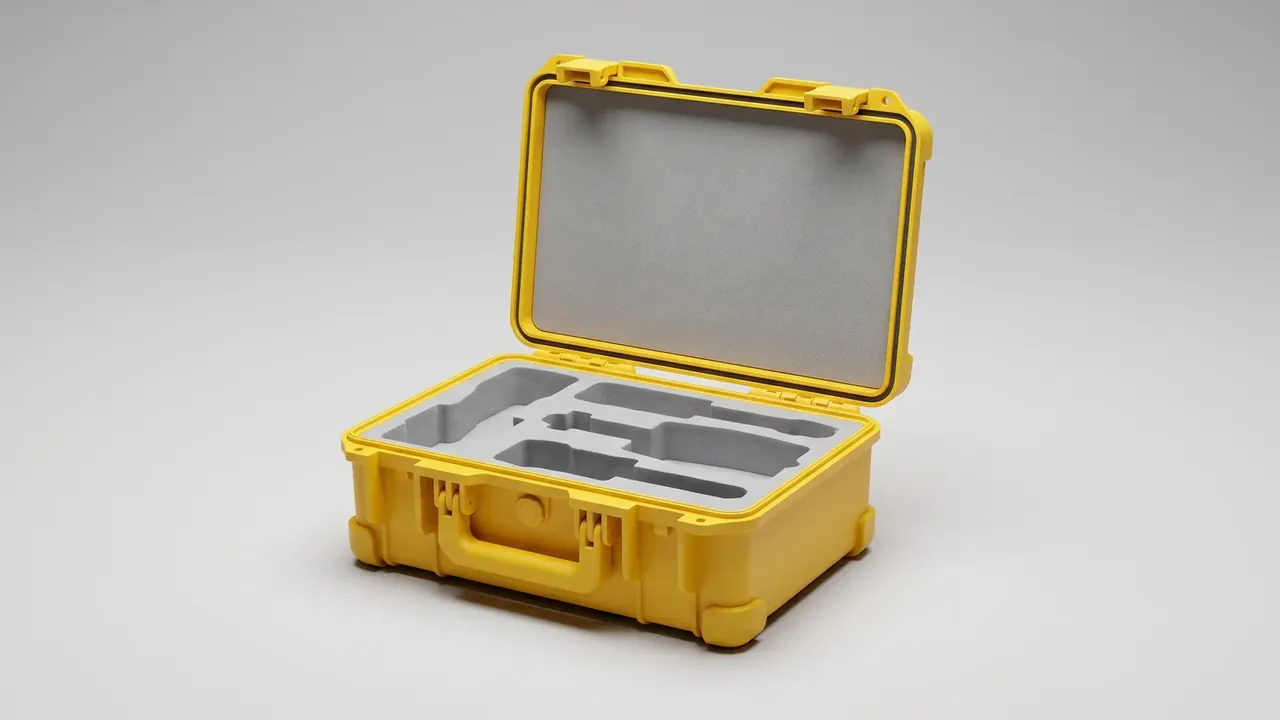
Quick answer: A Hardware Tool Box earns its rating from three numbers: 25 to 30 percent gasket compression, 2.4 mm walls with 6 mm ribs, and 250 N per latch. IEC 60529 and MIL-STD-810G define the tests.
Table of contents
- What a Hardware Tool Box Is Made Of
- Three Moulding Routes
- Sealing and the IP Code
- Wall Thickness and Ribs
- Latches, Hinges and Handle
- FAQ
1. What a Hardware Tool Box Is Made Of
Four parts make up a Hardware Tool Box: body, lid, gasket, latches. The weakest sets the rating.
Bodies and lids are moulded in PP copolymer at 0.90 g/cm³, under ABS at 1.04, so a 45 litre case finishes 0.6 kg lighter.
The gasket is the only soft part, silicone or EPDM at Shore A50, sealing by compression rather than adhesion: a 2.6 mm groove and a 3.5 mm cord give 25 to 30 percent squeeze. Too little leaks, too much takes a set.
Latches hold the lid down. A PA66 catch with 30 percent glass fill holds 250 N, so two carry a 1.2 m drop on six faces.
| Part | Material | Key figure | Basis |
|---|---|---|---|
| Body and lid | PP copolymer | 1.8–3.2 mm | ISO 527, ISO 179 |
| Gasket | Silicone or EPDM | Shore A50, 25–30% | IEC 60529 |
| Latch | PA66 + 30% GF | 250 N | MIL-STD-810G 516.7 |
| Hinge pin | 304 stainless | 3 mm, 20,000 cycles | In-house rig |
Walls carry shape, gasket carries the gap, latches carry closure.
2. Three Moulding Routes
Injection is the common route. PP runs at 225–245 °C melt, and a 45 litre body takes 55 seconds per shot, 35 of them cooling. Cut it and a 2.4 mm wall ejects at 2.1 mm, distorting the groove.
Blow moulding suits 60 litres and up. Thickness follows the parison and varies 0.5 mm across one case: cheap tooling, thin corners.
Rotational moulding builds an even shell for thick impact cases, at 18 minutes per part.
| Route | Typical wall | Cycle | Volume | Trade-off |
|---|---|---|---|---|
| Injection | 1.8–3.2 mm | 45–70 s | 8–50 L | Stable, fine inserts |
| Blow | 2.0–4.0 mm | 90–150 s | 30–120 L | Cheap tooling, uneven wall |
| Rotational | 3.0–6.0 mm | 18–25 min | 50–300 L | Even wall, slow |
Route follows volume: injection below 50 litres, blow from 50 to 120, rotational above that or past 4 mm wall.
3. Sealing and the IP Code
IEC 60529 writes protection as two digits: 5 for dust protected or 6 for dust tight, then 4 for splashing or 7 for 1 m immersion over 30 minutes. An IP67 Hardware Tool Box handles short immersion, not soaking.
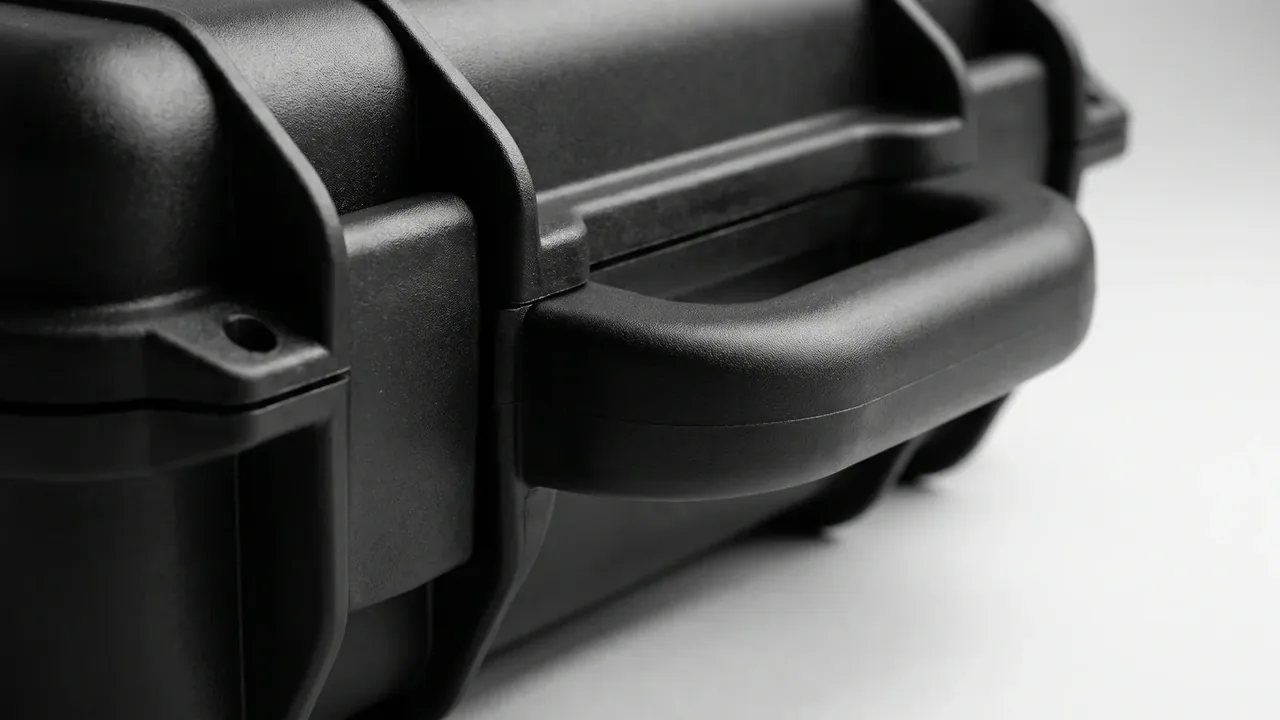
Groove geometry beats cord hardness. A trapezoid groove seats the cord before squeezing it flat, 0.3 mm at the floor takes displaced material, and a 2 mm dam inside the lid stops water first.
Past 150 mm between catches the lid bows and opens a 0.2 mm gap that spray finds at once.
Measure rather than inspect: inflate to 20 kPa, hold 60 seconds, allow 5 percent drop, or pull to -20 kPa and reject a gasket drawn inward.
4. Wall Thickness and Ribs
A 45 litre case loaded to 18 kg and stacked three high puts 36 kg on the bottom lid. At 2.4 mm the centre sags 1.5 mm with 0.3 mm of set; at 3.0 mm it falls to 1.1 mm for 0.4 kg more.
Ribs do the real work: a rib 6 mm high at 45 mm pitch lifts section modulus threefold for 8 percent extra weight, and position beats thickness. On the load path, 2.4 mm behaves like 3.0 mm.
Temperature rewrites the numbers: at -20 °C PP impact strength falls to a third, and at 60 °C a two high stack creeps.
Inserts eat volume: 30 mm of 25 kg/m³ EVA cuts usable height from 210 to 150 mm.
5. Latches, Hinges and Handle
Three movements settle acceptance: latch it, swing it, carry it.
- 250 N per catch, self returning after 3,000 cycles, no whitening
- 3 mm 304 pin, axial play under 0.3 mm after 20,000 cycles
- handle at four times payload, 30 minutes, 5,000 flips if folding
- 1.2 m drop on six faces, MIL-STD-810G Method 516.7
- 48 hours neutral salt spray, red rust under 5 percent
The handle is where designs slip: 3 mm of wall with an R3 fillet is the floor, and an R2 root shows a white line after three months.
Conclusion
A Hardware Tool Box earns its rating rather than printing it: 25 to 30 percent gasket squeeze, a 2.4 mm wall carried by 6 mm ribs, two latches at 250 N each. Moulding route sets the ceiling, and no redesign recovers a route chosen wrongly for a Hardware Tool Box.
This article discusses only the container (case body) side of specifications and design intent, and does not cover any handling, loading or use of the contents.
Related Reading
- How a tool box is built, part by part
- Seal design on a tool box lid
- How the outer cover meets the insert
- Compartments and sizes for a hand tools case
Related Products
- 8 Series — Gun Cases; Military Equipment Cases; Camera Equipment Cases; Drone Cases; Watch Cases; Knife Cases; First Aid Cases; Electronics Equipment Cases
- WL8-2812 PP Gun Case — model WL8-2812
- All protective cases and toolboxes: 7 series, 158 models