

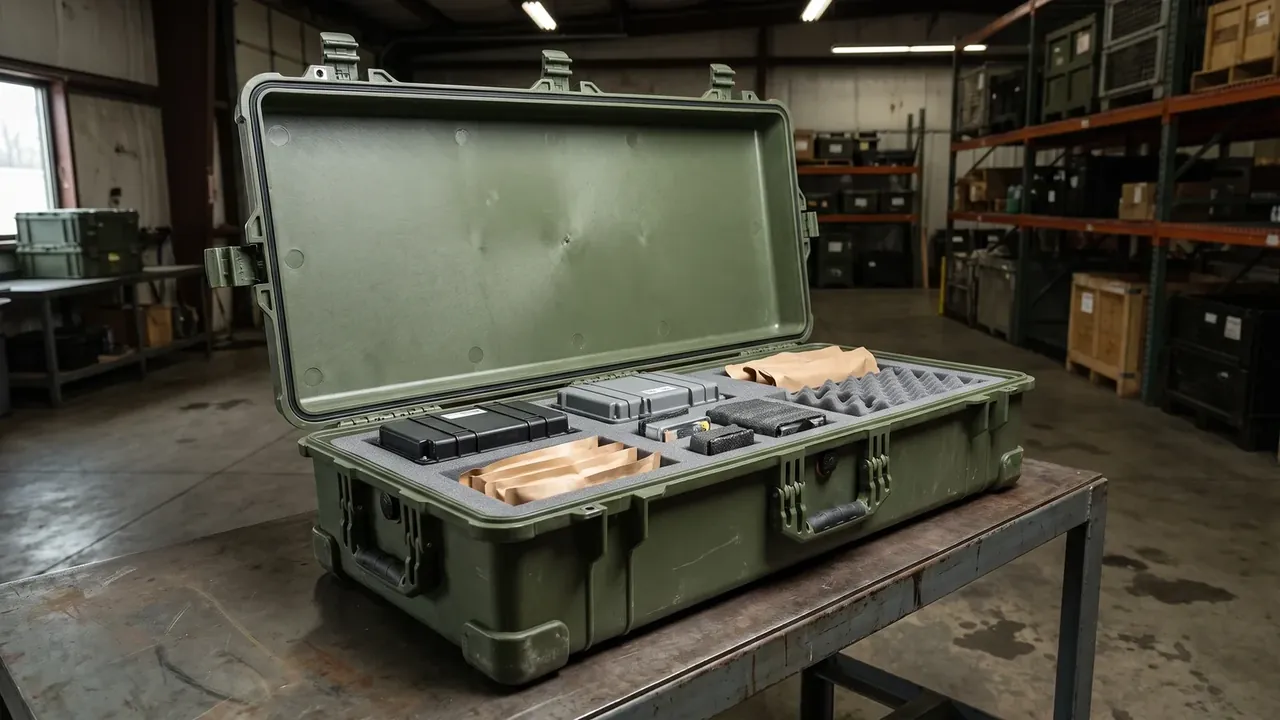
Quick answer: Choose an HDPE Plastic Protective Case by density first, ESCR second, wall thickness last. A copolymer at 0.948 to 0.955 g/cm³ holds ESCR beyond 1000 hours and keeps 12 kJ/m² notched impact at −40 °C.
Table of contents
- Where an HDPE Plastic Protective Case Starts: Density
- ESCR Hours Beat Impact Strength as a Life Estimate
- Impact and Drop Testing at Minus Forty Degrees
- Chemical Resistance: Acid, Alkali and Solvent
- Rotomoulding and Hot-Plate Welding
- FAQ
1. Where an HDPE Plastic Protective Case Starts: Density
Density comes before wall thickness. Every 0.001 g/cm³ lifts flexural modulus about 3 percent and drops ESCR by a visible step, so the two pull against each other on an HDPE Plastic Protective Case.
Melt index splits the family: rotomoulding powder runs 3.5 to 5 g/10 min and sheet grades 0.3 to 0.6 for molecular weight and ESCR. Wall and density are fixed together; 8 mm at 0.950 absorbs a 1.2 m drop, while 0.960 is stiffer and cracks sooner.
| Density (g/cm³) | Melt index | Modulus (MPa) | ESCR (h) | Typical use |
|---|---|---|---|---|
| 0.948 | 4.0 | 800 | over 1000 | Large rotomoulded shells |
| 0.950 | 0.4 | 950 | over 1000 | Sheet, liners, pallets |
| 0.955 | 3.8 | 1100 | 600 to 900 | Mid-size bodies and lids |
| 0.960 | 5.0 | 1250 | 200 to 400 | Fast-cycle tote boxes |
2. ESCR Hours Beat Impact Strength as a Life Estimate
ESCR measures how long the resin survives medium and residual stress together. Under ASTM D1693 condition B, an HDPE Plastic Protective Case specimen sits in pure nonylphenol ethoxylate at 50 °C, and the time for half the samples to crack is F50: copolymers pass 1000 hours, homopolymers often fail inside 100.
That number predicts service better than impact does, because surfactants migrate into micro-cracks and residual stress then opens them. Annealing at 70 °C for two hours halves moulded-in stress, and R5 corners remove the points where cracks begin.
3. Impact and Drop Testing at Minus Forty Degrees
Cold is where HDPE earns its place. The glass transition sits near −120 °C, so chain segments still move at −40 °C and an HDPE Plastic Protective Case fractures ductilely rather than shattering.
After four hours at −40 °C, notched Izod reads 12 kJ/m² against 28 at room temperature, about 43 percent retention, and six cases dropped 1.5 m on a corner show no crack and no latch release. The gasket is the weak link: silicone seals at −40 °C, EPDM does not.
4. Chemical Resistance: Acid, Alkali and Solvent
pH 1 to 14 at room temperature is routine for an HDPE Plastic Protective Case. Twenty percent sulfuric acid moves 0.1 percent in 60 days, 40 percent sodium hydroxide 0.15 percent, and 12 percent hypochlorite 0.3 percent in 30 days if kept dark.
Organics behave differently. Gasoline takes up 5 percent in a week and turns tacky, toluene 12 percent in a day with visible swelling, and chlorinated solvents soften the wall outright. Judge medium and stress together, never the medium alone.
| Medium (room temperature) | Duration | Mass change | Verdict |
|---|---|---|---|
| 20% sulfuric acid | 60 days | +0.1% | suitable |
| 40% sodium hydroxide | 60 days | +0.15% | suitable |
| 12% sodium hypochlorite | 30 days | +0.3% | suitable, keep dark |
| Gasoline | 7 days | +5%, tacky | not for long storage |
| Toluene | 24 hours | +12%, swells | not suitable |
5. Rotomoulding and Hot-Plate Welding
Rotomoulding sets the wall: 40 mesh powder near 420 µm, a 3 mm steel mould, 290 °C for 25 minutes, an 8 mm wall at ±0.8 mm. Coarse powder leaves pinholes, while powder that is too fine sticks to the cavity and tears.
Hot-plate welding runs 200 to 210 °C at 0.02 MPa, about 10 seconds per millimetre of wall. Extrusion welding with a 4 mm rod reaches 85 percent of parent strength and hot air about 70 percent. Dry the bevel first; trapped gas becomes a crack.
Conclusion
Four groups of numbers decide the purchase: the density and melt index pair, the ESCR F50 hours, the −40 °C impact and drop result, and weld strength against parent material. Put all four on the drawing with the medium and the stack height. An HDPE Plastic Protective Case built to that sheet holds acid without weeping and keeps its seams closed.
This article discusses only the container (case body) side of specifications and design intent, and does not cover any handling, loading or use of the contents.
Related Reading
- How rotational moulding builds a case wall
- Selection points for rotationally moulded cases
- Raw material drying and compounding
- Setting a waterproof rating for hard cases
Related Products
- 8 Series — Gun Cases; Military Equipment Cases; Camera Equipment Cases; Drone Cases; Watch Cases; Knife Cases; First Aid Cases; Electronics Equipment Cases
- WL8-2812 PP Gun Case — model WL8-2812
- All protective cases and toolboxes: 7 series, 158 models