

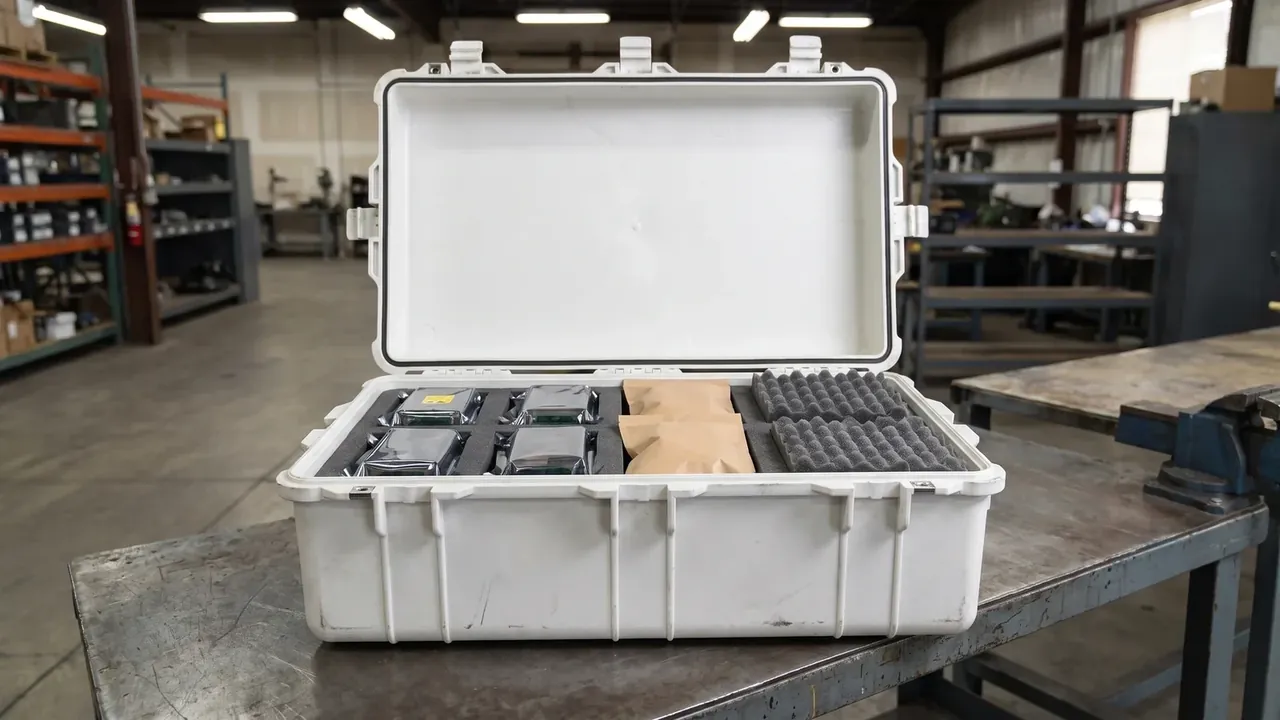
Quick answer: Rate static load distributed and concentrated, count layers at real storage temperature, fix rib pitch and wall thickness, then check fork pocket depth against forklift practice. Four measured values decide whether the box sags in year three.
Table of contents
- Five Criteria for a Heavy-Duty Plastic Box
- Static Load and Safety Factor
- Stack Layers and Creep Allowance
- Wall Thickness and Rib Layout
- Forklift Duty and Handling
- FAQ
1. Five Criteria for a Heavy-Duty Plastic Box
Selection turns site forces into five numbers: load per box, layers, rib layout, fork entry and the surface under the feet.
| Check | Number to obtain | Frequent mistake |
|---|---|---|
| Static load | Distributed, concentrated, deflection | Accepting one load figure |
| Stacking | Layers, weight per layer, temperature | Stacking empty boxes |
| Wall and ribs | Side, base, rib pitch | Asking for average wall |
| Forklift duty | Pocket size, insertion, dynamic factor | Applying static values |
| Feet and surface | Foot span, beam pitch | Ignoring beam gaps |
Two 600 by 400 mm boxes with base ribs two millimetres apart behave differently by layer four. Three items are usually left vague: one load figure, an average wall, a pocket size without insertion depth.
2. Static Load and Safety Factor
Static load needs two figures. Distributed load covers the whole base, where 800 kg is a common rating for a 600 by 400 mm Heavy-Duty Plastic Box. Concentrated load uses a 100 by 100 mm steel block at the centre, where the same box often carries only 250 kg.
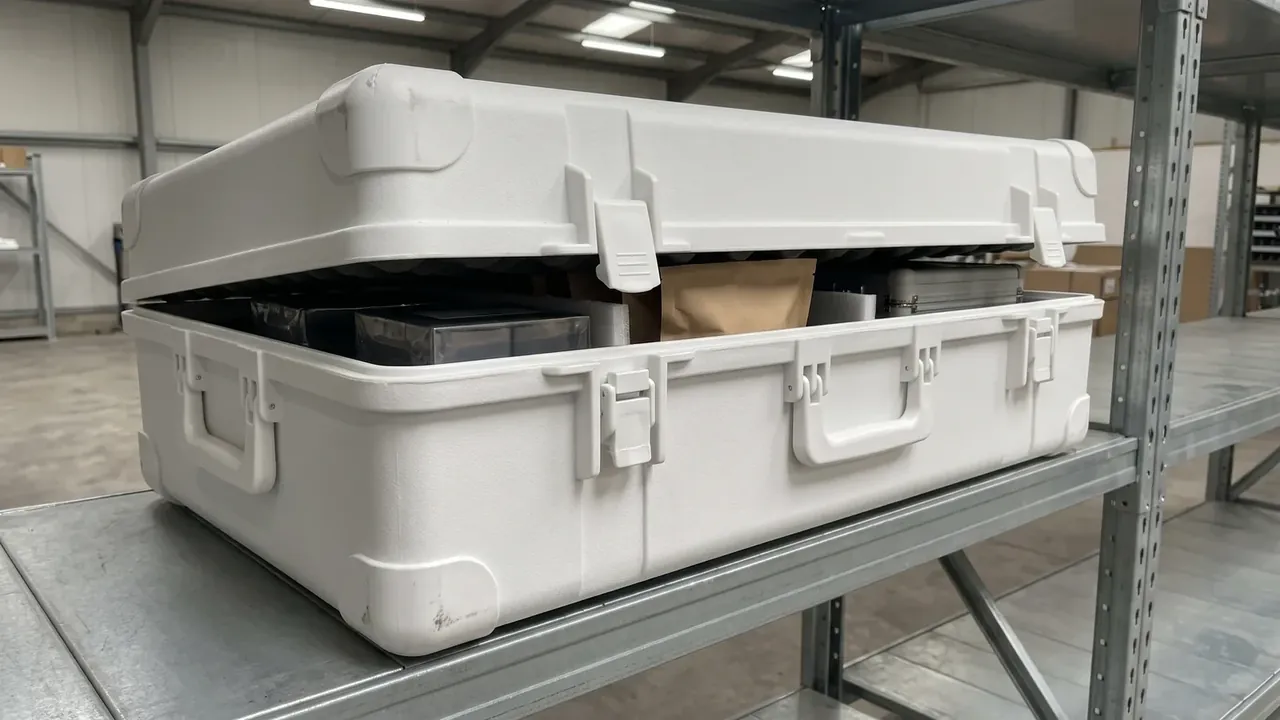
Take the safety factor as 2.0: a 400 kg load calls for an 800 kg rating, and the margin absorbs offset loads and heat softening. A box specified at 1.5 looks fine for two years, then dips permanently.
Deflection is the neglected line on a Heavy-Duty Plastic Box: under a full base at 800 kg for 24 hours the pass line is 3 mm per metre, and 3 mm versus 8 mm decides whether a forklift can slide under the box.
3. Stack Layers and Creep Allowance
Layer counts for a Heavy-Duty Plastic Box cannot come from stacking empty boxes. Four full layers at 25 °C leave the bottom box carrying the three above it. In a 40 °C warehouse the walls soften and bow, and the upper base edge can drop into the lower rim.
One protocol covers it: 40 °C for 30 days at the real weight per layer, then measure height loss, which should stay under 3 mm, roughly a year of ambient storage.
Test one layer beyond the design count: the extra layer shows the room left in service.
4. Wall Thickness and Rib Layout
Report Heavy-Duty Plastic Box wall thickness in three places. For load-bearing boxes, 4.0 mm at the side, 5.0 mm at the base and 6.0 mm at the rim is a common spread. A 4.5 mm average reads better in a datasheet, but an unthickened base sags first.
Ribs move load to the corners. A 120 mm pitch, 12 mm rib height and R2 root radius is workable in injection moulding; past 150 mm the panel between ribs bows, and a rib without a root radius cracks as the part cools.
A cross pattern under the base, aligned with the feet, sends load straight into the rack beam. Vertical side ribs should sit above the feet so the force path stays vertical.
5. Forklift Duty and Handling
Forklift work is not static load. A 100 mm high, 200 mm wide pocket with fork insertion of at least three quarters of the box length decides whether a Heavy-Duty Plastic Box tips when lifted; enter halfway and the rear base has no support.
Use a dynamic factor of 1.3: lifting, braking and threshold impacts run about 1.3 times static, and a site handling forty boxes a day should ask for 2,000 drops from 300 mm onto concrete.
| Duty | Key figure | How to check |
|---|---|---|
| Forklift | Pocket 100 by 200 mm | Insertion over three quarters of length |
| Pallet stacking | Foot span against beam pitch | Corners on beams, gap under 30 mm |
Check feet against the surface too. Beams at 800 mm spacing under a 600 mm foot span leave 200 mm unsupported, which sags over months; add a slip sheet or choose a wider box.
Conclusion
Four numbers settle most of it: distributed and concentrated load, layers against temperature, wall thickness with rib pitch, pocket size with the dynamic factor. Written into the technical agreement, they replace feel with evidence. Get load, stack, ribs and fork entry aligned, and a Heavy-Duty Plastic Box holds up over three years.
This article discusses only the container (case body) side of specifications and design intent, and does not cover any handling, loading or use of the contents.
Related Reading
- How load ratings and wall thickness are specified
- Structural points when choosing a shipping case
- Stacking and picking in warehouse storage
- Pallet marking and stacking practice
Related Products
- 8 Series — Gun Cases; Military Equipment Cases; Camera Equipment Cases; Drone Cases; Watch Cases; Knife Cases; First Aid Cases; Electronics Equipment Cases
- WL8-2812 PP Gun Case — model WL8-2812
- All protective cases and toolboxes: 7 series, 158 models