

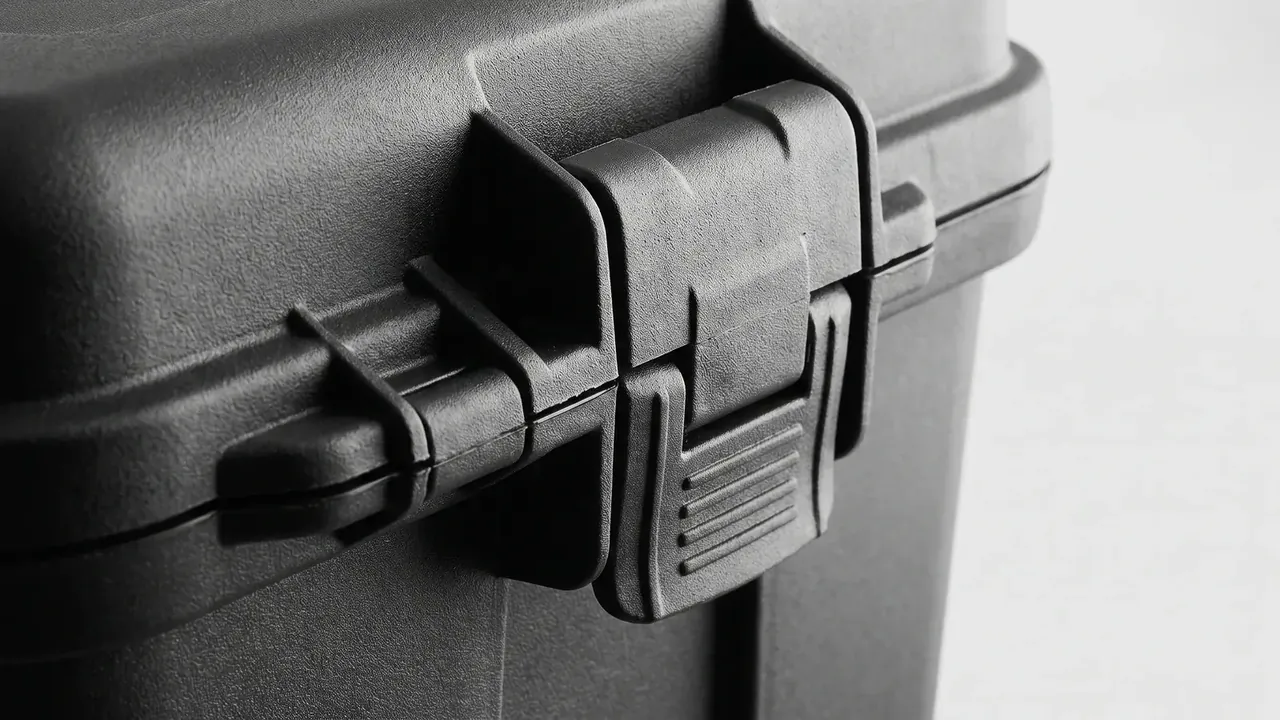
Quick answer: One 28 kg wind-service kit, one loaded build: list review, a 4 to 6 mm wall split, hinge and twin latches, nine foam pockets, a 1.2 m drop, a three-high stack, then a forklift mis-clamp. A heavy duty plastic tool case is only as good as the numbers it leaves at each gate.
Table of contents
- The First List a Heavy Duty Plastic Tool Case Receives
- 4 to 6 mm Walls Following 28 kg of Load
- Hinge and Twin Latches: the Moment the Lid Closes
- Nine Compartments: from List to Cutting Die
- 1.2 m Drop and Three-High Stack: Two Tests
- After a Forklift Mis-Clamp: the Recovery List
- FAQ
1. The First List a Heavy Duty Plastic Tool Case Receives
March, a prototype run for a six-man wind crew: six items, 28.0 kg, from a 9.2 kg socket set to 2.4 kg of consumables.
Size came backwards from the longest item. A 520 mm wrench will not lie flat in a 500 mm cavity, so it rides the 610 mm diagonal, fixing the cavity at 500 by 350 by 200 mm.
| Item | Weight | Seating |
|---|---|---|
| Socket set | 9.2 kg | Floor pocket, strap |
| Crimper | 6.4 kg | Own cavity |
| Torque wrench | 3.6 kg | Diagonal lid slot |
| Driver and packs | 2.1 kg | Mid tray |
| Hand tools | 4.3 kg | Top pouch |
| Consumables | 2.4 kg | Lid mesh pocket |
The heavy duty plastic tool case is 5.6 kg empty and 33.6 kg loaded, past a one-person lift. Two 90 mm side handles, top handle for short moves.
2. 4 to 6 mm Walls Following 28 kg of Load
Load does not sit evenly: force gathers under the socket set, under the crimper and at the hinge seats.
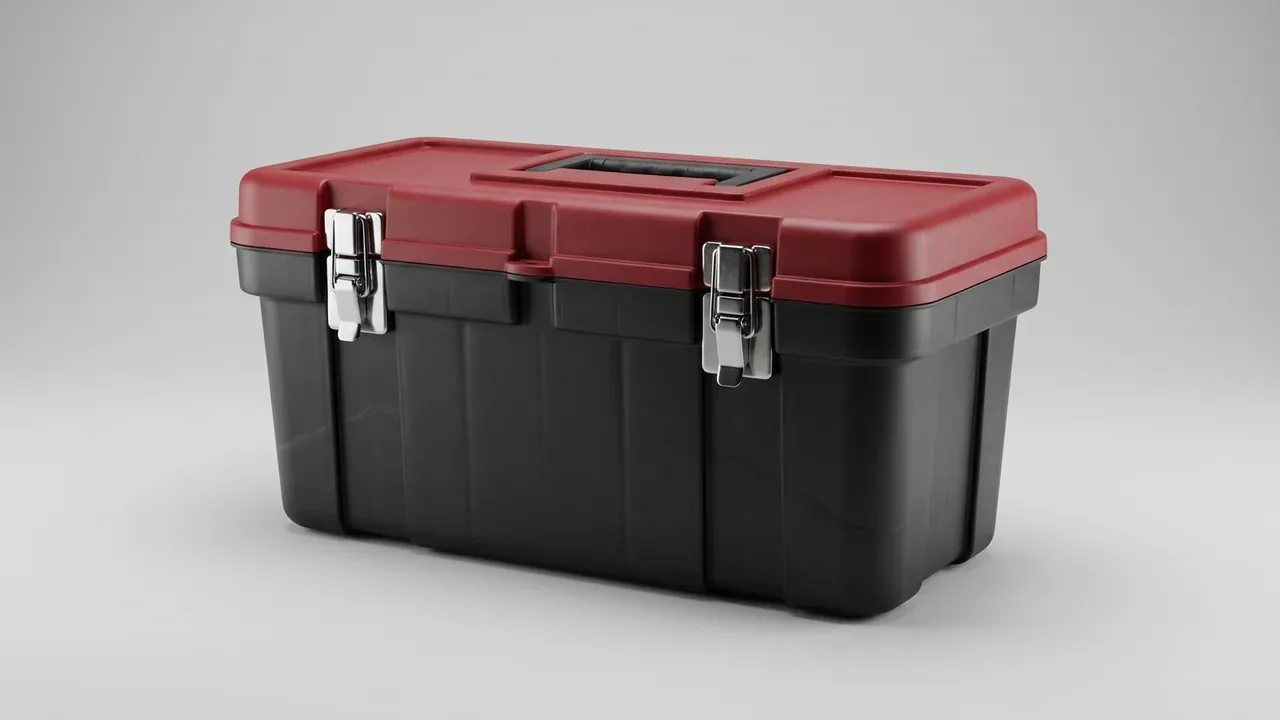
Walls 4.0 mm, floor 5.0 mm, rib roots and hinge seats 6.0 mm. Ribs stand 12 mm tall at 55 mm pitch on an R2 root, giving the floor near 8 mm plate stiffness for 0.4 kg of resin. The lid, thinnest at 4.0 mm, carries only the feet stacked above it through a 15 mm ring rib.
At 25 °C the floor sagged 1.8 mm in 30 days; at 60 °C for 72 hours, 3.4 mm. Creep never springs back, and deflection follows the fourth power of span, so rib pitch from 80 mm to 55 mm cuts deflection to a quarter.
Thickness is not a reason to thicken everything.
3. Hinge and Twin Latches: the Moment the Lid Closes
Three knuckles, a 60 mm centre, a 5 mm 304 pin, a limit block at 105 degrees. Latches get deleted first. Each holds 220 N over 18 mm and locks 15 degrees past centre, keeping gasket compression near 30 percent; one latch alone lets the far rim lift 1.5 mm, a grit channel in dust. The first fit failed: foam sat 3 mm proud of the rim and closing took 90 N. Shaving it 2 mm below the rim with a 5 mm EVA pad brought that to 35 N.
4. Nine Compartments: from List to Cutting Die
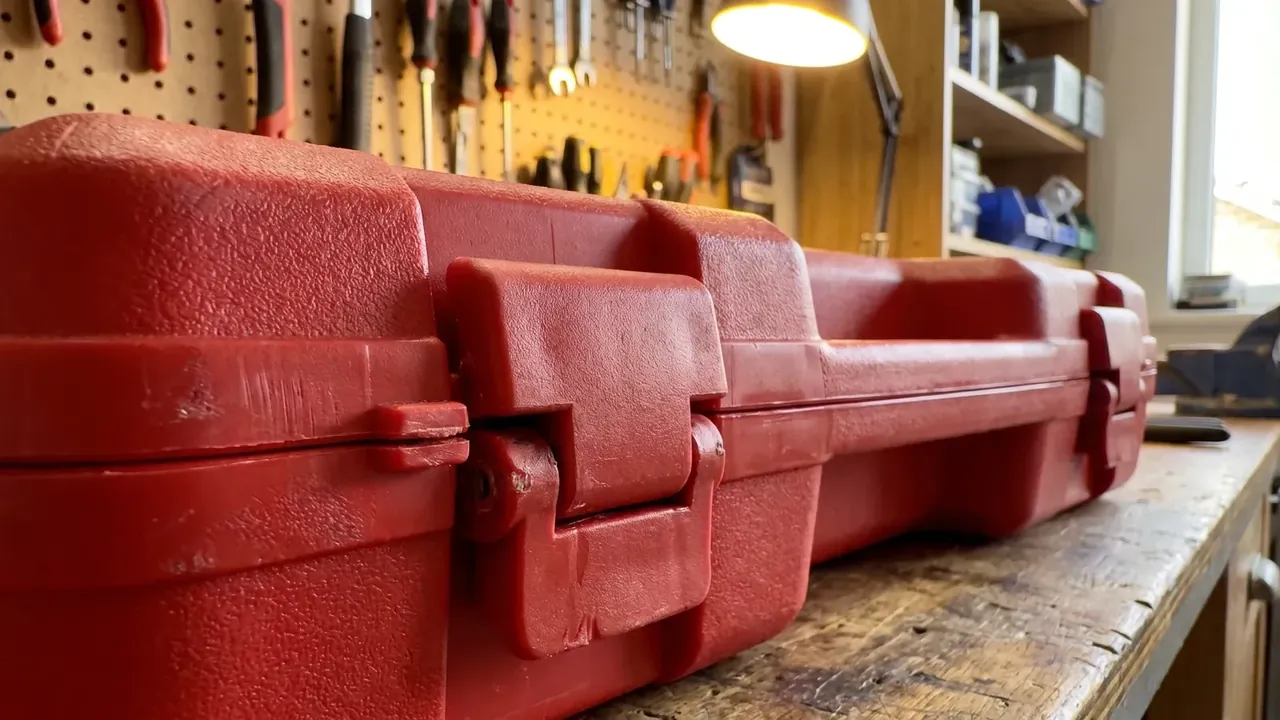
Nine pockets in this heavy duty plastic tool case were counted, not drawn first. The die leaves 1.5 mm around each outline and 10 mm of void at the crimper jaws.
| Layer | Material | Thickness |
|---|---|---|
| Base pad | EVA | 30 mm |
| Shape layer | PE | 20 mm |
| Partitions | PP board | 8 mm |
Heavy low, light high shows as depth: 90 mm at the sockets, 40 mm at hand tools; the 50 mm gap is the lid slot clearance.
5. 1.2 m Drop and Three-High Stack: Two Tests
Dropped at minus 10 °C after four hours with 28 kg of ballast: 1.2 m onto a corner, an edge and the lid face.
The corner took 0.6 mm of whitening, no crack. The edge left both latches engaged. The lid face peaked at 68 g inside, ballast moving under 2 mm.
Three high: 33.6 kg per case, so the bottom unit carried 67.2 kg plus itself, 100.8 kg, for 30 days. The lid sagged 3.1 mm, returned to 1.2 mm, leaving 1.9 mm of set inside the 2 mm limit.
Three high is the boundary for this heavy duty plastic tool case; one more layer crosses 2 mm and the latches take the bending.
6. After a Forklift Mis-Clamp: the Recovery List
An incident, not a design step: forks against the side walls instead of the pallet pockets, a 2.5 t mast closed, a 9 mm dent, a 2 mm seam step.
- Unload at once; stress left overnight becomes shape.
- Warm the wall with a 70 °C gun at 150 mm, 10 minutes.
- Prop the inside with 350 mm timber for 24 hours.
- Measure: this case returned 6 mm, leaving 3 mm.
- Recheck: 0.8 mm latch offset, gasket over 30 percent, dry service only.
- Scrap past 3 mm of set or at whitening cracks.
Step three is the one people skip: without a prop the wall cools back halfway, and the latches pull the rest shut.
Conclusion
The log: 28 kg, walls split 4 to 6 mm, three knuckles and two latches, nine pockets, no latch release at 1.2 m, 1.9 mm of set after 30 days. Four gates, all checkable: that is what a heavy duty plastic tool case is worth.
This article discusses only the container (case body) side of specifications and design intent, and does not cover any handling, loading or use of the contents.
Related Reading
- Heavy duty protective cases in field load-outs
- Deriving wall thickness and load rating
- Hardware tool boxes on the workshop floor
- Securing a tool case in a vehicle
- Laying out compartments inside a tool box
Related Products
- 8 Series — Gun Cases; Military Equipment Cases; Camera Equipment Cases; Drone Cases; Watch Cases; Knife Cases; First Aid Cases; Electronics Equipment Cases
- WL8-2812 PP Gun Case — model WL8-2812
- All protective cases and toolboxes: 7 series, 158 models