

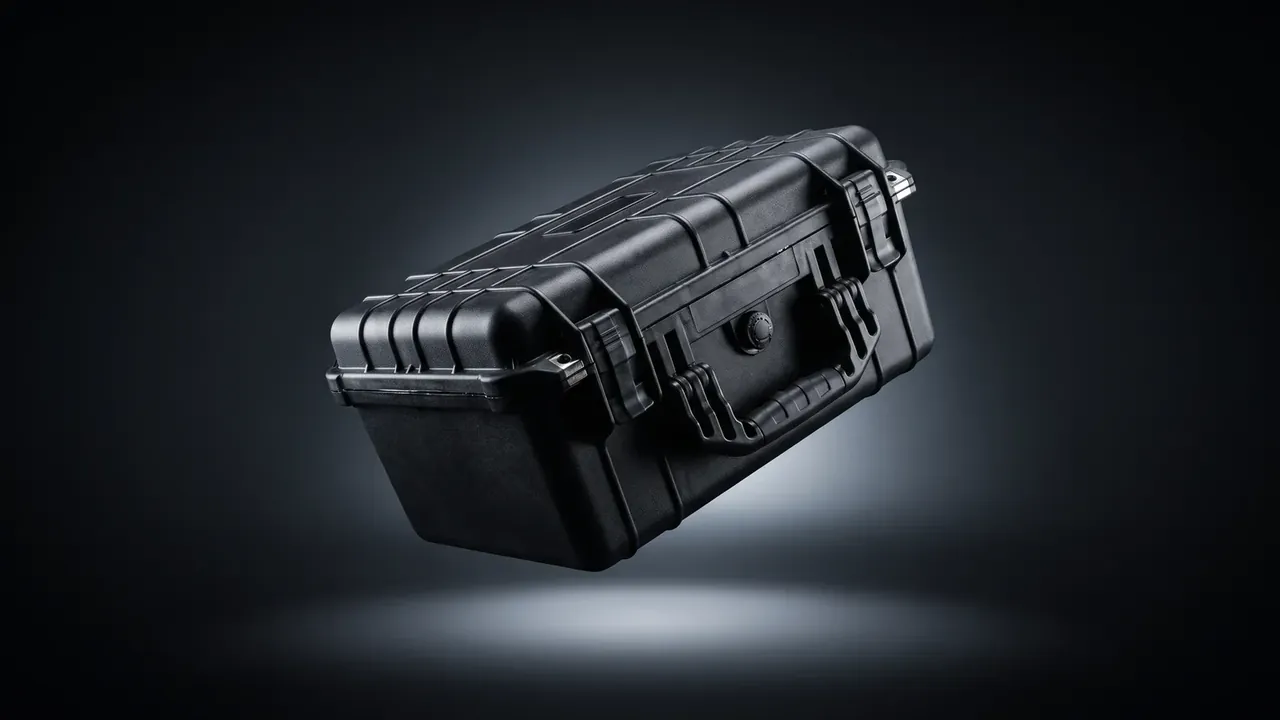
Quick answer: Acceptance of a heavy-duty protective case runs on two levels: a full first-article check and lot sampling. The first article proves the process is fixed; the lot proves it stays fixed. Every item needs a number and a verdict.
Table of contents
- First-Article and Lot Inspection for a Heavy-Duty Protective Case
- Wall Thickness and Dimension Measurement
- Seal and Rain Testing
- Drop and Stack Testing
- Lifting Proof Load and Nonconformance
- FAQ
1. First-Article and Lot Inspection for a Heavy-Duty Protective Case
A first article asks whether this mould, material and parameters can be frozen; a lot check asks whether the frozen process holds. Limits are shared, sample size is not.
| Stage | Trigger | Sample | Verdict |
|---|---|---|---|
| First article | New mould, material or parameters | 3 cases, all items | Pass all, then release |
| Lot | Each delivery lot | 5 of up to 200 | All 5 pass |
| Tightened | One lot failure | 10 cases | Any failure, reject lot |
When a first article fails, change the process rather than the limit: thin walls trace to hold pressure or melt temperature, oversize parts to cooling time. A failed lot is quarantined before judgement.
2. Wall Thickness and Dimension Measurement
Measure thickness by ultrasonic gauge at five points: four corners and the base centre. On a 6.0 mm nominal wall no reading may fall below 5.7 mm, and the spread must stay within 0.4 mm, which tracks fill and packing better than any single value.
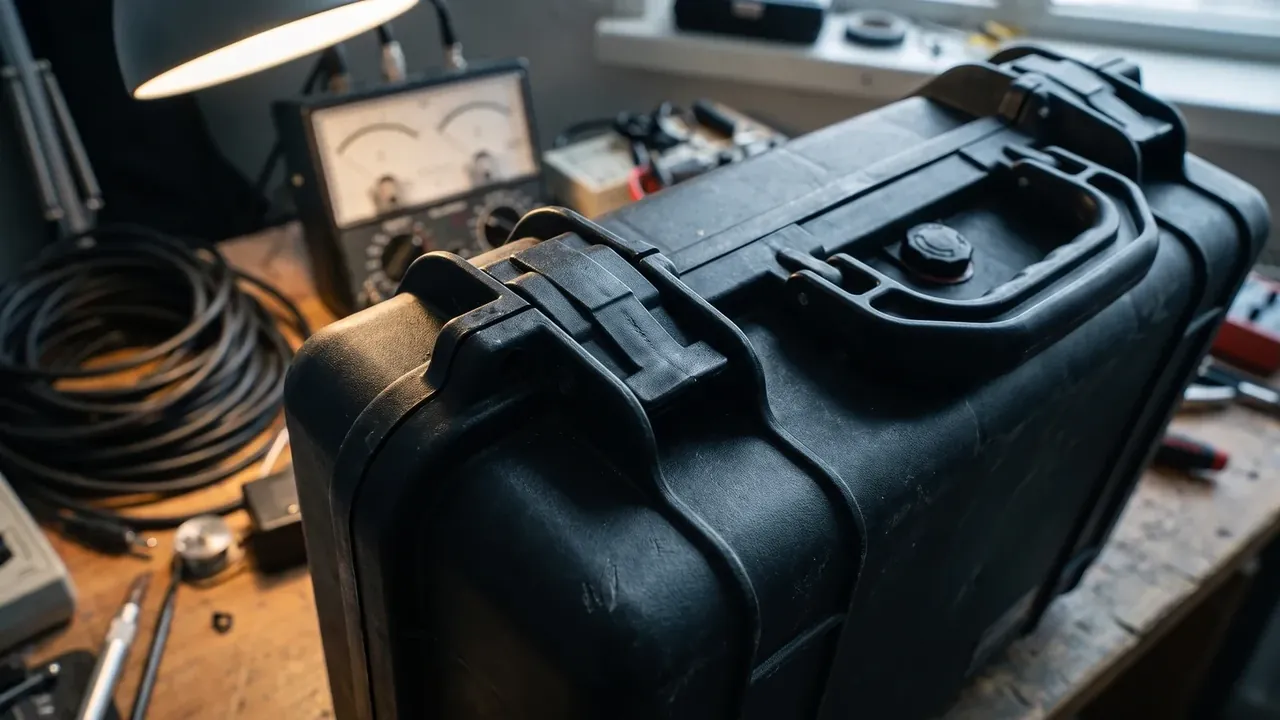
Internal dimensions carry plus or minus 2 mm, external plus or minus 3 mm. Diagonal difference on the closing face stays within 4 mm, and a 1.5 mm feeler gauge must not enter the closed joint.
3. Seal and Rain Testing
Start with pressure hold. Close an empty heavy-duty protective case, charge through the valve to 30 kPa and wait 5 minutes; a drop beyond 1 kPa fails. To locate a leak, cap the valve and repeat to rule out the disc, then brush soap solution along the joint.
Rain follows IPX5: a 6.3 mm nozzle delivers 12.5 L/min from 2.5 to 3 m, three minutes in each of four directions. Weigh absorbent paper inside before and after; a gain above 5 g fails.
Do not wipe the case before opening it; water marks show the leak path. Rain also precedes pressure hold, or residual moisture counts as loss.
4. Drop and Stack Testing
Drop from 1.2 m onto six faces, three edges and one corner, ten impacts per case at rated load. Latches must stay closed, no through-crack may appear, and pressure hold must still pass.
| Test | Condition | Pass criteria |
|---|---|---|
| Drop | 1.2 m, six faces, three edges, one corner | Latches closed, no through-crack, hold passes |
| Stack | Four times own weight, 24 hours | Top face under 2 mm, residual under 1 mm after 1 hour |
Apply stack load at the lid centre, not uniformly: in a warehouse the load arrives through the four feet above.
5. Lifting Proof Load and Nonconformance
Lifting proof load is twice the rating held 5 minutes; the diagonal between lifting points may not change by over 0.5 mm after release. A dynamic check follows at 1.5 times the rating.
A rejected heavy-duty protective case is never patched and re-shipped: reinforcement changes local stiffness while the load path can no longer be verified.
| Class | Typical defect | Disposition |
|---|---|---|
| A | Through-crack, cracked eye, hold drop over 3 kPa | Scrap, no repair release |
| B | Wall 5.7 to 5.4 mm, diagonal 4 to 6 mm | Repair, then full retest |
| C | Scratches, colour shift, wrong label | Concession or cosmetic rework |
Verdicts carry a signature: Class A by the quality manager, B by the inspection lead, C by the inspector.
Conclusion
Acceptance of a heavy-duty protective case comes down to one line: the first article fixes the process, the lot guards consistency, every verdict is a number. Wall 5.7 mm, diagonal 4 mm, hold drop 1 kPa, drop 1.2 m, stack at four times weight, lifting at twice the rating. Sign, then dispose: scrap, repair and retest, or concession. These items make heavy-duty protective case acceptance repeatable.
This article discusses only the container (case body) side of specifications and design intent, and does not cover any handling, loading or use of the contents.
Related Reading
- Heavy-duty cases in large equipment transport
- Load ratings, wall thickness and reinforcement
- First-article approval and production release
- Quality control points in case assembly
Related Products
- 8 Series — Gun Cases; Military Equipment Cases; Camera Equipment Cases; Drone Cases; Watch Cases; Knife Cases; First Aid Cases; Electronics Equipment Cases
- WL8-2812 PP Gun Case — model WL8-2812
- All protective cases and toolboxes: 7 series, 158 models