

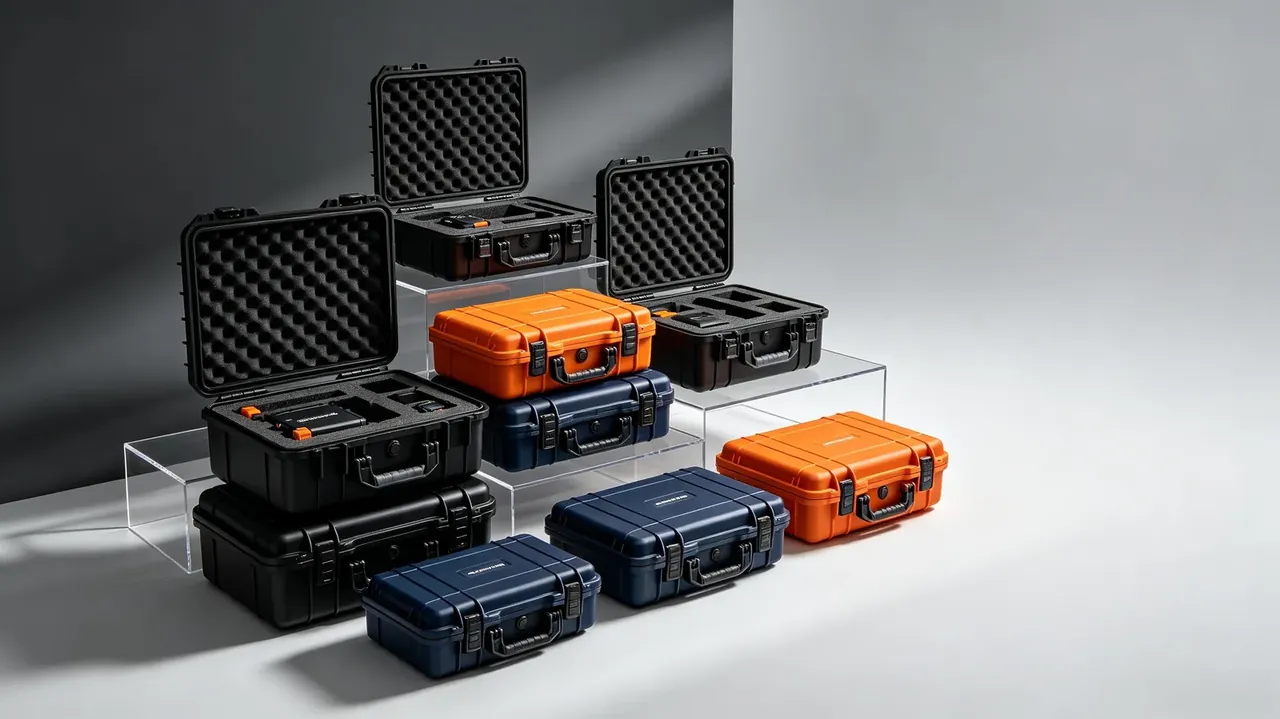
Quick answer: The High-altitude inspection meter safety portable box rates each of four φ5 mm handle rivets at 1200 N and caps corner deflection at 2.0 mm.
Table of contents
- High-altitude inspection meter safety portable box: how it is carried
- Handle rivets and the drop load path
- Edge cushioning and corner wall thickness
- Wrist anchor and one-hand opening
- Anchor settings for work-at-height crews
- FAQ
1. High-altitude inspection meter safety portable box: how it is carried
A harness clip sits on the waist, the case hangs from a hand, and the first parts to feel the weight are the four rivets under the handle. The High-altitude inspection meter safety portable box measures 360×270×135 mm outside and 315×225×95 mm inside, at 1.9 kg total. Light enough for one hand on a ladder, but the centre of gravity sits low and the wrist keeps pulling back. By hand, load runs straight up both ends of the handle and the bosses see pure tension. Looped on a wrist, the pull arrives at 45 degrees and the rivets take tension with shear. Clipped to a harness, the box rides on the hip and the long edge scrapes the guardrail first.
The handle is fixed, spanning 118 mm, with the grip 42 mm above the lid so a gloved hand passes through.
| Anchor setting | Load direction | Rating | Typical duty |
|---|---|---|---|
| Hand-carry position | Vertical, upward | 1200 N pull-out per handle | Shifting between stores |
| Wrist position | About 45 degrees | φ8 mm hole, single point | Ladder climbs, narrow platforms |
| Harness position | Horizontal, on the hip | Shell flat on the hip bone | Both hands needed aloft |
2. Handle rivets and the drop load path
Each handle end carries two φ5 mm rivets, 4×φ5 mm in total, with pull-out quoted at 1200 N, three times the static load of a 1.9 kg case. On a plastic rivet, pull-out depends on hole diameter, sheet thickness and loading rate: the same rivet in a 3.6 mm side wall can read twenty to thirty percent away from one in a 2.8 mm lid face. A drawing has to list hole size and wall thickness together.
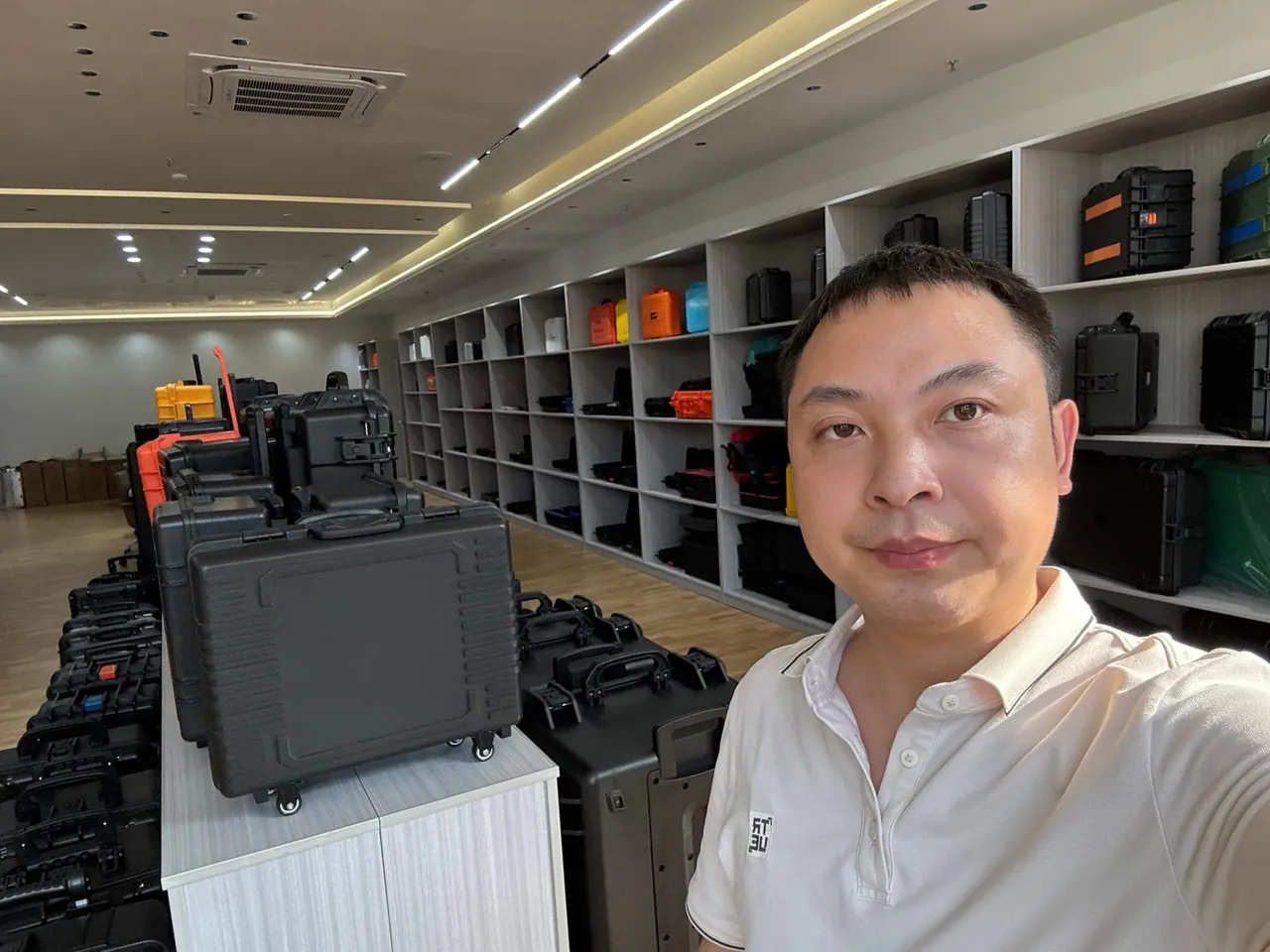
Load enters at the handle, lands on the boss and spreads along the side wall into the two horizontal edges. A 3.6 mm wall would bulge under that bending, so a 5.2 mm pad behind each boss steers force into the edge. In a drop the path reverses and the rivets feel an outward tear, and the thinnest point on that route sets how the case behaves.
The High-altitude inspection meter safety portable box goes onto the rig at 1.5 m, one impact on each of the 6 faces per round, three rounds, onto a 100 mm concrete base.
| Drop round | Height | Impact face | Check for that round |
|---|---|---|---|
| First | 1.5 m | Base and lid | Cracks at the rivet bosses |
| Second | 1.5 m | Four long edges | Depth of edge dents |
| Third | 1.5 m | Eight corners | Corner deflection reading |
3. Edge cushioning and corner wall thickness
The corner wall on the High-altitude inspection meter safety portable box is 5.2 mm against a 3.6 mm side wall, joined by a 12 mm ramp. Polypropylene shrinks 1.5% to 2.5% as it cools, and a step in section cools slowly and shrinks hard, pulling a sink mark inside the corner; the ramp is the allowance shrinkage gets. Miss it and the corner sags inward, handing impact straight to the shell.
Edges keep an R3 blend rather than a generous radius, since a rounded edge loses section modulus; a 2 mm rib along each long edge pulls deflection out of the span.
The High-altitude inspection meter safety portable box takes readings from four corners, one height measurement each against an undropped case from the same batch, largest value recorded, pass line at 2.0 mm.
| Deflection reading | Disposition | Next step |
|---|---|---|
| Within 2.0 mm | Accepted | Refit the insert and ship |
| 2.0 to 3.5 mm | Recheck | Add a 10 mm foam pad |
| Over 3.5 mm | Retired | Replace the shell, keep no joints |
4. Wrist anchor and one-hand opening
The wrist anchor on the High-altitude inspection meter safety portable box is a φ8 mm through hole with a 6 mm minimum wall, centred 8 mm below the edge line. Lower than the handle, it sends an angled pull through the pad before the boss, so a swinging case loads the anchor first.
Two draw latches open the box one-handed, 260 N each and 520 N together, pressing an 8 mm seal. Total clamp force says little; distribution decides. The latches sit at the third points, the middle span relies on lid stiffness, and that is where a soft lid leaks first.
The High-altitude inspection meter safety portable box is cycled 3600 times, latch wear and seal set checked every 600 cycles. IP65 is a benchmark only: six faces sprayed 3 min each through a 6.3 mm nozzle at 12.5 L/min and 30 kPa, then opened for standing water.
5. Anchor settings for work-at-height crews
The setting is the finest rivet pattern that keeps corner deflection under 2.0 mm after six-face drops, and anything finer serves light sample cases. A corner under 2.0 mm still has spring, so round three does not stack onto the set left by rounds one and two.
At handover the High-altitude inspection meter safety portable box is issued by anchor setting: wrist position for fixed ladders, harness position where both hands are needed, hand-carry for store moves. They look identical; hole position and wall thickness differ, and mixing them stretches a wrist hole into an oval.
The High-altitude inspection meter safety portable box stacks to 6 layers in storage, which presses the lid rather than the handle. Each lid corner carries a 3 mm locating pad, so at the sixth layer the load lands on four edges instead of the middle.
Conclusion
The High-altitude inspection meter safety portable box is laid out in the order of anchor, then rivet, then corner wall. The anchor decides which way the load arrives, the rivet decides whether four φ5 mm pins can hold it, the corner thickness decides the margin left after a fall.
Related Reading
- How Corner Radii Eat Usable Length
- Weighing Wooden Crates Against Plastic Cases
- Three Carrying Formats for Measuring Instruments
- Probe Cavities and Couplant
Related Products
- 8 Series — Gun Cases; Military Equipment Cases; Camera Equipment Cases; Drone Cases; Watch Cases; Knife Cases; First Aid Cases; Electronics Equipment Cases
- WL8-2812 PP Gun Case — model WL8-2812
- All protective cases and toolboxes: 7 series, 158 models