

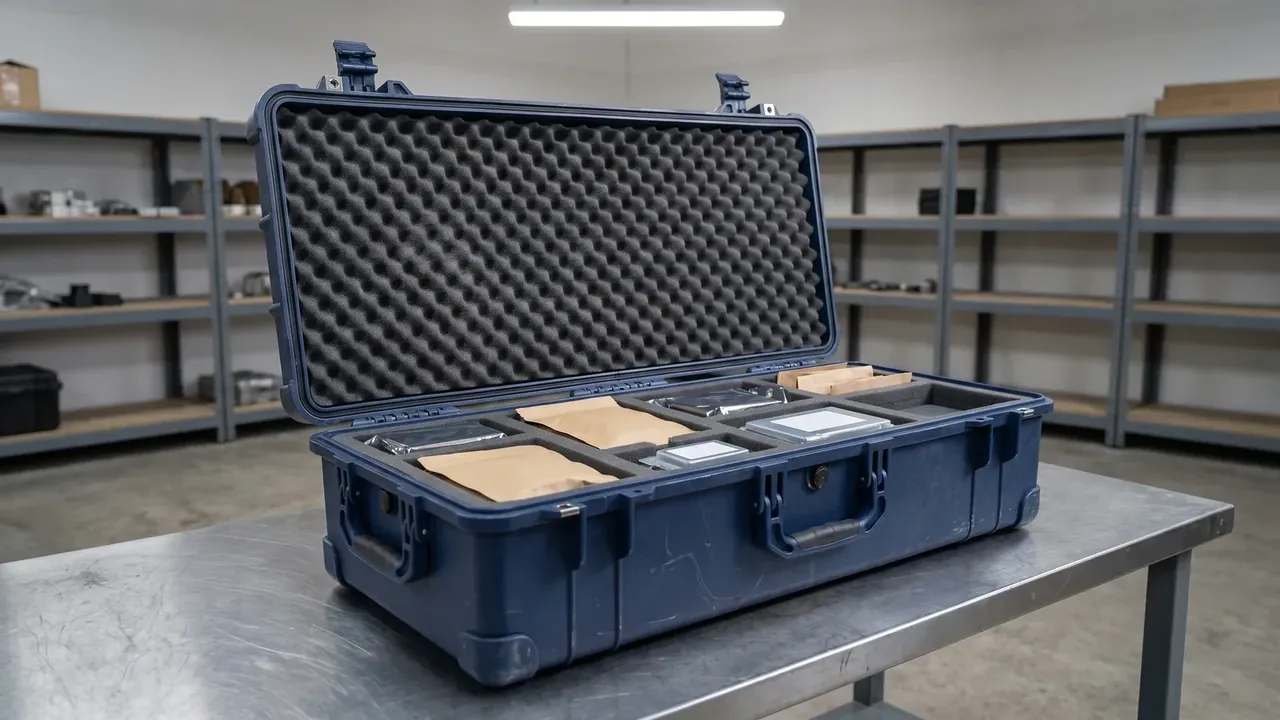
Quick answer: A Hospital infection control test device hard case keeps residue under 0.8 mg/dm2 after 600 wipes; Ra 1.6 um surface and R10 mm corners limit buildup.
Table of contents
- Surface roughness of the Hospital infection control test device hard case
- Radius of the lid corners
- Residue readings across wipe cycles
- Buildup judgement at the seams
- Roughness ceiling for infection-control batches
- FAQ
1. Surface roughness of the Hospital infection control test device hard case
Cleanability starts as a geometry problem: roughness governs whether a wipe lifts residue away, while corner radius governs whether a seam keeps a dead spot. The Hospital infection control test device hard case is finished to a Ra 1.6 um outer surface, so fibre contact stays moderate and residue neither snags in the texture nor clings to a mirror face. Three roughness tiers go on the rig: the Ra 0.8 um tier returns the lowest residue, whereas the Ra 3.2 um tier keeps a film in its grooves that no pass removes, and the tiers only separate after about 300 wipes. Holding 23 C / 50% RH keeps each pass comparable, since a humidity shift alone changes the reading.
Lower roughness alone does not make wiping easier. Polish the Hospital infection control test device hard case too bright and the cloth skids; the flat area looks clean while the corners hold residue the cloth never carried off.
| Roughness tier | Ra value | Wipe pickup |
|---|---|---|
| Ra 0.8 um tier | 0.8 um | Residue lifts easily |
| Ra 1.6 um tier | 1.6 um | Stable, passes |
| Ra 3.2 um tier | 3.2 um | Coarse, holds residue |
2. Radius of the lid corners
A R10 mm corner radius is fixed by lid forming and seam width. The Hospital infection control test device hard case runs one continuous radius around the lid mouth; too small a radius folds the cloth at the turn, too large a one widens the mold seam. With a 3.6 mm shell and R10 mm corners, feeler depth into the seam stays inside the logged band, while a R6 mm comparison lifts corner residue well above the middle run.
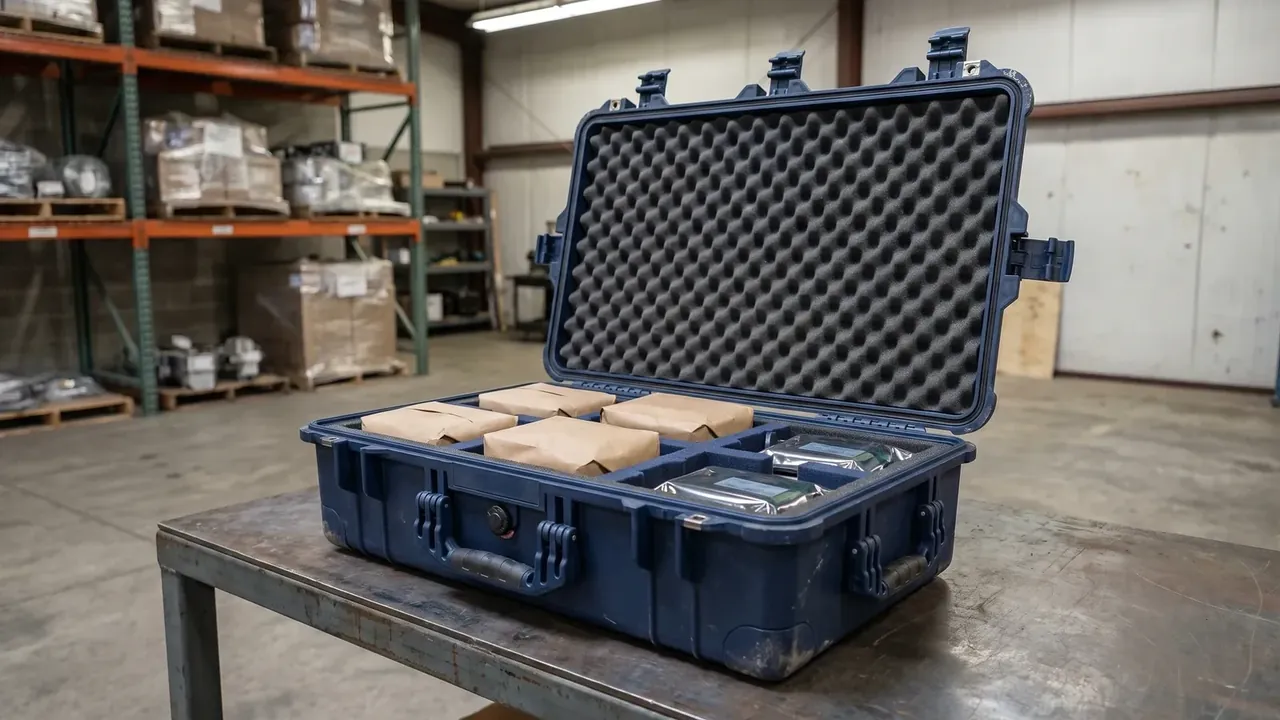
Local wall thickness at the corners is measured again ahead of the seam retest, since repeated load around the latch seats lets the mating face settle. At 3900 open-close cycles the Hospital infection control test device hard case must still show R10 mm; a feeler along the turn gives the reading, and any lid outside the band goes back for rematching.
3. Residue readings across wipe cycles
The wipe programme totals 600 passes, with residue weighed per unit area every 150. The Hospital infection control test device hard case closes on 0.8 mg/dm2; the three tiers sit close for the first 150 passes and only separate beyond 450. Buildup is not steady: a coarse tier often jumps after a single pass, which is why every round is logged instead of keeping only the last figure.
| Wipe cycle | Cumulative passes | Residue at R10 mm corner |
|---|---|---|
| Pass 150 | 150 | 0.21 mg/dm2 |
| Pass 300 | 300 | 0.38 mg/dm2 |
| Pass 450 | 450 | 0.55 mg/dm2 |
| Pass 600 | 600 | 0.72 mg/dm2 |
The final round is archived on its own, since the ceiling accepts only the 600-pass figure. Small mid-run swings do not trigger rejection, and as long as no corner shows visible buildup, continued wiping brings the reading back down.
4. Buildup judgement at the seams
Retest attention goes to the four corners, because a spotless flat area says nothing about what a seam retained. The Hospital infection control test device hard case fits one gasket at 18% compression, and 2 latches at 320 N each pull the lid seam into the logged band; once a corner shows visible buildup, the next pass reads higher. Ingress work here is benchmarked only against the method named in IP65, the result covers the lid seal alone, and no whole-case rating claim is drawn from it.
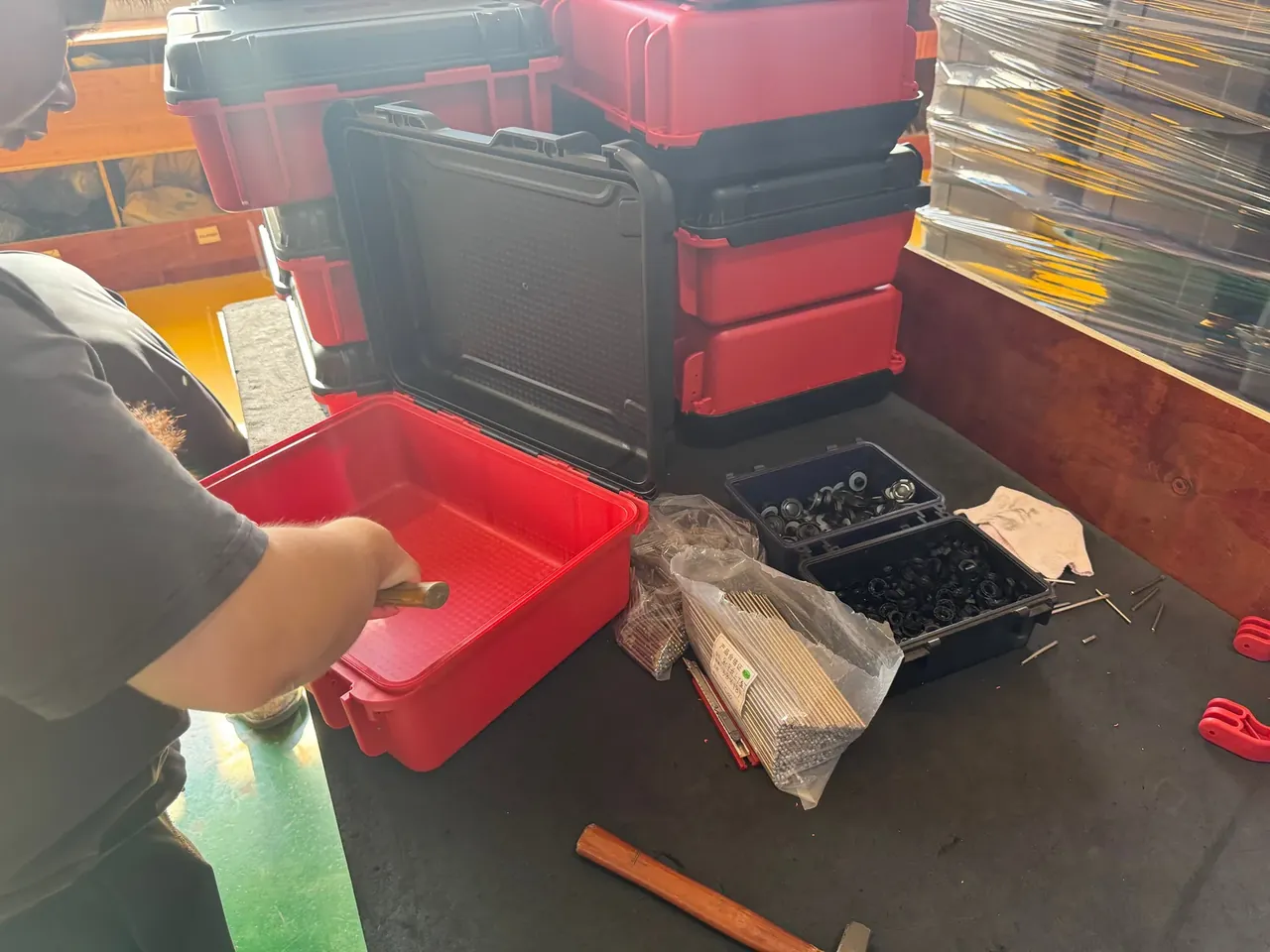
That one gasket at 18% compression is hardness-tested before the first pass and after the last; a drift outside the logged band means a fresh gasket and a retest. Corner buildup and flat-area residue share one lid interface, so both figures sit on one page and are checked line by line at sign-off.
5. Roughness ceiling for infection-control batches
The roughness ceiling takes the coarsest tier whose residue stays under 0.8 mg/dm2, and any surface rougher than that is kept off the delivery list. The Hospital infection control test device hard case is released as a whole lot on this line with no special cases; the recheck at 3900 open-close cycles only confirms that latches and hinges have not pulled the lid mouth out of true. The ledger must let a box number lead back to its measured roughness and matching round residue, and one missing item stops the release signature.
| Residue reading | Roughness tier | Seam decision |
|---|---|---|
| 0.8 mg/dm2 or less | Ra 1.6 um tier | No visible buildup, release |
| 0.8-1.2 mg/dm2 | Ra 1.6 um tier edge | Recheck corners |
| above 1.2 mg/dm2 | Ra 3.2 um tier | Scrap |
A baseline set of dimensions accompanies the sheet for clamp alignment: outer 510 x 370 x 200 mm, inner cavity 445 x 310 x 140 mm, wall 3.6 mm, empty 4.0 kg, rated payload 7.5 kg. The Hospital infection control test device hard case has its corner radius remeasured under load, and the offset against the empty reading goes on the batch card kept under JUNZHIJIA.
Conclusion
Cleanability of the Hospital infection control test device hard case rests on three linked figures: a Ra 1.6 um surface, R10 mm lid corners and residue at or under 0.8 mg/dm2 after 600 wipes. If texture, corner geometry and lid seam are not matched together, the wipe readings drift apart in later rounds, so corner figures are checked per box before sign-off. Set the roughness ceiling ahead of the dimension and payload check; reverse them and the residue figures stop being comparable between lots.
Related Reading
- Hospital sterilisation supply case: sealing and marking for instrument transfer
- Medical device transport case: protection, compliance and clean handling
- Medical case maintenance: inspection items and replacement lines
- Disinfecting cases in medical use: agent choice for the enclosure
Related Products
- 8 Series — Gun Cases; Military Equipment Cases; Camera Equipment Cases; Drone Cases; Watch Cases; Knife Cases; First Aid Cases; Electronics Equipment Cases
- WL8-2812 PP Gun Case — model WL8-2812
- All protective cases and toolboxes: 7 series, 158 models