

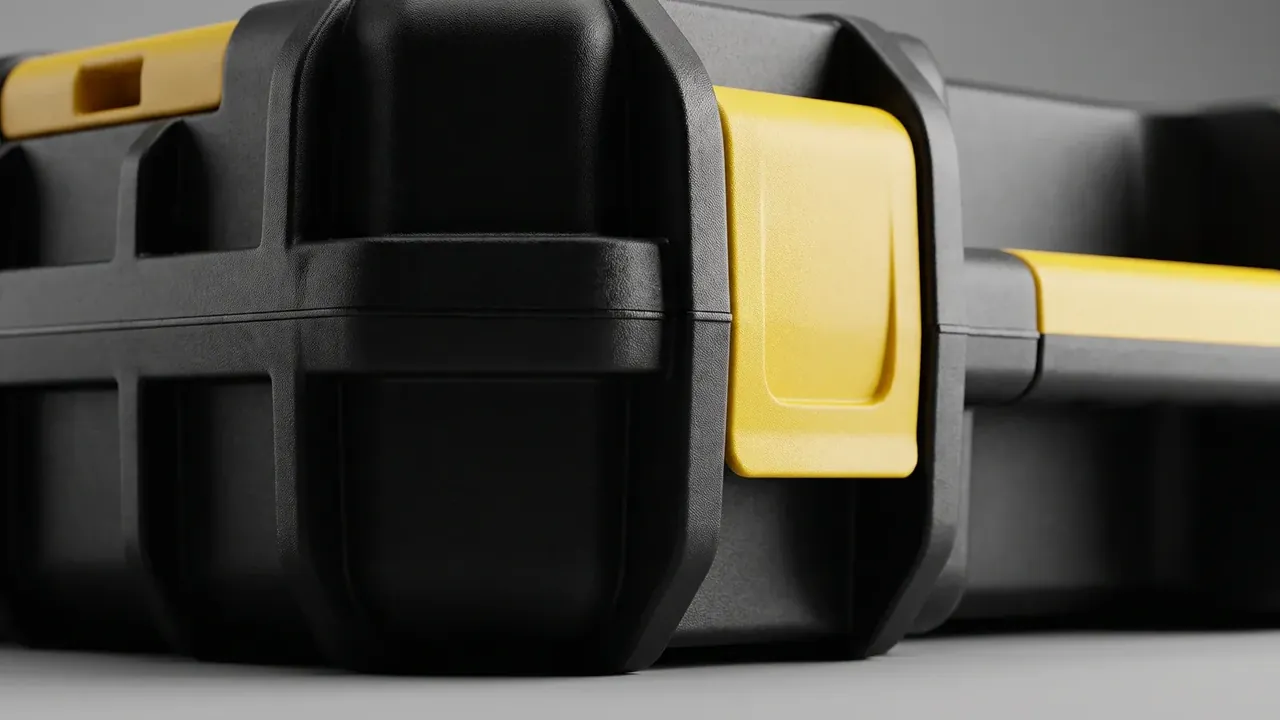
Quick answer: Industrial Case Supplier Evaluation Criteria weigh five dimensions at 25/25/20/20/10, with an 80-point pass line and a 70-point cut line.
This article covers the case side only: wall, seal, insert and hardware.
Table of contents
- How qualification and system documents are checked
- Reading equipment and capacity on site
- Which incoming and process records to sample
- Comparing a sample against a production lot
- Setting weights and the cut line
- FAQ
1. How qualification and system documents are checked
Industrial Case Supplier Evaluation Criteria start at a desk, not on the show floor. A sample can be the best unit in the plant, while records must hold for six months. Three documents open the review: a licence whose scope covers plastic case moulding, a quality system spanning incoming material to dispatch, and test evidence behind any ingress claim.
Documents are read in layers: the manual states policy, procedures name who signs at which gate, work instructions land at the machine, check sheets underneath. A plant holding only the top two runs on word of mouth, and two operators measure one wall at two thicknesses. Industrial Case Supplier Evaluation Criteria walk a check sheet back to its instruction; where the path breaks, the file lives in a cabinet.
Protective case sealing claims fail most often. When IP67 is quoted, ask for the 1 m, 30 min immersion record, the note on sample-to-water temperature within 5 K, and the lid-open check. The record counts, the promise does not: 0.5 mm less gasket compression turns a pass into water inside.
Paper and plant must confirm each other. The file says 3–6 mm wall and the calliper reads 4.8 mm. The process card lists a regrind ratio while the hopper holds unlogged material: one mismatch. The two-mismatch red line in the verdict grows from this pairing.
2. Reading equipment and capacity on site
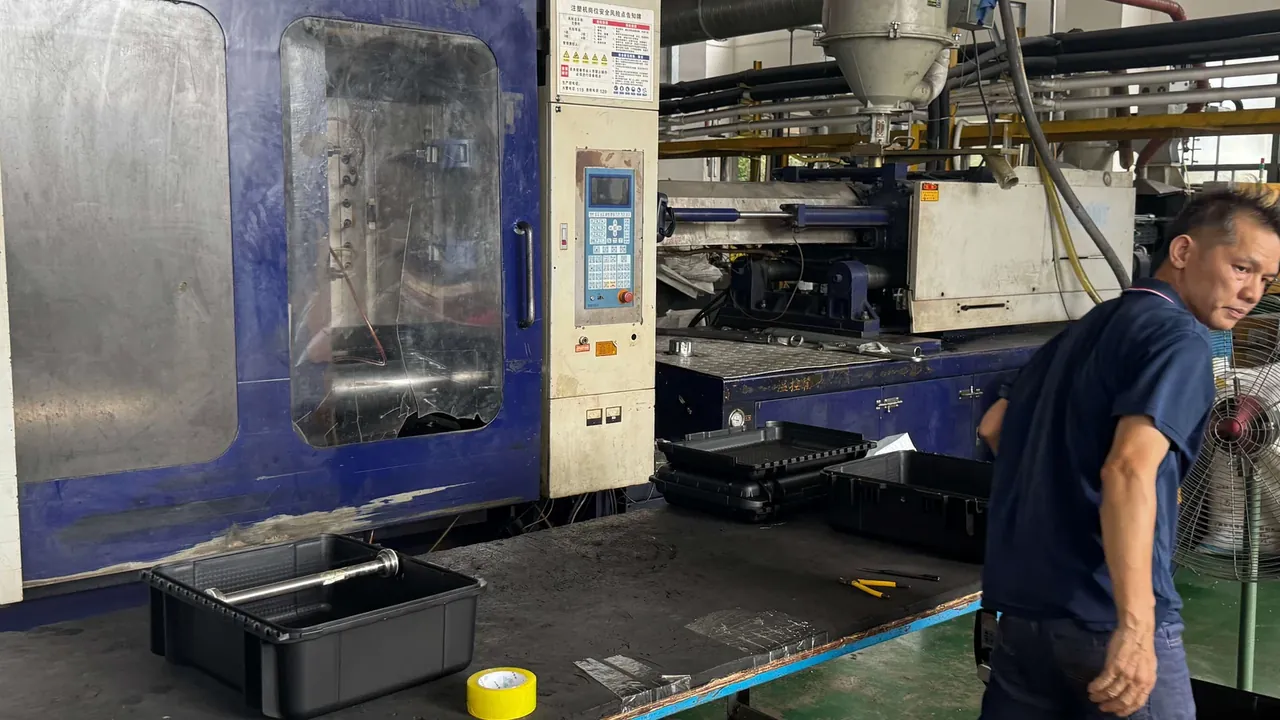
Rotomoulding and injection moulding are audited differently. Rotomoulding is read through oven 250–300 ℃, biaxial 3–8 rpm and a 15–45 min cycle; how evenly the mould turns decides wall uniformity, and ±10%–20% thickness tolerance is ordinary. Injection is read through press tonnage and cavity count.
Capacity is timed, not quoted. Industrial Case Supplier Evaluation Criteria have the plant run one case from loading to demould while you hold the stopwatch, then multiply by presses and shifts; a figure 30 percent above the timed value is usually outsourced.
The equipment log has to match the nameplates. Eight machines on paper and six turning on the floor means two are down or were never there. Industrial Case Supplier Evaluation Criteria weight equipment at 25: scale decides whether a date can be kept and whether wall thickness drifts at volume.
3. Which incoming and process records to sample
Records carry 20 points because they pin spoken claims to a calendar. Industrial Case Supplier Evaluation Criteria ask for five logs: incoming, first article, in-process patrol, final and nonconformance. Pull three lots from each, spread across six months.
| Log | What the sample must show | Mismatch signal |
|---|---|---|
| Incoming | grade, lot, moisture, colour | verdict with no measured value |
| First article | wall and latch alignment | signature against wrong shift |
| Patrol | frequency, exception column, closure | column blank for weeks |
| Final | quantity, date, verdict | will not trace to dispatch |
| Nonconformance | cause, action, rework | action with no cause |
Incoming inspection starts with resin: grade, lot, moisture and colour. Skip one and later wall and appearance swings have no root. Regrind ratio belongs on the process card; the batch record shows what went in.
Industrial Case Supplier Evaluation Criteria read patrol logs for frequency and closure: every two hours or once a shift, signed or not, exception column blank or answered. A blank means nothing was written, not that nothing happened.
Final records must trace to dispatch: three lots back to their shipping documents, quantity, date and verdict lining up. Where the chain breaks, the records were written after the fact.
4. Comparing a sample against a production lot
A sample is a promise and a lot is the payment; Industrial Case Supplier Evaluation Criteria compare the wall, the latch and the texture: three calliper readings on each wall and the base against the sealed sample, then the latch on a gauge, where 200–400 N is the working band and anything below it opens in transit vibration.
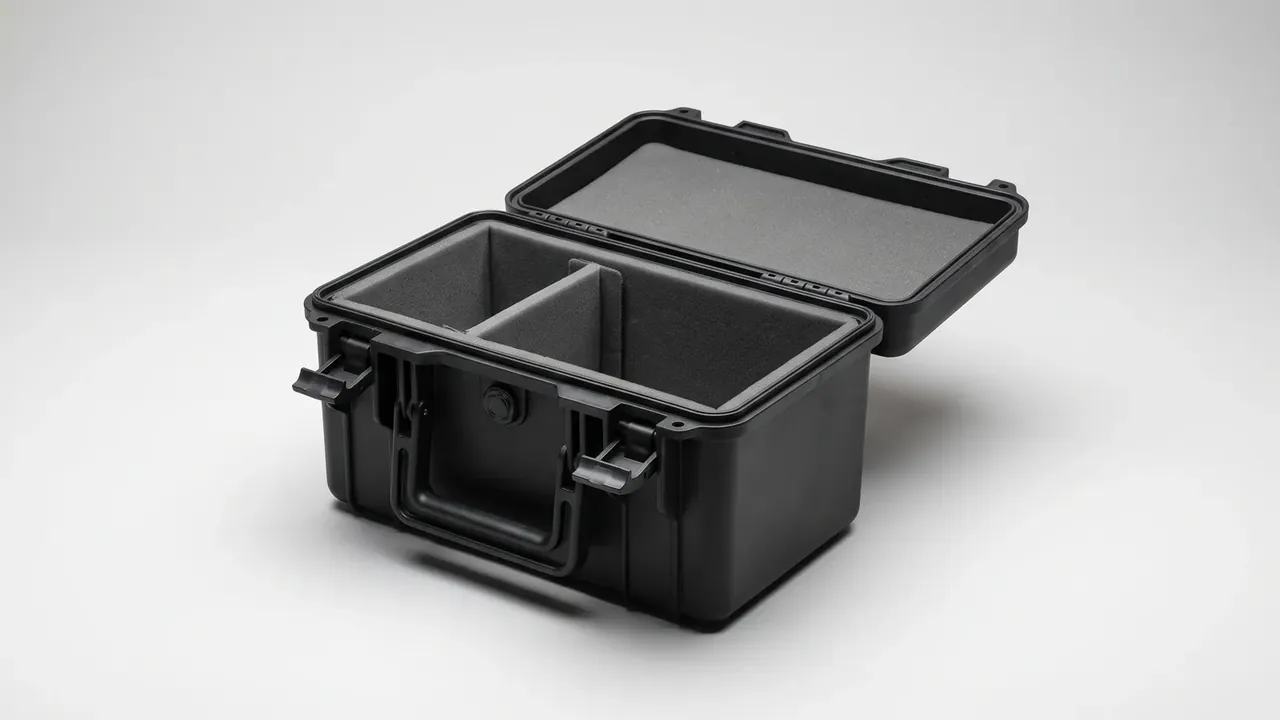
Texture is compared under one lamp, sample left and lot right, watching grain depth, parting-line width and colour. Rotomoulded shifts come from powder lots, moulded ones from masterbatch ratio; either should resolve to a lot-change record.
Hinge life is sampled: two sets run 20,000 cycles with latch alignment logged at 10,000 and 20,000. Drift past 1 mm says the pin and bore have loosened, and the lot will rattle within half a year.
Industrial Case Supplier Evaluation Criteria give consistency 20 points because it is the hardest item to repair. Walls can be dialled in and colour rematched; mould wear and assembly clearance are structural.
5. Setting weights and the cut line
Industrial Case Supplier Evaluation Criteria only work when the card both scores and cuts. Five dimensions carry 25/25/20/20/10, each scored out of 100 and multiplied by its weight.
| Dimension | Weight | What the evidence must carry | Typical gap |
|---|---|---|---|
| Qualification | 25 | four document layers, scope covering case moulding | manual and procedures only |
| Equipment | 25 | logs matching nameplates, cycle re-timed | quoted above stopwatch |
| Records | 20 | five logs unbroken across six months | patrol column left blank |
| Consistency | 20 | wall, latch force and grain agree | a single sealed sample |
| Delivery | 10 | dates backed by a production plan | verbal assurance |
An 80-point pass line and a 70-point cut line leave a rectification zone. A supplier inside it gets 30 days and one re-score, and leaves the list if still under 80; approved suppliers are re-scored every 12 months.
| Total | Action | Review |
|---|---|---|
| 80 or above | enter the approved list | re-score after 12 months |
| 70 to 79 | rectify within 30 days | one re-score |
| under 70 | stay off the list | may reapply after six months |
A total under 70 across the five dimensions, or two or more mismatches between system documents and shop-floor records, removes the supplier from the approved list.
The cut sits at 70 rather than 60 because a zero in one dimension drags the total under 80 by arithmetic alone. Weights are uneven for a reason: qualification and equipment take 25 apiece because they are the slowest to repair.
On paper Industrial Case Supplier Evaluation Criteria are a weight table; on the floor they are five logs and a calliper. A card that cannot cut is only a sheet that looks tidy.
Related Reading
- How to design a case supplier scorecard
- Supplier evaluation system and the annual re-score
- How to audit a protective case factory
- Record checklist for a supplier site audit
JUNZHIJIA
Related Products
- 8 Series — Gun Cases; Military Equipment Cases; Camera Equipment Cases; Drone Cases; Watch Cases; Knife Cases; First Aid Cases; Electronics Equipment Cases
- WL8-2812 PP Gun Case — model WL8-2812
- All protective cases and toolboxes: 7 series, 158 models