

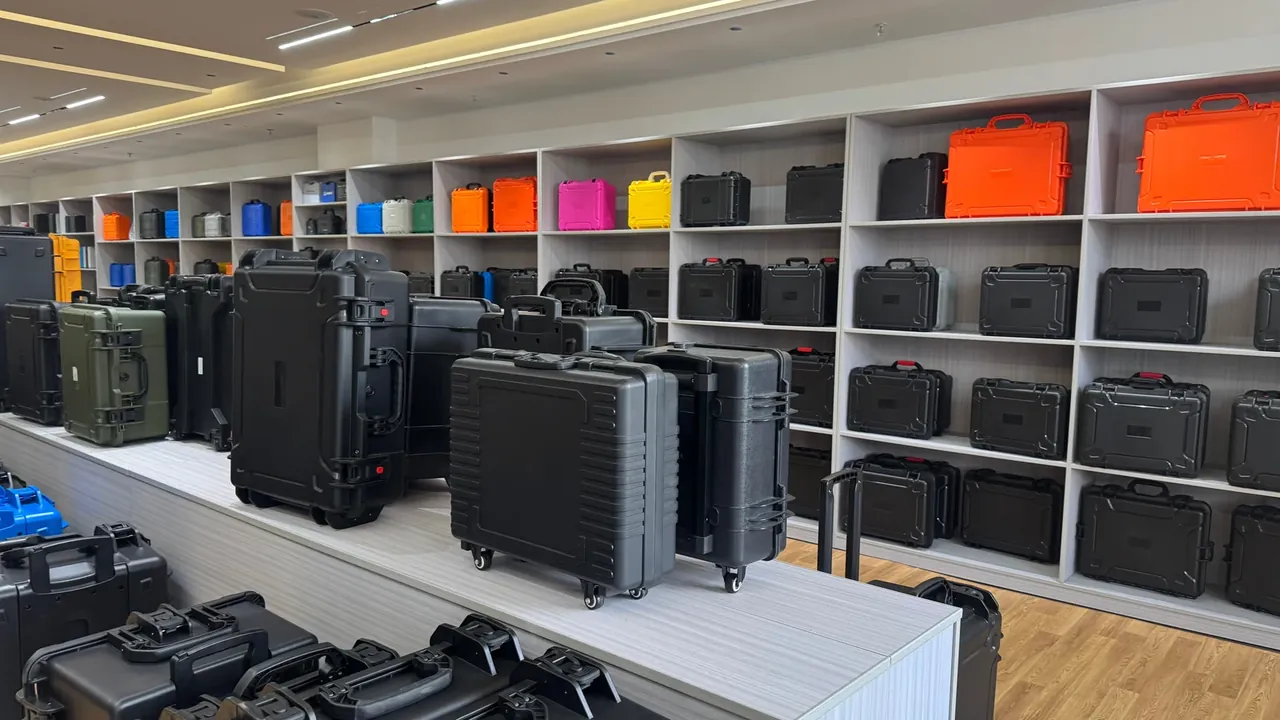
Quick answer: Industrial case with wheels lives or dies on diameter and housing: 50 mm for smooth floors, 75 mm over 3 mm/m, 40 kg per wheel, 60 N of push.
Table of contents
- Wheel diameter and floor: what 50 mm and 75 mm change
- Pairing swivel casters with fixed casters
- Caster housings and where the base concentrates load
- Push force, noise and the brake
- Stairs, thresholds and ramps in practice
- FAQ
1. Wheel diameter and floor: what 50 mm and 75 mm change
What fails first on an Industrial Case with Wheels is seldom the wheel; it is the ring of base plate around the housing. The 25 mm gap between a 50 mm and a 75 mm caster reaches that ring as two load patterns: the small wheel presses a narrow pad near the edge, the tall housing carries its reaction inboard, and a sill lifts and drops the shell instead of letting it roll.
Climbing follows the radius. A 50 mm wheel has a 25 mm radius and must raise its axle the full sill height; a 75 mm wheel meets the same sill at a flatter angle and crosses on a forward push. The trade is height: bigger wheels raise the centre of gravity, so a side nudge tips the shell sooner.
A 40 kg rating per wheel is the first gate on an Industrial Case with Wheels. At 120 kg each of four casters carries 30 kg with a quarter in reserve, and past that the 8 mm axle develops play.
Flatness of 3 mm/m then divides the sizes: below it they differ by under 5 N and the smaller one saves cavity space, above it the smaller wheel hops at every high spot.
| Diameter | Floor type | Push force | Case weight |
|---|---|---|---|
| 50 mm | Epoxy shop floor | 38 N | ≤120 kg |
| 50 mm | Warehouse concrete | 52 N | ≤120 kg |
| 75 mm | Yard asphalt | 58 N | ≤160 kg |
| 75 mm | Corridor with thresholds | 60 N | ≤160 kg |
2. Pairing swivel casters with fixed casters
Four swivels steer a case obediently between racks, yet on a straight run the shell wanders and the wrist corrects. Four fixed casters hold a line and cannot turn at all, so every corner means lifting the front edge of a loaded shell.
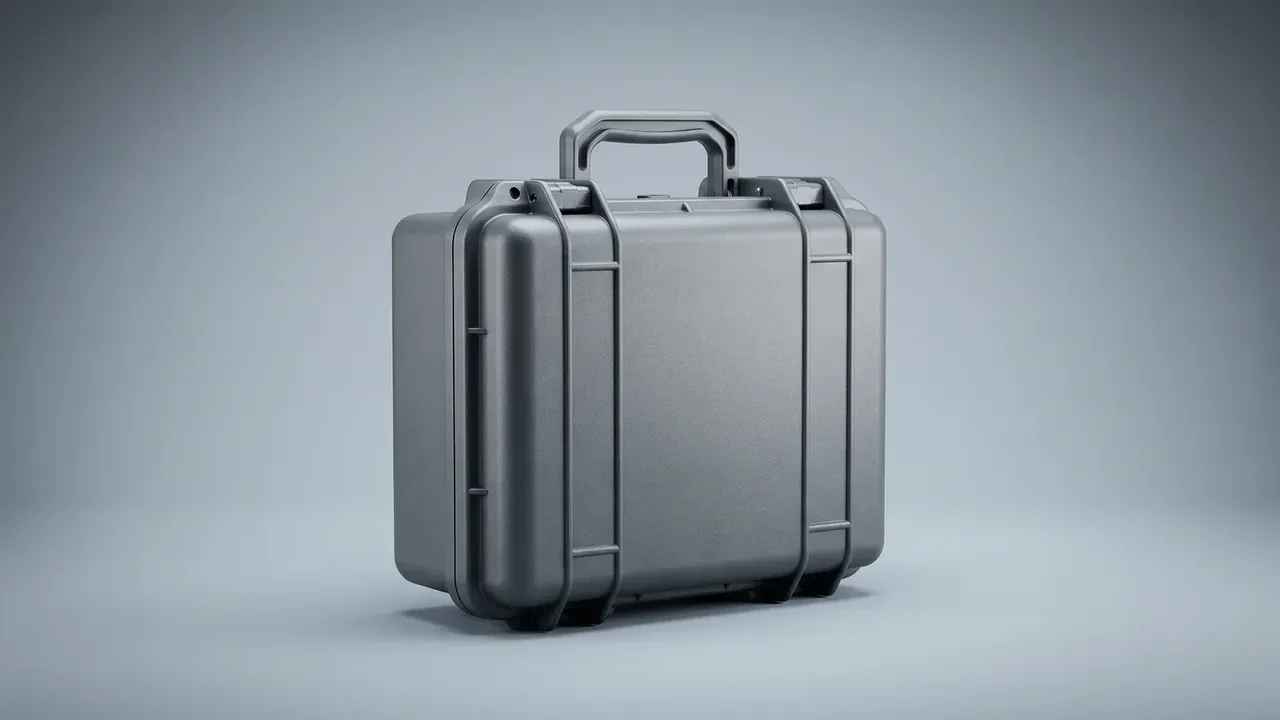
Two swivels and two fixed is the pairing that works on an Industrial Case with Wheels. Fixed casters take the leading edge for direction, swivels take the trailing edge on the operator's side for steering, and the shell follows the hand rather than being twisted into a turn.
Reversed, the tail swings: swivels at the front put the rear mass over the fixed pair, and in a tight aisle one swing means reversing.
Housings should land on a continuous rib, never on the thin panel between two, or the 5 mm wall carries turning torque alone.
| Caster layout | Count | Steering | Typical problem |
|---|---|---|---|
| Both corners, leading edge | 2 | Fixed | Front catches on thresholds and needs a lift |
| Both corners, trailing edge | 2 | Swivel | Tail swings when the load sits rearward |
| All four corners | 4 | All swivel | Constant correction on straights, axle play arrives early |
| Fixed front, swivel rear | 4 | 2 fixed, 2 swivel | Turning circle limited by case length |
3. Caster housings and where the base concentrates load
The housing is the first point of trouble on an Industrial Case with Wheels. Weight divides between four casters, the landing impulse multiplies it several times, and the force runs from axle to housing wall to base plate; where it cannot spread, the root splits.
A 5 mm housing wall is the floor for that path. Thinner walls put the moulding's weld line at the root, so the first impact opens a crack exactly there.
The base has to cooperate: a solid pad around each housing and ribs radiating from its corners, so load reaches the long edges. Ribs that stop mid-base hang the casters on a diaphragm.
A running-gear verdict follows: after 5 km of loaded travel, one wheel worn unevenly by more than 2 mm, or a crack in any housing, rules that set out for this case weight. Two kilometres a day reaches the line in a week and a half, and an Industrial Case with Wheels starts to weave as the crack opens.
4. Push force, noise and the brake
A ceiling of 60 N is roughly the effort of lifting 6 kg. Starting 120 kg on a flat floor is the hardest moment, with drag falling by half once the wheels turn; dry bearings will not hold that figure.
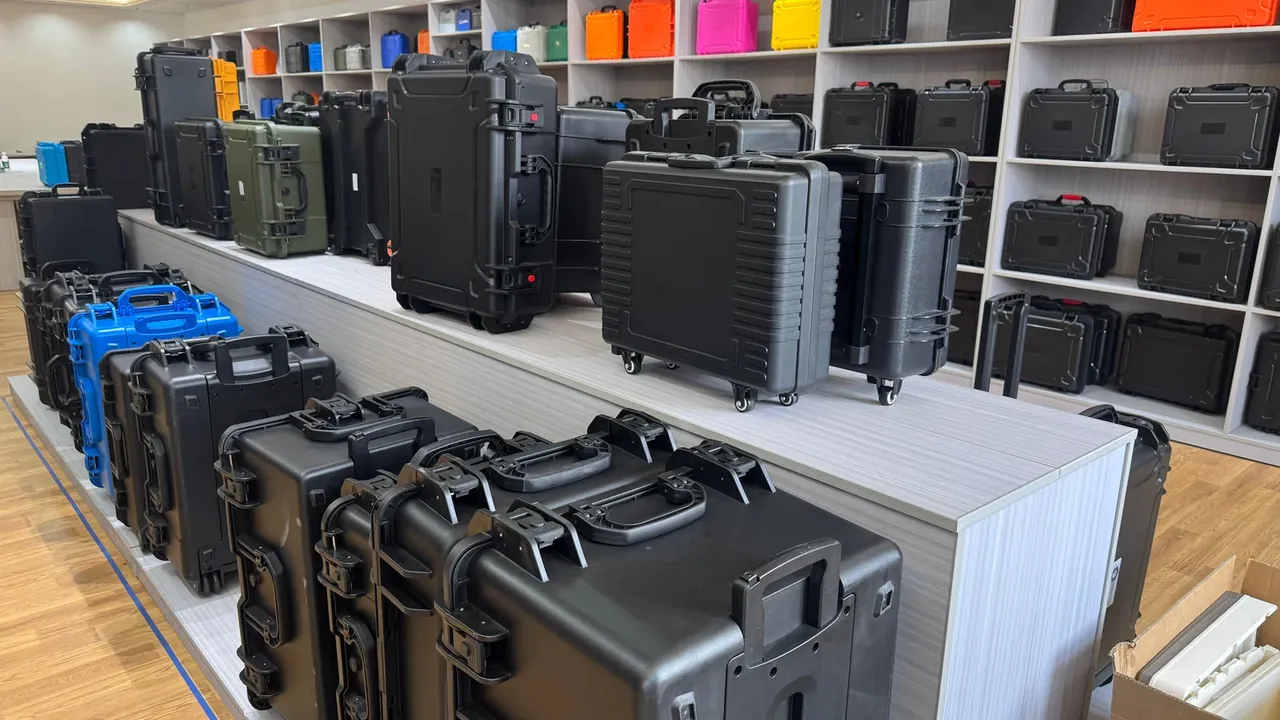
Compound decides noise. Polyurethane rolls under 65 dB on epoxy, elastomer is silent over joints but deforms under load, and nylon wears well and drums on tile. Which compound an Industrial Case with Wheels should carry follows the floor, not the price list.
One brake on the trailing edge is enough. It holds the case on an 8° ramp, and because the pad bears on the tread it thins with use, so a softening pedal signals replacement.
| Floor | Flatness | Noise | Suggested compound |
|---|---|---|---|
| Epoxy | Within 3 mm/m | ≤58 dB | Polyurethane |
| Terrazzo and tile | Within 3 mm/m | ≤64 dB | Thermoplastic elastomer |
| Yard asphalt | Over 3 mm/m | ≤65 dB | Nylon with thicker web |
| Outdoor gravel | Over 3 mm/m | ≤62 dB | Large polyurethane |
5. Stairs, thresholds and ramps in practice
Eight degrees is the limit for this set, because at 120 kg the push force already sits at 60 N; add slope and the operator leans body weight into the case while side load on the housings climbs. Warehouse loading ramps fall between 5° and 8°, so the gradient matters more than the brand.
Thresholds need grading by height. Threshold strips between corridor and workshop, or the channel at a lift entrance, are low enough for a 75 mm wheel; a step is not, and the case is carried by two people.
Whether an Industrial Case with Wheels survives a stairwell depends on a second way of moving it. A telescopic handle lets it be dragged up a couple of steps before the lift; a shell that only rolls must be carried whole.
At the top of a ramp, an Industrial Case with Wheels left waiting without the brake travels on its own after a single knock.
Related Reading
- Choosing the wheel compound
- Two casters against four
- Matching casters to a telescopic handle
- Hard cases against cartons for e-commerce despatch
JUNZHIJIA
Related Products
- 8 Series — Gun Cases; Military Equipment Cases; Camera Equipment Cases; Drone Cases; Watch Cases; Knife Cases; First Aid Cases; Electronics Equipment Cases
- WL8-2812 PP Gun Case — model WL8-2812
- All protective cases and toolboxes: 7 series, 158 models