

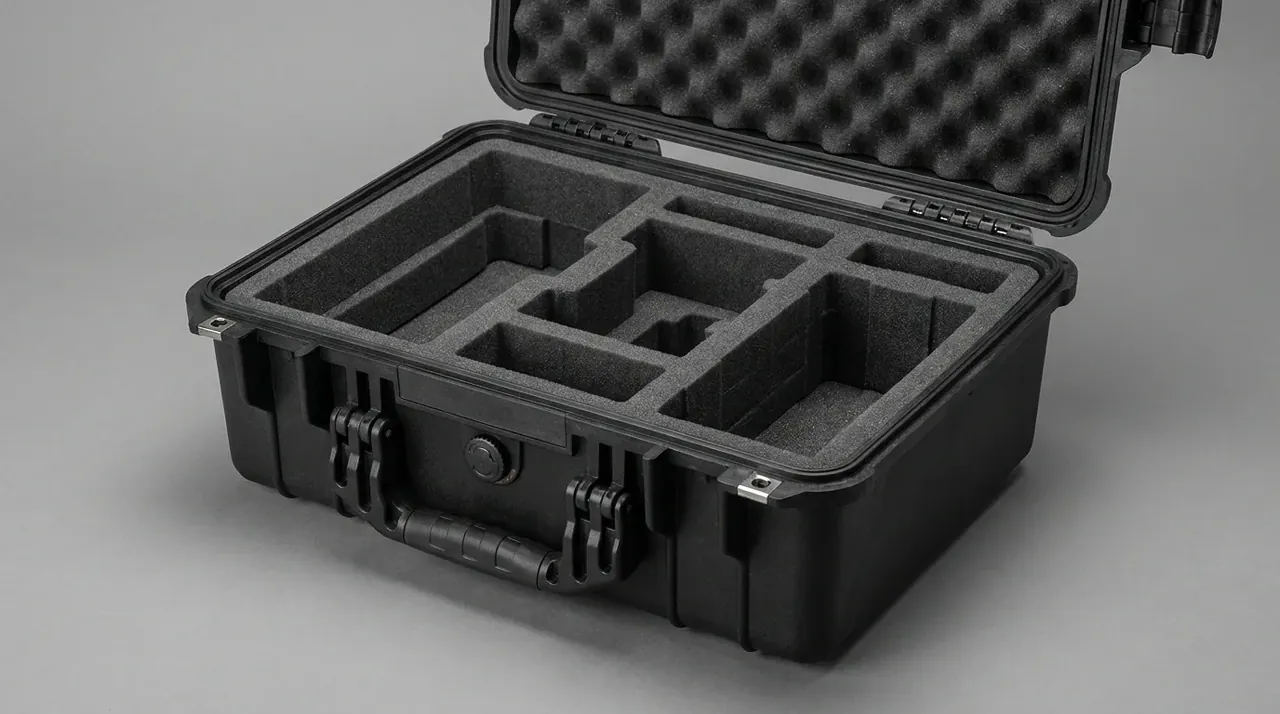
Quick answer: An industrial endoscope protective hard latch case measures 500×390×205 mm outside with a 150 mm deep cavity for a 300 mm coil envelope, and its two latches hold 320 N each while the lip step stays under 0.4 mm after a 1.2 m six-face drop.
Table of contents
- Cavity depth and coil allowance of the industrial endoscope protective hard latch case
- Closing force and tongue travel of the two hard latches
- Hinge stop angle and pin fit along the full-length hinge
- Lip step re-check after a 1.2 m six-face drop
- Gasket compression and internal humidity after immersion
- FAQ
1. Cavity depth and coil allowance of the industrial endoscope protective hard latch case
The industrial endoscope protective hard latch case is built to a 500×390×205 mm outer envelope, a 445×330×150 mm cavity and a 3.4 mm wall, weighing 3.1 kg empty. The 150 mm depth is taken from a 300 mm coil envelope: 20 mm clear underneath and 15 mm left to the tips of the lid foam. At 130 mm the foam pins the coil to the floor and transport vibration runs into the wall root; at 170 mm the coil rolls on a drop and strikes the side ribs.
Depth tolerance is measured only as the distance from cavity floor to foam tips, with foam compression logged on its own line and never folded into the same figure.
| Dimension | Value | Reading use |
|---|---|---|
| Outer envelope | 500×390×205 mm | Aligns with pallet slots |
| Cavity | 445×330×150 mm | Allowance over a 300 mm coil |
| Wall | 3.4 mm | Side dent resistance and boss depth |
| Empty weight | 3.1 kg | One-person carry limit |
Cavity depth is moulded in one shot, never milled, so it is tied to foam thickness at the tooling stage. Five units per lot are gauged at four corners and the centre, and a 1.2 mm spread across the five points sends the tool back for review.
2. Closing force and tongue travel of the two hard latches
Two hard latches sit opposite each other, each rated 320 N with 9 mm of tongue travel and a 1.5 mm stainless catch plate. Force is read with a pull gauge at 30 mm/min until the tongue releases, recorded per latch rather than averaged. The 320 N floor keeps the lid from popping open on impact; a 400 N ceiling keeps the catch openable with one hand.
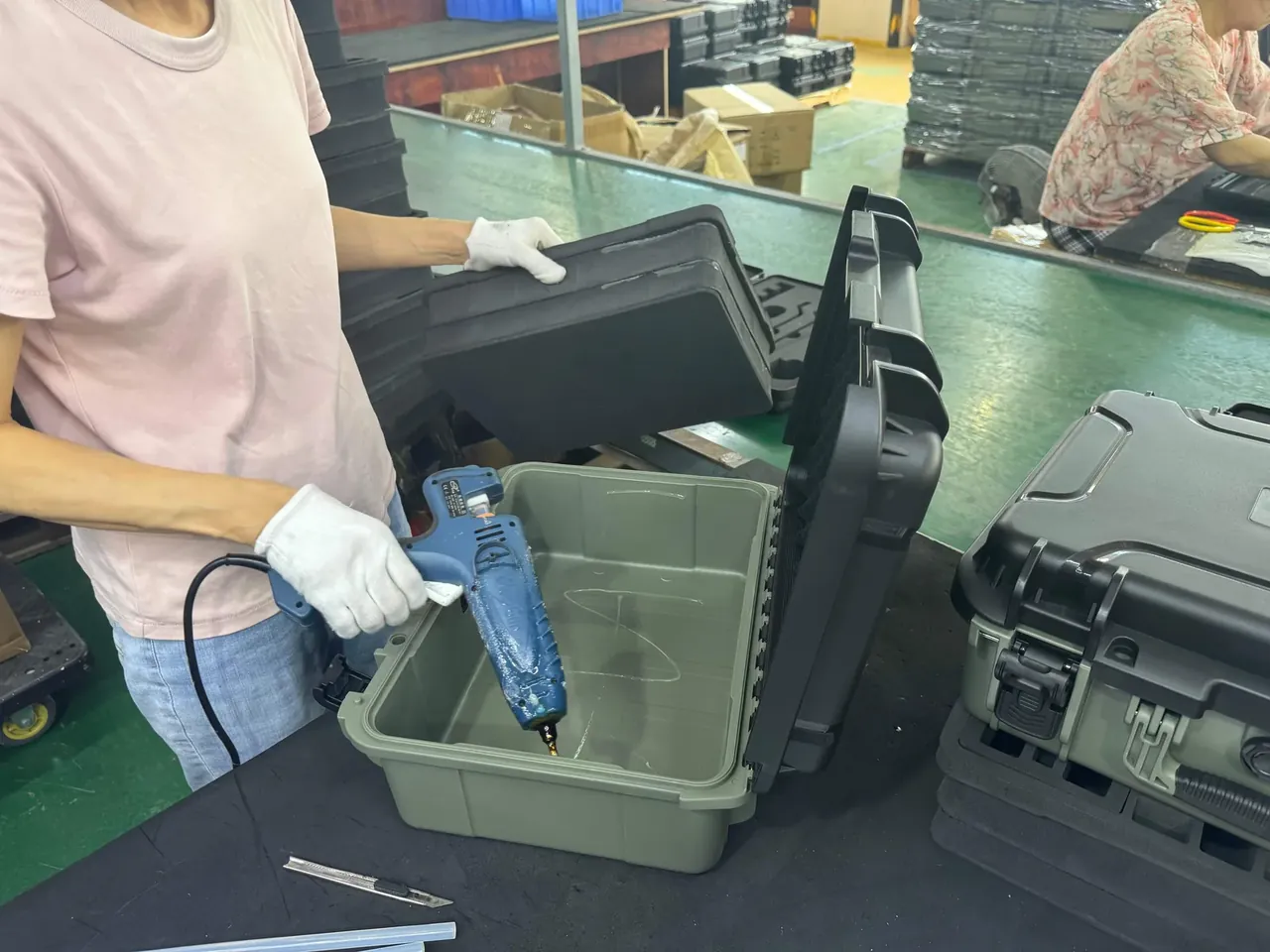
Tongue travel and lip step move together. At 9 mm the tongue clears the catch lip by 2 mm, the lid presses onto the gasket and compression settles at 30%. At 7 mm the tongue grips only 0.5 mm of lip and releases on a drop; at 11 mm the load angle goes oblique and whitens the plastic hook.
Closing runs centre-first on the assembly card, though only even load on both sides matters in service, which holds lip step difference under 0.3 mm. Force is re-checked after 5000 cycles against a 15% decay line; past that the catch insert is swapped and the lid stays untouched.
3. Hinge stop angle and pin fit along the full-length hinge
The hinge runs the full 180 mm rear edge, with a 4 mm stainless pin and 0.15 mm clearance. Its stop face meets at 105°, so the 0.9 kg lid neither falls back nor closes by itself when the case sits on a 15° slope. A stop under 95° crowds the opening; over 115° raises the bending moment at the root and cracks the pin bore over time.
Each bore sits inside a 2 mm reinforcement boss moulded with the shell and hinge seat in one shot. Pin insertion is held under 250 N; press harder and stress concentrates at the bore, showing as whitening after 5000 cycles. Hinge and latch are measured as two separate groups: radial pin clearance for the hinge, tongue-to-catch contact face for the latches, with neither reading standing in for the other.
4. Lip step re-check after a 1.2 m six-face drop
The case is dropped from 1.2 m onto all six faces with a 6.5 kg load, after 4 h at -10°C. Once the rig stops, the lip step comes first: close the lid and try a feeler gauge from 0.05 mm around the lip, reading eight points at the four corners and four edge midpoints, with a 0.4 mm maximum. A step out of tolerance means the lip ribs took permanent set, shifting the face where lid and gasket meet.
The order is fixed: step, then force on both catches, then cracks. A good step with force under 270 N means new latches; a bad step with radial corner cracks retires the unit. Each case takes one drop round, since a second impact can hide the first set.
| Re-check item | Gauge and value | Verdict |
|---|---|---|
| Lip step | Feeler from 0.05 mm | ≤0.4 mm |
| Latch closing force | Pull gauge peak | ≥270 N |
| Corner cracks | Visual plus 5× loupe | No radial cracks |
| Hinge pin clearance | Plug gauge | ≤0.25 mm |
5. Gasket compression and internal humidity after immersion
The gasket is EPDM, 8×6 mm section, seated in a 6.5 mm channel and compressed 30% at closure, from 6 mm to 4.2 mm. Below 25% the lip bubbles at 1 m depth; above 40% the gasket fights the 320 N latch force and tongue travel feels dead at the end.
Immersion runs 1 m deep for 30 min; the case is wiped, left 2 h, then opened with 10 g of desiccant inside. A gain of no more than 0.8 g means the seal holds. Temperature runs separately: 24 h at -20°C against a 12% set limit, then 24 h at 60°C against a 0.3 mm lip step.
| Check | Condition and value | Verdict |
|---|---|---|
| Gasket compression | 6 mm to 4.2 mm | 25%–40% |
| Immersion | 1 m depth, 30 min | Desiccant gain ≤0.8 g |
| Cold compression set | -20°C for 24 h | ≤12% |
| Hot distortion | 60°C for 24 h | Lip step ≤0.3 mm |
Conclusion
The industrial endoscope protective hard latch case carries five coupled figures: a 150 mm cavity against a 300 mm coil envelope, 320 N per latch with 9 mm tongue travel, a 105° stop on a 180 mm hinge, a 0.4 mm lip step after a 1.2 m six-face drop, and 30% gasket compression paired with a 0.8 g desiccant gain. Each belongs to tooling, assembly, rig or immersion work, and none is converted into another. How a cable is coiled or pulled out inside the case is outside this discussion.
Related Reading
- Converting cavity depth into foam thickness
- Where 5 mm, 10 mm and 15 mm foam stop working
- Shell structure and insert layout of detection instrument cases
- Sampling rules and records for incoming lot checks
Related Products
- 8 Series — Gun Cases; Military Equipment Cases; Camera Equipment Cases; Drone Cases; Watch Cases; Knife Cases; First Aid Cases; Electronics Equipment Cases
- WL8-2812 PP Gun Case — model WL8-2812
- All protective cases and toolboxes: 7 series, 158 models