

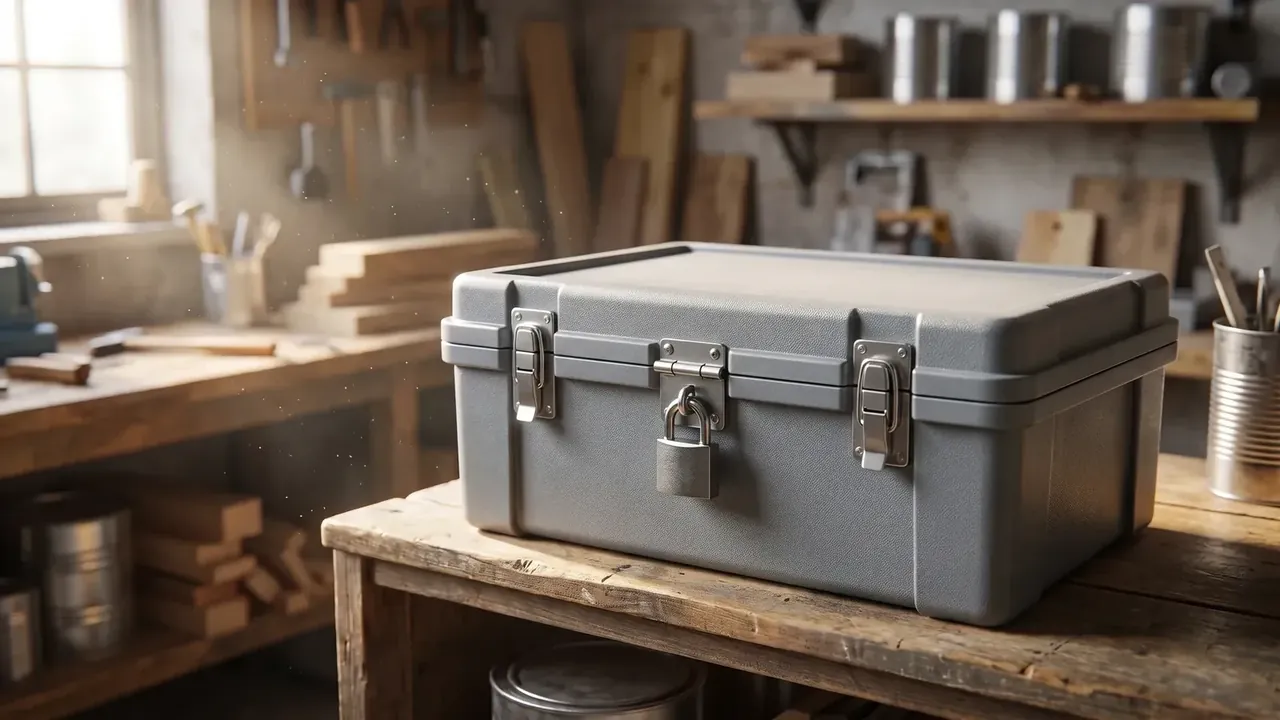
Quick answer: An Industrial Equipment Protective Case carries a 65 kg machine on two beams to six feet, 0.21 MPa at three high and 0.35 MPa at five.
Table of contents
- Load distribution in an Industrial Equipment Protective Case
- Lifting points and forklift apertures
- Foot pressure under three-high stacking
- Corner margin in a 1.2 m drop
- Load rating for an equipment batch
- FAQ
1. Load distribution in an Industrial Equipment Protective Case
The centre of gravity sits about 30 mm behind the middle of the cavity floor. A 65 kg machine on a 21 kg shell makes 86 kg that must reach the ground along a defined path. An Industrial Equipment Protective Case lays that path on the base: two beams run along the 600 mm short side, tops flush with the cavity floor and undersides over six feet.
Each beam is 40 by 60 mm over a 520 mm span and takes 318 N of the 637 N machine weight. Uniformly loaded, mid-span deflection is 0.62 mm, one eight-hundred-and-fortieth of the span, and peak bending stress stays under 1 MPa, inside the elastic range of a PP shell. Below 1 mm the floor keeps mounting feet level, so the gasket needs no extra latch force.
| Load-bearing part | Load carried | Check value |
|---|---|---|
| Two beams | 318 N each | 0.62 mm mid-span |
| Six feet | 140 N each | 0.07 MPa pad pressure |
| Four lifting points | 800 N each | 3.8 times shell weight |
| Four walls | No vertical load | Enclosure and seal only |
A wall carrying nothing still cannot be thinned at will: at 4.0 mm the edge plate at each fork aperture must grow from 3 to 5 mm, putting 1.2 kg back on the shell.
2. Lifting points and forklift apertures
Four lifting points sit two per end, each on a boss above a beam with the bolt through the web. At 800 N apiece they total 3200 N against an 843 N shell, a margin of 3.8 times; a 30 degree sling raises one point 1.15 times to 243 N, under a third of its rating.
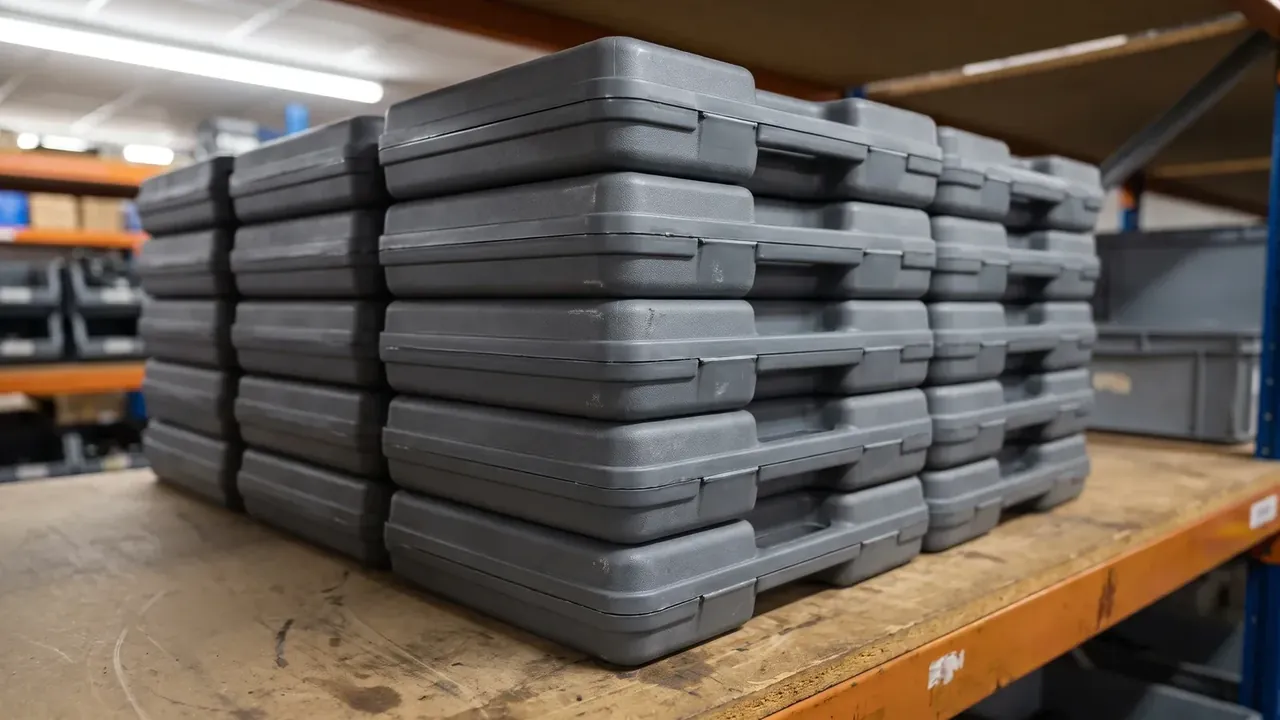
Two fork apertures are cut in the end faces, 120 mm high, lower edge 35 mm off the ground, centres 400 mm apart. The height is a 45 mm fork blade plus 75 mm of clearance, enough to slide in without raising the mast; the 35 mm gap keeps tips from biting the base.
Because both features share the beams, apertures stay inside the quarter span, where moment is about half the mid-span value. The same 120 mm cut at mid-span would drop usable section by nearly a third and push deflection past 0.9 mm, so an Industrial Equipment Protective Case logs forking as handling, never as stacking capacity.
3. Foot pressure under three-high stacking
Stack height follows from the pad area. Each pad is 50 by 40 mm, six give 12000 mm², and at three high the bottom shell carries 172 kg above plus its own 86 kg, so 258 kg rests on those pads.
| Stack height | Load on bottom shell | Load per foot | Foot pressure |
|---|---|---|---|
| 1 high | 86 kg | 140 N | 0.07 MPa |
| 2 high | 172 kg | 281 N | 0.14 MPa |
| 3 high | 258 kg | 421 N | 0.21 MPa |
| 4 high | 344 kg | 562 N | 0.28 MPa |
| 5 high | 430 kg | 702 N | 0.35 MPa |
The rejection line sits at 0.35 MPa, which five high meets exactly, while four high leaves 0.07 MPa and three high 0.14 MPa. Floors are never level and pallets warp, so often only four feet touch; on four feet three high reads 632 N per foot, or 0.32 MPa, and that worst case is why three high became the working grade for an Industrial Equipment Protective Case.
One layer more breaks it: four high on four feet reaches 0.42 MPa, and a 10 mm steel plate only brings it to 0.36 MPa. Four high would need 60 by 50 mm pads, adding 1.8 kg and cutting the lifting margin to 3.4 times.
4. Corner margin in a 1.2 m drop
A 1.2 m free fall lands at 4.85 m/s, and the 86 kg shell arrives with about 1012 J that the corner absorbs first. Left to a 5.5 mm wall alone, that energy would leave in under 2 mm of travel and tear the mounting feet off the base plate.
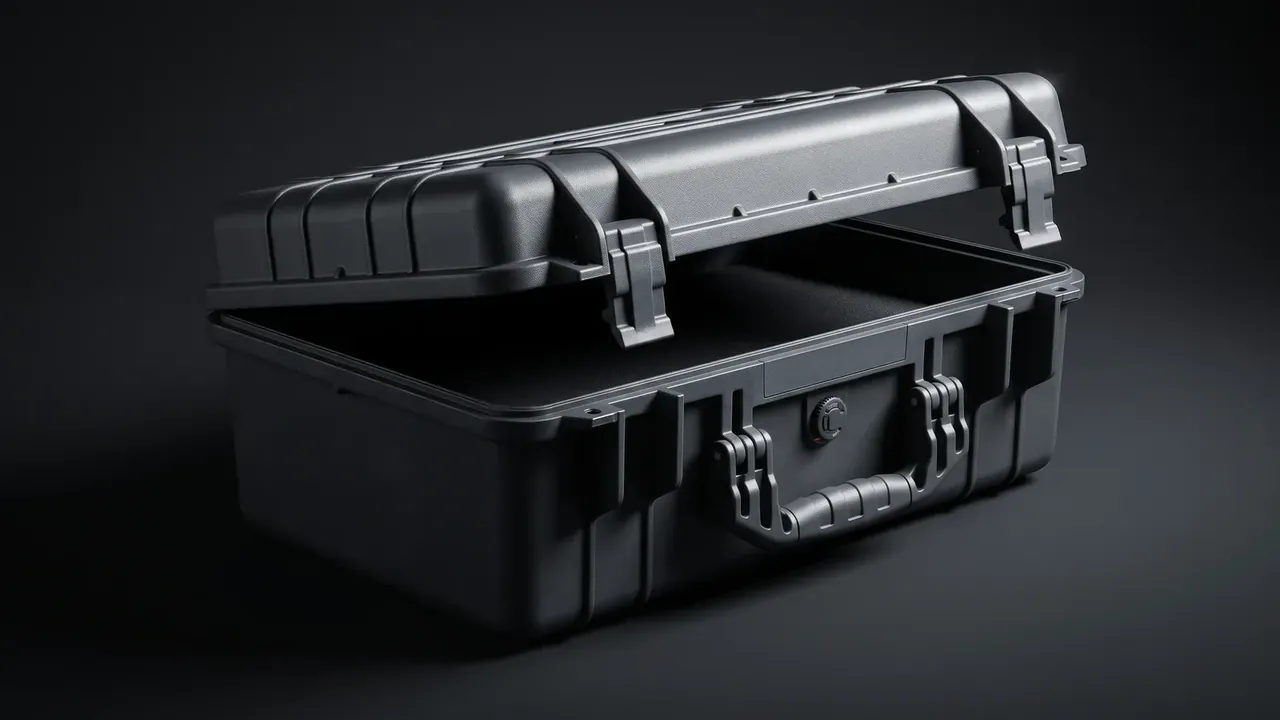
The corner runs in three stages: an R20 radius, three internal ribs and a 25 mm foam cap that takes the first compression.
| Corner travel | Peak acceleration | Permanent corner set |
|---|---|---|
| 25 mm | 48 g | 0.4 mm |
| 18 mm | 67 g | 1.1 mm |
| 12 mm | 100 g | 2.6 mm |
At 25 mm the permanent set is 0.4 mm, invisible beyond a scuff; at 18 mm it is 1.1 mm and the cap needs replacing; at 12 mm it reaches 2.6 mm, past the 2 mm appearance limit on our bench. An Industrial Equipment Protective Case grades a drop on set rather than cracks, since cracking has no middle grade.
5. Load rating for an equipment batch
A batch rating rests on one figure, a 65 kg load: 21 kg empty, 65 kg loaded, four lifting points at 800 N, two apertures, three-high stacking, a 1.2 m drop and 2 h of vibration, all seven on the batch card. Change one and beams, pads and corners are recalculated together.
The 2 h vibration run mounts the shell with a 65 kg ballast, sweeps the range, then checks bolt preload at the feet, contact between beam and base plate, and whitening in the thickened corner. A preload loss above 15 percent drops the batch one grade.
At 75 kg the beam moment rises 15 percent, deflection reaches 0.71 mm, three-high pressure climbs from 0.21 to 0.24 MPa and stays legal, while four high goes to 0.31 MPa with 0.04 MPa left, so the stack drops to three. On an Industrial Equipment Protective Case batch card, load and stack height are one paired entry.
Conclusion
The load path through an Industrial Equipment Protective Case closes with arithmetic: 65 kg travels along two beams into six feet, giving 0.21 MPa at three high, 0.28 at four and 0.35 at five, exactly on the line. A 25 mm corner travel holds a 1.2 m drop to 48 g with 0.4 mm of set, and four lifting points at 800 N leave 3.8 times the 843 N shell weight. JUNZHIJIA keeps 2 h vibration records by equipment batch, with drawing tolerances issued by Kexin New Materials (Guangdong) Co., Ltd.
Related Reading
- Reading the protection rating of an ABS waterproof equipment box
- Where aviation equipment protective cases fit, and what the structure gives up
- Converting case volume into usable cavity space
- Plastic cases against wooden crates on cost and turnover
Related Products
- 8 Series — Gun Cases; Military Equipment Cases; Camera Equipment Cases; Drone Cases; Watch Cases; Knife Cases; First Aid Cases; Electronics Equipment Cases
- WL8-2812 PP Gun Case — model WL8-2812
- All protective cases and toolboxes: 7 series, 158 models