

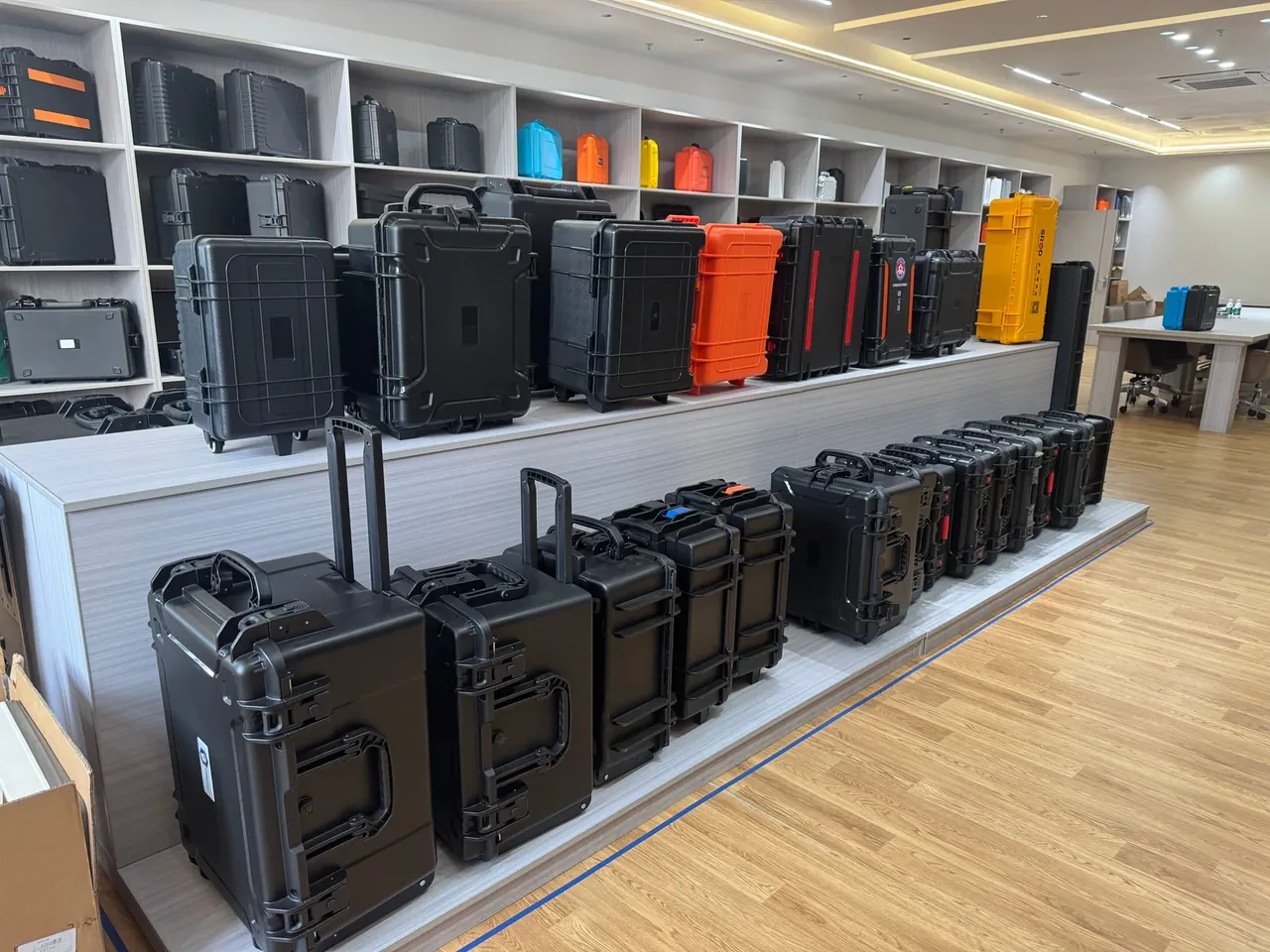
Quick answer: An industrial grade injection tool trolley case fails at three joints long before the shell does: wheel housing, handle guide sleeve and lid hinge.
Table of contents
- Ribs in the Wheel Housing
- Interference Fit of the Handle Guide Sleeve
- Hinge Load Under Loaded Rolling
- Where Rotomoulding Stops and Injection Starts
- Gasket Compression Against Drain Holes
- FAQ
1. Ribs in the Wheel Housing
An industrial grade injection tool trolley case usually fails where the castor meets the base. At 45 kg gross each of the two castors carries 22.5 kg, and the rolling push and the obstacle knock land on that one corner.
The housing runs 6 mm thick, which sets what a rib may be. A rib as thick as the wall cools last and sinks the visible floor; at 0.6 of the wall, a 6 mm wall takes a 3.6 mm rib with a 0.5 mm root radius.
| Joint | Wall figure | Load | Failure | Check |
|---|---|---|---|---|
| Housing to base corner | 6 mm wall, 3.6 mm rib | 45 kg static, 30 mm knock | Root crack | Whitening after 5 km |
| Sleeve to side wall | 2.0-3.5 mm wall | 850 mm bending | Bulged seat, 3 mm wobble | Play plus gauge |
| Hinge seat to lid | 2 hinge sets | Torsion, lid open | Torn screw holes | Play after 20,000 cycles |
| Castor axle to housing | 100 mm wheel | 30 mm obstacle | Oval bore, 1.2 mm wear | Wheel OD measurement |
Ribs run with the rolling direction, not around the boss: a ring stiffens only its own circle, while the load travels flat through the base. The moulded-in nuts matter as much, because four M8 screws sit in a 6 mm wall and a shallow nut is pulled out by the first serious torque, after which every hole goes oval. With a 100 mm castor and a 30 mm obstacle, an industrial grade injection tool trolley case needs 50 mm of ground clearance, or the housing takes the hit.
2. Interference Fit of the Handle Guide Sleeve
An industrial grade injection tool trolley case with a two-section handle extended to 850 mm turns a small push at the grip into a bending moment at the lowest sleeve mouth.
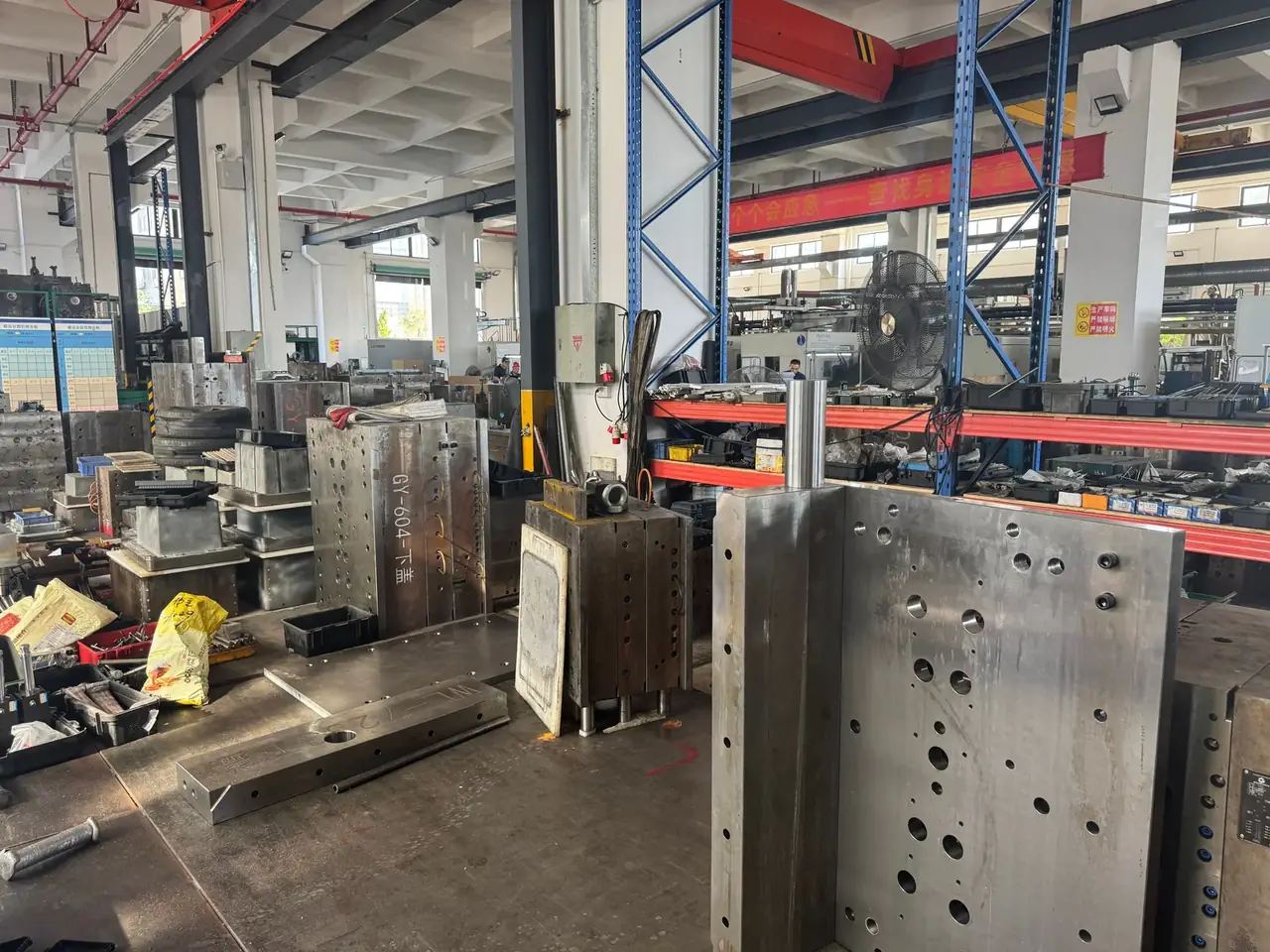
On an industrial grade injection tool trolley case the sleeve is held by interference, not screws. With enough interference the wall grips it and the tube slides inside; with too little, the tube drags the sleeve upward and that travel adds straight into the 3 mm wobble limit. Too much splits the wall.
The wall is only 2.0-3.5 mm, the thinnest element in the fit: under thickness it bulges as the sleeve goes in and the mouth turns oval months later. Precision moves to an injection moulded seat at ±0.1-0.2%, assembled to the shell so a replacement seat restores the fit. Trolley case verdict: after 5 km at 45 kg, over 3 mm of handle wobble or over 1.2 mm of castor eccentric wear sends the wheel set back for rework.
3. Hinge Load Under Loaded Rolling
An industrial grade injection tool trolley case hands the whole lid to two hinge sets. Under loaded rolling the base rocks on the castors and the lid is dragged by inertia, so the seat sees torsion rather than a straight pull, and the pin grows thicker while the seat stays thin.
| Hinge layout | Share per set | Cycles | Failure | Remedy |
|---|---|---|---|---|
| Two sets, symmetric | Half of 45 kg | 20,000 | Holes elongate | New seats and screws |
| Two sets, offset | 60% on one side | 15,000 | Seat cracks | Wider seat plate |
| Three sets, even | A third each | 20,000 | Centre set wears | New centre pin |
The seat needs the same wall as the housing: once its holes elongate, the lid closes crooked, the gasket misses compression and the IP rating drops. Latch and hinge split the work, the latch holding 200-400 N and pressing the lid down while the hinge only pivots. Load the hinge with that duty and an industrial grade injection tool trolley case levers the seat twice per opening, turning 20,000 cycles into 6,000.
4. Where Rotomoulding Stops and Injection Starts
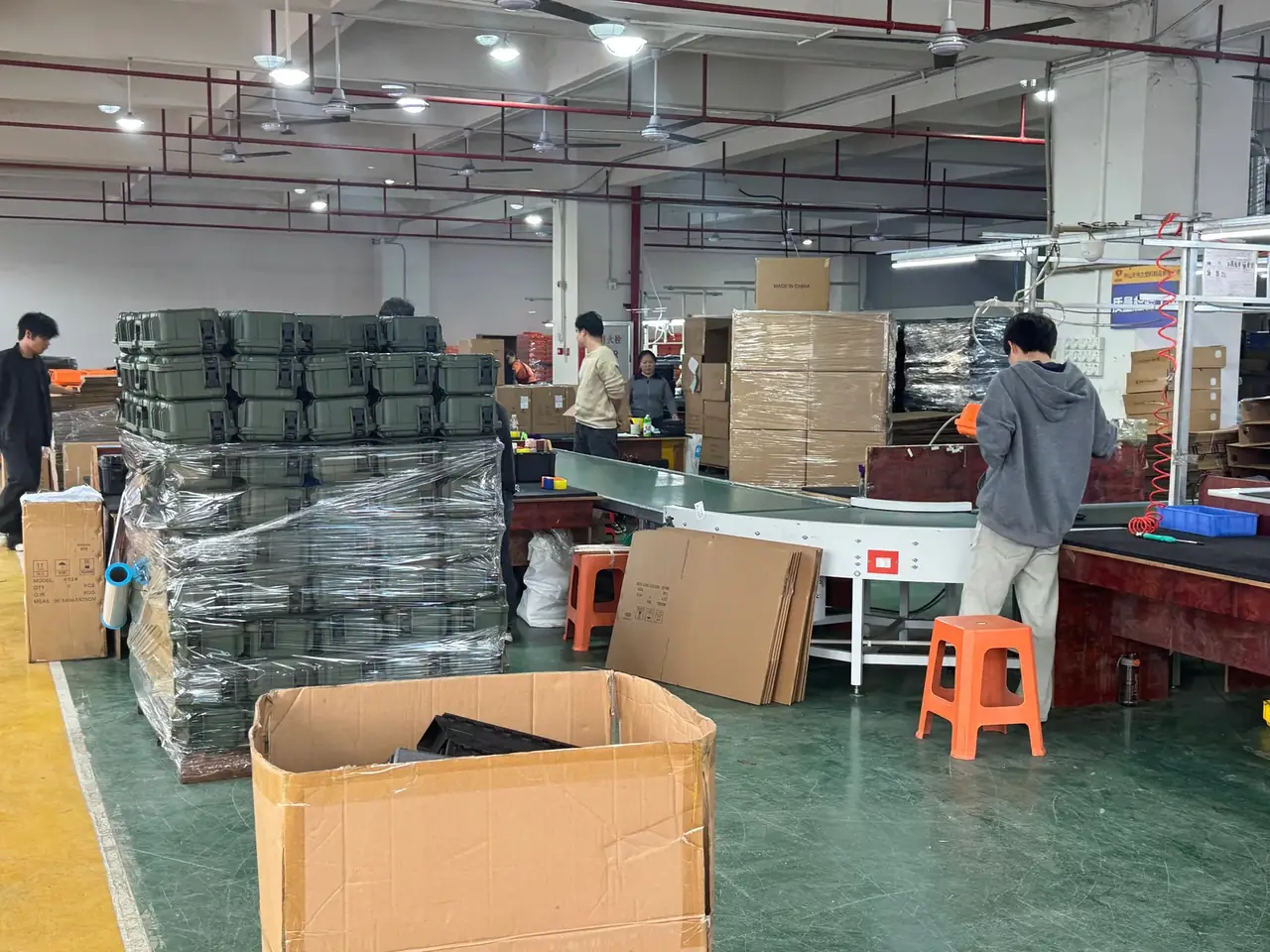
An industrial grade injection tool trolley case is rarely one process. The shell is rotationally moulded: seamless hollow body, 3-6 mm wall, thick rounded corners, at the cost of ±10-20% thickness variation and no narrow ribs.
| Part | Process | Wall | Tolerance | Reason |
|---|---|---|---|---|
| Shell and lid | Rotomoulding | 3-6 mm | ±10-20% | Seamless, impact resistant |
| Wheel housing | Injection | 6 mm | ±0.1-0.2% | Inserts and impact |
| Sleeve seat | Injection | 3 mm | ±0.1-0.2% | Carries the interference fit |
| Hinge seat | Injection | 6 mm | ±0.1-0.2% | Holes must stay round |
PP shrinks 1.0%-2.5% and HDPE 1.5%-3.0%, so the cavity is scaled accordingly. The halves join on parting faces and screws, with 1 mm of gasket margin kept on the shell so a later change touches one tool.
5. Gasket Compression Against Drain Holes
An industrial grade injection tool trolley case seals on a TPE gasket at Shore A50-60, compressed 25%-30%. Under 25% it never beds down and splash creeps past the lid edge; over 30% it flattens, loses rebound and leaves a gap.
The ratings test different things. IP54 covers limited dust plus splashing, IP65 dust-tight plus water jets, IP67 immersion at 1 m for 30 min and no jets. Rain outdoors is served by IP54; a boat or a cold store needs IP65.
On an industrial grade injection tool trolley case, drain holes sit at the lowest point of the base, one or two, clear of the compression band. A hole under the gasket lets its edge cut the seal and the perimeter fails; a hole outside the band, in a recess, lets water out without letting it back. Ground clearance belongs to the same decision: below 50 mm the drain stands in water and lets moisture in.
Three joints decide the life of an industrial grade injection tool trolley case: a white line at the housing corner, 3 mm of wobble at the grip, 20,000 cycles at the hinge seat.
Related Reading
- How castors and telescopic handles are built
- Rotational moulding against injection moulding
- IP54 and IP65: what actually differs
- Usable internal volume after corners
Related Products
- 8 Series — Gun Cases; Military Equipment Cases; Camera Equipment Cases; Drone Cases; Watch Cases; Knife Cases; First Aid Cases; Electronics Equipment Cases
- WL8-2812 PP Gun Case — model WL8-2812
- All protective cases and toolboxes: 7 series, 158 models