

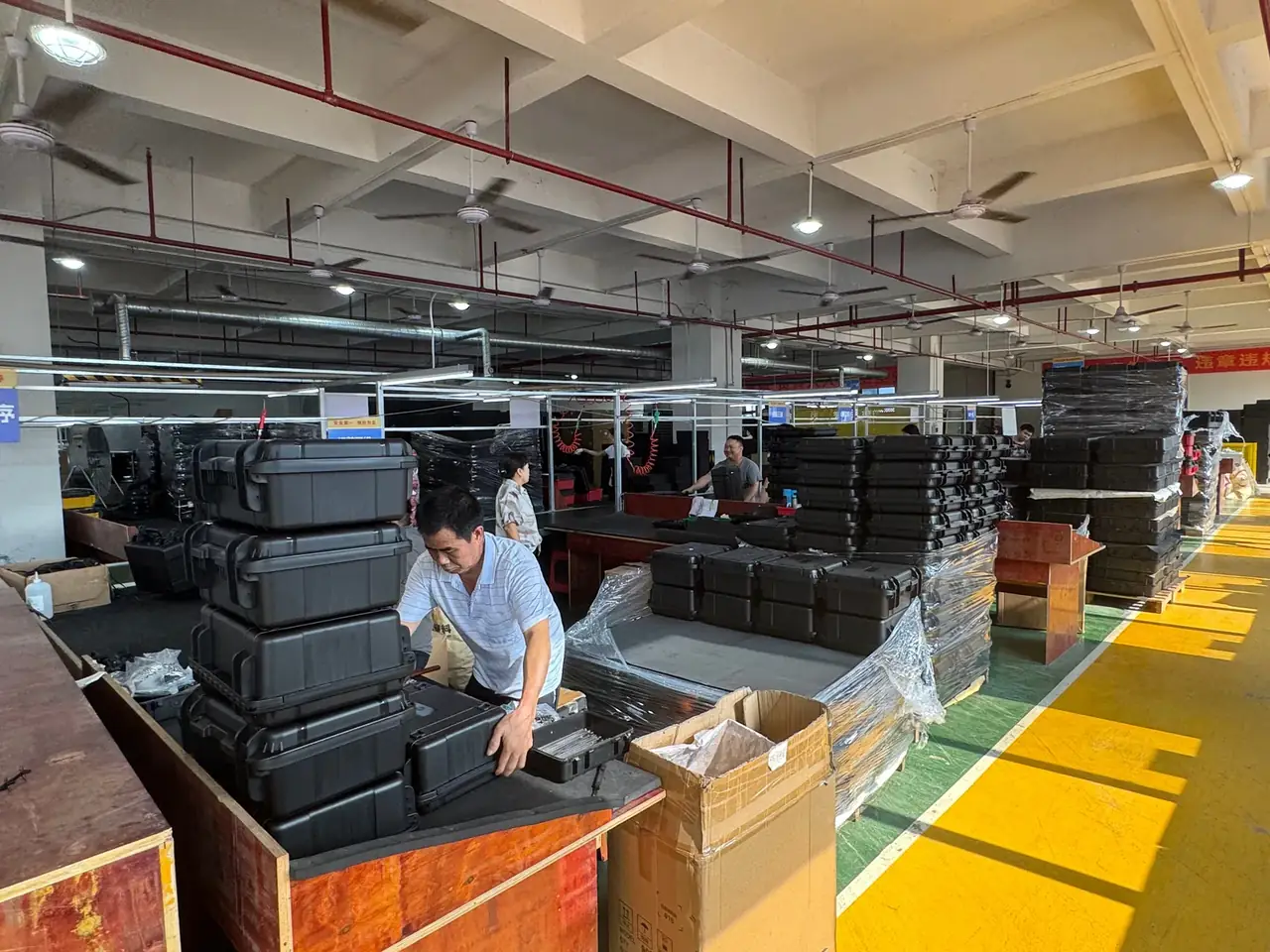
Quick answer: An industrial high pressure washer tool box keeps residual water at 12 mL after a 40 L/min rinse and 30 min rest, on a 3.5 degree slope and 9 mm channel.
Table of contents
- Drain slope angle in the industrial high pressure washer tool box lid
- Base channel width
- Residual water readings after the rinse
- Drain rate on the rest retest
- Slope reject line for rinse batches
- FAQ
1. Drain slope angle in the industrial high pressure washer tool box lid
This industrial high pressure washer tool box measures 540×390×220 mm outside, 475×330×155 mm inside, with a 4.0 mm wall. Its inner lid face carries a 3.5° slope, not a flat panel. Too shallow and water pools, creeping back along the hinge seam; too steep and the lid-to-mouth overlap thins, so the single gasket loses 20% compression. The 3.5 degree grade balances runoff against a sealed overlap.
The slope stays on the lid, leaving cavity depth intact. The industrial high pressure washer tool box carries 5.0 kg empty and 12 kg loaded on its base, so the lid bears no payload; its low end feeds a drip edge opposite the hinge into the base channel.
| Slope grade | Water held on lid | Verdict |
|---|---|---|
| 2.5 degree | 26 mL | Reject |
| 3.5 degree | 12 mL | Threshold |
| 4.5 degree | 9 mL | Reject |
A 4.5 degree slope drains faster but eats the overlap, so the gasket fails first.
2. Base channel width
The base channel is 9 mm wide, catching lid runoff and carrying it out. On the rig the industrial high pressure washer tool box sends water down the 3.5 degree face, then along a matching fall to drain holes at both ends. Narrow it and flow overtops; widen it and the base sags at 12 kg. The 9 mm section keeps flow area and stiffness both intact.
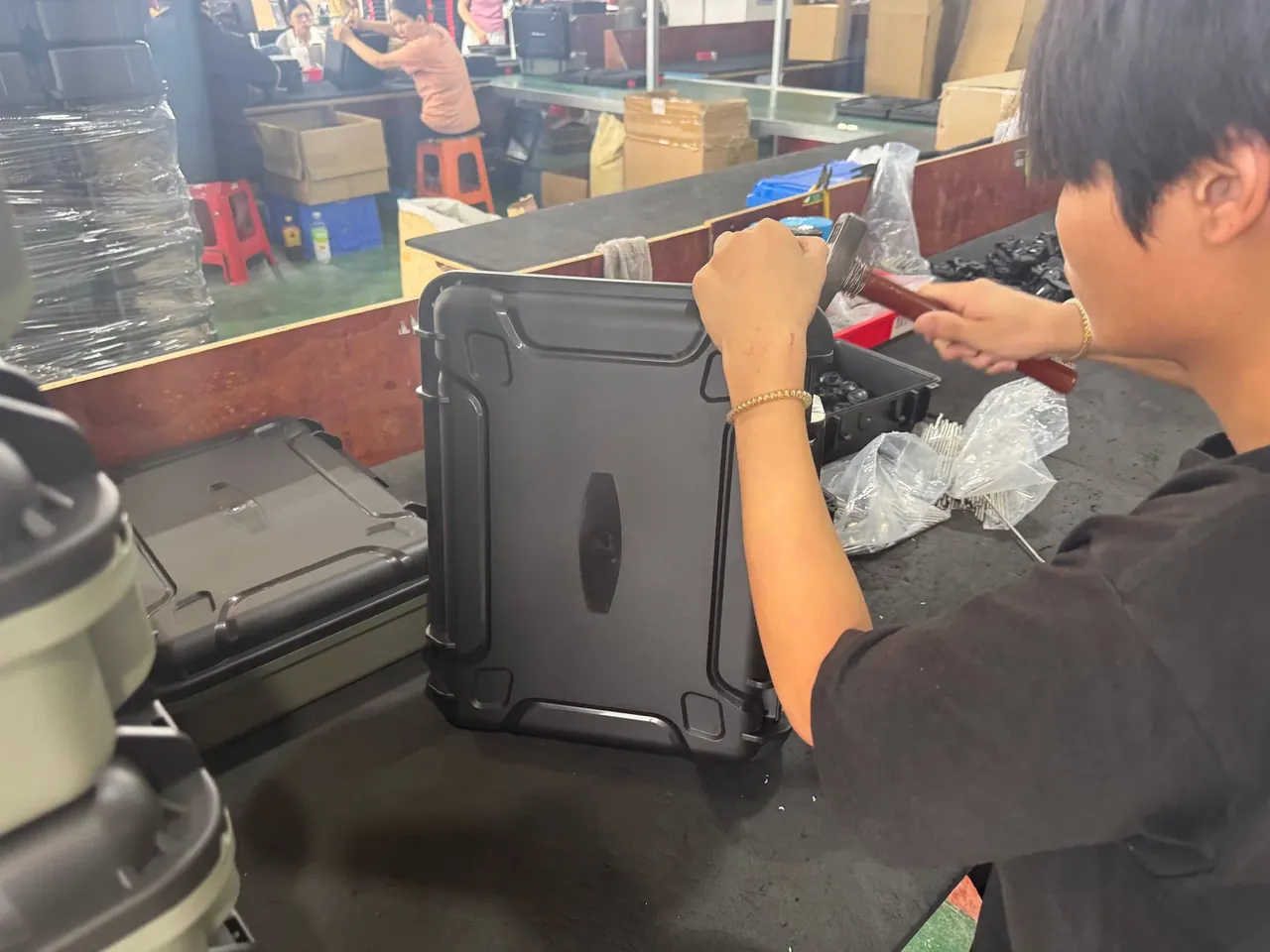
The channel floor has its own 1.5 degree fall, with a countersunk hole at each end so burrs cannot snag droplets. The industrial high pressure washer tool box moulds channel and ribs together, keeping ribs clear of the water path; a solid web separates channel from gasket groove. Channel width and slope decide how the industrial high pressure washer tool box sheds water, and IP66 is cited only as a benchmark, not a claimed rating.
3. Residual water readings after the rinse
The rig supplies 40 L/min for 10 min, rests the case 30 min, then measures the base, with the line at 12 mL. The industrial high pressure washer tool box is logged at 5, 10, 20 and 30 min, so a falling curve shows whether water leaves or clings to the wall. Crossing 12 mL early ends the run.
| Rest interval | Base water (mL) | Drop vs shutoff |
|---|---|---|
| 5 min | 21 | 0% |
| 10 min | 18 | 14% |
| 20 min | 14 | 33% |
| 30 min | 12 | 43% |
The 30 min row sits on the 12 mL boundary; half a millilitre more rejects the batch. Reading residue as lid inflow plus channel capacity beats one dimension alone. A spread above 2 mL across three cases points to unstable moulding. After 3900 cycles the rinse runs again to confirm the slope has not worn flat. These readings confirm the industrial high pressure washer tool box keeps a clear drain path at end of life.
4. Drain rate on the rest retest
Drain rate, the fall in base water per minute, is a second check beyond residue. The industrial high pressure washer tool box takes water over its whole surface in the rinse, while the rest retest watches the two drain holes and the countersunk floor, checking whether the 5 to 30 min slope is cut by a burr or rib. Falling from 21 mL to 12 mL across 25 min gives about 0.36 mL/min.
The retest empties the cylinder and reads the lowest point again; no continuous film is the hard line. If the two latches at 360 N each collect water first, the fault is how the overlap meets the sloped lid. Burrs inside the 9 mm channel understate flow area and are cleared before reassembly. The 1.0 m drop reset and drain retest share one round, because a crack along the channel floor shifts the width. These points confirm the industrial high pressure washer tool box still drains after ageing, with IP66 only a benchmark.
5. Slope reject line for rinse batches
The reject line lands on two figures: the lower deviation of the 3.5 degree slope, and base water after 30 min. Each industrial high pressure washer tool box batch is measured for slope first, then residue backs out channel capacity; both must clear before sign-off.
| Residue reading | Slope angle | Channel measured |
|---|---|---|
| 16 mL | 2.8 degree | 8.6 mm |
| 12 mL | 3.5 degree | 9.0 mm |
| 11 mL | 3.6 degree | 9.1 mm |
| 9 mL | 4.4 degree | 9.4 mm |
Take the 16 mL row: at 2.8 degrees and 8.6 mm it passes 12 mL and is rejected. The 9 mL row at 4.4 degrees drains faster but thins the overlap, leaving 20% compression loose. JUNZHIJIA centres rinse batches on 3.5 degrees, 9 mm and 12 mL at 30 min, with slope, width and end residue on one line; a batch missing any figure leaves the pass count.
Conclusion
The drainage verdict for the industrial high pressure washer tool box is whether lid slope and channel width still hold 12 mL after a rinse. A 3.5 degree slope, 9 mm channel, 40 L/min for 10 min, 12 mL at 30 min and a repeat after 3900 cycles must be read on one batch. Measure slope and width, run staged readings, then the 1.0 m drop reset and drain retest; reversing it scores clinging water as residue. Sign-off rests on all three figures on one line.
Related Reading
- Industrial waterproof oil-resistant tool case materials and sealing
- Field service tool case load-out and reload on one call-out
- Industrial grade plastic tool box drops and stacking in heavy workshops
- Hardware tool box wall thickness and rib sizing
Related Products
- 8 Series — Gun Cases; Military Equipment Cases; Camera Equipment Cases; Drone Cases; Watch Cases; Knife Cases; First Aid Cases; Electronics Equipment Cases
- WL8-2812 PP Gun Case — model WL8-2812
- All protective cases and toolboxes: 7 series, 158 models