

Quick answer: An Industrial sensor drop-proof portable case pairs a 16 mm corner block with a 30/45 kg/m3 foam gradient to hold peaks under 42 g.
Table of contents
- Corner block thickness of an Industrial sensor drop-proof portable case
- Density gradient of the foam liner
- Acceleration readings after face-by-face drops
- Lid pressure drop retested at low temperature
- Block-thickness convergence for drop-proof batches
- FAQ
1. Corner block thickness of an Industrial sensor drop-proof portable case
Drop energy lands on a corner first, then passes through the block into the liner, and a stiffness mismatch between the two stages amplifies the peak instead of cutting it. The Industrial sensor drop-proof portable case fits one block into each of four corners at 16 mm, so the first part of the impact is absorbed by corner deflection before it reaches the liner. Corners touch the deck first among the six faces, which makes block thickness the lever on that first energy split.
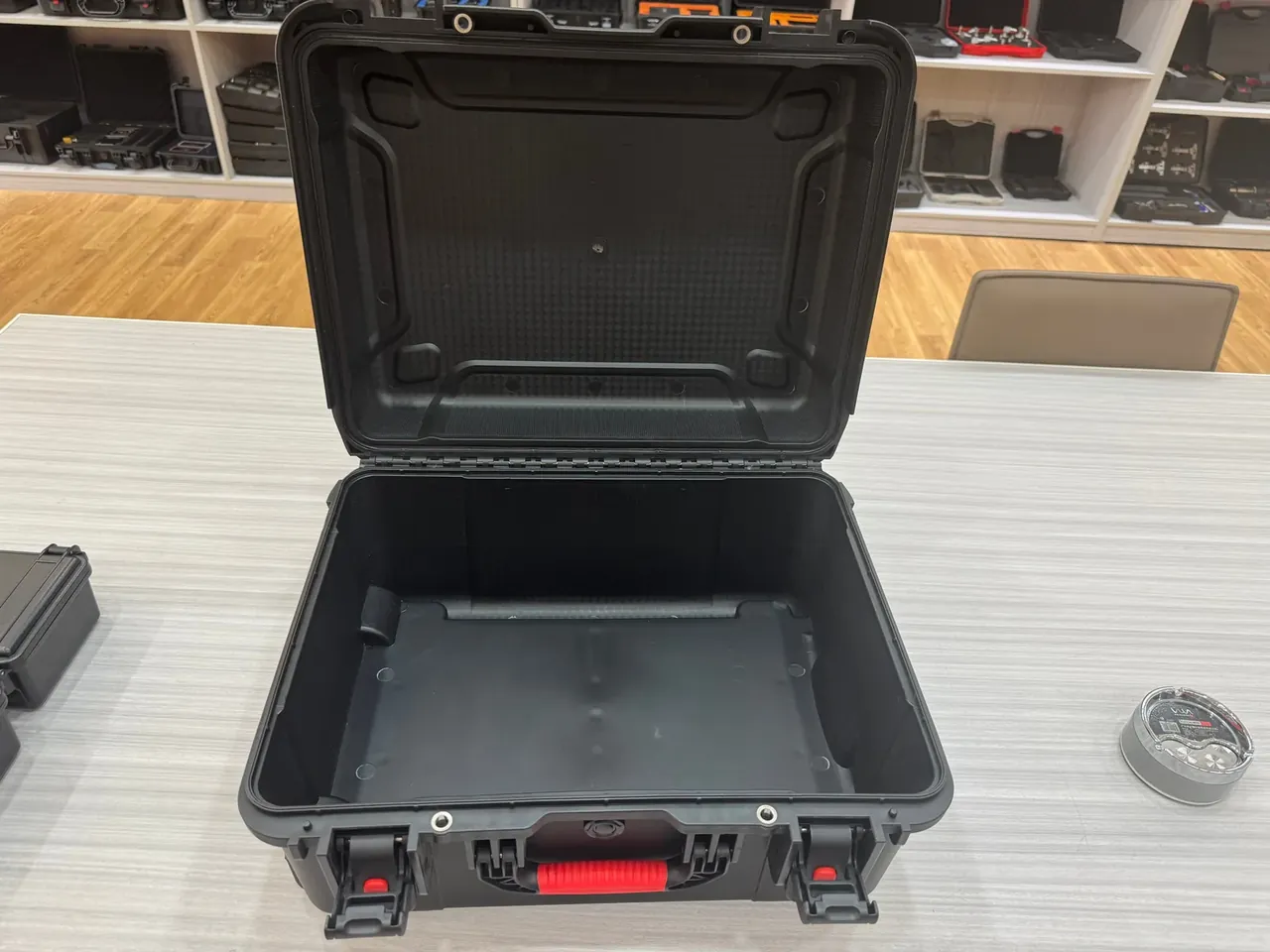
The outer envelope is 480 x 360 x 190 mm, the inner cavity 420 x 300 x 130 mm, wall thickness 3.8 mm, 4.2 kg empty and 8 kg loaded on the drop rig. Sizing fixes the four corner blocks before the cavity depth, and the block seats stay off the lid line so lid foam never bears on a seat.
Thicker blocks do not keep improving the result. A longer rebound raises the reading on the second deck contact.
| Block-thickness step | Comparison value | Corner deflection state |
|---|---|---|
| Thin step | under 16 mm | corner touches first, deflection short |
| Nominal step | 16 mm | block crushes first, shell loads later |
| Thick step | over 16 mm | rebound slow, second-contact reading rises |
2. Density gradient of the foam liner
The liner uses a 30/45 kg/m3 density gradient, high against the shell and low against the load, so the impact decays in stages after the block. The Industrial sensor drop-proof portable case stacks two foam layers without glue, held by ribs on the cavity wall so the layers do not shift on impact.
The rig drops each of six faces from 1.5 m and records every orientation separately rather than folding them into a mean. The Industrial sensor drop-proof portable case keeps the same foam and ribs through all six, so differences between orientations reflect block thickness and gradient only, with no assembly variable mixed in.
3. Acceleration readings after face-by-face drops
An accelerometer on the inner shell wall takes the peak after six drops from 1.5 m, with the accept line at 42 g; each orientation of the Industrial sensor drop-proof portable case is judged on its own, not on a six-face average. Readings are filed by drop orientation, and two consecutive orientations under 42 g count as a stable stretch.
| Drop orientation | Rig setting | Acceleration value |
|---|---|---|
| Corner drop | one of 1.5 m / 6 faces | highest peak, under 42 g |
| Edge drop | one of 1.5 m / 6 faces | middle peak, under 42 g |
| Face drop | one of 1.5 m / 6 faces | lowest peak, under 42 g |
Where the sensor sits matters more than the peak it reports. The peak is the maximum over each full contact, not the initial spike, and the sensor stays at one fixed spot on the inner wall for all six orientations. The Industrial sensor drop-proof portable case lines up contact order, peak and rebound for each orientation on one card, recalled by orientation number at retest. A crossing orientation is not re-dropped to replace the number; the original reading is filed and the crossing is noted. The gap between orientations gets its own column marked against 42 g, with numeric and qualitative notes kept apart rather than merged. After all six faces, corner blocks are checked for cracks and ribs for looseness, and only once the liner has not shifted are the six readings filed.
4. Lid pressure drop retested at low temperature
After soaking at -25 C, the Industrial sensor drop-proof portable case must hold lid pressure drop within 0.25 kPa / 10 min, with one gasket ring at 17 percent compression, two latches at 330 N each, and an IP65 comparison by air-tightness method after 3800 open-close cycles.
The retest connects the case to a pressure rig, charges it, closes the valve and reads the 10 min decay curve at its end. The case is not charged straight out of the cold box; the mouth is brought back to a measurable state first, then the latches are closed to the same torque.
The cold round moves the seal reading only; the block-thickness convergence value stands.
5. Block-thickness convergence for drop-proof batches
The convergence value is the thinnest step where acceleration stays under 42 g for two consecutive orientations, and anything thinner is excluded. Each drop-proof batch of the Industrial sensor drop-proof portable case is checked corner by corner against this value, and a shell thinner than it stays out of the accepted lot.
| Acceleration value | Orientation | Filing method |
|---|---|---|
| under 42 g | two consecutive orientations | enters the accepted lot |
| first reach of 42 g | trace the convergence value | starts the reject review |
| readings past the line | trend only | kept out of acceptance |
With the convergence value fixed, the 17 percent compression of one gasket, two latches at 330 N each, the 3800-cycle record and the IP65 pressure-drop comparison are checked as a set. JUNZHIJIA files corner readings by corner number and sets the batch convergence value from the pressure curves.
Conclusion
The Industrial sensor drop-proof portable case is judged by how its corner blocks meet the foam gradient. A 16 mm block with a 30/45 kg/m3 gradient maps to a peak under 42 g after six-face drops at 1.5 m, and a -25 C round adds a lid pressure drop within 0.25 kPa / 10 min. JUNZHIJIA keeps corner readings and pressure curves on one card and issues a block-thickness convergence value per lot.
Related Reading
- Protective case drop sequence: corner, edge and face drops
- Six faces of a protective case drop test: why the base cracks first
- Choosing case foam thickness: 5, 10 and 15 mm
- What to do when a case seal ages
Related Products
- 8 Series — Gun Cases; Military Equipment Cases; Camera Equipment Cases; Drone Cases; Watch Cases; Knife Cases; First Aid Cases; Electronics Equipment Cases
- WL8-2812 PP Gun Case — model WL8-2812
- All protective cases and toolboxes: 7 series, 158 models