

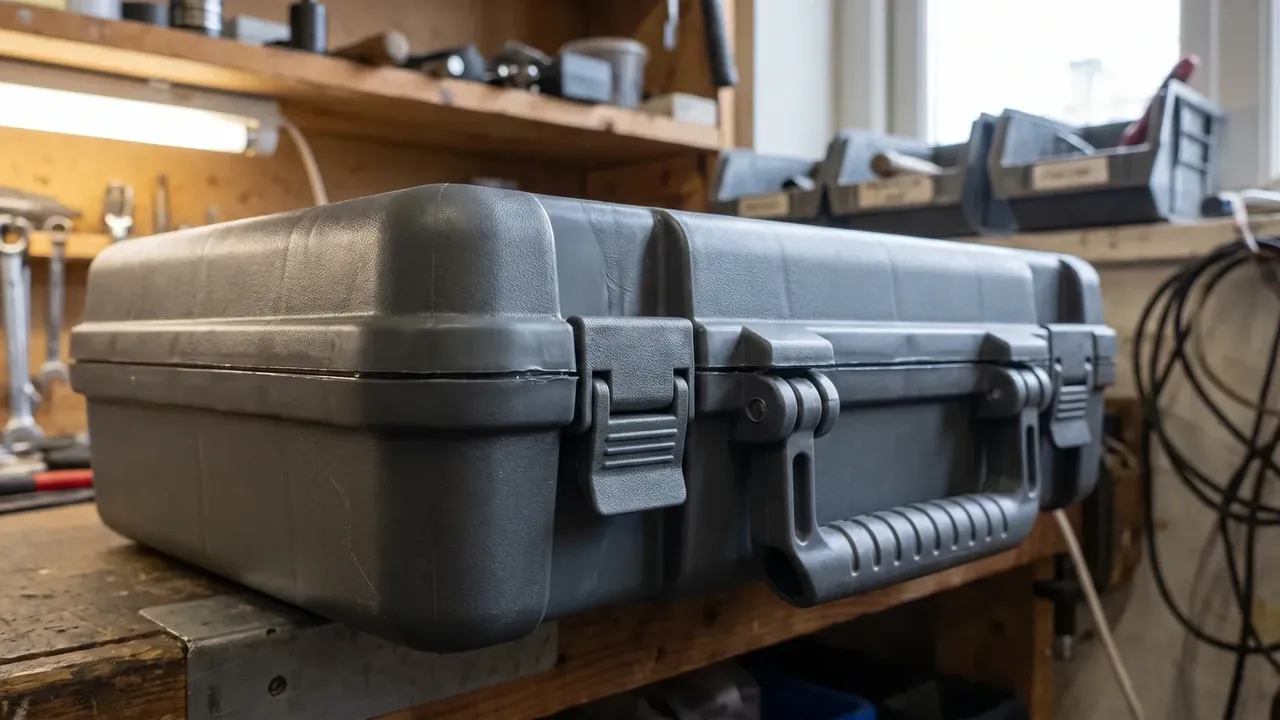
Quick answer: An Industrial Tool Transport Case grades its latches at 12,000 open-close cycles, 420 N per latch, and 22% seal compression held through 60 turns.
Table of contents
- Latch life of an Industrial Tool Transport Case
- Hinge pin diameter and lid sag
- Seal compression after sixty turns
- Four-high stacking on a pallet
- Turnover setting for a tool batch
- FAQ
1. Latch life of an Industrial Tool Transport Case
Opening count is the first allowance an Industrial Tool Transport Case spends. Four over-centre latches at 420 N each put 1,680 N on a 700 by 480 mm rim, and every cycle drags the hook about 4 mm along the seat ramp. After 12,000 cycles hook wear must stay under 0.35 mm, or opening force creeps past the 480 N rejection line and one hand no longer lifts the lid.
Mould tolerance on the seat decides how soon that line arrives. The shell is modified PP at 4.8 mm wall, cavity allowance 1.7% shrinkage, seat holes held to plus or minus 0.25 mm. Widen that distance and the hook catches on one flank, so force climbs about twice as fast.
| Latch grade | Clamping force each | Opening force at 12,000 cycles | Hook wear |
|---|---|---|---|
| One step loose | 380 N | 405 N | 0.42 mm |
| Nominal | 420 N | 452 N | 0.31 mm |
| One step tight | 460 N | 496 N | 0.24 mm |
The loose grade opens at 405 N yet wears to 0.42 mm and never seats the rim, so spray water walks in along the seam. The tight grade wears least at 0.24 mm but needs both hands at 496 N. Nominal lands between the two faults at 452 N, 0.31 mm and 22% compression, all taken from one lid mould of the Industrial Tool Transport Case.
2. Hinge pin diameter and lid sag
Each side of the rim carries one hinge block with a 6 mm 304 stainless pin in a bore cleared by 0.08 mm. Drop the pin to 5 mm and free-edge sag on the same lid grows from 0.9 mm to 1.6 mm across 12,000 cycles; past 1.2 mm the lip lifts the seal into a hairline gap that water finds overnight.
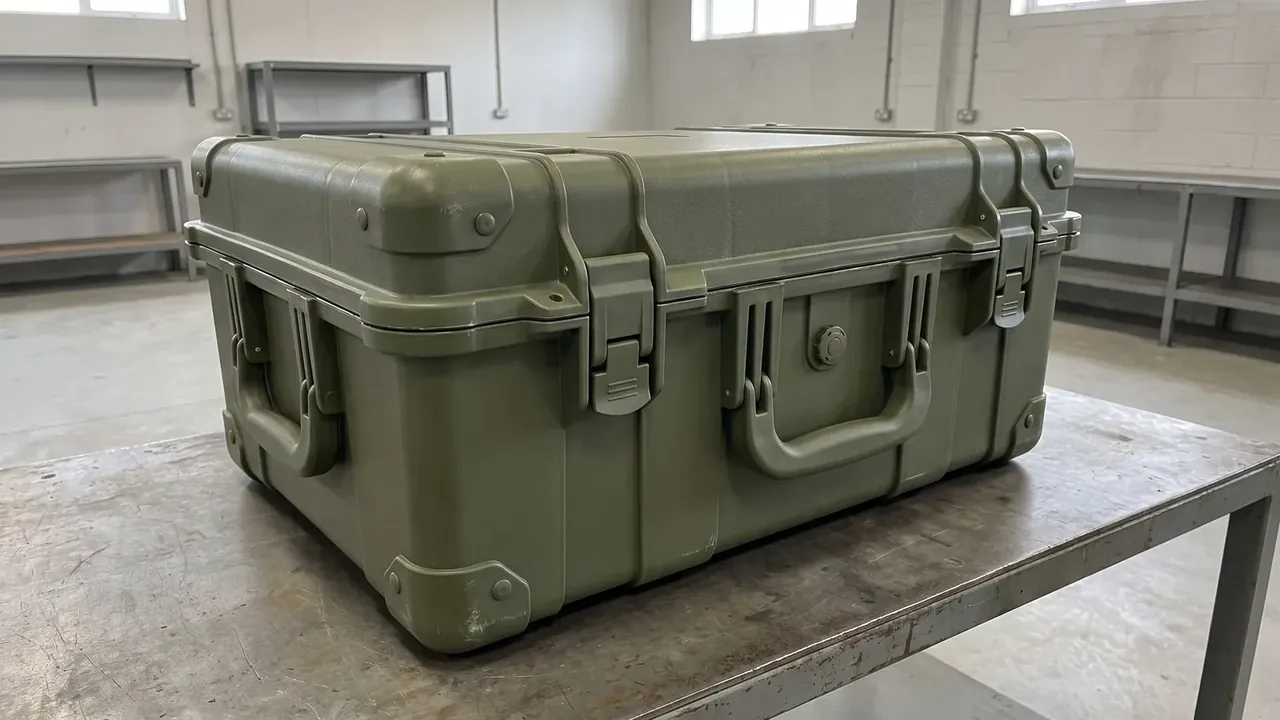
Sag is read with the case empty, lid closed and all four latches released, sliding feeler gauges along the free edge. At 6 mm the 420 N sits on a 6 by 18 mm projected area, about 3.9 MPa, far below the stainless allowable, so wear comes from rotation rather than crushing. An 8 mm pin is a poor trade: with a 4.8 mm block wall the boss thins and a drop cracks the root first, so an Industrial Tool Transport Case keeps 6 mm plus a 2 mm root rib.
3. Seal compression after sixty turns
Turnover count and cycle count are different rulers, because the seals carry load only on the closed leg of a turn. Two seals of 8.2 mm cord sit in a 6.4 mm groove at 22% initial compression, and 200 cycles per turn brings 60 turns to exactly 12,000 cycles. By turn 60 compression set has taken about 3 points, leaving 18.6%. Below 15% the cord stops bearing and water enters at the corner radii first. The IP67 immersion condition of 1 m for 30 min is a bench reference here, never a printed rating, because rim gap and compression do the grading.
| Turn number | Cumulative cycles | Seal compression | Rim gap |
|---|---|---|---|
| Turn 15 | 3,000 cycles | 21.2% | 0.10 mm |
| Turn 30 | 6,000 cycles | 20.1% | 0.18 mm |
| Turn 45 | 9,000 cycles | 19.4% | 0.26 mm |
| Turn 60 | 12,000 cycles | 18.6% | 0.34 mm |
Rim gap climbs from 0.10 mm to 0.34 mm, and the last 30 turns add less than the first 30, which says set mostly happens early. Past 0.40 mm the spray rig shows water at the front lip, so both columns share one sheet. A 7.0 mm groove leaves 14.6% and a new case leaks on its first shower, while 5.8 mm at 29% leaves no rebound.
4. Four-high stacking on a pallet
Stack height includes the pallet. The shell stands 300 mm tall on a 144 mm deck, three cases per layer reach 1,044 mm, and the pallet then goes on racking where four clear levels are kept. Empty weight is 7.4 kg, load 26 kg, 33.4 kg per case and 100.2 kg per layer.
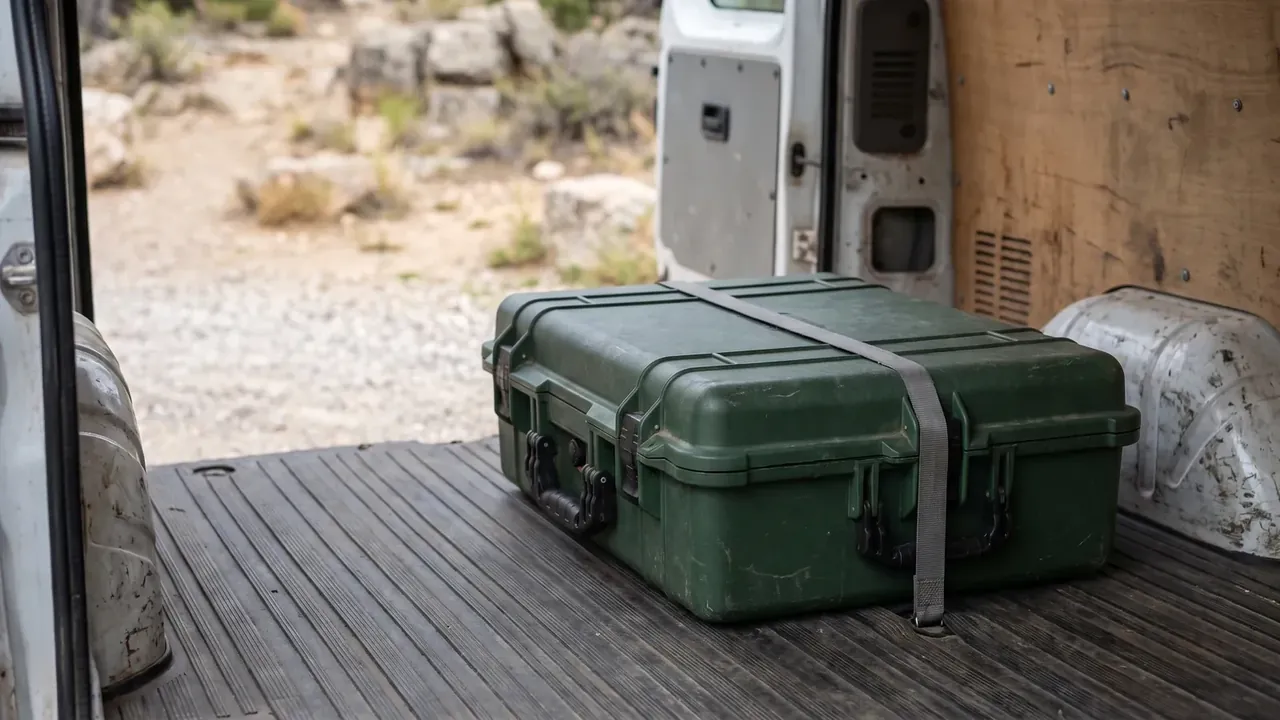
Load in a four-high stack runs down the corners and wall ribs, and four corner pads gather it onto small patches; a long wall unsupported at mid-span bends rather than compresses. An Industrial Tool Transport Case moulds its ribs 3 mm proud at 120 mm pitch, which holds mid-wall bulge inside 3 mm.
| Stack height | Weight per layer | Load on a bottom case | Wall deflection |
|---|---|---|---|
| 2 high | 100.2 kg | 100.2 kg | 0.9 mm |
| 3 high | 200.4 kg | 200.4 kg | 2.4 mm |
| 4 high | 300.6 kg | 300.6 kg | 4.1 mm |
On a pallet the stack stops at three, where 2.4 mm is still elastic. The fourth level belongs to the rack beam, the case being pressed rather than pressing; four on bare floor needs a 12 mm plywood spreader to carry 300.6 kg.
5. Turnover setting for a tool batch
A tool batch answers to four readings: opening force under 480 N after 12,000 cycles, compression above 18% after 60 turns, sag under 1.2 mm, wall deflection under 3 mm at three high. All four must come off one case, and another case's pass does not stand in.
Release runs case by case. An Industrial Tool Transport Case files two books: the assembly book records seat centre distance, pin diameter, groove depth and measured PP shrinkage, the turnover book records force, compression and sag per run. A change of compound, mould or seal sends all four readings back to the rig, because the wear path follows the holes.
Conclusion
Four readings settle an Industrial Tool Transport Case: 452 N of opening force against the 480 N line, 18.6% compression against 18%, 0.9 mm of sag against 1.2 mm, 2.4 mm of deflection against 3 mm at three high. Measured on one shell, the batch closes; one crossed reading sends that shell back alone. JUNZHIJIA stores 12,000-cycle retest records by batch number, and Kexin New Materials (Guangdong) Co., Ltd. re-qualifies after any mould or compound change.
Related Reading
- Assembly Line Tool Case: Turnover and Positioning at the Workstation
- Automotive Tool Case: Securing and Reaching On-Board Tools
- Aviation Maintenance Tool Case Guide: Line Tool Counts and Protection
- Plastic Case vs Wooden Crate: Cost and Service Life of Returnable Packaging
Related Products
- 8 Series — Gun Cases; Military Equipment Cases; Camera Equipment Cases; Drone Cases; Watch Cases; Knife Cases; First Aid Cases; Electronics Equipment Cases
- WL8-2812 PP Gun Case — model WL8-2812
- All protective cases and toolboxes: 7 series, 158 models