

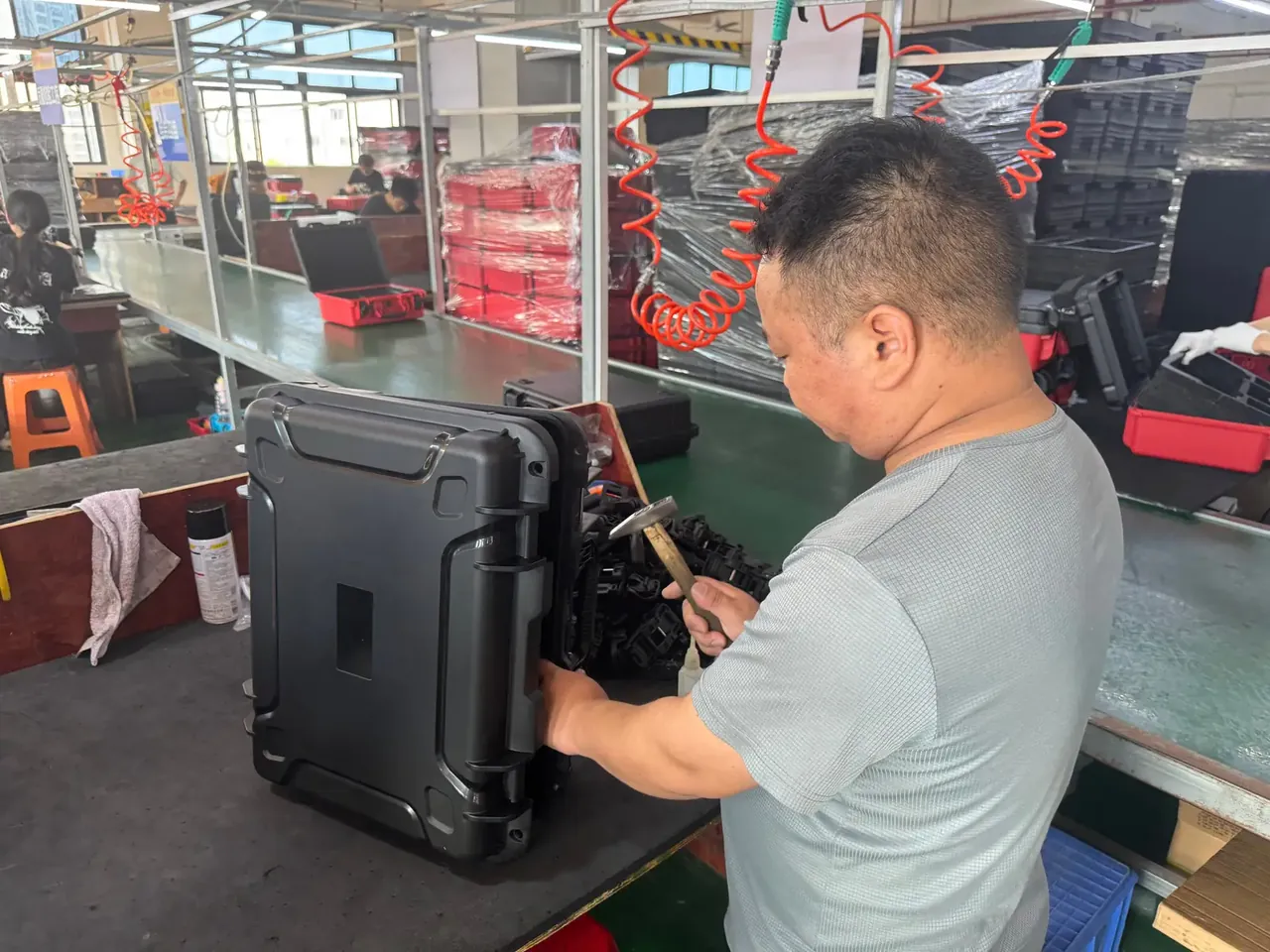
Quick answer: A single drop test tells you that one case survived, not that a batch will. Auditing an injection molded protective case takes six reproducible checks — size, immersion, salt spray, thermal cycling, hinge life, latch retention — each with a stated instrument, condition and disposition.
Table of contents
- One Drop Proves Little: Set the Judging Basis First
- Appearance and Size: Three Checks That Need Instruments
- Sealing and Immersion: Reproducing IP67 On Site
- Metal Parts and Salt Spray: What to Look at After 48 Hours
- Disposition: Rework, Concession or Whole-Lot Return
- FAQ
1. One Drop Proves Little: Set the Judging Basis First
A dropped case cannot be sold, so drop testing is sampling only. Passing proves those few units held, not the batch: how many of 500 fail within three months?
Write the basis down first: which standard and edition, who performs the check, and how results grade into critical, major and minor. Sampling follows level II at AQL 1.0 — 50 units from a batch of 500, one minor defect allowed, the first major defect rejecting the lot.
The weakest link is the standard reference: an order that omits the year lets supplier and buyer grade against different editions.
2. Appearance and Size: Three Checks That Need Instruments
Appearance can pass on eyesight; dimensions cannot.
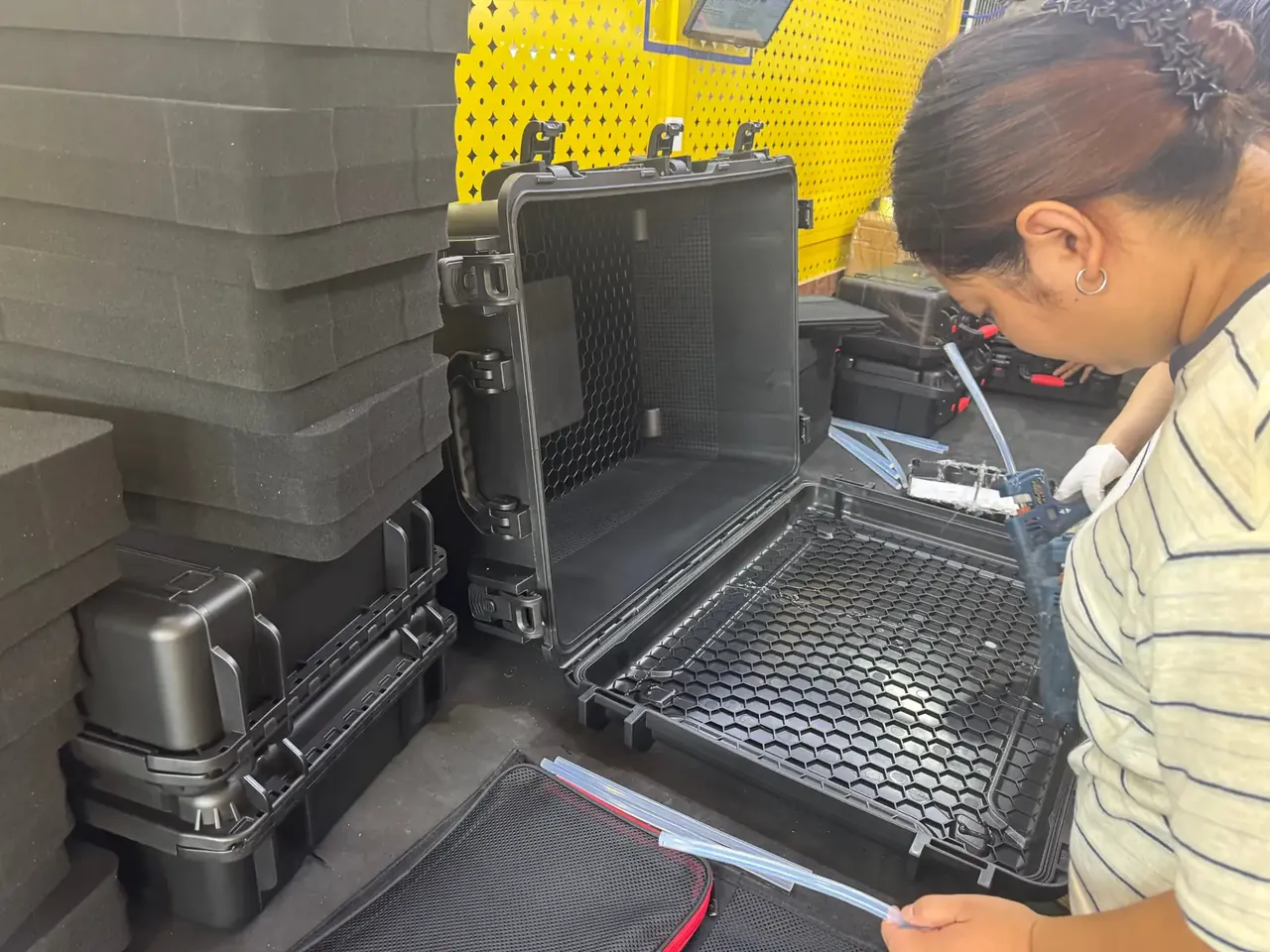
Cavity length and width go on a tape and caliper to ±1.5 mm. Diagonal difference, capped at 3 mm, exposes squareness problems. Base flatness goes on a surface plate with a feeler gauge and stays under 2 mm, or an injection molded protective case rocks on four corners when stacked.
| Check | Instrument | Tolerance |
|---|---|---|
| Cavity L×W×H | Tape, vernier caliper | ±1.5 mm |
| Cavity diagonals | Steel tape | 3 mm max |
| Base flatness | Surface plate, feeler gauge | 2 mm max |
| Lid-to-body gap | Feeler gauge | 0.3 mm max |
| Wall thickness | Ultrasonic gauge | ±0.15 mm |
Visual criteria need conditions too. Keep a sealed reference, view at 800 lux from 500 mm, and grade any sink mark or flash absent from it as minor; a crack at a latch seat is critical.
Wall thickness is the check most often skipped: read five points, and anything below 2.4 mm rejects the lot.
3. Sealing and Immersion: Reproducing IP67 On Site
IP67 appears on every datasheet and is rarely reproduced on the floor. Immersion runs at 1 m for 30 minutes with indicator paper sealed inside; any colour change fails. Pressure decay is faster: charge to 20 kPa, hold 60 seconds, accept a 0.5 kPa drop.
Gasket compression sits at 30%–40%, roughly 55 Shore A. Too hard and it stops recovering in cold; too soft and it takes a permanent set. Silicone stiffens below 5 ℃, so test in a conditioned room.
Then check the tongue-and-groove: a 0.3 mm gap cannot be closed by a softer gasket.
4. Metal Parts and Salt Spray: What to Look at After 48 Hours
The body is plastic; the failures are usually metal — hinge pins, latch springs, rivets.
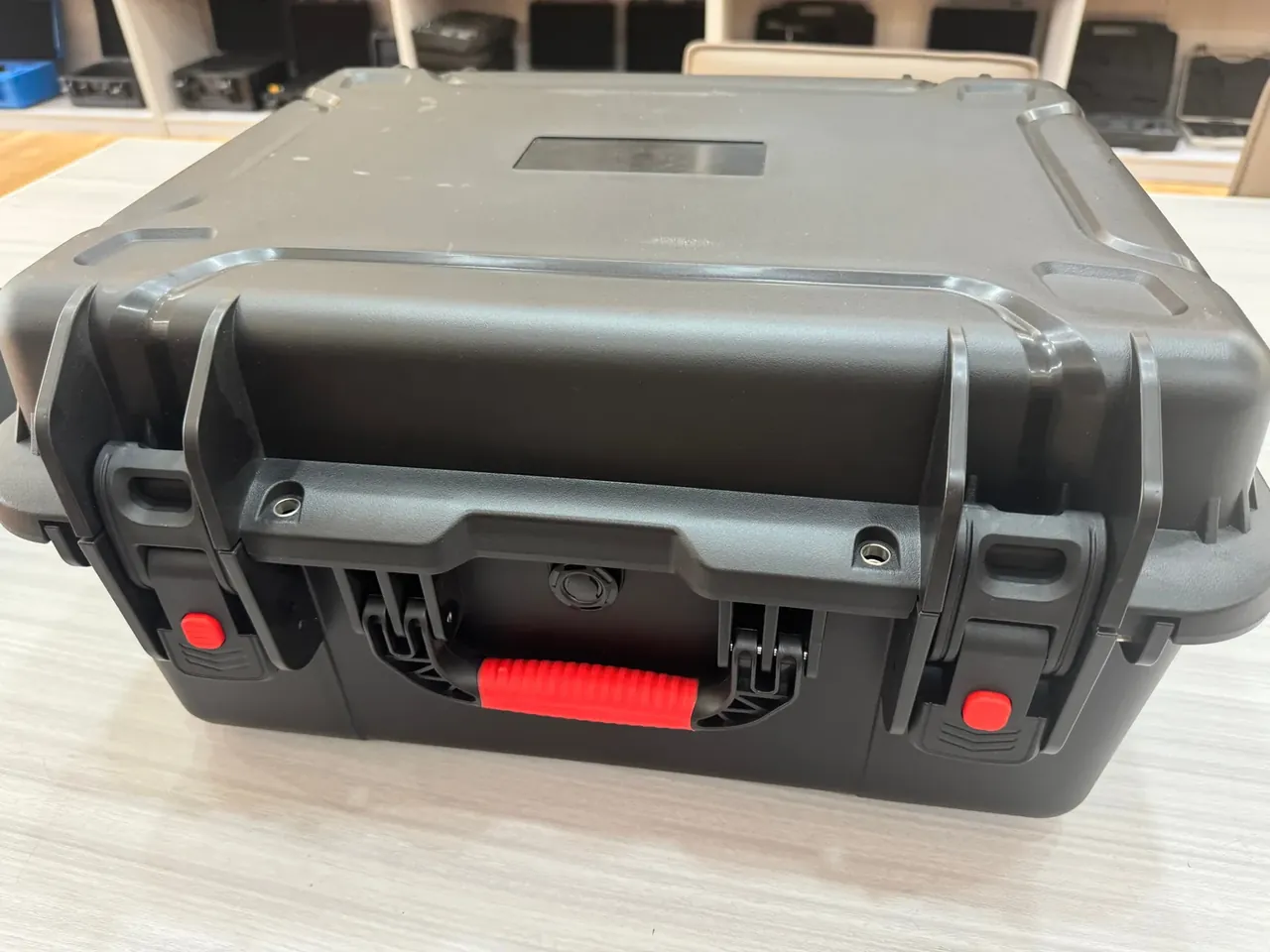
Neutral salt spray runs at 5% sodium chloride, 35 ℃, for 48 hours, graded at protection rating 9 or better, meaning defect area under 0.1%. Zinc plating shows white rust at 24 hours and red rust by 48; stainless comes through unchanged.
| Test | Condition | Duration | Acceptance |
|---|---|---|---|
| Neutral salt spray | 5% NaCl, 35 ℃ | 48 hours | Rating 9 or better |
| Hot storage | 55 ℃ | 4 hours | No warp, latches free |
| Cold storage | -20 ℃ | 4 hours | Survives 1.2 m drop |
| Thermal cycling | -20 ℃ to 55 ℃ | 2 cycles | Decay 0.5 kPa max |
| Hinge cycling | Ambient, unloaded | 5000 cycles | Torque shift 20% max |
Read the cold check with the drop. Impact strength of polypropylene at -20 ℃ falls to about 60% of room temperature, so an injection molded protective case that survives a 1.2 m drop warm can lose a corner after four hours in a freezer.
Latch retention is pulled to 480 N and held 10 seconds, with no release or set.
5. Disposition: Rework, Concession or Whole-Lot Return
A verdict without an action is paper. Grade every injection molded protective case lot five ways:
- Critical — seal failure, broken latch, cracked hinge boss: return the lot.
- Major — size out of tolerance or flatness above 2 mm: rework, resample at double size.
- Minor — colour drift or local sink marks: accept with a 3%–5% price adjustment.
- Salt spray at rating 8 only: run a 96-hour retest before deciding.
- Hinge life under 3000 cycles: a design fault, not a per-unit replacement.
Keep the record traceable: lot, sample size, defect count, disposition, signature.
Conclusion
An injection molded protective case rarely fails on the day it ships; it fails three months later under a stack, in rain, or on a cold drop. Put instrument, condition, sample size and disposition for all six checks on one sheet, and both sides use the same ruler. A reproducible record beats a good-looking drop video, and it tells you whether the next injection molded protective case lot will hold.
This article discusses only the container (case body) side of specifications and design intent, and does not cover any handling, loading or use of the contents.
Related Reading
- How a protective case is moulded, stage by stage
- What a factory inspection capability should prove
- Holding colour and gloss across one batch
- Storage and upkeep rules for case moulds
Related Products
- 8 Series — Gun Cases; Military Equipment Cases; Camera Equipment Cases; Drone Cases; Watch Cases; Knife Cases; First Aid Cases; Electronics Equipment Cases
- WL8-2812 PP Gun Case — model WL8-2812
- All protective cases and toolboxes: 7 series, 158 models