


Quick answer: An injection shop aisle is not clear because people fit through; 2.4 m lets a 1.1 m trolley turn on a 1.6 m radius in one sweep. That width seats a 12 m crane span and a 100 mm floor line.
Table of contents
- Fixing the 2.4 m Main Aisle
- A 1.8 m Side Aisle for a 1.1 m Trolley
- A 12 m Crane Rail and 6 m Clearance
- 100 mm Floor Lines and 300 mm Margin
- Three Places That Block First
- FAQ
1. Fixing the 2.4 m Main Aisle
The first drawing of an injection shop aisle is usually a single straight line. It survives until the presses arrive and the trolley cannot turn. The cart measures 1.1 by 0.7 m and carries six cases at 320 kg, and its tail swings out 0.5 m through a corner.
Add the swing and the turning radius lands at 1.6 m. At 2.4 m clear, the cart completes a 90-degree turn inside the aisle without reversing. Nothing in that figure is borrowed from a code; it comes off one cart's footprint.
At a peak of 42 trips an hour, one reverse costs 12 seconds, or 84 minutes a shift. Width saved on the drawing is paid for at the pick face.
| Main aisle clear width | Turn | Time per trip | Where it works |
|---|---|---|---|
| 2.4 m | single sweep | 38 s | two-way peak |
| 2.0 m | sweep plus trim | 44 s | mostly one-way |
| 1.8 m | one reverse | 52 s | emergency only |
| 1.6 m | two reverses | 61 s | not advised |
Another 250 mm belongs on each side for people to step aside. The 2.4 m is clear width and excludes those strips, so the drawing carries 2.9 m.
Clear width also has to be read with equipment layout. A press presents an operating face of about 0.8 m, and counting that strip as aisle makes the 2.4 m evaporate, so the injection shop aisle starts at the edge of the machine zone.
2. A 1.8 m Side Aisle for a 1.1 m Trolley
A side aisle never carries passing traffic; in the injection shop aisle layout it only moves fresh cases from the press to the main run. Its 1.8 m is arithmetic: 1.1 m of cart plus 0.35 m of person on each side.
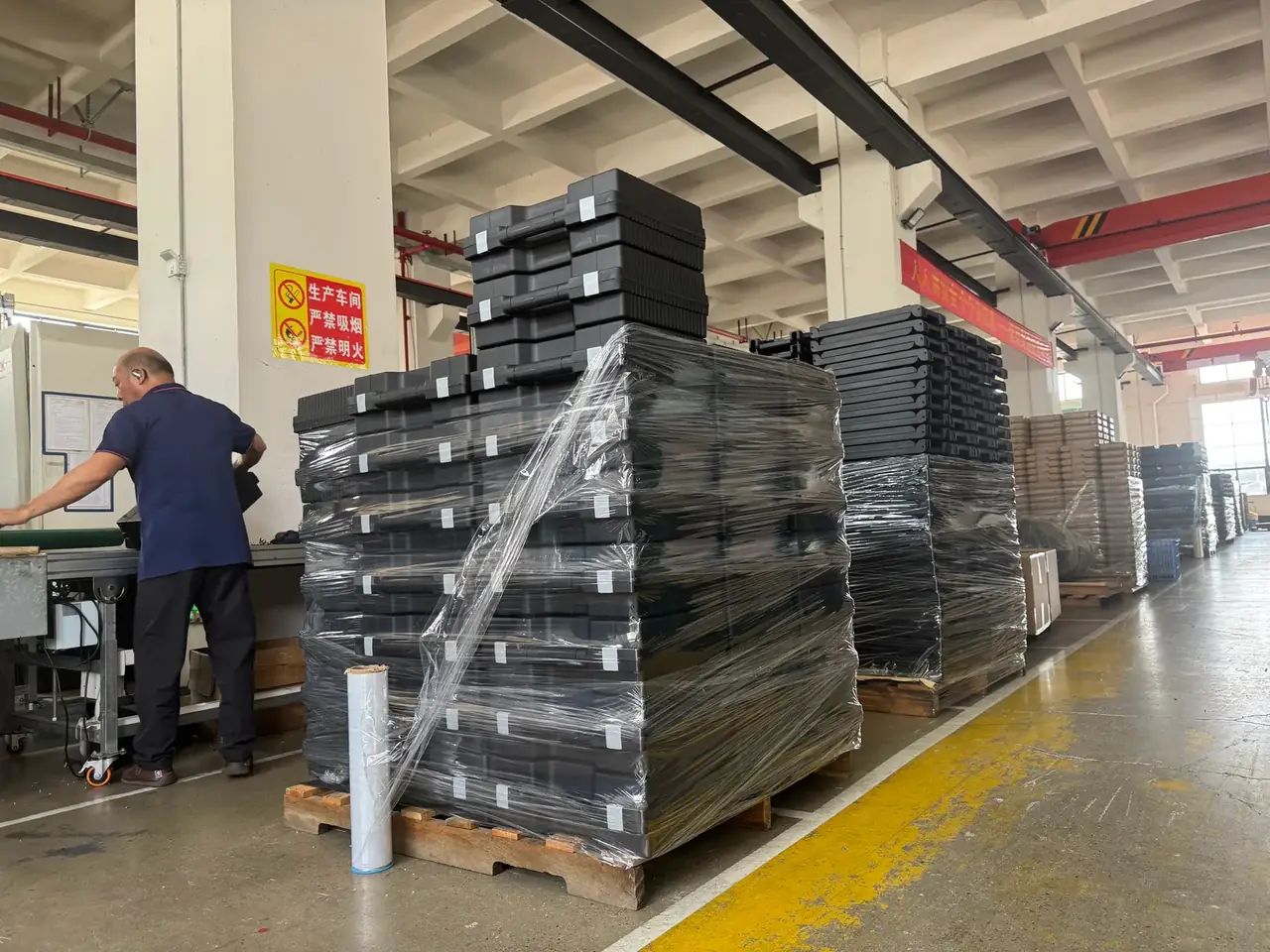
When two carts meet in a side aisle, one backs into a passing bay. Bays sit every 12 m at 2.2 m deep, enough for a cart and a person without touching the racks.
| Side aisle clear width | Passing | Push style | Comment |
|---|---|---|---|
| 1.8 m | no | single, forward | standard |
| 1.5 m | no | side-on | short spur |
| 1.2 m | no | pedestrians only | maintenance |
| 1.0 m | no | closed to carts | not advised |
Dead ends need a 1.2 m turning pocket, or the cart can only leave in reverse. That pocket is the first thing a press crew borrows for storage, so it earns a line on the walk sheet.
3. A 12 m Crane Rail and 6 m Clearance
Over the injection shop aisle the crane rail spans 12 m, its beam underside sits at 6.5 m, and the hook drops to 2.2 m. That last figure sets how high a case stack may rise under the beam and whether anyone walks there.
The 6 m figure is a ground radius held clear while a load is in the air. It is not a width rule, yet the aisle has to be routed around it.
Putting the main aisle directly under the rail saves floor and invites a shutdown notice. Offsetting the run by 1.5 m separates lifting from walking on the plan, so a lift no longer closes the route.
Crane maintenance needs a lockout and a platform 0.8 m wide with a 1.1 m handrail. A platform that eats into clear width quietly rewrites 2.4 m into 1.6 m.
Lifts are not only molds. A pallet of cases measures 1.2 by 1.0 m at 240 kg, and it swings about 0.3 m once airborne, which is where the 6 m radius comes from rather than from a round number.
4. 100 mm Floor Lines and 300 mm Margin
Floor lines run 100 mm wide in yellow wear-resistant epoxy. They are not decoration: they are the boundary of the injection shop aisle, and clear width is measured from the inner edge.
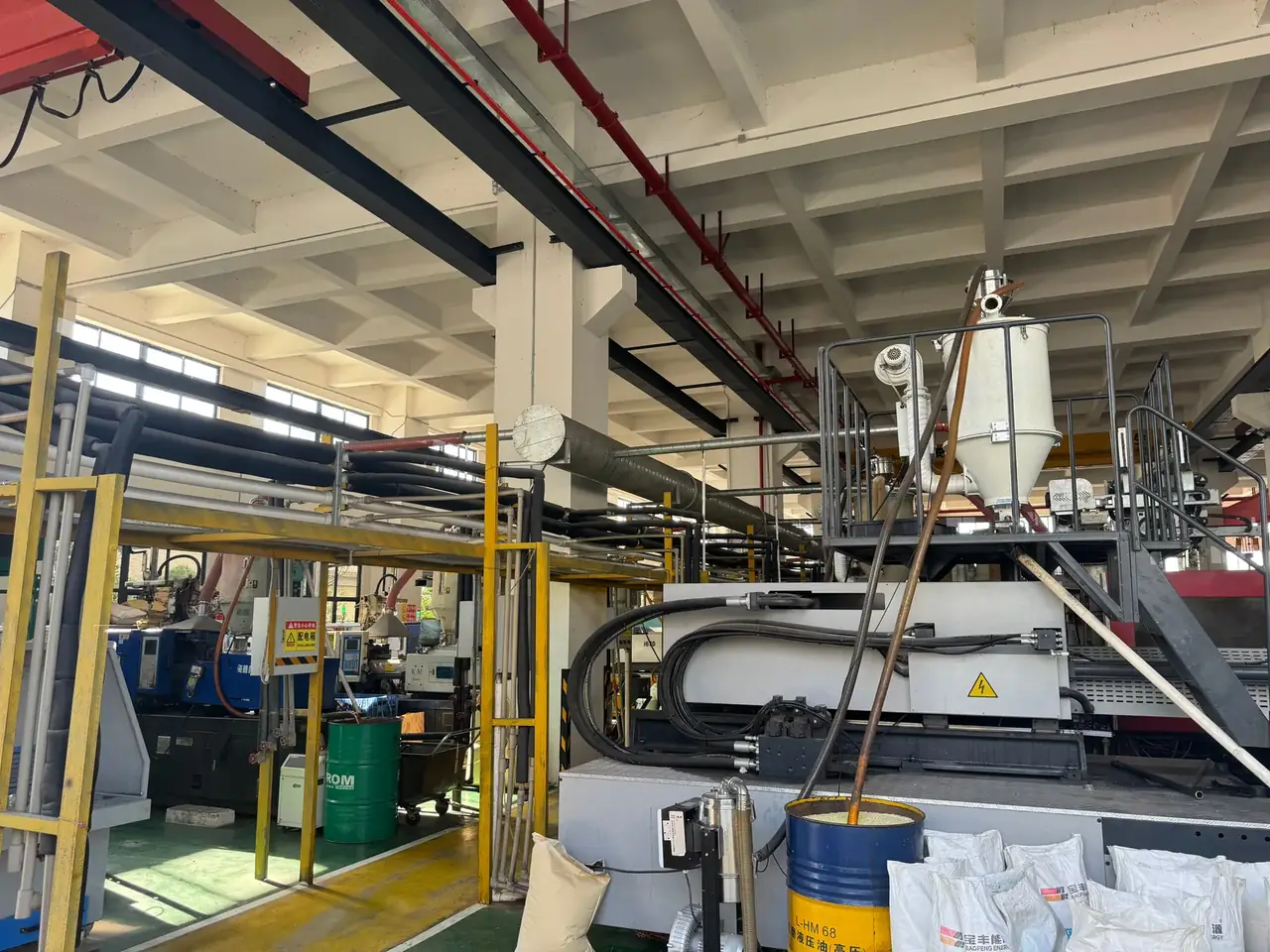
In the injection shop aisle the line sits 300 mm off the press, a strip reserved for door swing, cabling and sweeping. Push it closer and every door opening crosses the paint; within six months the line blurs and the measurement loses its reference.
| Floor line item | Value | Note |
|---|---|---|
| Line width | 100 mm | yellow epoxy |
| Off the press | 300 mm | door and cable margin |
| Off the rack | 200 mm | pick stance |
| Repaint cycle | 6 months | sooner past 30 percent wear |
Three checks follow any repaint: corner arcs not under 1.6 m, bay mouths not under 2.2 m, thresholds not over 20 mm. Fail any one and the aisle is 2.4 m on paper and 2 m in practice.
Case movement is where nominal width fails first. A neat line still forces the driver to slow at the corner, and the cycle time follows the brake.
5. Three Places That Block First
Bags block the injection shop aisle first. Resin sacks at 25 kg stack 1.5 m high against the press and reach 0.4 m into the lane, enough that two people cannot pass.
Molds block second. A mold set down for a change occupies 1.2 m square, and while the crane holds it the lane is effectively halved.
Pallets block third. A wrapped pallet at 1.2 by 1.0 m and 1.4 m tall waits by the aisle for a forklift, and the wait is usually half an hour.
All three share one cause: the aisle was not drawn narrow, the temporary storage beside it was never given a home. A 1.2 m deep bin for bags, a 2 m square bay for molds and a 1.5 m staging box for pallets remove most of the habit.
Managing an injection shop aisle is not a painting job; it is finding a place for each temporary object that does not cross the line. Once those places exist, 2.4 m holds through a shift change.
Related Reading
- Stack height and aisle width
- Factory audit for presses and molds
- Machine count, cycle and capacity
- Four sections of a case line
JUNZHIJIA
Related Products
- 8 Series — Gun Cases; Military Equipment Cases; Camera Equipment Cases; Drone Cases; Watch Cases; Knife Cases; First Aid Cases; Electronics Equipment Cases
- WL8-2812 PP Gun Case — model WL8-2812
- All protective cases and toolboxes: 7 series, 158 models