

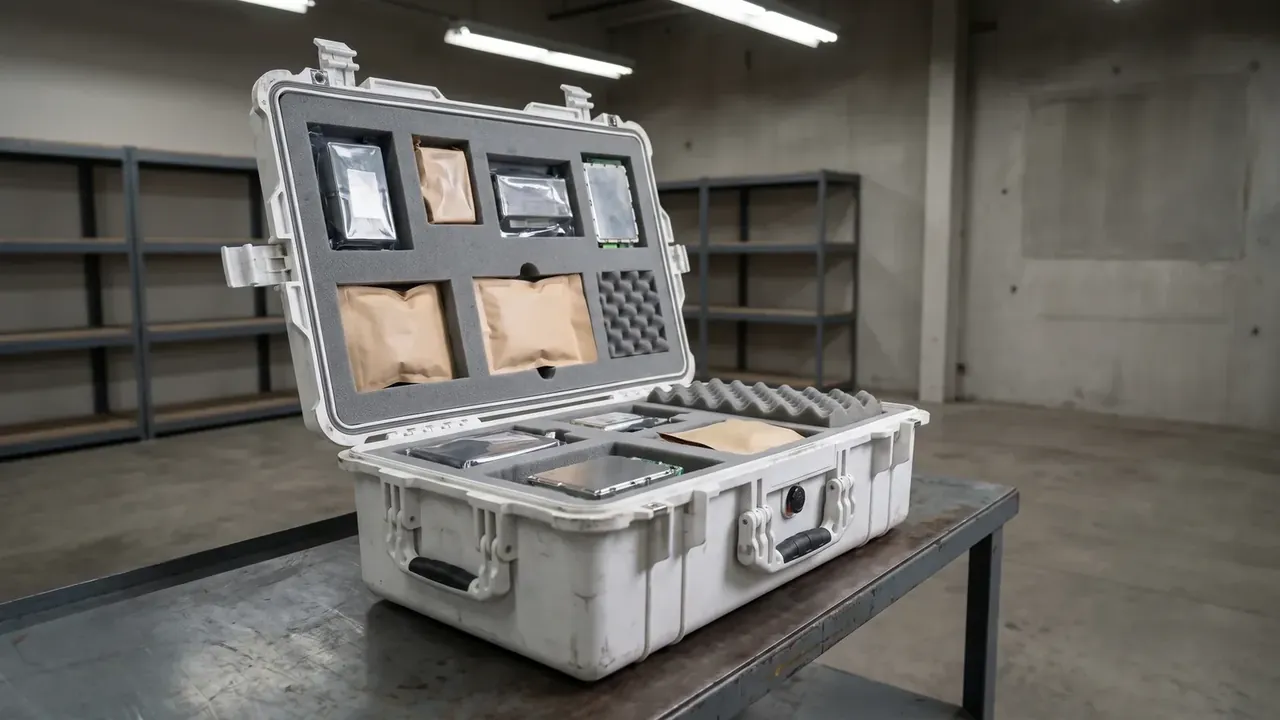
Quick answer: Energy labelling rarely covers a bare shell: an inmetro case label joins it only as the enclosure of powered equipment, so reproduce layout and durability.
Table of contents
- Who Certifies, Who Only Carries the Label
- Splitting a 60 × 40 mm Face into Three Bands
- Six Portuguese Fields and a Four-Digit Body Number
- Reproducing the Multi-Step Grade Band
- Fifty Wipes and Five Years
- FAQ
1. Who Certifies, Who Only Carries the Label
A 60 × 40 mm label sits bottom right of the shell, 20 mm in from both edges. Fixed scan brackets in a warehouse sit at that height, and a label 10 mm higher forces manual scanning on every carton.
The phrase inmetro case invites a wrong reading, as if the shell were certified. Mandatory certification is issued per product category, and an empty plastic case is not on that list; the powered equipment or accessory is certified, and the grade, registration and body number follow it. Energy labelling is narrower still: a bare plastic shell normally sits outside it and joins only as the enclosure of powered equipment declared with the machine.
Add a lamp, a charging port or a cooling module, even bolted on, and the scope pulls the assembly in. A bare shell with foam and latches is packaging, and the case side only carries the label.
2. Splitting a 60 × 40 mm Face into Three Bands
Sixty by forty is not much room for a mark, a number, six fields and a 38 mm barcode. Bands are the only reliable answer: 16 mm at the top, 14 mm in the middle, 10 mm at the bottom, which adds to exactly 40 mm.
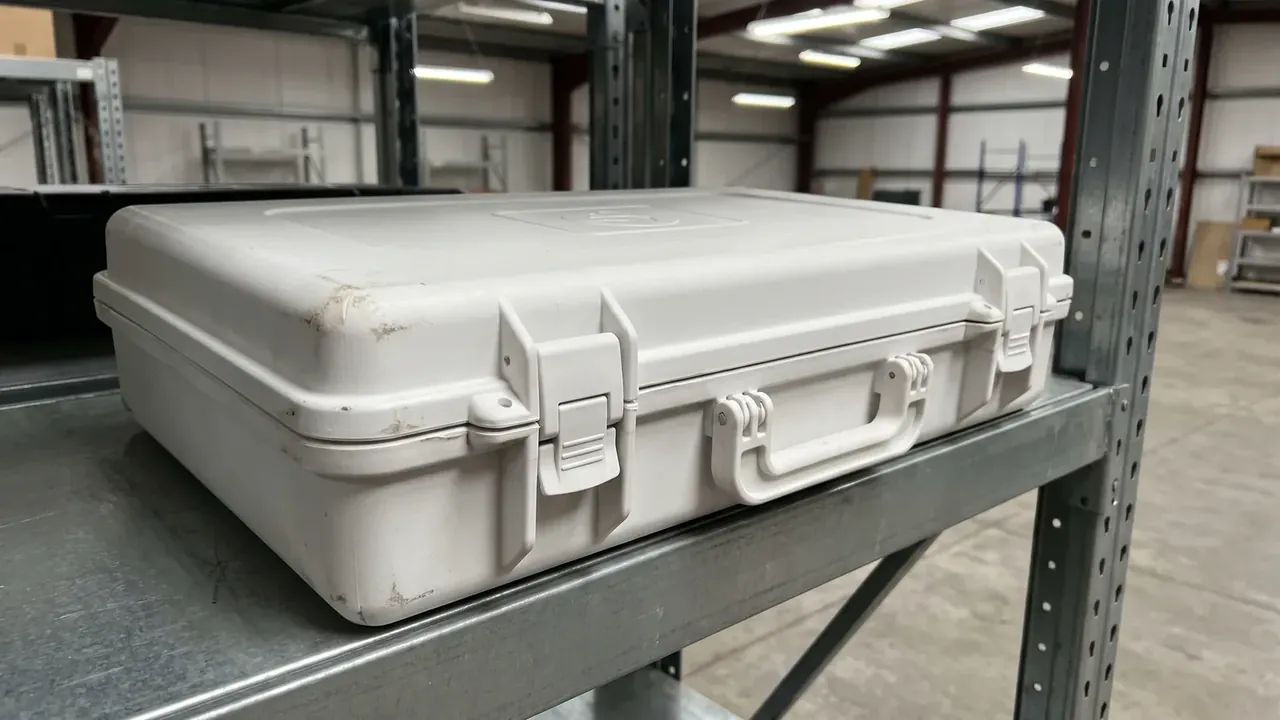
The mark takes 12 mm, three quarters of the top band, with a 3 mm gap to the four-digit number. The middle band runs two columns at 6 mm rows and 1.8 mm type. The barcode is 38 mm wide with a 2.5 mm quiet zone on each side.
Skip any area with a curvature radius under 50 mm, hold flatness to 0.3 mm per 100 mm, and never bridge a 1.2 mm rib. Natural polypropylene sits near 31 dyn/cm; below 38 dyn/cm the adhesive cannot wet out, and the label peels off whole at -10 °C.
| Element | Value | If it fails |
|---|---|---|
| Outline | 60 × 40 mm, R2 corners | Will not feed the applicator |
| Mark height | 12 mm | Layout rejected |
| Body number | 4 digits, 2.5 mm type | Whole run scrapped |
| Fields | 6, Portuguese | Held at customs |
| Position | 20 mm margins | Scanner misses it |
| Barcode | 38 mm, 2.5 mm zone | Read rate falls to 70% |
3. Six Portuguese Fields and a Four-Digit Body Number
The six fields are fixed: product name, model, manufacturer or importer, country of origin, batch number, rated data. A bare shell writes not applicable for rated data; the field is never left blank.
Portuguese only, no parallel English. Units take international symbols, and country and company names are used exactly as the importer supplies them, because a retranslation breaks the match with the registration file.
The four-digit number is the most fragile element. At 2.5 mm type, one wrong digit scraps the run, and a roll change needs a line clear, since a leftover piece prints onto the next batch.
4. Reproducing the Multi-Step Grade Band
The step count is not fixed: it follows the product category, commonly A to G with seven, under the current INMETRO Portaria. On the label it becomes a vertical band plus a pointer arrow, 8 mm per step, 30 mm tall, 6 mm letters. The case side does not judge the step, it reproduces the artwork.
Mixed rolls are where this fails. Adjacent steps differ by a few ΔE after printing, so a roll change without a line clear pushes the old grade into the next batch and the container comes back. Hang a colour card on every roll and reject above ΔE 2; after five years the limit is 3.
| Band parameter | Value | Check | Typical fault |
|---|---|---|---|
| Step count | Per category, often 7 | Compare with current artwork | Carrying over an old count |
| Step width | 8 mm | Caliper | Rows out of line after shrink |
| Total height | 30 mm | Caliper | Overlaps the barcode zone |
| Letter height | 6 mm | Projector | Broken strokes |
| Pointer arrow | Tip on the current step | Visual | Arrow sitting between steps |
| Colour shift | ΔE 2 or less at dispatch | Colorimeter | Adjacent steps look mottled |
5. Fifty Wipes and Five Years
Durability arrives as one line, must not rub off. The executable version is 75% ethanol, 500 g load, 50 strokes, then no print loss, barcode grade 1.5 or better and ΔE 3 or less.
Temperature runs 24 h at -10 °C and 24 h at 50 °C with a 2 h recovery; damp heat runs 48 h at 40 °C and 90% RH. Adhesion uses a 1 mm cross-cut, a 6 × 6 grid, grade 3 or better.
Five years is an indoor estimate. Direct UV cuts the acrylic adhesive to about 2 years, so move the label to a shaded face or switch to a UV-stable face stock, and check 3 samples per batch.
| Test | Condition | Pass |
|---|---|---|
| Ethanol wipe | 75%, 500 g, 50 strokes | No print loss |
| Cold storage | -10 °C / 24 h | No lifting |
| Hot storage | 50 °C / 24 h | No adhesive bleed |
| Damp heat | 40 °C / 90% RH / 48 h | No blister |
| Cross-cut | 1 mm, 6 × 6 | Grade 3 or better |
Conclusion
An inmetro case label divides cleanly: certification sits with the equipment, layout and durability sit with the shell. A bare plastic case normally falls outside energy labelling and joins it only as the enclosure of powered equipment. Fix the 60 × 40 mm face at 16 / 14 / 10 mm bands, a 12 mm mark, a four-digit number, six Portuguese fields and a 38 mm barcode, reproduce the grade band at whatever step count the current Portaria sets, then prove durability with 50 ethanol strokes and 48 h of damp heat.
This article covers case-side specifications only and does not address any handling, loading or use of the contents.
Related Reading
- Wireless approval for Brazil
- Label compliance for export packaging
- Label area and nameplate layout
- Certification sets for one export unit
- Layout rules for English case labels
Related Products
- 8 Series — Gun Cases; Military Equipment Cases; Camera Equipment Cases; Drone Cases; Watch Cases; Knife Cases; First Aid Cases; Electronics Equipment Cases
- WL8-2812 PP Gun Case — model WL8-2812
- All protective cases and toolboxes: 7 series, 158 models