

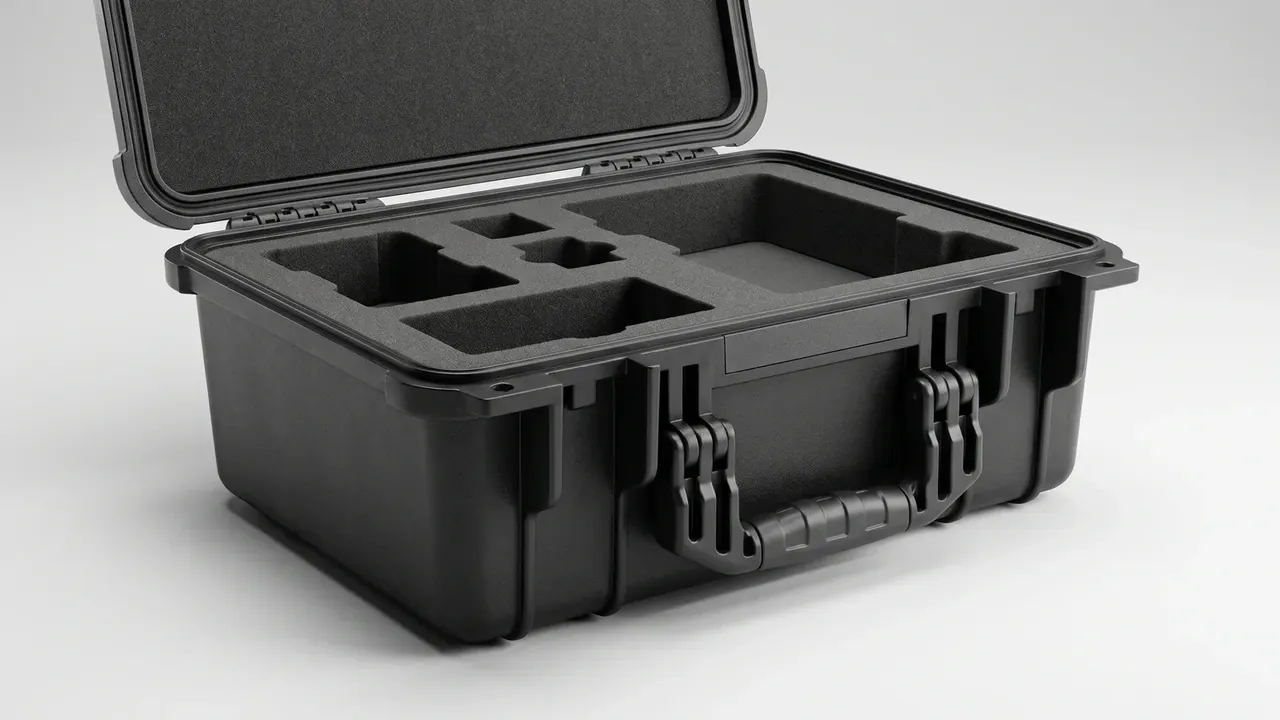
Quick answer: An Instrument Case ODM Factory is paid for translation work: a paragraph about where an instrument lives becomes a shell that can be cut in steel. The route runs brief, five review gates, a printed mock-up for fit, a first shot for dimension, then pocket edits once the tool exists. A brief missing packed weight sends the job back to the start three weeks later.
Table of contents
- ODM Starts With a Product Brief, Not a Drawing
- Five Review Gates: Wall, Draft, Latch, Seal, Insert
- A Printed Prototype Against a Steel First Shot
- Reworking Pockets Without Cutting a New Tool
- Four Validations Between Prototype and Volume
- FAQ
1. ODM Starts With a Product Brief, Not a Drawing
An ODM factory rarely receives a drawing first; it receives a description of where the instrument will be used. Who lifts the case, how far it travels, which vehicle it rides in, at what temperature the lid opens — four answers that fix the outside shape.
Every entry in the brief needs a number: outside dimensions, clear cavity, packed weight ceiling, operator posture at full lid, stacking count, monthly call-off. Five drive structure, the sixth cavity count; an Instrument Case ODM Factory reads all six before quoting a tool.
Weight is the entry most often left blank. An 8 kg instrument in a case capped at 12 kg leaves about 4 kg for shell and insert; a PP body at 3 mm wall already sits near that at 520 mm, ruling out 45 kg/m³ foam for roughly 20 kg/m³.
| Brief entry | Figure to fix | Consequence downstream |
|---|---|---|
| Outside dimensions | L × W × H, ±3 mm | Tool size, pallet pattern |
| Clear cavity | Space left after wall and ribs | Insert thickness cap |
| Packed weight | Ceiling, kg | Wall gauge, material |
| Opening posture | Lid angle, reach height | Hinge type, lid depth |
| Stacking | Empty versus loaded | Top rib height |
| Call-off | Monthly plus peak volume | Cavity count, slots |
2. Five Review Gates: Wall, Draft, Latch, Seal, Insert
The order is fixed, because each gate feeds the next. An Instrument Case ODM Factory keeps a signed note at each gate: who changed what, on what evidence.
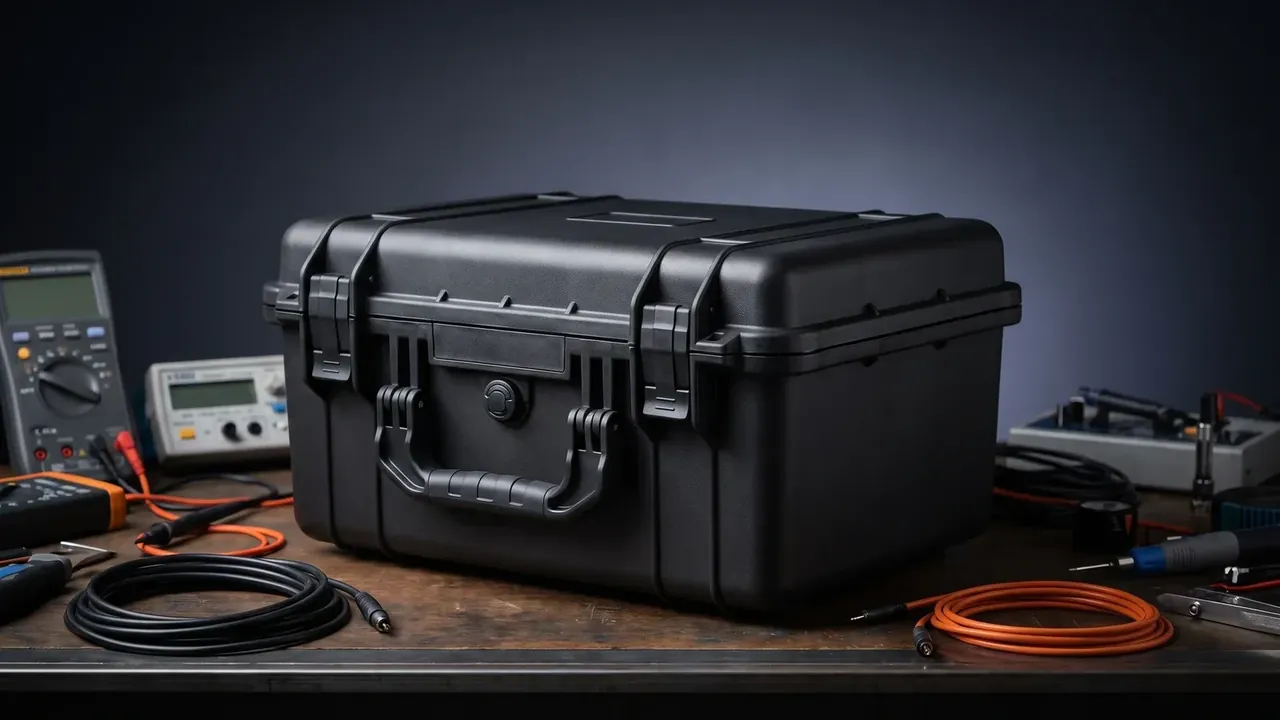
Wall needs two numbers, which an Instrument Case ODM Factory asks for before steel is ordered: 2.5 mm to 3.5 mm main wall on a PP body, rib roots near 0.6 of that. Heavy ribs show sink on the visible face, thin ones snap first on a corner drop.
Draft and latch share one drawing — 1 to 2 degrees on deep walls, 0.5 on shallow faces, a 1.5 mm radius where the latch seat meets the shell, 3 to 5 mm of travel.
Seal review reads the groove, not the ring: a 3.5 mm wide, 2.5 mm deep channel holding 3 mm cord lands near 25 percent compression.
| Gate | Check figure | Cost of a miss |
|---|---|---|
| Wall | 2.5–3.5 mm main, 0.6× rib | Sink, snapped rib, overweight |
| Draft | 1–2° deep, 0.5° shallow | Scuff, drag, no release |
| Latch | 3–5 mm travel, 1.5 mm radius | Cracked seat, stiff lid |
| Seal | 3.5 × 2.5 mm groove, 25% | Leak path, permanent set |
| Insert | 5 mm to wall, 1–2 mm shallow | Rattle, lid not seating |
3. A Printed Prototype Against a Steel First Shot
A print proves fit and little else: at 0.2 mm layers an FDM latch seat reaches 30 to 50 percent of moulded strength, so the lid closes on the bench and whitens after twenty cycles.
The steel first shot prices shrinkage into the geometry: PP moves 1.0 to 2.5 percent against ABS at 0.4 to 0.7, and one drawing carried across both shifts the cavity by several millimetres.
First shots rarely pass on attempt one; two or three corrections are normal, and they touch steel only. An Instrument Case ODM Factory treats a correction that moves packed weight or stacking height as a brief that was never finished.
4. Reworking Pockets Without Cutting a New Tool
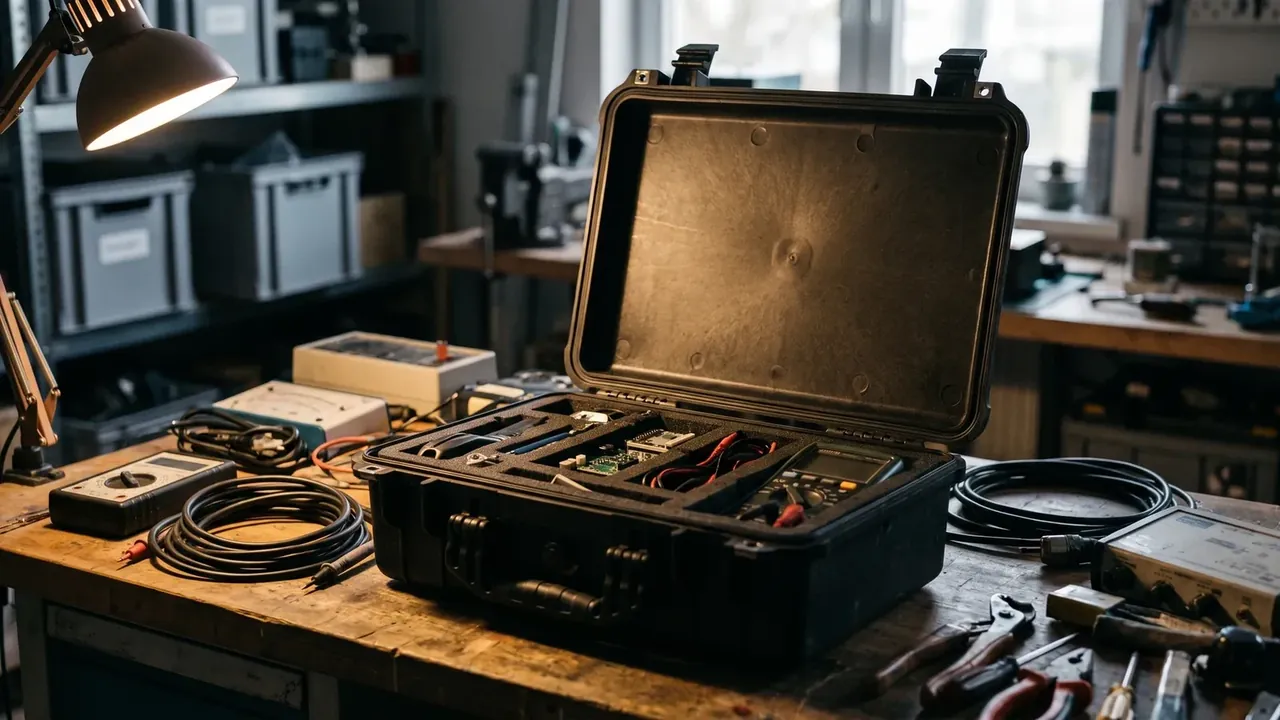
A second hardware generation usually fits the same shell, so an Instrument Case ODM Factory writes three conditions into the insert drawing: outside shape and stacking footprint unchanged, sealing groove and latch seats untouched, every pocket at least 5 mm from the shell.
Crossing it is just as plain: a cable port through the side wall, a pocket routed hard against the shell, a different latch model, a cavity deeper by more than 10 mm — any one means steel, and validation restarts from first shot.
Insert tolerance can stay at ±0.5 mm, since EVA springs back after routing; tightening to ±0.2 mm doubles cost. An Instrument Case ODM Factory adds depth before width when pocket count grows, because depth only eats lid foam margin.
| Change requested | New tool needed | Typical lead time |
|---|---|---|
| Pockets re-routed | No | 5–7 days |
| Insert material changed | No | 3–5 days |
| Label recess added | No | 4–6 days |
| Cavity under 10 mm deeper | Maybe, insert block | 12–18 days |
| Side port, new latch | Yes | 25–35 days |
5. Four Validations Between Prototype and Volume
Each carries a different verdict, and the schedule labels them T0 to T3. Assembly on the print asks only whether hardware drops in, the lid closes, a finger reaches the bottom — geometry, no strength claim.
The first shot judges dimension and appearance together: cavity diagonal, groove width, latch seat position, whether sink or weld lines land on hidden faces. A pilot of thirty units then judges repeatability, pulling five at random and swapping lids to see whether compression holds near 25 percent.
The last is the production first article, reporting on the line rather than the part: machine, mould temperature, cycle time, inspection station against the pilot run. Volume starts after all four are signed; later lots need only a first article and a patrol, which an Instrument Case ODM Factory holds to.
Related Reading
- ODM custom case procurement
- Custom case specification elements
- Depth and centre of gravity
- Plastic case against wooden crate
JUNZHIJIA
Related Products
- 8 Series — Gun Cases; Military Equipment Cases; Camera Equipment Cases; Drone Cases; Watch Cases; Knife Cases; First Aid Cases; Electronics Equipment Cases
- WL8-2812 PP Gun Case — model WL8-2812
- All protective cases and toolboxes: 7 series, 158 models