

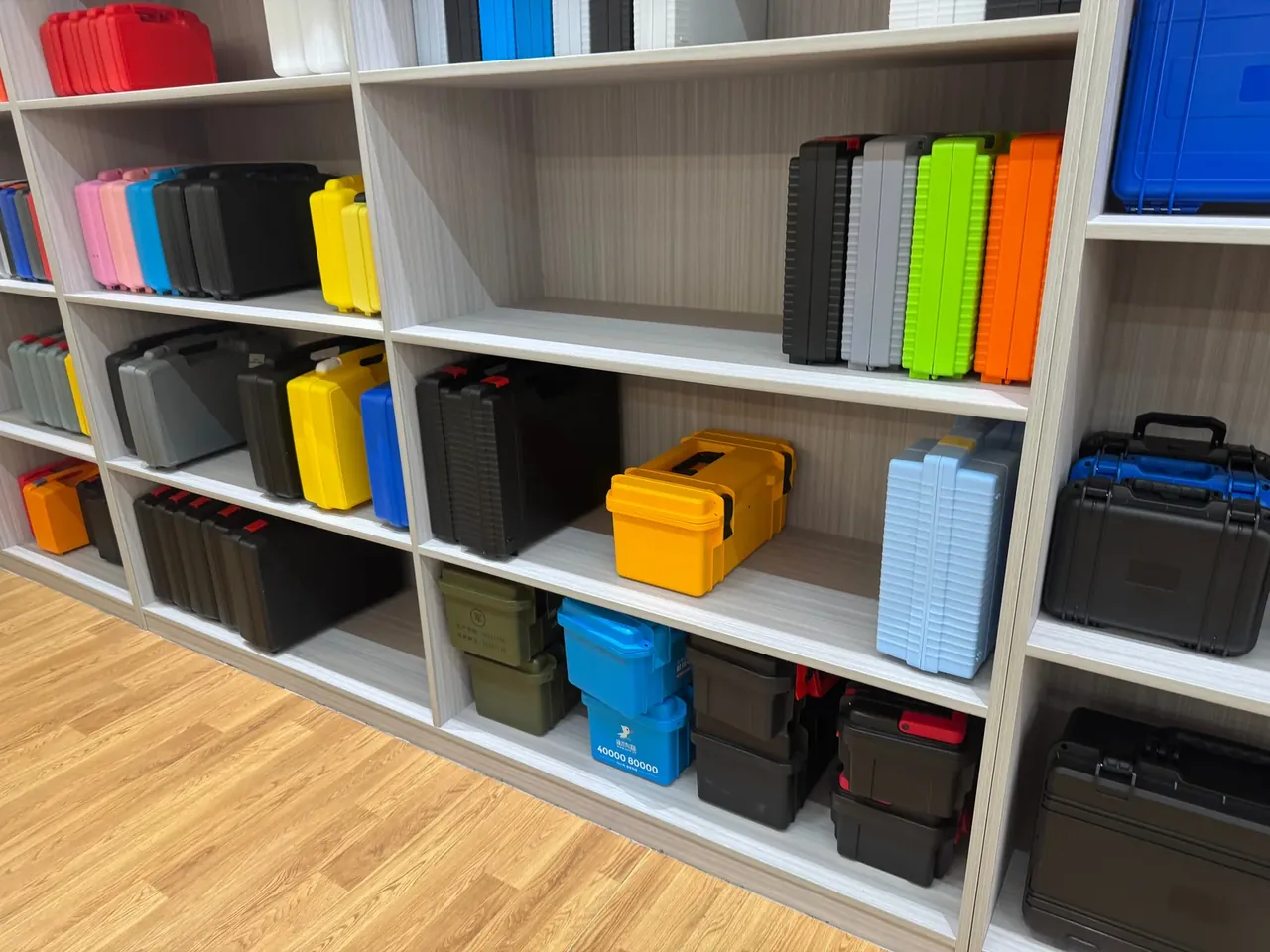
Quick answer: Insulated Rainproof Toolboxes clear two lines at once: 10 kV for 1 minute with leakage under 1 mA, plus IP54 splash drainage through two 4 mm holes.
Table of contents
- Withstand Voltage and the Insulation Line
- Gasket Compression and Weep Holes
- Single-Hand Latch Design
- Outline Size and Pole Climbing
- Marking, Testing and Replacement
- FAQ
1. Withstand Voltage and the Insulation Line
Opening a case at the foot of a pole in rain, the first thing to keep out is not damp air but water running down the lid edge.
Forget wall thickness. PP runs about 45 kV/mm, so a 3 mm wall is far beyond 10 kV on its own; stacking thickness buys nothing. What decides the result is the surface, where rain, dust and filings build an invisible film across the lid land, and leakage current crawls along it. The wall is intact and the test has already failed.
Insulated Rainproof Toolboxes are therefore run twice, dry and wet: the dry pass checks material and creepage path, the wet pass checks what survives contamination. One criterion governs both: 10 kV held 1 minute, leakage no higher than 1 mA, and any breakdown or flashover rejects the batch.
| Check point | What to look at | Failure signature |
|---|---|---|
| Wall and base | voids, cracks | local puncture, smoke |
| Lid land | step intact, no flash | leakage current jumping |
| Latch hole | inner lip, no through path | tracking along the bore |
A two-step lid land forces water around two corners before it can enter. Latch holes are the second door, kept off any straight path into the cavity.
2. Gasket Compression and Weep Holes
The gasket is the first line of rain defence and the weep holes are the last, so Insulated Rainproof Toolboxes need the two designed as one system.
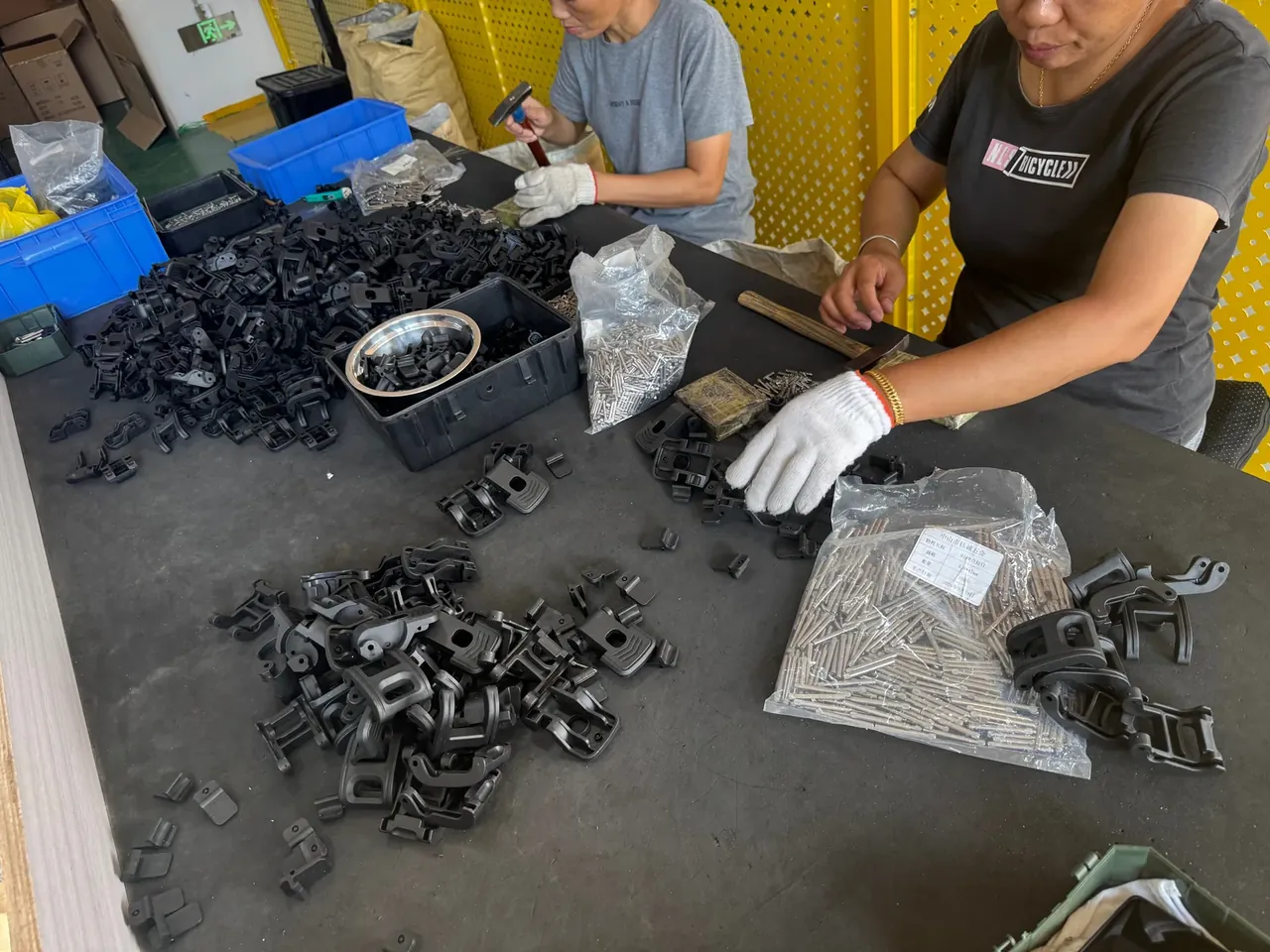
Use TPE at Shore A55, the middle ground: softer cannot seal, harder will not close. Compress it 25% to 30% with groove depth left for rebound, because past 30% set the gasket stops returning and the seam stays open. Cold stiffens it, and a slow gasket no longer hugs the land.
Two weep holes of 4 mm on Insulated Rainproof Toolboxes sit at the lowest corners, bored down and out so water leaves and splash cannot climb in. Too large and splash pours through; too small and a smear of mud turns the hole into a trap. No mesh inside, since mesh is the first cause of a blocked hole.
Rainproof is not sealed shut. IP54 allows a little water in as long as nothing is harmed; sealed to the molecule, the case traps moisture until the night swing condenses it on the lid underside. Drainage beats a thicker gasket.
| Part | Design intent | Failure without it |
|---|---|---|
| Gasket groove | 25%–30% compression | seam never closes |
| Weep holes | two at 4 mm, low outside | water reaches the tools |
| Lid land | two-step offset | rain runs inside |
3. Single-Hand Latch Design
One hand holds the belt and the other opens the lid, and every latch decision on Insulated Rainproof Toolboxes follows from that.
On Insulated Rainproof Toolboxes the closing force belongs between 200 N and 400 N. Below it the case pops open on a rough ride; above it a gloved thumb cannot flick the tab, the crew needs both hands. The force comes from interference and tab length, not from a tighter screw.
The tab rises above the lid edge, wide enough for a glove and rounded. Two latches sit symmetrically, since a third centre catch only turns one motion into two. The lid must not fall back by itself, so the hinge needs damping or a stop. And no metal may sit exposed on the latch: a steel spring on an insulated case is a floating potential, and once it touches a live part the case turns from insulation into a conductor.
4. Outline Size and Pole Climbing
An outline of 420×320×180 mm at 2.8 kg empty is the common pattern for Insulated Rainproof Toolboxes, and the numbers follow the climbing action rather than a catalogue.
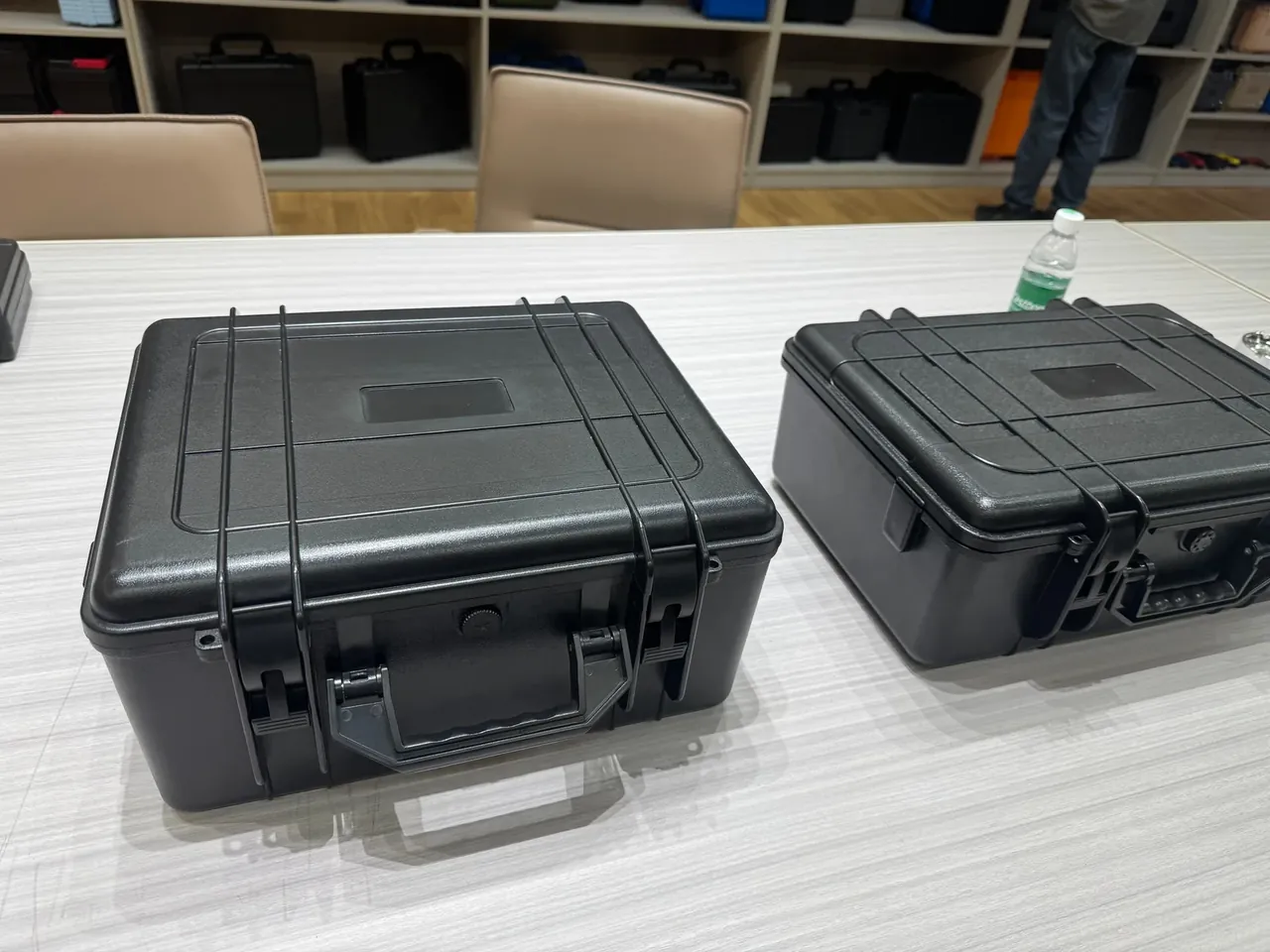
At 420 mm the case sits across the hip without covering the belt attachment; at 320 mm wide it rests on the body without pushing the climber out; at 180 mm deep it holds a wrench set, a clamp meter, tape and a few fittings. The 2.8 kg is empty weight.
Carrying comes down to three points: handle, strap and hanging ring. The handle is arched to clear a glove; strap bosses are moulded into the wall; the ring holds the case on the pole while both hands work, clear of the latches. Round the four corners so rope and webbing do not catch.
| Carry mode | Load path | Design note |
|---|---|---|
| One hand | handle root | arch clears a glove |
| Shoulder strap | side bosses | moulded in, not screwed |
| Hung on pole | side ring | clear of latches |
5. Marking, Testing and Replacement
A well-built case still has to be managed, and for Insulated Rainproof Toolboxes management rests on three items: marking, cycle and log.
Marking on Insulated Rainproof Toolboxes must survive wear. Withstand level, serial number, test date and next test date belong on the shell, as an in-mould label or a screen print under clear coat; paper lifts within a fortnight. Colour can carry the voltage class, and the warning line goes on the lid face rather than the side.
The test cycle runs 12 months, aligned with the interval for insulating rods at the same depot, local procedure taking precedence. The clock starts at commissioning, and any drop, soaking or impact sends the case for test regardless of date. Replacement falls at 5 years: even with a pass, a flattened gasket or whitened wall is telling you ageing has happened. Routine checks are four looks: gasket, weep hole, wall, latch. Insulation rule: breakdown at 10 kV for 1 minute, leakage above 1 mA, or gasket compression set beyond 30% retires the batch.
| Item | Cycle | Criterion |
|---|---|---|
| Withstand and leakage | 12 months | 10 kV/1 min, 1 mA or less |
| Gasket | every shift | no flat spots, rebounding |
| Weep holes | weekly | drains at once, no pooling |
| Whole case | 5 years | replaced on age |
Related Reading
- IP54 versus IP65: where splash ends and jets begin
- IP65, IP66 and IP67: one step at a time
- Hinge, latch and gasket working together
- Latch holding force: the 200 N to 400 N band
Related Products
- 8 Series — Gun Cases; Military Equipment Cases; Camera Equipment Cases; Drone Cases; Watch Cases; Knife Cases; First Aid Cases; Electronics Equipment Cases
- WL8-2812 PP Gun Case — model WL8-2812
- All protective cases and toolboxes: 7 series, 158 models