

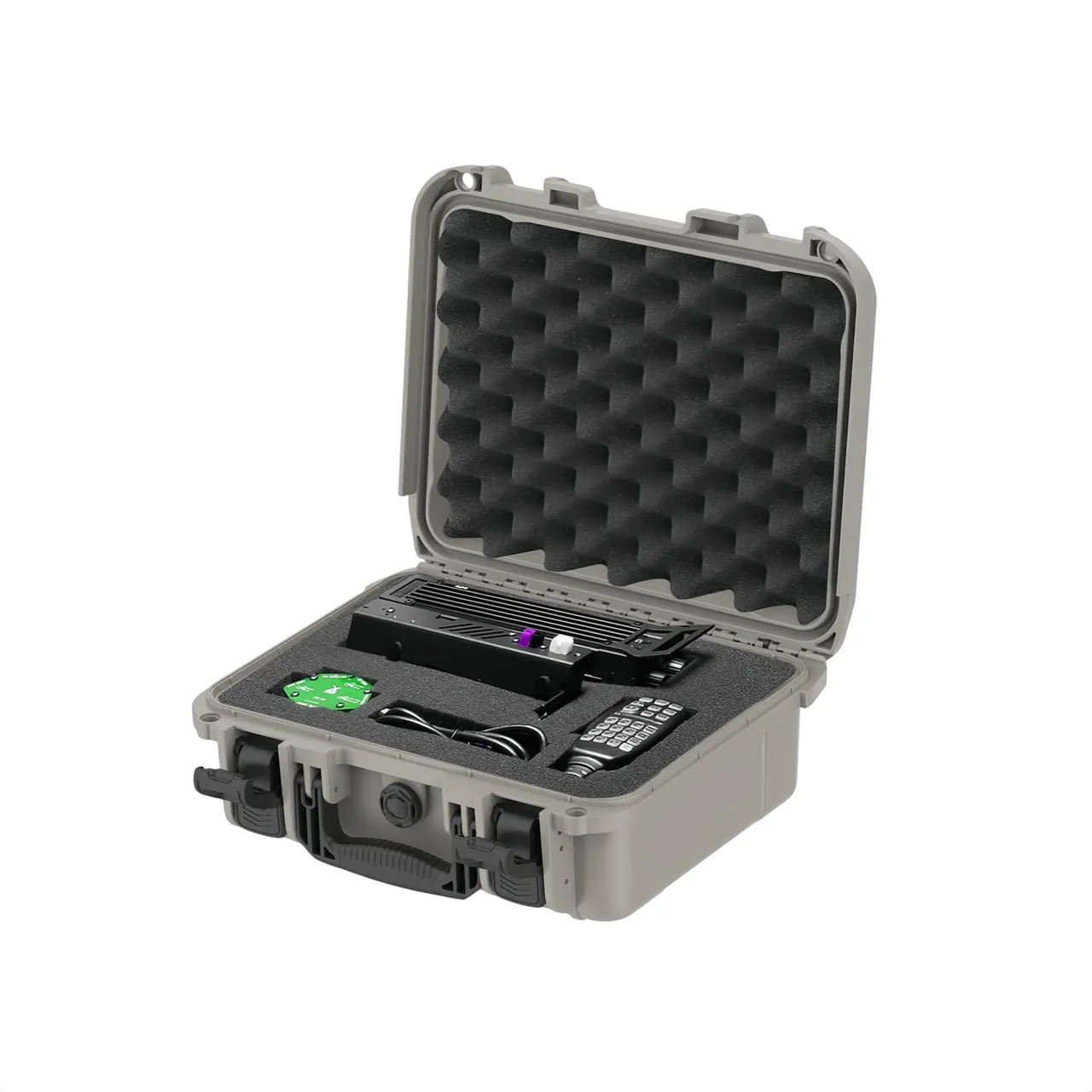
Quick answer: IP rating selection for instrument cases runs in a fixed order: ask how water reaches the shell, ask whether the lid can hold 25 percent gasket compression for years, then ask how cold the site gets. IP54 stops splash, IP65 stops jets, IP67 promises one metre of still water for thirty minutes — and no grade contains another, since IP67 does not cover the IPX5 or IPX6 jet. Put grade, seal geometry and temperature on one line of the specification.
Table of contents
- Where IP54, IP65 and IP67 Part Company
- Reproducing a One-Metre, Thirty-Minute Immersion
- Twenty-Five Percent Gasket Compression and Groove Size
- Pressure Relief Valves: Water Against Differential
- Seal Failure at Minus Twenty
- FAQ
1. Where IP54, IP65 and IP67 Part Company
For IP rating selection for instrument cases, IP67 promises one metre of still water for thirty minutes; it covers neither a pressure washer nor long immersion. The three differ in the shape of the water, not the size of the number, which is why IP rating selection for instrument cases starts with the site rather than the datasheet.
IP54 steps both digits back. The 5 tolerates dust ingress that does not stop the equipment working, and the 4 tolerates splash from any direction. Rain and deck spray are its habitat.
IP65 lifts the dust digit to 6 while water stays at 5. Grade 6 puts talc at 75 microns against eight hours of internal vacuum; grade 5 plays a 6.3 mm nozzle at 12.5 litres a minute for three minutes per square metre. Jets carry momentum, so the gasket is judged while water pushes sideways.
IP67 returns to still water: the lowest point one metre under, thirty minutes, water and specimen within 5 K. Below 850 mm height that point sits 1000 mm down; at or above 850 mm the highest point sits 150 mm down.
| Grade | Dust digit in practice | How water arrives | Site it suits |
|---|---|---|---|
| IP54 | Ingress allowed if harmless | Splash, any direction | Rain, site dust |
| IP65 | Talc-tight for 8 hours | 6.3 mm jet | Washdown, open loading |
| IP67 | Talc-tight, same test | Still water, 1 m, 30 min | Dropped overboard |
None of the three contains another, so IP rating selection for instrument cases cannot climb the digits: a case proven at IP67 was never jet tested and cannot claim IP65, and an IP65 build dropped into a tank leaks at the latch faces inside half an hour.
2. Reproducing a One-Metre, Thirty-Minute Immersion
Once IP rating selection for instrument cases settles on IP67, the reproduction conditions belong in the purchase order. Depth runs from the waterline to the lowest point of the case, never to the bench, and the case never rests on the tank floor.
Temperature is the second variable. Let the sample stand two hours until it is within 5 K of the water; a cold shell chills the trapped air, builds vacuum, and pulls water through seams that would otherwise hold.
Time starts at full submersion. Thirty minutes cannot be discounted, and shallower water for longer is not equivalent: pressure is linear at roughly 0.1 MPa per 10 m, so one metre is about 10 kPa, half a metre only 5 kPa.
Judgement happens with the lid open: dry the outside, then read water tracks and pooling. A bead at the lip is ingress; condensation needs the log.
3. Twenty-Five Percent Gasket Compression and Groove Size
Compression is the number the seal hangs on: cord diameter minus groove depth, divided by cord diameter. Ask what a lid delivers and the answer is often vague, which is where IP rating selection for instrument cases quietly fails. The band is 20 to 30 percent, 25 the middle; under 20 the cord never seats, over 35 it stress-relaxes.
Grooves derive from the cord, not from taste, and IP rating selection for instrument cases is arithmetic from there. Width runs 1.15 to 1.25 times the cord so rubber has somewhere to bulge; depth runs 0.75 times, which is exactly 25 percent compression. A 6 mm cord wants a 4.5 mm deep, 7 to 7.5 mm wide groove.
| Cord | Groove depth | Groove width | Nominal compression |
|---|---|---|---|
| 5 mm | 3.75 mm | 5.8 to 6.3 mm | 25% |
| 6 mm | 4.5 mm | 7.0 to 7.5 mm | 25% |
| 8 mm | 5.6 mm | 9.2 to 10 mm | 30% |
Latches matter as much: two latches 200 mm apart let the lid bow, and mid-span compression falls to seventy percent of the ends; spacing at 150 mm evens the load. Corners matter: a square corner extrudes rubber and drops local compression below 15 percent, which is where water enters, so IP rating selection for instrument cases should specify a radius.
4. Pressure Relief Valves: Water Against Differential
Differential pressure rarely enters IP rating selection for instrument cases, yet it is present on every flight. A hold at 70 kPa against a case sealed at ground pressure leaves 30 kPa across the lid; on a 300 by 400 mm lid that is roughly 3.6 kN, well beyond a hand.
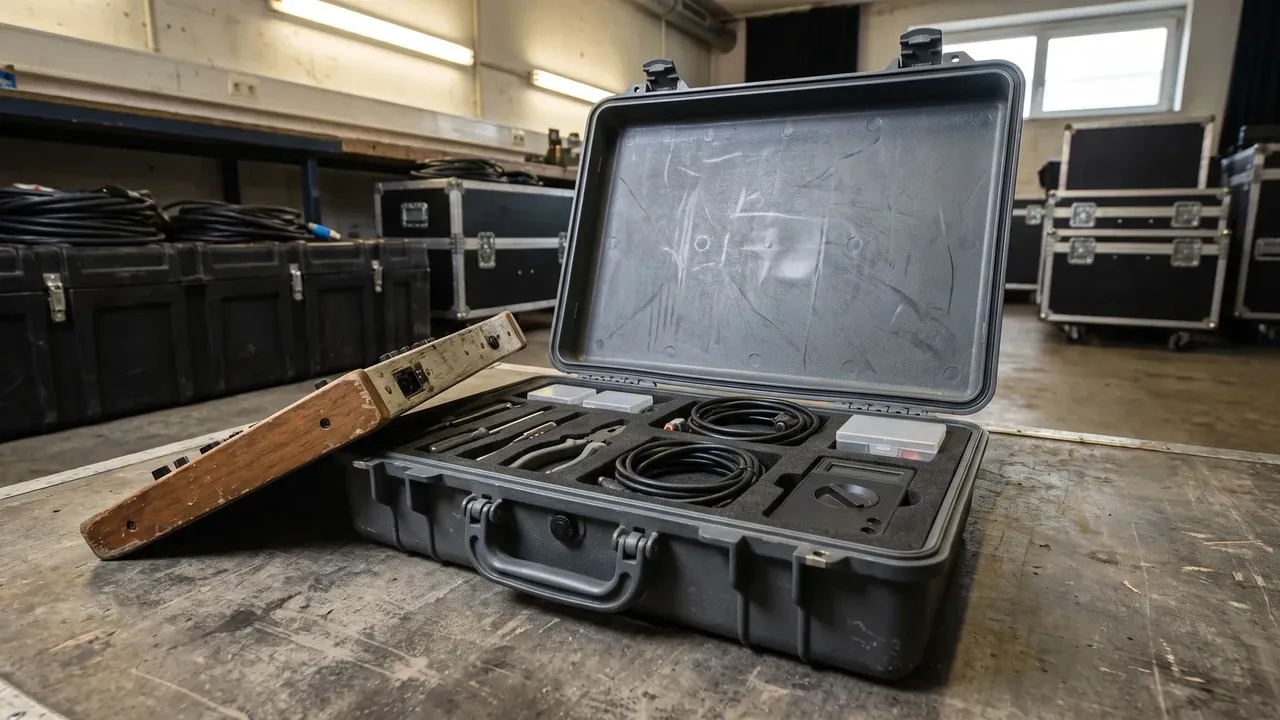
A valve vents that difference. The common build puts a breathable membrane behind a spring disc that cracks at 5 to 10 kPa and closes once pressures equalise. It buys opening effort and shell stress, not water resistance.
A valved case claiming IP67 needs its own verification: thread sealing at the wall, membrane integrity, disc reseat. Maintenance decides the trade: valved cases want a membrane check every six months, unvalved ones a stiff lid after transport.
5. Seal Failure at Minus Twenty
Temperature closes the loop on IP rating selection for instrument cases. A seal set at 25 percent at room temperature roughly doubles in hardness at minus twenty; the latch still closes, but the cord no longer follows the groove.
Materials diverge from there. Silicone stays flexible at minus twenty with hardness up 10 to 15 points; EPDM approaches glass transition and takes a permanent set; nitrile stiffens earlier still. The shell moves as well, ABS expanding an order of magnitude more than steel, so latch fits loosen.
| Temperature | Cord hardness | Rebound | Main risk |
|---|---|---|---|
| 23 C | Reference | Normal | None |
| Minus 10 C | Up 10 points | Slower | Stiff lid |
| Minus 20 C | Up 15 to 20 points | Clearly slower | Corners lift |
| Minus 30 C | Near material limit | Lagging | Permanent set |
Three fixes stack: raise compression to 30 percent for cold duty, move to a low-temperature compound, or deepen the groove 0.2 to 0.3 mm. A cold test only counts after four hours of soak, once the cord has reached temperature.
Related Reading
JUNZHIJIA
Related Products
- 8 Series — Gun Cases; Military Equipment Cases; Camera Equipment Cases; Drone Cases; Watch Cases; Knife Cases; First Aid Cases; Electronics Equipment Cases
- WL8-2812 PP Gun Case — model WL8-2812
- All protective cases and toolboxes: 7 series, 158 models