

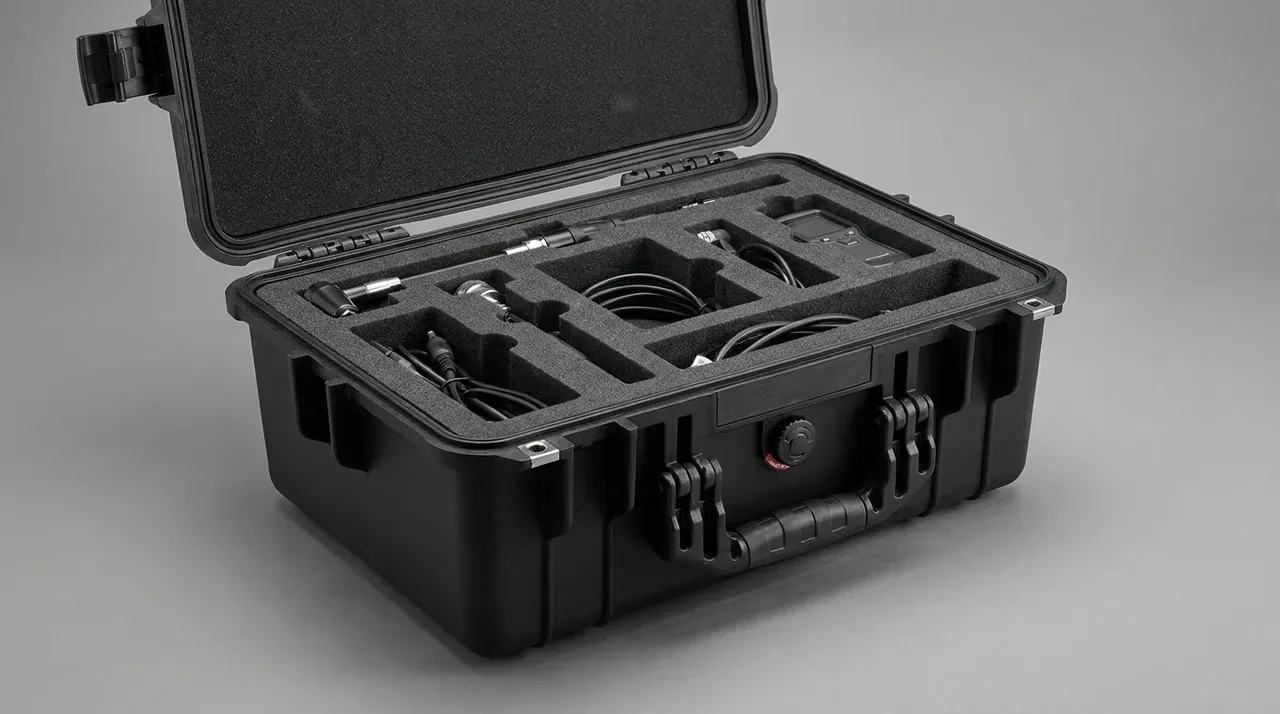
Quick answer: IP67 waterproof NDT testing instrument protective case: 460×350×200 mm outside, 155 mm inside depth driven by a 120 mm cable coil, 4.2 kg empty.
Table of contents
- Why the 200 mm depth follows the cable coil
- Couplant is handled by compartments, not the seal
- IP67 stops water outside; condensation is separate
- Two latches at 350 N and 3 000 cycles
- −20 °C to 60 °C against a 1.0 m drop
- FAQ
1. Why the 200 mm depth follows the cable coil
On an IP67 waterproof NDT testing instrument protective case, depth is set by the coiled lead, not by the instrument. A coaxial cable wound for field work sits near 120 mm outside diameter and needs 130 mm of clear height stood on edge. Add a 30 mm EVA base pad and internal height locks at 155 mm, which puts external depth at 200 mm.
The envelope is 460×350×200 mm against 400×290×155 mm inside; the 60 mm and 45 mm differences carry 3.0 mm of shell, the lip that holds the gasket, and the base ribs.
| Field condition | Case response | Value |
|---|---|---|
| Coil at 120 mm cannot fold | Height by coil plus bend allowance | 155 mm inside |
| Instrument and probes together | Divided slots, no contact | 9 slots |
| Rain and airborne dust | Gasket compressed by the lip | IP67 (1 m / 30 min) |
| Pressure swing | One-way relief valve | opens at 8 kPa |
At 4.2 kg empty plus instrument and leads, a one-handed walk of 200 m forces a hand change, so the handle sits above the centre of mass, with two latches rated 350 N holding the lid through a 1.0 m drop.
2. Couplant is handled by compartments, not the seal
Couplant inside the IP67 waterproof NDT testing instrument protective case is not a sealing problem: it arrives on the bottle and the probe face, never through the gasket.
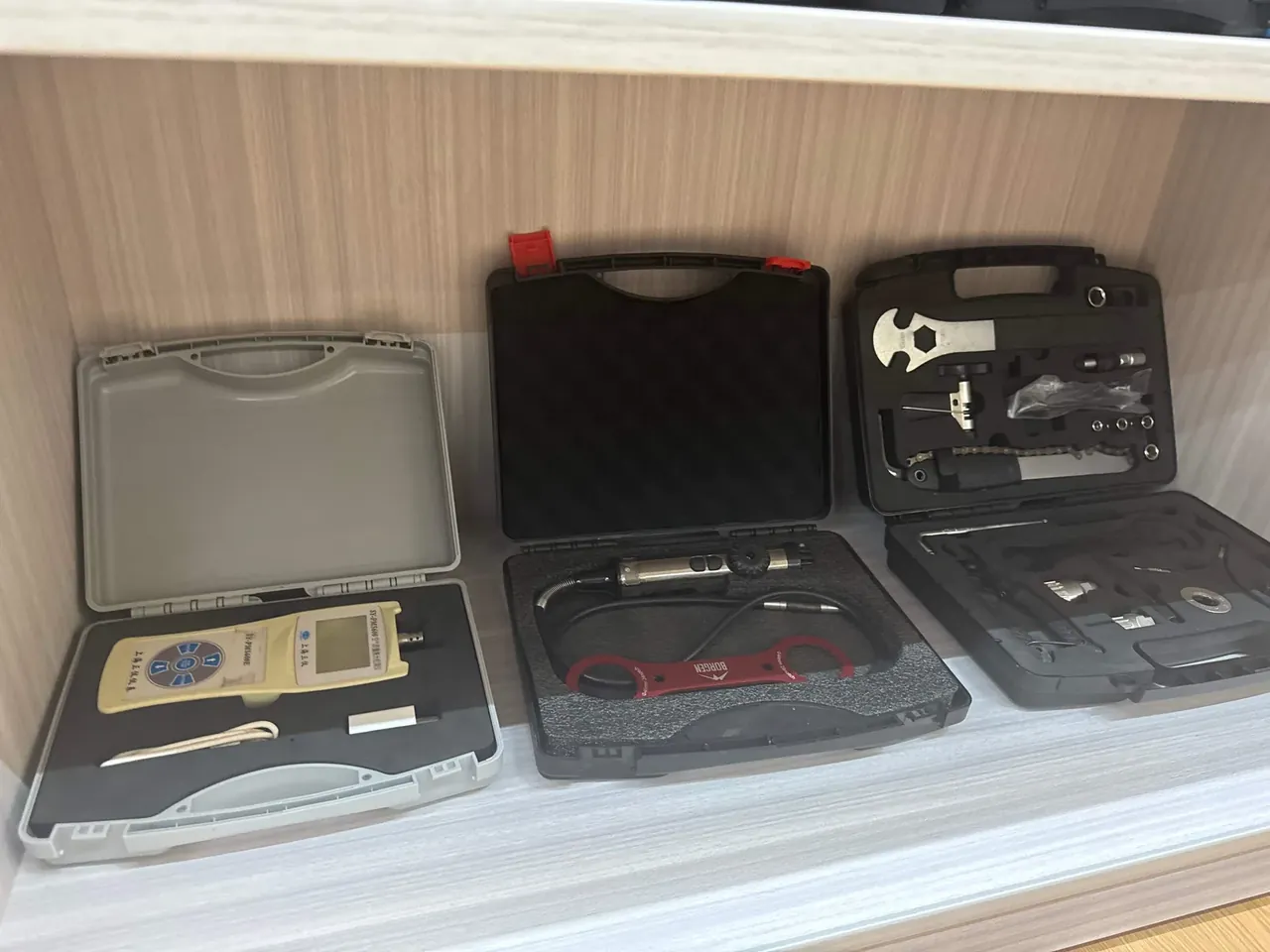
Two of the 9 slots are reserved: a 40 mm round-bottomed recess for the bottle and a pad pocket sunk 5 mm below the foam face.
Dividers stand 25 mm, 5 mm under the foam face. A 250 mL bottle shaken flat for 3 min put visible liquid in the neighbouring slot at 20 mm walls, and none at 25 mm.
The 30 mm EVA is the base pad, not the divider: closed-cell foam at 25 °C returns to 95% of its thickness after 40% compression.
| Leak path | Where it is stopped | Value |
|---|---|---|
| Residue down the bottle | Round recess plus pad | 40 mm deep |
| Film wiped off the probe | Divider height step | 25 mm wall |
| Rain along the lip | Gasket in the groove | IP67 |
| Moisture from breathing | Valve plus desiccant | 50 g |
3. IP67 stops water outside; condensation is separate
The two digits on this IP67 waterproof NDT testing instrument protective case answer different questions: 6 is dust, 7 is no ingress at 1 m for 30 min. Both describe liquid outside the shell, not vapour already inside.
A case that sat at 5 °C is opened at 35 °C and beads up at once; the tighter the seal, the less moisture escapes, so 50 g of desiccant sits in a lid pocket.
The 8 kPa valve serves that breathing cycle: above 8 kPa of differential the disc lifts and reseats as the difference falls. Below 8 kPa, wind pressure in rain can open it; above 12 kPa, the lid is hard to open after a cargo-hold drop.
Rating and valve are not in conflict: one handles liquid, the other vapour.
Inspection of an IP67 waterproof NDT testing instrument protective case is two movements: check the disc sits flat, then feel compression around the lip. It is designed at 30%, and a softer section is carrying no load.
4. Two latches at 350 N and 3 000 cycles
More latches are not better. At 460 mm of length, two at the third points keep mid-lid deflection lowest; four add two movements to every opening.
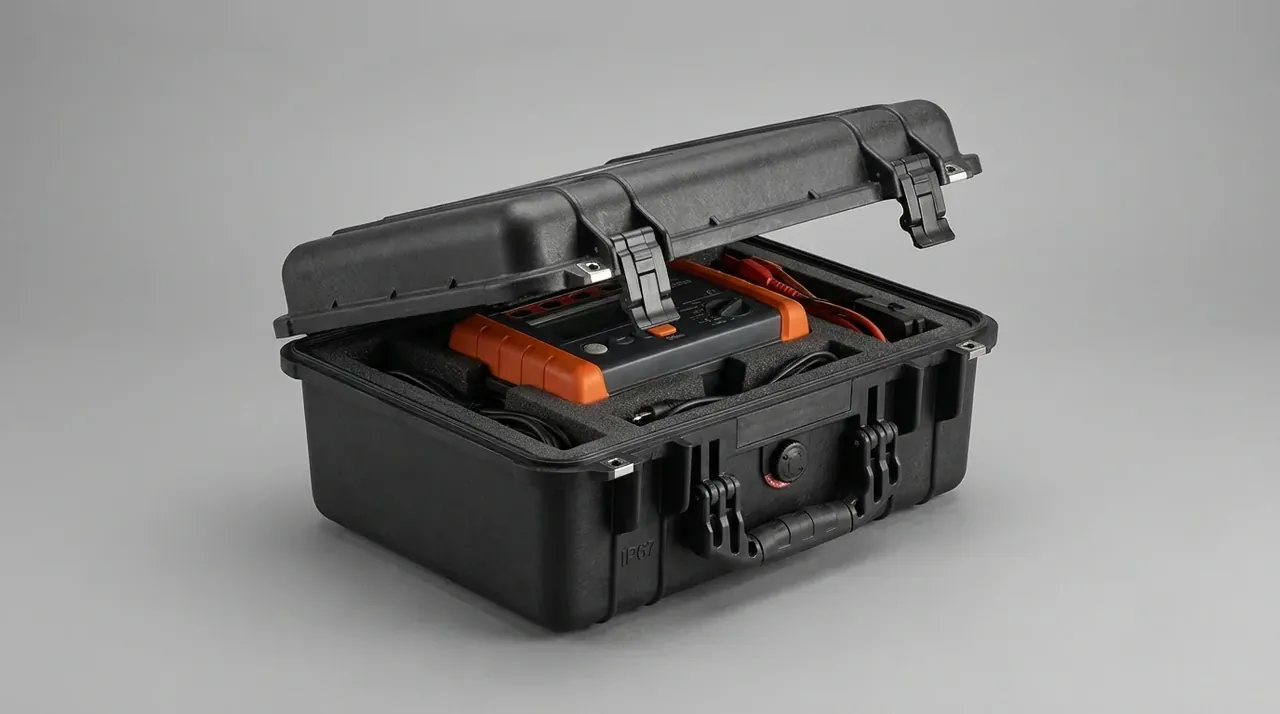
350 N is holding force, not hand force: in a 1.0 m drop the lid load splits across two latches at roughly 200 N each, and the margin absorbs pin wear.
The 3 000 cycles come from 8 openings a day over 250 working days for eighteen months; pin clearance stays under 0.3 mm at the end.
On this IP67 waterproof NDT testing instrument protective case each boss thickens from 3.0 mm to 5.5 mm without raising total weight, and the stainless pins show no rust after 48 h of salt spray.
5. −20 °C to 60 °C against a 1.0 m drop
The IP67 waterproof NDT testing instrument protective case range reads −20 °C to 60 °C, 5 °C narrower at each end than the common −25 °C to 65 °C, because a 3.0 mm wall cannot hold cold impact and hot stability further out.
The cold end is a drop: 4 h at −20 °C, then one fall on each of six faces from 1.0 m, with no cracking, latch release or gasket shift. The hot end is shape: 6 h at 60 °C leaves the 460 mm long edge within 1.5 mm.
A case carried at one side sits 0.8 m to 1.0 m up and lands on an edge more often than a face, so edges are radiused at R8.
| Check | Condition | Pass line |
|---|---|---|
| Water ingress | 1 m still water, 30 min | no water inside |
| Air tightness | 8 kPa held | ≤0.3 kPa loss in 30 s |
| Drop | 1.0 m, six faces | no crack, latches shut |
| Heat | 60 °C for 6 h | long edge within 1.5 mm |
| Cycling | 3 000 open and close | pin clearance ≤0.3 mm |
Conclusion
Three numbers on an IP67 waterproof NDT testing instrument protective case get overlooked: the 155 mm internal height that follows from a 120 mm cable coil, the 8 kPa valve that manages breathing rather than water entry, and the 50 g desiccant that manages condensation rather than leakage. Keep them apart and the 3.0 mm wall and 4.2 kg empty weight fall into place.
Related Reading
- Detection instrument case buying guide
- How airtight leak testing is run
- Foam specifications for instrument cases
- Gasket ageing and replacement
Related Products
- 8 Series — Gun Cases; Military Equipment Cases; Camera Equipment Cases; Drone Cases; Watch Cases; Knife Cases; First Aid Cases; Electronics Equipment Cases
- WL8-2812 PP Gun Case — model WL8-2812
- All protective cases and toolboxes: 7 series, 158 models