

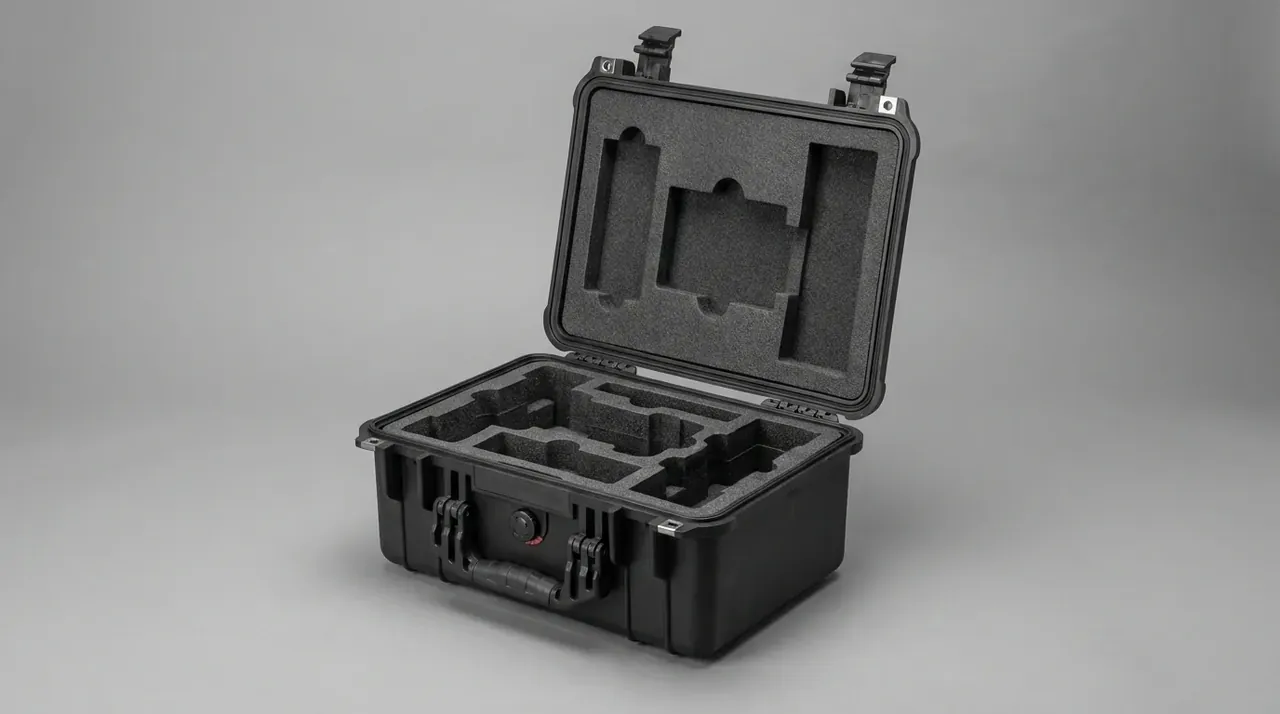
Quick answer: IPX5 IPX6 comparison turns on the nozzle, not the shell: 6.3 against 12.5 mm bore, 12.5 against 100 L/min, 30 against 100 kPa at the tip.
Table of contents
- The gap sits in the nozzle, not the shell
- Bore size sets jet shape and load pattern
- Flow rate drives water, drainage and scheduling
- What 30 kPa and 100 kPa feel like in practice
- Positioning the sample and reading the result
- FAQ
1. The gap sits in the nozzle, not the shell
Hang a 40 L hard case in the booth and hit the front for 3 min. The 6.3 mm nozzle of an IPX5 run leaves about 1.4 N on the wall; the 12.5 mm nozzle of IPX6 leaves roughly 22.7 N.
Both runs share one rig: lance, hose, flowmeter, gauge, timer. Only bore and pump change. Exit area grows from 31.2 mm² to 122.7 mm², a factor of 4; flow grows from 12.5 L/min to 100 L/min, a factor of 8. Velocity only doubles, from 6.7 m/s to 13.6 m/s.
| Grade | Bore | Flow | Exit velocity | Pressure at tip | Standoff and duration |
|---|---|---|---|---|---|
| IPX5 | 6.3 mm | 12.5 L/min | 6.7 m/s | 30 kPa | 2.5 to 3 m, 3 min |
| IPX6 | 12.5 mm | 100 L/min | 13.6 m/s | 100 kPa | 2.5 to 3 m, 3 min |
| IPX5, extended | 6.3 mm | 12.5 L/min | 6.7 m/s | 30 kPa | extra 1 min per m² |
| IPX6, extended | 12.5 mm | 100 L/min | 13.6 m/s | 100 kPa | extra 1 min per m² |
Stagnation pressure scales with velocity squared, which is why the gauge reads 30 kPa on one run and 100 kPa on the other, and why panel force climbs about 16 times.
A grade on a report is a label; the nozzle is what the wall feels.
2. Bore size sets jet shape and load pattern
A 6.3 mm bore breaks up around 2.5 m and lands as a fist-sized patch. A 12.5 mm bore leaves twice as fast, holds together at 3 m, and arrives as a sheet a hand wide.
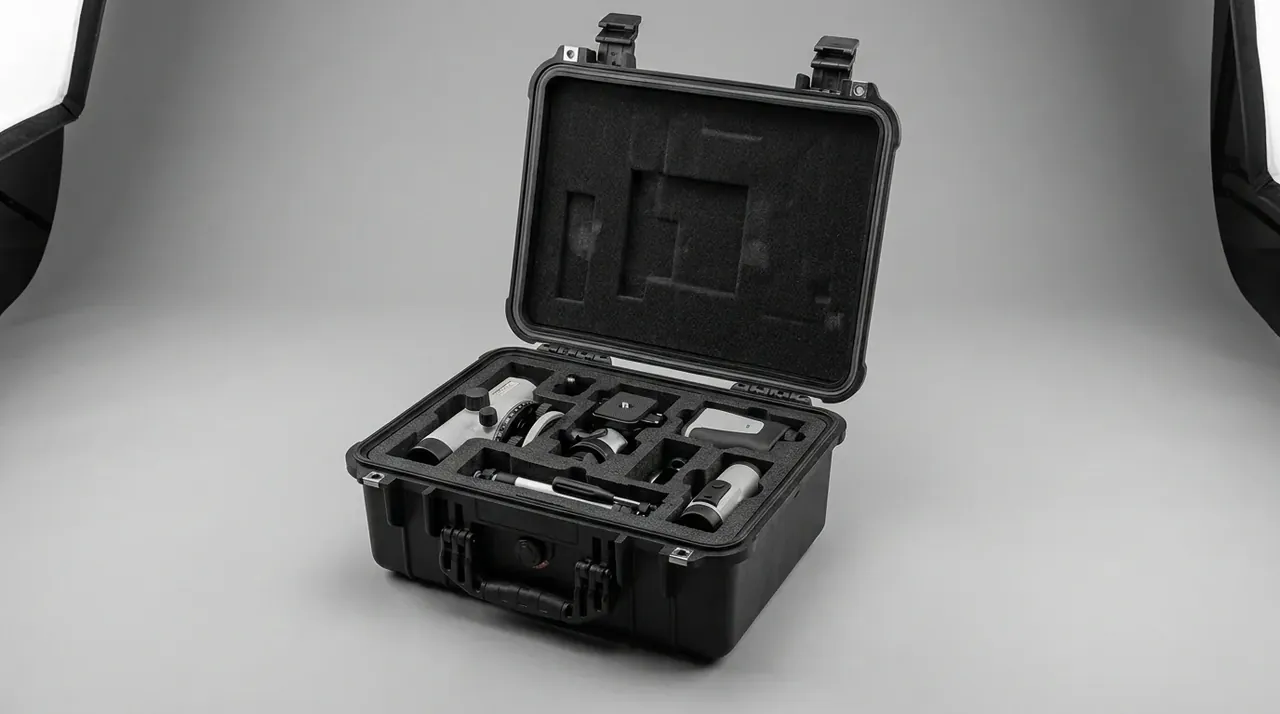
That changes the load type. The small bore gives a point load: a 3 mm wall deflects locally and the foam barely moves. The large bore loads the whole lid seam, and every latch gap works open and shut for 3 min.
Structure follows. IPX5 needs a continuous sealing face and two latches. IPX6 needs rib stiffness behind the seam: space latches past 220 mm and the middle bows, opening a path.
Rain on a truck bed and washdown at a dock are low-momentum; a pressure washer in a mixing plant is not, which settles the choice.
3. Flow rate drives water, drainage and scheduling
At 12.5 L/min a 3 min run uses 37.5 L, which a 60 L tank absorbs. At 100 L/min it uses 300 L, and a bench without recirculation cannot keep up.
Drainage is the part people forget. Three minutes at 100 L/min puts 15 mm of water on the floor of a 20 m² room, so size the drain for 6 m³/h or the case sits in its own runoff.
Pump headroom bites too. A 12.5 mm nozzle on a pump sized for the small bore sags the gauge to under 15 kPa; add a 20 L accumulator. One bench then pushes 20 shells a day at the lower grade, 6 at the higher one.
4. What 30 kPa and 100 kPa feel like in practice
30 kPa is a 3 m head on one spot; 100 kPa is 10 m, or 1 bar. Mains water at 200 to 400 kPa is static pressure in a pipe, not jet pressure, so the two are not comparable.
Moving water is a better yardstick. A stream at 2 m/s carries 2 kPa. A pressure washer at 8 MPa is 80 times the IPX6 figure; a fire hose at 0.4 MPa is 4 times it.
A free jet loses about 60 percent of its pressure over 3 m, leaving 40 kPa for IPX6 and 12 kPa for IPX5 at the panel. Hence the standoff of 2.5 m to 3 m: closer and the load runs high, farther and it runs soft.
Quotations go wrong here. A shell specified against 100 kPa asks for three times an IPX5 result, exactly an IPX6 result, and the reverse does not hold.
5. Positioning the sample and reading the result
Under 0.1 m² of exposed face, one 3 min pass on the front is enough. Above that, work in stages at 1 min per angle, turntable carrying the case through 360°.
| Exposed face | Angles | Time each | Turntable | Total |
|---|---|---|---|---|
| Up to 0.1 m² | 1, front | 3 min | static | 3 min |
| 0.1 to 0.5 m² | 4, front back left right | 1 min | 360° constant | 4 min |
| 0.5 to 1 m² | 6, adding top | 1 min | 360° constant | 6 min |
| Above 1 m² | 1 extra angle per m² | 1 min | indexed | adds with area |
Mount the case as it will be used: lid up, valve and handle in the worst position. Turn the valve up and water creeps through the membrane; lay it sideways and the shell takes half as much.
Open within 1 h, wipe, lift the lid. The criterion is no harmful ingress, on two points:
- Acceptable: up to 5 mL pooling on the floor, drying with one pass of paper, no continuous line behind a latch.
- Rejected: droplets inside the valve, or a connected water trace behind the liner.
Write four items on the record: bore, flow, pressure ahead of the nozzle, standoff. Omit one and the report proves only that water was sprayed.
Conclusion
Choosing between IPX5 and IPX6 comes down to three figures: 6.3 mm against 12.5 mm at the nozzle, 12.5 against 100 L/min on the flowmeter, 30 against 100 kPa on the gauge. Together they mean a sixteenfold impact load and a different requirement for lid seam stiffness. Rain and washdown sit inside the lower grade; a directed hose needs the higher one, with latches under 220 mm. Put those figures in the annex.
This article covers case-side specifications only and does not address any handling, loading or use of the contents.
Related Reading
- How to read both digits of an IP code
- Rain and pressure-washing tests compared
- Checking an IP67 certificate page by page
- Leak testing and spray testing in sequence
- Reading the conditions page of a third-party report
Related Products
- 8 Series — Gun Cases; Military Equipment Cases; Camera Equipment Cases; Drone Cases; Watch Cases; Knife Cases; First Aid Cases; Electronics Equipment Cases
- WL8-2812 PP Gun Case — model WL8-2812
- All protective cases and toolboxes: 7 series, 158 models