

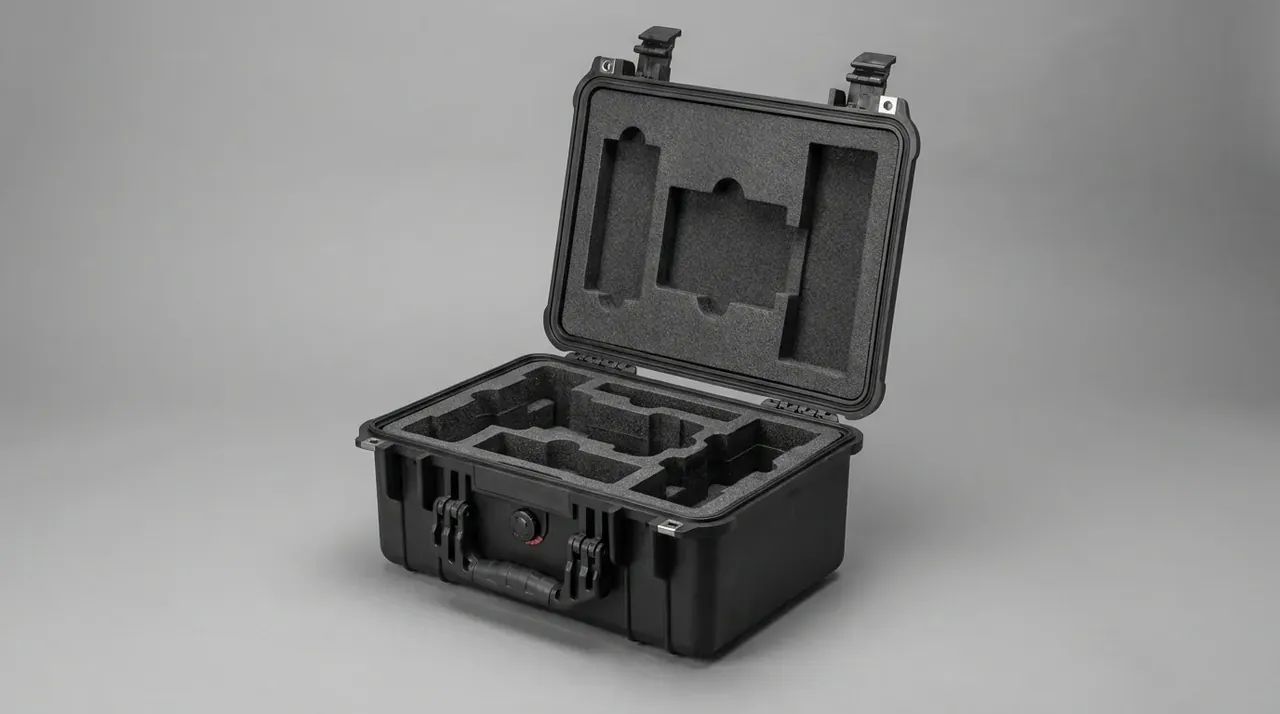
Quick answer: Case water test methods use three loads that never substitute: 100 L/m²/h spray for 3 min, 1 m immersion for 30 min, and 20 kPa decay held 120 s.
Table of contents
- Why Rain Alone Is Not Enough
- Rain Test: Intensity, Angle, Duration
- Immersion Test: Depth, Time, Heated Water
- Pressure Decay and Flow Testing
- What Each Method Actually Catches
- Sampling Ratios and Batch Decisions
- FAQ
1. Why Rain Alone Is Not Enough
A case that fails rain gives its leak away to a pressure rig in 30 s; a case that passes rain can still trip it. Spray is dynamic wash, immersion is static head, pressure is a differential with a gas path through the wall.
A 520 mm × 420 mm × 210 mm case projects 0.22 m², so 3 min at 100 L/m²/h delivers 1.1 L. That wets a gasket line and never fills a gap, so rain finds an uncompressed gasket, never a 0.2 mm pinhole. At 20 kPa the equivalent head is 2 m, and a slot 0.05 mm wide by 30 mm long passes enough air in 60 s to push decay past 0.3 kPa.
2. Rain Test: Intensity, Angle, Duration
Spray testing is the fastest of the case water test methods, with three variables that must be written down: intensity, angle, duration. Intensity is quoted per projected area, normally 100 L/m²/h, which is a 6.3 mm nozzle at 30 kPa; the severe setting lifts pressure to 100 kPa and flow to 100 L/min with the same bore.
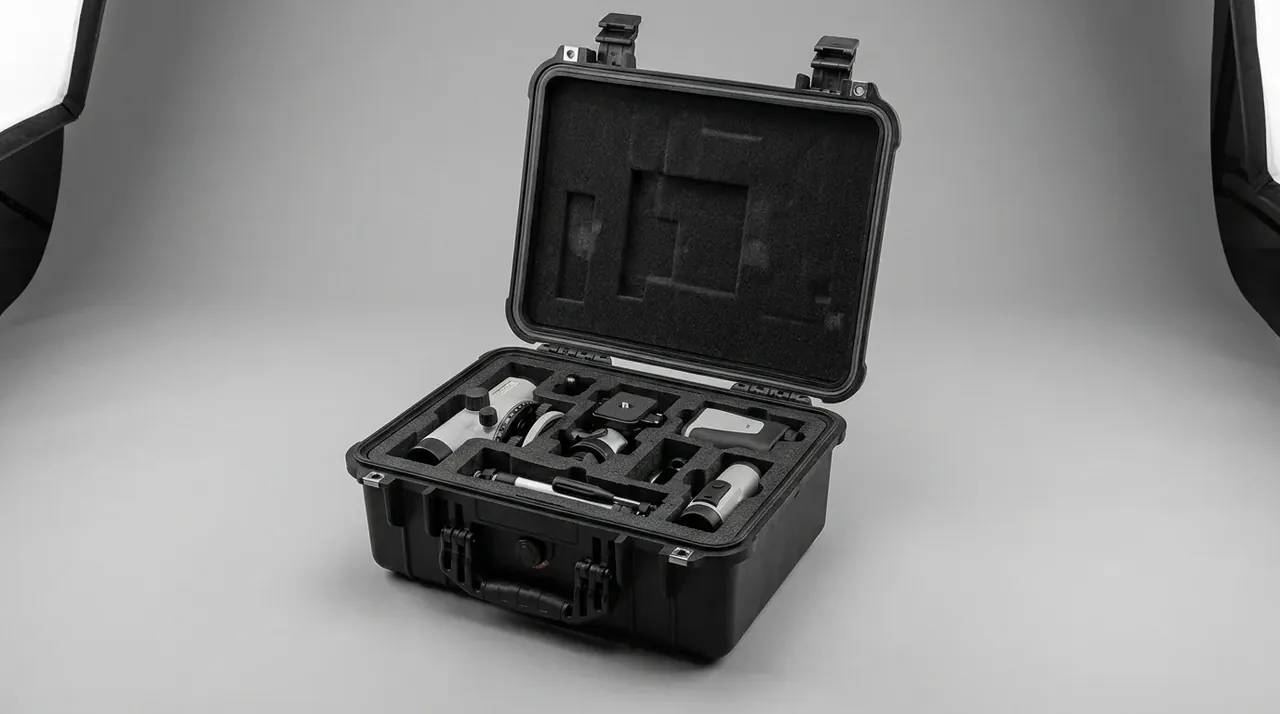
Angle decides more than expected: run 0° and ±60° with the boom at 1 r/min and 2.5–3 m standoff, because a raised lid rib shadows the gasket at 0° and exposes it at 60°.
Duration is not fixed at 3 min: at 3 min/m² the case needs 3 min as a floor, and a wheel housing adds 1 min. Water sits at 20 ± 5 °C and within 5 °C of the case, or an 8 °C case in a 25 °C spray tests shrinkage, not sealing.
| Item | Standard | Severe |
|---|---|---|
| Intensity | 100 L/m²/h | 100 L/min |
| Pressure | 30 kPa | 100 kPa |
| Pass | no droplets | gain ≤2 g |
3. Immersion Test: Depth, Time, Heated Water
Immersion applies static head: 10 kPa at 1 m, half the pressure rig's load, held 30 min so water creeps into micro-gaps. The closed case sinks until the lid sits 1 m below the surface at 20 ± 5 °C, then the outside is dried and the lid opened.
The heated variant simulates a swing in transit: pre-charge to 20 kPa, immerse 1 m in 65 °C water for 30 min, cool within 5 min. A vacuum forms, water is drawn toward the gasket, and the round finds a gasket that softens at 65 °C and takes a set.
Acceptance is three dry zones plus a mass check of 1 g, roughly 1 mL of water; above that the leak is continuous, not condensation, which 4 h at 40 °C and 90% RH tests separately. Depth and time move together, 2 m and 60 min for deck duty, 3 m and 24 h for subsea, every extra metre adding 10 kPa and pushing gasket compression from 25% to 35%.
4. Pressure Decay and Flow Testing
Pressure testing is non-destructive, which is why it can sit on a production line. Decay charges to 20 kPa, stabilises 30 s, then holds 120 s; 0.3 kPa or less passes, and cases above 60 L get 0.05 kPa per extra 10 L.
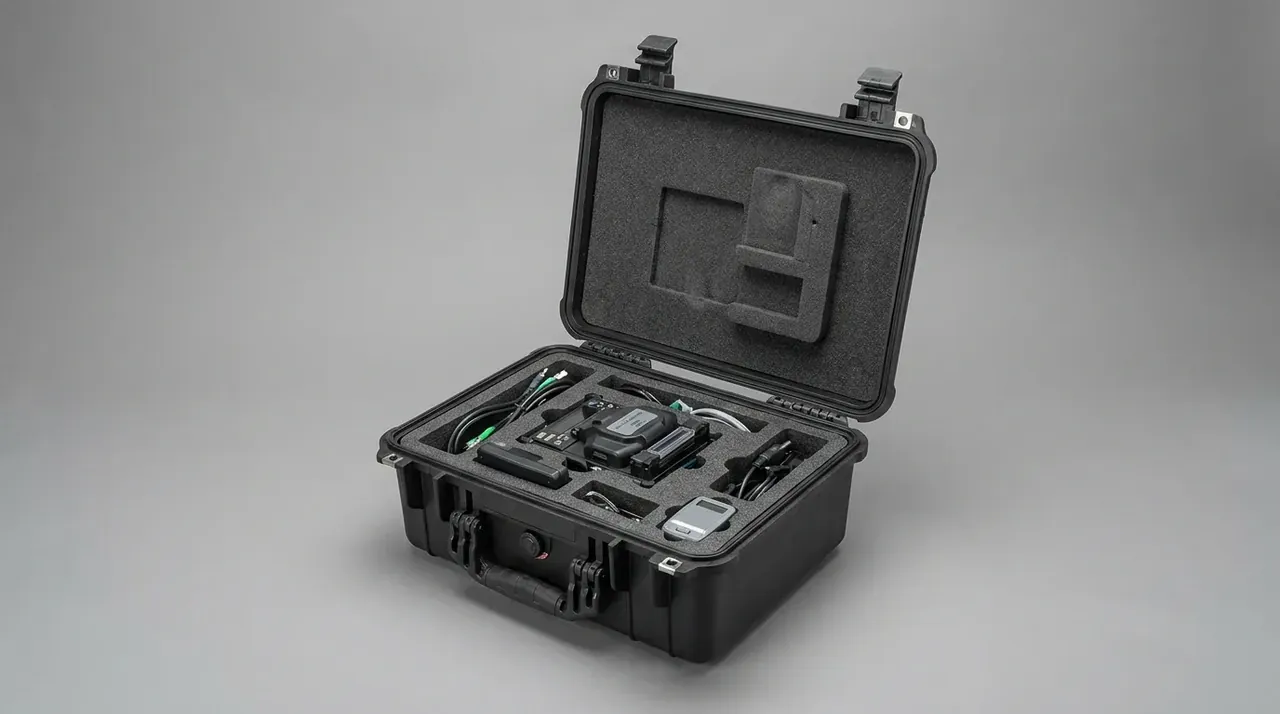
Flow testing runs at 5 kPa against a laminar meter and reads leak rate directly, gated at 30 mL/min; the number needs no volume compensation, but a 5 °C shop swing moves it 15%. Both routes fail first on the fixture: calibrate it empty, and if its decay exceeds 0.1 kPa, fix the fixture first.
| Method | Pressure | Cycle | Reading | Best use |
|---|---|---|---|---|
| Decay | 20 kPa | 150 s | kPa drop | 100% line check |
| Flow | 5 kPa | 45 s | mL/min | Failure analysis |
| Bubble | 0.5 kPa | 30 s | bubble position | Pinpointing |
5. What Each Method Actually Catches
Gasket collapse is caught by immersion only. When the lid rib stands under 1.5 mm, latch tension drops compression below 25%: 3 min of spray may not enter while 30 min of head always does, and pressure can pass the unit, because water pushes the soft gasket down while gas still finds a path.
Parting-line flash is the pressure method's home ground: a 0.05 mm fin holds a 3 min water film and cannot hold 20 kPa. Corner sink marks sit between the two: at 0.3 mm spray pools water, immersion seeps, and the rig reads normal, since a sink mark is a surface defect, not a through path.
Threaded inserts and relief valves seal on an O-ring, fail as slow seepage, and leave the gasket line merely damp after 30 min immersion. Hinge-boss warpage needs a −10 °C immersion round.
6. Sampling Ratios and Batch Decisions
Because the loads destroy or delay, case water test methods carry different sampling ratios. Decay is non-destructive at 150 s per unit and runs 100%. Rain needs foam removal and 4 h of drying, so it runs 3 units per batch. Immersion runs 1 unit per batch, for first articles and new gasket lots.
First articles get all three, to pin the mould state: cavity number, press and hold-pressure curve. Production then follows AQL 2.5 counting sampling with 13 pieces and an acceptance number of 1; two consecutive failures stop the line.
Conclusion
Treat the three methods as three sieves, not one exam taken three times. Case water test methods should end in a defect verdict: gasket collapse belongs to immersion, a through path belongs to pressure, surface wetting belongs to rain, and only a case clearing all three has earned a rating. Run all three on the first article, then 100% decay with 3 rain and 1 immersion unit per batch, and send every leak back to mould coordinates, not a tube of compound.
| Defect | Most sensitive | Criterion | Passes anyway |
|---|---|---|---|
| Gasket collapse | Immersion 1 m, 30 min | gain >1 g | Rain 3 min |
| Flash 0.05 mm | Decay 20 kPa, 120 s | drop >0.3 kPa | Rain 3 min |
| Corner sink 0.3 mm | Immersion 1 m, 30 min | pooled water | Decay normal |
| Valve seepage | Flow 5 kPa | rate >30 mL/min | Immersion damp only |
This article discusses container-side specifications and design implications only, and does not cover any handling, loading or use of the contents.
Related Reading
- How to size the gasket groove
- Running an air leak test correctly
- What the relief valve does under temperature swing
- Judging batches with AQL 2.5 sampling
- Depth requirements for subsea equipment cases
Related Products
- 8 Series — Gun Cases; Military Equipment Cases; Camera Equipment Cases; Drone Cases; Watch Cases; Knife Cases; First Aid Cases; Electronics Equipment Cases
- WL8-2812 PP Gun Case — model WL8-2812
- All protective cases and toolboxes: 7 series, 158 models