


Quick answer: Kayak/surfboard sealed waterproof dry case: 380×280×160 mm outside, 8.5 kg positive buoyancy, four tie-down rings at 200 N, O-ring 4 mm at 22%.
Table of contents
- On deck, tie-down points come before the seal
- Floating upright comes from 8.5 kg of buoyancy, not the gasket
- After salt water, the seal face has to come off for rinsing
- 500 h of UV against a 3.2 mm wall
- A 1.5 m drop against a 2.6 kg empty case
- FAQ
1. On deck, tie-down points come before the seal
A Kayak/surfboard sealed waterproof dry case lands on a curved deck, and the rings decide more than the gasket does. Webbing can only pull along two lines on that curve, so the shell has to sit between them or it walks with every swell.
Four rings, two forward and two aft, each rated 200 N. That figure follows the webbing: 25 mm polyester creeps into a cam buckle near 150 N and grooves the side wall.
The 200 N is holding force, not webbing break strength.
On a Kayak/surfboard sealed waterproof dry case each boss is moulded into the wall, not bonded on. The body is 3.2 mm and the root thickens to 6 mm locally; a bonded boss peels in cold weather, a moulded one has no joint.
| Mount point | Method | Load |
|---|---|---|
| Forward deck | 25 mm webbing through ring and cam | 200 N per point |
| Aft deck | Opposite pull, paired with the front | 800 N for all four |
| Board tail | Bungee through two rings | 200 N per point |
2. Floating upright comes from 8.5 kg of buoyancy, not the gasket
Whether a case floats face up is set by the gap between centre of buoyancy and centre of mass, not by gasket pressure. Positive buoyancy here is 8.5 kg, from displaced water.
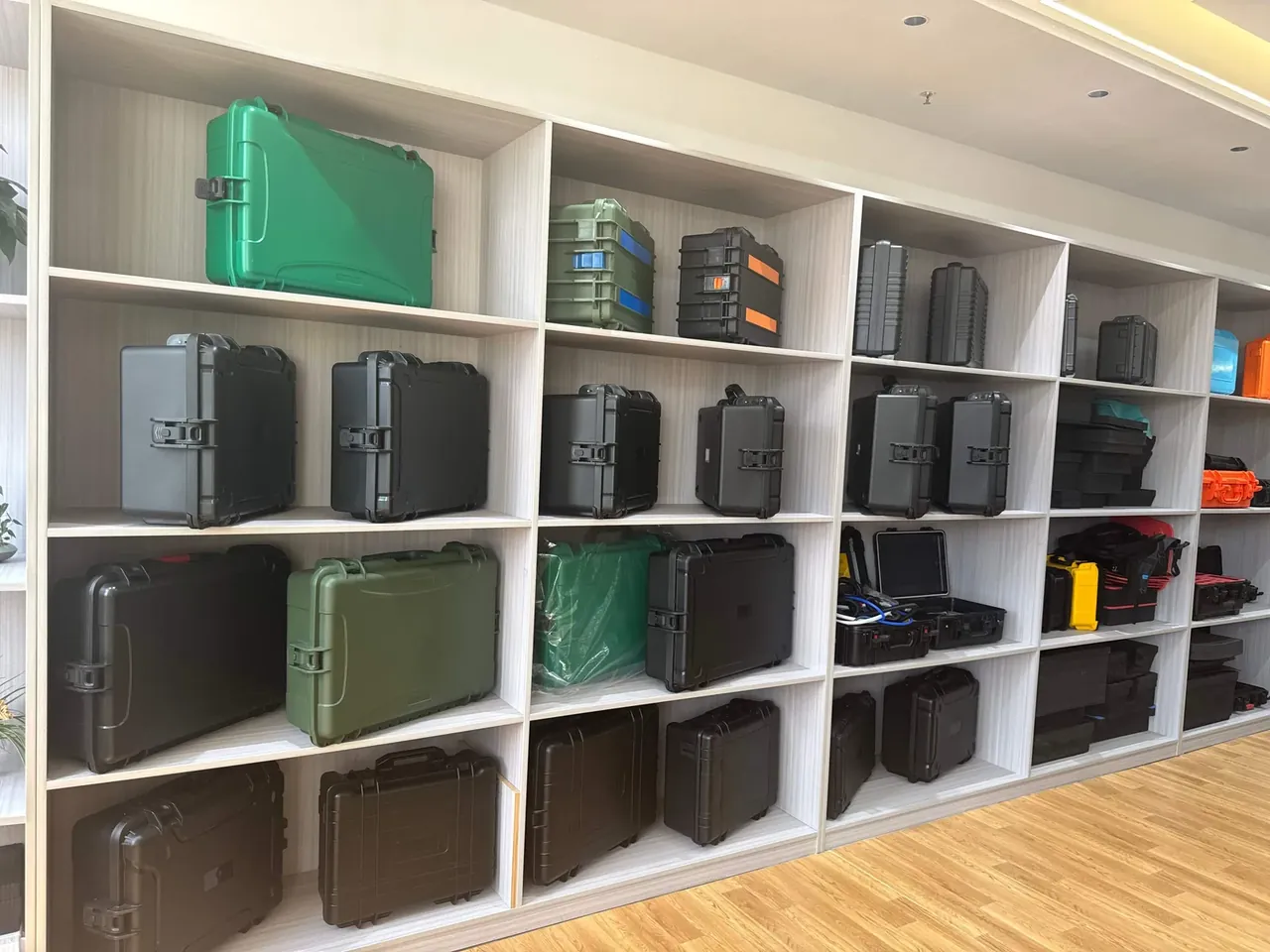
The arithmetic is outside volume minus material: 380×280×160 mm is about 17 L, the 330×230×120 mm interior about 9.1 L, the wall 3.2 mm, the empty case 2.6 kg. Displaced water outweighs the shell, so it floats; once water gets in, the lift goes with the volume.
Weight placement beats total: latches and hinge sit on opposite long sides, hardware under 200 g, and the centre of mass falls 8 mm below centre.
On a Kayak/surfboard sealed waterproof dry case the seal protects buoyancy rather than producing it. Acceptance work trips on that: 1 m / 30 min immersion asks whether water got in, not whether it floats.
Attitude is measured, not assumed. Dropped from 1.5 m, an empty case returns lid-up within 3 s at no more than 25° of tilt and holds it for over ten minutes; entering vertically, it needs another 1 s to 2 s and tilts past 40°.
3. After salt water, the seal face has to come off for rinsing
Salt crystallises on the seal face and lifts the O-ring off the groove floor; under 10% compression, IP67 is gone. This Kayak/surfboard sealed waterproof dry case uses a 4 mm ring in a 3.1 mm groove, compressed 22%, relying on the ring's own rebound rather than adhesive.
On this Kayak/surfboard sealed waterproof dry case the ring lifts out in one piece because the groove is not glued: rinse, dry, press back by hand.
The 22% is calculated: 4 mm of section against a 3.1 mm groove leaves 0.9 mm, or 22.5%, which keeps the ring elastic.
A 0.6 mm lip on the outer edge of the groove stops sand. Without it, grit is pressed to the floor and compression falls from 22% to 12%, which no latch force recovers. On this Kayak/surfboard sealed waterproof dry case the lip sits outside the groove so grit can travel out.
| Medium | Seal face treatment | Value |
|---|---|---|
| Salt water | Ring out, fresh rinse, dry, refit | 4 mm section |
| Fine sand | Groove lip blocks grit | 22% compression |
| Salt spray | Stainless latch pins and hinge | 48 h, no rust |
4. 500 h of UV against a 3.2 mm wall
A case strapped to a deck lives in sunlight, and UV breaks surface chains until the skin chalks away. The Kayak/surfboard sealed waterproof dry case is verified at 500 h of UV ageing, then re-measured for colour shift and impact strength.

The 3.2 mm wall carries margin for that. Chalking after 500 h reaches roughly 0.1 mm, and the remaining 3.1 mm still has to survive a 1.5 m drop. Samples at 2.5 mm cracked at the edge on the same drop.
The band reads −10 °C to 55 °C, narrower than a land case: a deck rarely drops below −10 °C, while sun pushes the surface to 55 °C and interior air 5 °C to 8 °C higher.
Two results are checked after ageing: colour shift within ΔE 3, notched impact above 70% of original. On this Kayak/surfboard sealed waterproof dry case both stay inside the line at 500 h.
5. A 1.5 m drop against a 2.6 kg empty case
The 1.5 m is not a transport drop height but gunwale plus hand height. Handing a case up from a boat, a fumble drops the base 1.2 m to 1.5 m onto a corner or long edge.
The Kayak/surfboard sealed waterproof dry case carries two latches at 260 N each. In the drop the load splits between them at roughly 120 N per latch, the margin covering pin wear and cold brittleness.
An empty 2.6 kg lifts in one hand; loaded it doubles, so the handle becomes the only contact point.
Drop testing runs once on each of six faces and each edge: no crack, no latch release, no O-ring pushed out of its groove. Cold samples sit at −10 °C for 4 h first.
Conclusion
Three numbers carry this Kayak/surfboard sealed waterproof dry case: four rings at 200 N set the webbing and boss geometry, 8.5 kg of buoyancy decides whether it comes up lid-high, and a 4 mm O-ring at 22% compression decides whether IP67 survives a season of rinsing. The 3.2 mm wall, the 2.6 kg empty weight and the 1.5 m drop follow from those three.
Related Reading
- Hard-shell structure of diving dry boxes
- How fishing and marine gear cases are fixed
- Dry bag versus hard case
- Acceptance criteria for hard plastic waterproof cases
Related Products
- 8 Series — Gun Cases; Military Equipment Cases; Camera Equipment Cases; Drone Cases; Watch Cases; Knife Cases; First Aid Cases; Electronics Equipment Cases
- WL8-2812 PP Gun Case — model WL8-2812
- All protective cases and toolboxes: 7 series, 158 models