

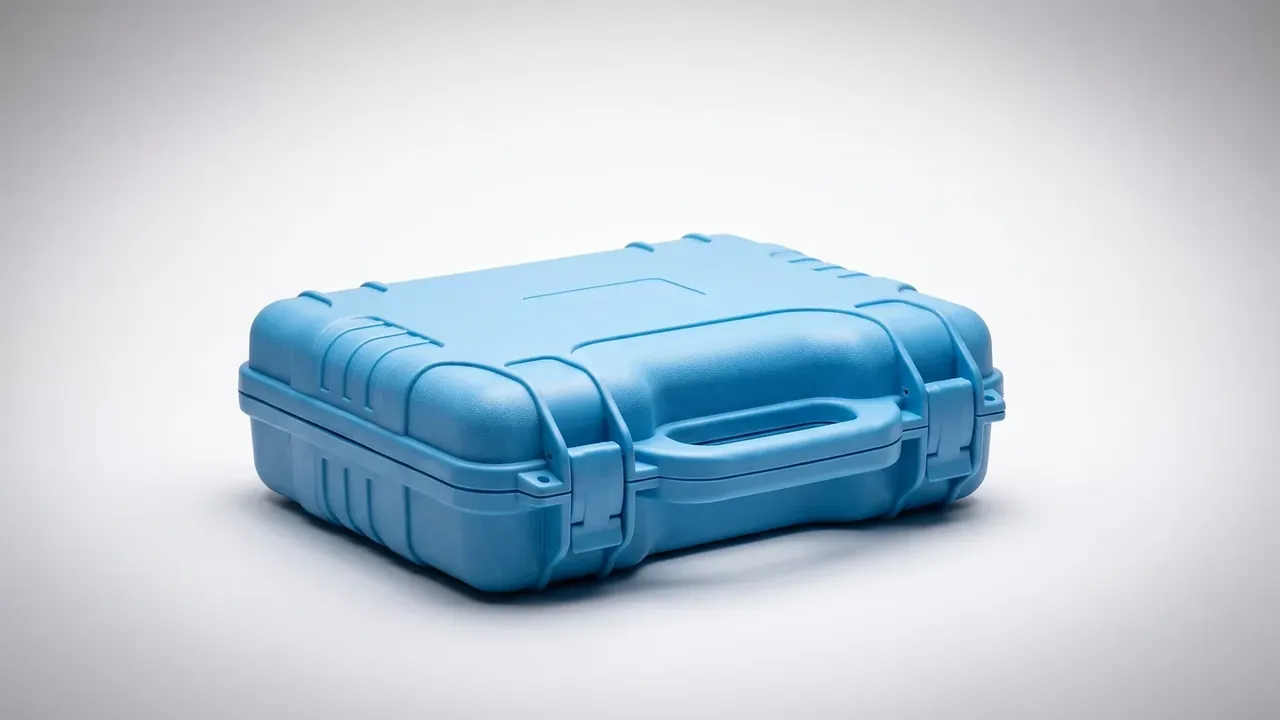
Quick answer: A Kids Tool Box runs on a 90-day loop with four readings: gasket squeeze, single-latch force, hinge end play, cavity residue. Under 0.8 mm of squeeze, 10 N of force or 0.6 mm of play the part is replaced; a body crack past 15 mm retires the box.
Table of contents
- Inspection Cycles for a Kids Tool Box
- When the Rim Gasket Is Spent
- Latch and Hinge Wear Readings
- Cleaning the Cavity and Its Residue
- Cracks, Warp and the Scrap Line
- Storage That Slows Ageing
- FAQ
1. Inspection Cycles for a Kids Tool Box
The blue case in the corner is 3 years old. Both latches catch, yet the gasket has flattened into a hard ridge and daylight shows at the seam. Failure arrives in sequence: rubber stops springing back, seam widens, water enters, a latch lets go.
Daily takes 5 minutes on latch position and seam evenness. The quarterly pass at 90 days puts a feeler gauge and a force gauge on four numbers; the annual pass at 360 days pulls pins and re-greases. A household opens the box 6 times a week, so 78 cycles land in 90 days, right where squeeze drops; a classroom at 12 a day needs the pass at 45 days.
| Level | Interval | Time | Read | Limit |
|---|---|---|---|---|
| Daily | Shift end | 5 min | Latches, seam | Daylight |
| Quarterly | 90 days | 25 min | Squeeze, force | 0.8 mm |
| Half-year | 180 days | 40 min | Cracks, warp | 15 mm |
| Annual | 360 days | 90 min | Pins, grease | 40 g gain |
2. When the Rim Gasket Is Spent
Cord is extruded EPDM or TPE at 55 to 65 Shore A in a 1.2 mm groove; the lid compresses it 25% to 30%, taking 4 mm down to 2.8 mm. Below 0.8 mm it has taken a permanent set: the eye sees nothing, a light test sees a line. Groove geometry is checked against the lid structure breakdown.
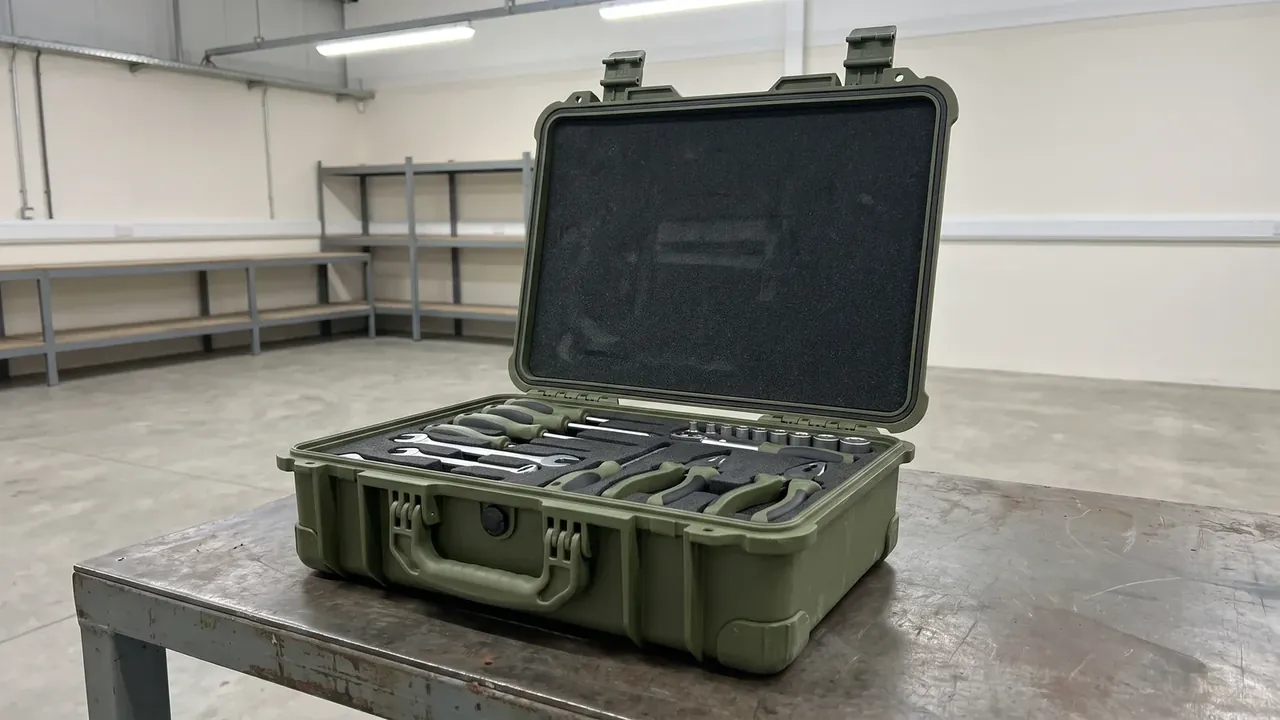
Three field tests decide it, and one hit is enough: a fingernail dent that has not recovered in 30 seconds, a corner lifted 2 mm from its groove, 3 fine cracks in a row. If none fires but squeeze sits at 1.0 mm, run one more quarter.
Interval follows location: 24 months indoors, 18 above 80% humidity, 12 in a vehicle reaching 35 °C. Fit dry: lift the cord with a scraper, wipe the groove with 75% alcohol, wait 10 minutes, press from a long-side midpoint to the corners. Past 5% stretch it creeps out in 3 months.
3. Latch and Hinge Wear Readings
Force loss outnumbers breakage. New, a latch reads 18 N; at 2 years most sit at 12 to 14 N. Under 10 N the lid lifts when the case lies on its side.
| Part | Gauge | New | Replace | Recheck |
|---|---|---|---|---|
| Latch force | Force gauge | 18 N | Under 10 N | 90 days |
| Hinge end play | Feeler | 0.2 mm | Over 0.6 mm | 180 days |
| Catch pin bore | Micrometer | 3.0 mm | 3.3 mm | 360 days |
Read it the same way each time: hook the tongue middle, pull at 50 mm per minute, take the median of 3 peaks. A 15° off-axis pull adds 4 N and passes a latch that should have gone.
A 0.6 mm feeler entering from inside means a new pin; ignored, the lid shifts and the root whitens inside 2000 cycles.
4. Cleaning the Cavity and Its Residue
Inside dirt is not outside dirt: residue changes closure and smell. Foam takes up sweat and coolant, smells at 2 weeks and feeds chips to the hinge.
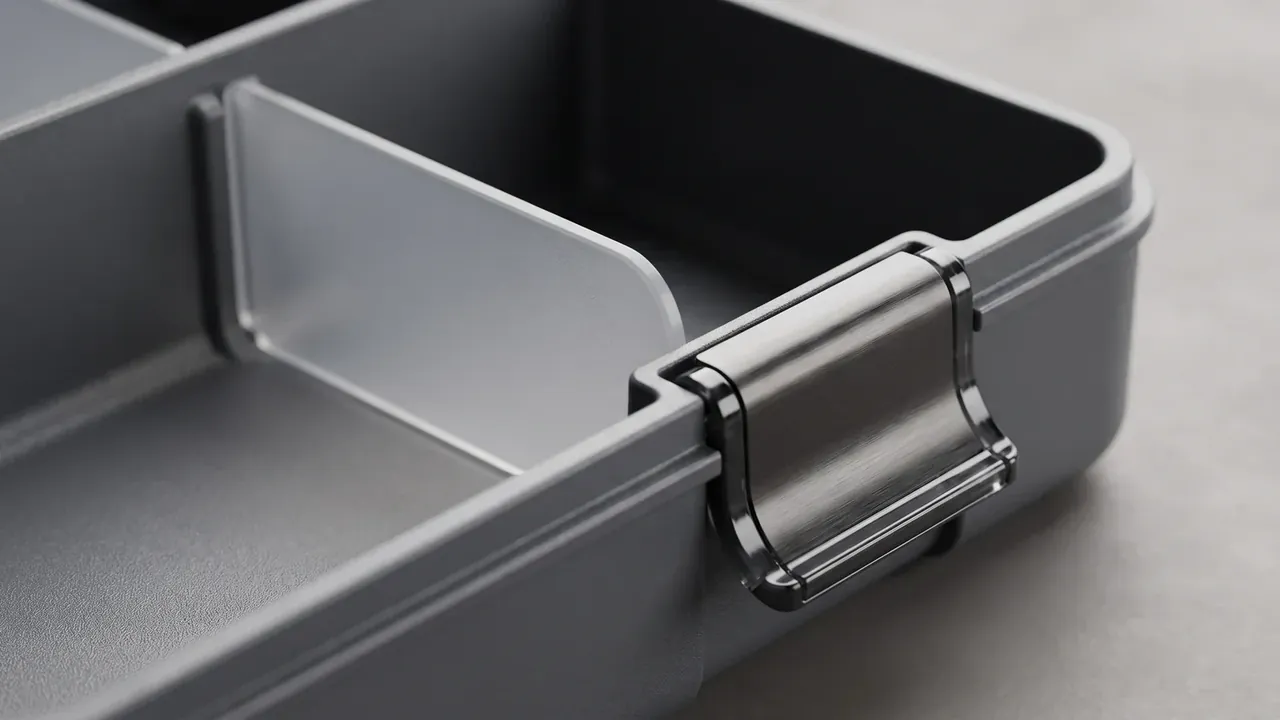
Dust: soft brush and vacuum, never a 0.6 MPa blast, which drives chips deeper. Grease: neutral detergent at pH 6 to 8, water at 40 °C. Mildew: bleach 10:1 for 5 minutes.
| Soil | Method | Dwell | Never |
|---|---|---|---|
| Dust | Brush, vacuum | Immediate | Air blast |
| Grease | Detergent, pH 6 to 8 | 10 min | Thinner |
| Mildew | Bleach 10:1 | 5 min | Neat bleach |
| Tape residue | Soften at 40 °C | 3 min | Metal blade |
Drying outranks washing: 30 minutes in air or 15 at 40 °C, with a cotton bud in the catch recess. Closed damp for 48 hours, the groove blooms white.
5. Cracks, Warp and the Scrap Line
Length and location decide a crack. Read length with a steel rule; past 15 mm it comes out of service. Location outranks length: across a hinge or catch seat it is scrap at any length. On the rim, check the load path in the lid first.
A torch at 45° throws a bright line along a crack; straight on, a 2 mm hairline vanishes.
| Defect | Size | Action | Recheck |
|---|---|---|---|
| Body crack | Over 15 mm | Out of service | None |
| Load-path crack | Any length | Scrap | None |
| Base warp | 2 mm diagonal | Storage only | 30 days |
| Handle set | 2 mm under 8 kg | Replace | 90 days |
| Latch whitening | 3 mm at root | Replace | 30 days |
The handle carries 8 kg for 1 hour; a root set over 2 mm means replacement, at 1.5 mm the thinnest wall on the box.
Repair stops at structural faces: a 220 °C PP torch closes a non-structural crack, while welding a load path moves failure 10 mm sideways. One scrapped body donates parts for 2 others.
6. Storage That Slows Ageing
Half the ageing rate is storage. PP holds dimensions from 5 to 35 °C; above 45 °C it creeps, and the lid diagonal grows 1.5 mm in half a year.
Keep humidity under 70% with a 50 g desiccant in the wet season. Stack 4 high, with 8 kg on the bottom unit.
Leave 10 mm inside for transport and click both latches before lifting; a half-latched carry puts shear across the tongue rather than the designed pull.
Cycle an idle box 20 times every 6 months, and 5 years of service becomes 8.
Conclusion
The work is simple; holding the interval takes discipline. Four readings at 90 days, cracks at 180, pins at 360, and after 2 years the condition is predictable. What retires a Kids Tool Box early is rarely wear, but the missing record, gauge and date.
This article discusses only the container (case body) side of specifications and design intent, and does not cover any handling, loading or use of the contents.
Related Reading
Related Products
- 8 Series — Gun Cases; Military Equipment Cases; Camera Equipment Cases; Drone Cases; Watch Cases; Knife Cases; First Aid Cases; Electronics Equipment Cases
- WL8-2812 PP Gun Case — model WL8-2812
- All protective cases and toolboxes: 7 series, 158 models