

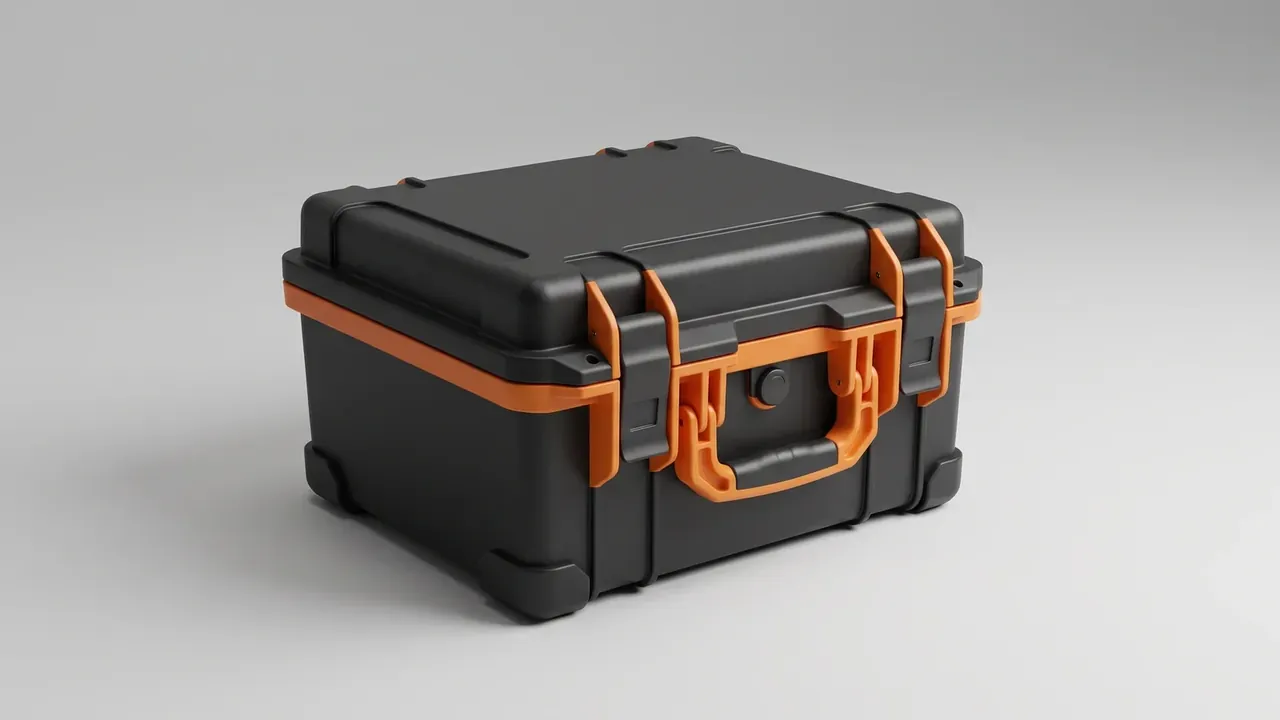
Quick answer: A custom plastic case and box starts from four reference dimensions — outer, cavity, usable, stacking — assigns wall thickness by location, and proves load three ways.
Table of contents
- Four Reference Dimensions for a Custom plastic case and box
- Wall Thickness by Location, Not by Average
- Load, Stacking and Drop Arithmetic
- How a Case and a Box Differ in Specification
- Writing Tolerances and the Seal Groove
- FAQ
1. Four Reference Dimensions for a Custom plastic case and box
A drawing with one outer dimension cannot be quoted. A custom plastic case and box needs four: outer with bumpers, cavity at the widest core point, usable cavity after ribs, and stacking from feet to lid boss.
A 600 × 400 × 220 mm case runs 560 × 360 × 195 mm inside, 548 × 348 × 186 mm usable; the 12 mm comes from a 3.2 mm wall, an R8 radius and a latch boss.
| Reference | Measured at | Case tolerance | Box tolerance |
|---|---|---|---|
| Outer | Widest contour with bumpers | ±0.8 mm | ±0.5 mm |
| Cavity | Widest point of the core | ±0.5 mm | ±0.4 mm |
| Usable cavity | Clear space after ribs | ±0.6 mm | ±0.5 mm |
| Stacking | Feet to lid boss | ±0.5 mm | ±0.3 mm |
Keep one datum: cavity from the floor, outer from the parting line. Mixing them adds 0.4 mm.
2. Wall Thickness by Location, Not by Average
One average wall is the commonest mistake. A case wants 3.2 mm at the side, 3.5 mm at the floor, 2.8 mm in the lid and 1.8 mm at the rib root: the floor carries stacking load, the lid only bends. Steps above 2:1 bring sink and weld lines.
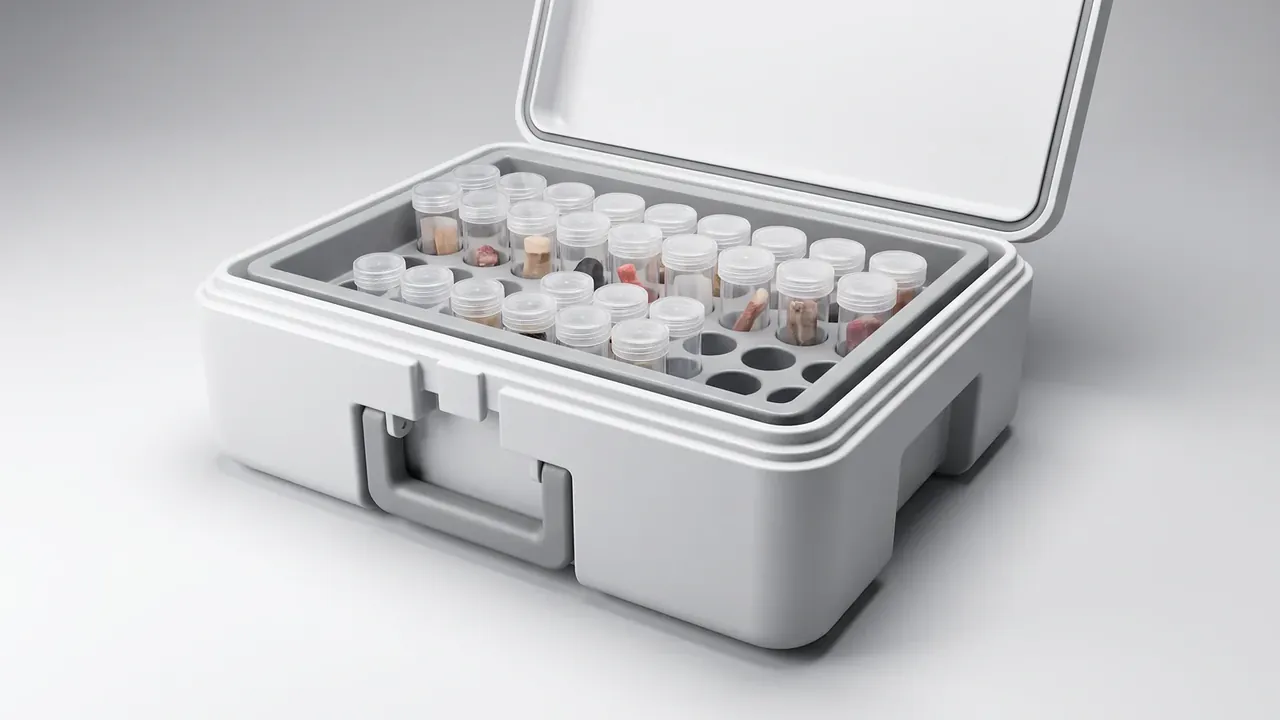
Draft follows depth: a 320 mm cavity runs at 1.5 degrees and gives up 2.6 mm per 100 mm of draw, an 85 mm box at 1 degree.
| Location | Case wall | Box wall | Reason |
|---|---|---|---|
| Side | 3.2 mm | 2.4 mm | Side impact |
| Floor | 3.5 mm | 2.6 mm | Load and creep |
| Lid | 2.8 mm | 2.0 mm | Bending |
| Rib root | 1.8 mm | 1.4 mm | Sink control |
3. Load, Stacking and Drop Arithmetic
For a custom plastic case and box, load is three numbers. Static: 120 kg for 24 hours with floor deflection under 2 mm. Stacking: four high at 35 kg a layer, so the bottom unit carries 140 kg. Drop: 1.2 m onto six faces, no latch release.
Clamp force belongs here too: a 0.42 m² projected area at 420 kg/cm² needs 420 tonnes, and a 1,000-tonne press leaves margin, or flash shows at the latch boss.
A one-piece lid at 2.2 mm should survive 20,000 cycles; a metal pin hinge needs a 1.6 mm collar.
4. How a Case and a Box Differ in Specification
A case and a box are two logics on one sheet. The case chases volume and sealing, so wall, draft and groove lean towards compression. The box chases division and access, with thinner walls and stacking where a lid rib meets the foot.
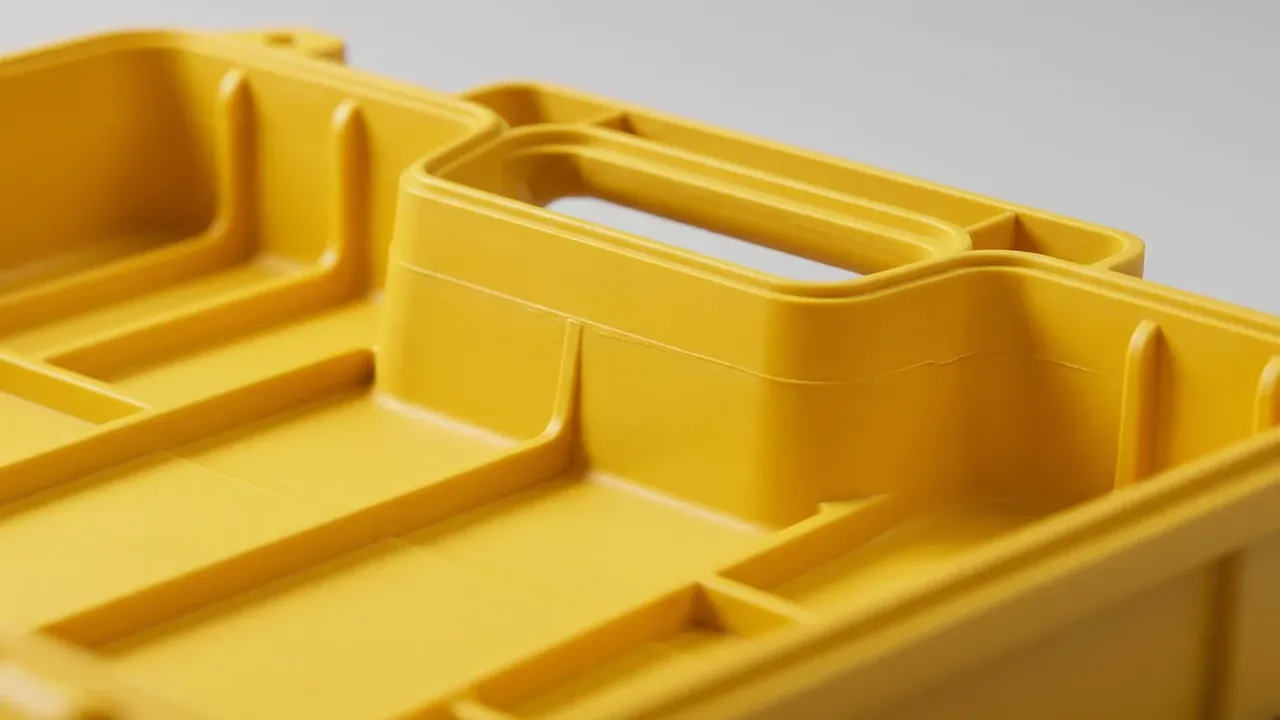
Partition size works backwards from the smallest item: an 8 × 6 box with 1.6 mm partitions gives a 42 mm cell for a 38 mm tube, and at 1.2 mm the cell grows to 44.8 mm and the middle rows bow.
| Item | Case | Box |
|---|---|---|
| Cavity | Single, 200–320 mm deep | Divided, 60–100 mm deep |
| Sealing | 6 × 4 mm groove, O-ring | Plain lip, no groove |
| Typical wall | 3.2 mm side | 2.4 mm side, 1.6 mm partition |
5. Writing Tolerances and the Seal Groove
On a custom plastic case and box drawing, put tolerances beside the dimension, not in a note: ±0.8 mm outer, ±0.5 mm cavity, ±0.2 mm on holes, with shrinkage stated, 1.6 percent for PP and 0.5 for ABS. A wrong figure moves the outer by 3 mm and the latches miss.
The seal groove is the easiest block to leave off: 6 mm wide, 4 mm deep, a 5.5 mm O-ring at 25 percent compression, an R1 lip, and 2.5 mm of steel behind it.
Drawing delivery is a set: 2D with a tolerance table, STEP, colour chips, key dimensions. First-article reports cover 12 dimensions at CPK 1.33.
Conclusion
A custom plastic case and box specification is three things a toolmaker can act on: four reference dimensions, a wall schedule by location, and load proved three ways. Dimensions make the tool accountable, the wall schedule keeps sink in check, and the load figures give inspection a basis. Tolerances, shrinkage and groove belong on that same custom plastic case and box sheet.
This article discusses only the container (case body) side of specifications and design intent, and does not cover any handling, loading or use of the contents.
Related Reading
- Choosing a protective case size
- Protective case size range explained
- Specifying a foam insert
- Choosing internal dividers
Related Products
- 8 Series — Gun Cases; Military Equipment Cases; Camera Equipment Cases; Drone Cases; Watch Cases; Knife Cases; First Aid Cases; Electronics Equipment Cases
- WL8-2812 PP Gun Case — model WL8-2812
- All protective cases and toolboxes: 7 series, 158 models