

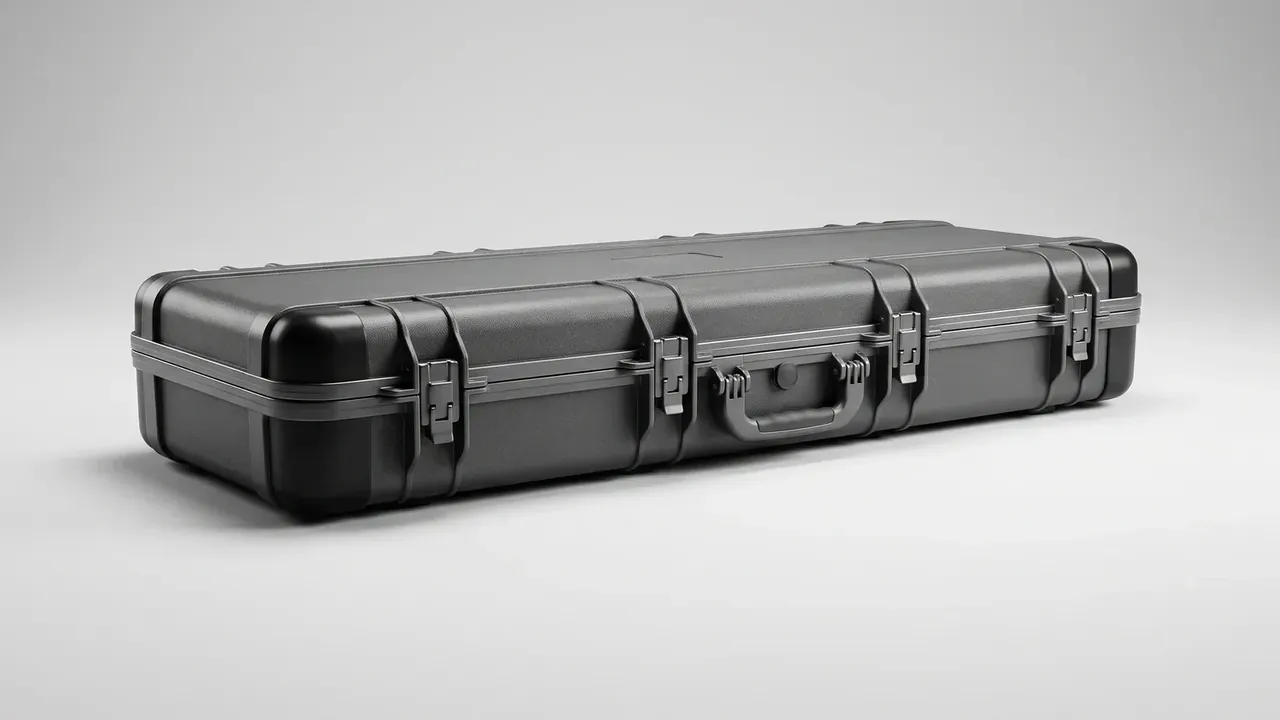
Quick answer: Judge a robot protective box by cavity layout, then wall thickness and stack load, then seal and inspection. A box for a pendant and two drive boards runs 420 by 320 by 180 mm at 3.2 mm wall and holds 55G on a 1.2 m drop.
Table of contents
- Layout of the Robot Protective Box Cavity
- Wall Thickness and Stacking Loads
- Sealing Face and Lid Action
- Inserts: Dividers and Cushioning
- Batch Consistency and Incoming Inspection
- FAQ
1. Layout of the Robot Protective Box Cavity
A robot protective box usually holds loose items: a teach pendant, servo drive boards, a spare reducer, end tools. Because none of it is one solid block, how the cavity divides matters more than the outer footprint.
For one pendant and two boards, 420 by 320 by 180 mm works, split into three bays by 8 mm PP honeycomb dividers on 100 mm slots. Leave 3 mm beside each part; open it to 10 mm and the part rattles and scuffs its corners. A 110 mm clear handle takes a glove.
| Decision point | Number to lock | How to check |
|---|---|---|
| Cavity | Part plus 3 mm, depth plus 10 mm | Trial fit of the real part |
| Bays | Split by size, dividers removable | Pull one divider |
| Divider | 8 mm PP, 100 mm slots | Press middle, under 2 mm |
2. Wall Thickness and Stacking Loads
On a robot protective box, a 3.2 mm wall with 1.8 mm ribs at 80 mm centres gives a 1.8 kg box a person can stand on empty. At 2.4 mm with no ribs the panel bulges under two hands and the lid line opens.
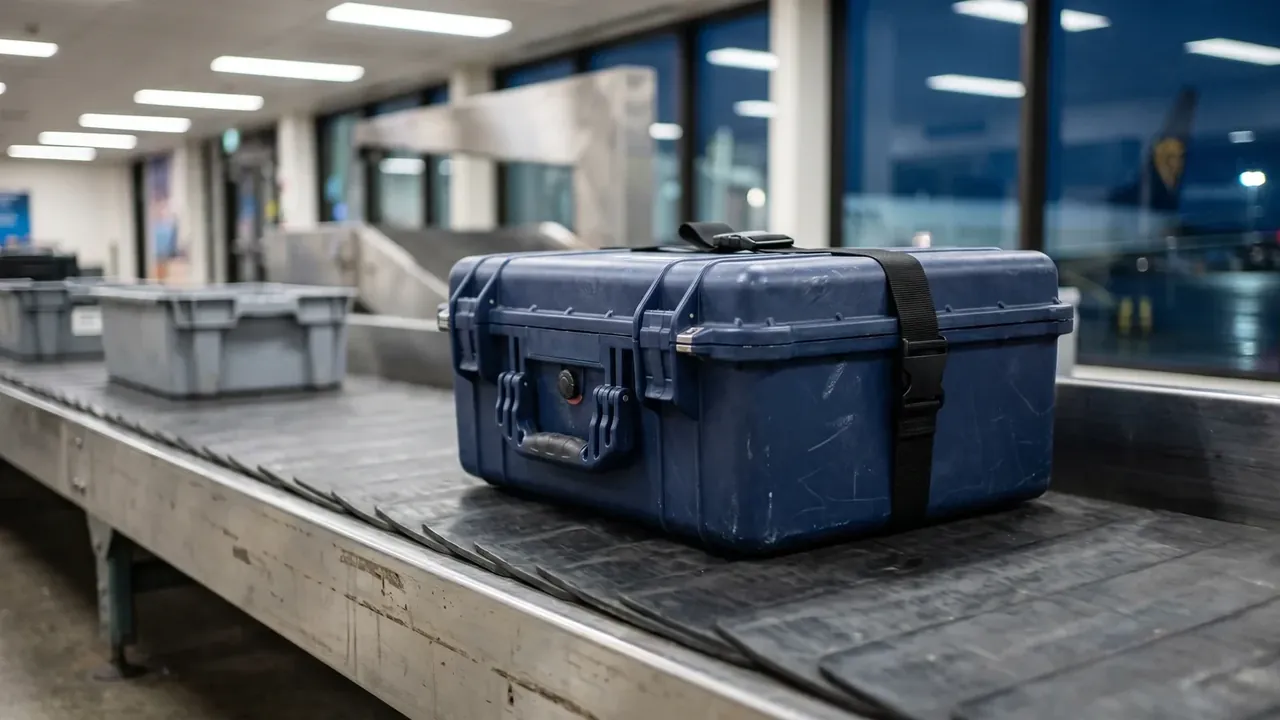
Five tiers put four loaded units on the bottom box: 48 kg of payload, 60 kg with the box, 90 kg with a 1.5 safety factor. Lid deflection must stay under 2 mm, or tier three slides inward. A 60 degree Celsius mould, 55 second cycle on a 380 t machine keeps walls even; at 40 degrees sink marks crack first in a drop.
3. Sealing Face and Lid Action
On a robot protective box, sealing comes from one gasket, not from cranking the latches down. A 6 mm section at Shore 50A, compressed 25 percent in a 4 mm groove, reaches IP65. Salt spray runs 240 hours, so pins and latch bodies are 304 stainless; zinc alloy rusts white long before that.
Two cam latches, a third of the way along each long side, open at 90 N with a thumb; a spring catch dies around cycle 2000. External hinge pins keep play under 0.2 mm after 3000 cycles. On a bench, 100 degrees with a damping strut; on shelving, a 90 degree side lid.
4. Inserts: Dividers and Cushioning
A small robot protective box needs contact, not thickness. On a 1.2 m six-face drop, 20 mm of EVA holds 55G; at 10 mm it reaches 85G and capacitors desolder first. Choose 35 kg per cubic metre.
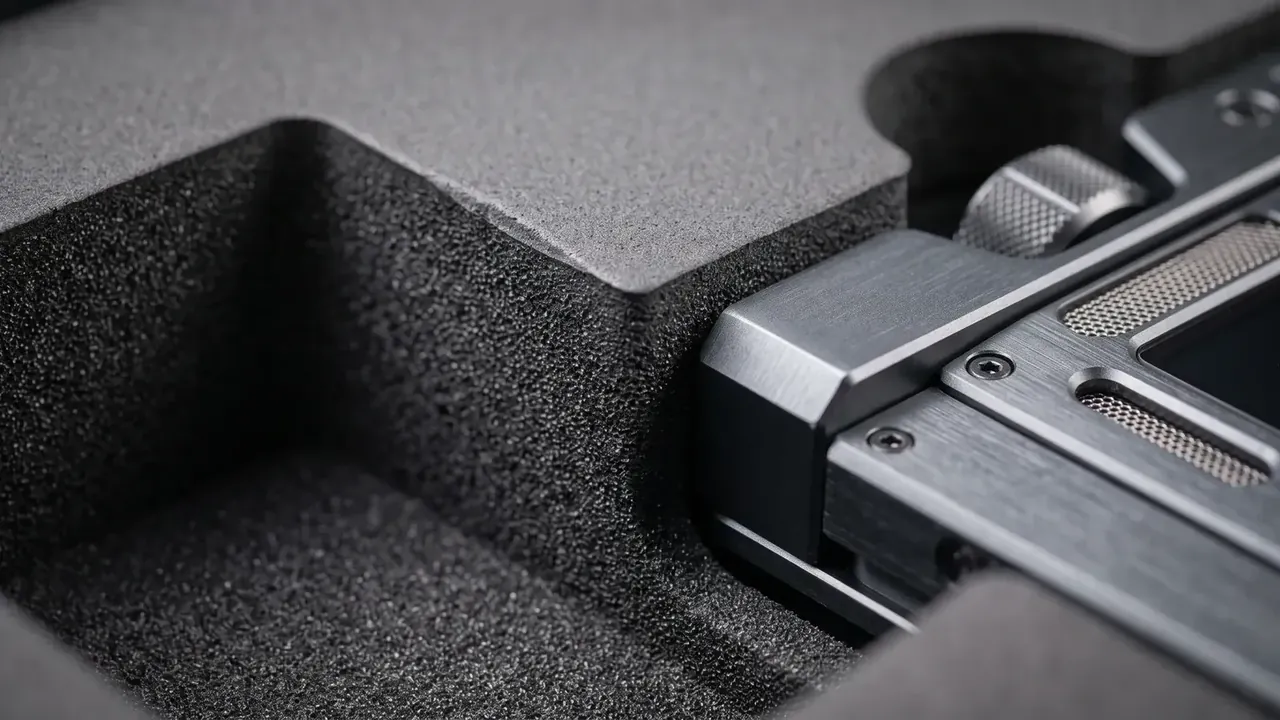
Glue 3 mm EVA to both divider faces and leave 5 mm of top compression so the lid holds parts gently. Rout irregular shapes 1 mm under size and let the foam grip. One block suits stable models; blocks plus dividers suit frequent changes.
5. Batch Consistency and Incoming Inspection
Lots run from tens to hundreds, and mismatched colour is the fastest route to a return. Hold ΔE to 1.0, compare five boxes side by side, and check drying: under three hours at 80 degrees Celsius, PP shows silver streaks.
Inspection has four steps: measure three cavity points to plus or minus 1 mm, weigh one box at 1.8 kg with 5 percent tolerance, cycle latches 50 times, and drop one box loaded to 12 kg from 1.2 m.
| Item | Criterion | Sample |
|---|---|---|
| Cavity | Plus or minus 1 mm | 5 per lot |
| Weight | 1.8 kg, within 5 percent | 10 per lot |
| Colour | ΔE 1.0 or better | 5 per lot |
| Drop | 1.2 m, no corner crack | 1 per lot |
Pack four per 1.2 by 1.0 m pallet with 5 mm corrugated sheets between layers; film alone scuffs every face on a long haul.
Conclusion
Four groups of numbers settle it: cavity and bays, wall and stack load, seal and latch feel, colour and sampling. A small box forgives less, so 0.8 mm off the wall shows at goods-in. Put the numbers on the drawing, and a lot of fifty matches a lot of five hundred; specified this way, the robot protective box divides, carries and latches shut.
This article discusses only the container (case body) side of specifications and design intent, and does not cover any handling, loading or use of the contents.
Related Reading
- How injection-moulded cases are formed
- Setting dividers and internal bays
- Colour and appearance acceptance for cases
- Drawings needed for a custom case project
Related Products
- 8 Series — Gun Cases; Military Equipment Cases; Camera Equipment Cases; Drone Cases; Watch Cases; Knife Cases; First Aid Cases; Electronics Equipment Cases
- WL8-2812 PP Gun Case — model WL8-2812
- All protective cases and toolboxes: 7 series, 158 models