

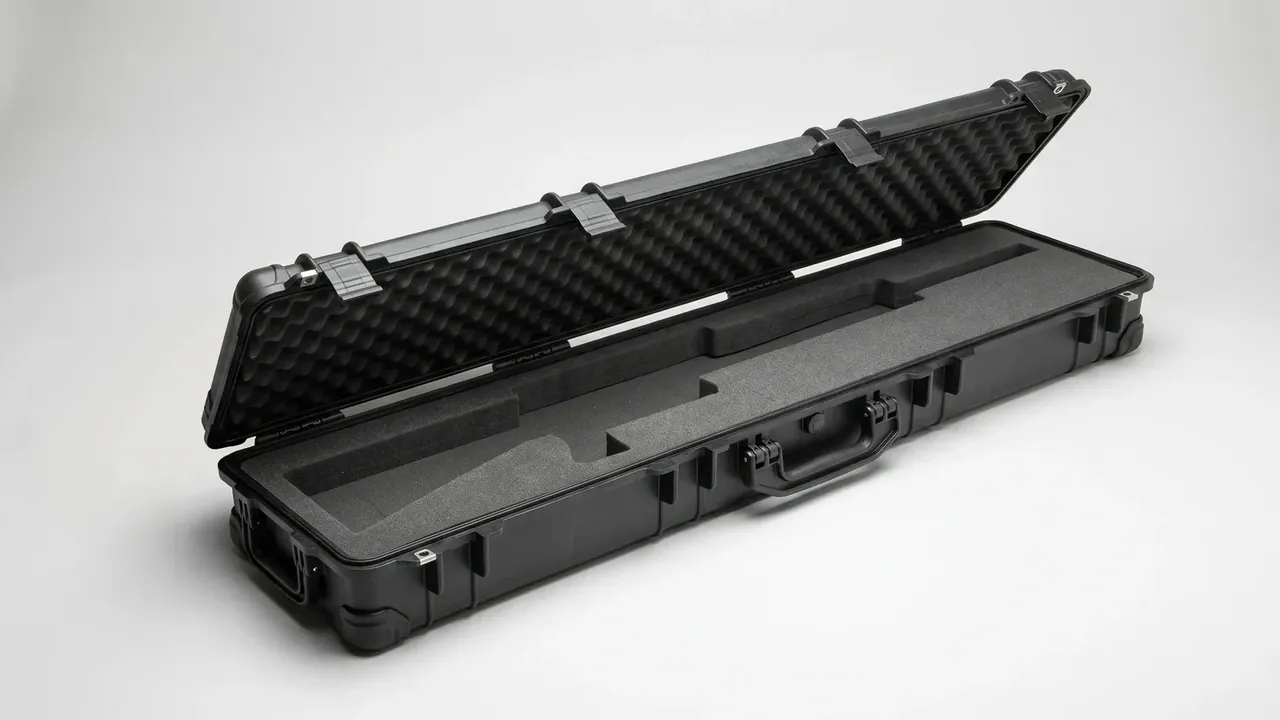
Quick answer: Choose the format first, size latches from how often the box opens, lock the unit in place with foam cavity tolerance, then settle carry method and order quantity.
Table of contents
- Pick a Robot Packaging Box Format First
- Latch Count and Hinge Pin Size
- Foam Cavity Tolerance and Fit
- Carry Handle or Telescopic Trolley
- Sampling Lead Time and Order Size
- FAQ
1. Pick a Robot Packaging Box Format First
Format is not styling: it fixes cavity ratio, opening motion and load path. Four shapes cover most projects, and usable cavity volume differs by about 12% at the same footprint.
The first test is the ratio of longest edge to thickness. Below 3, a compact unit takes a briefcase format; above 6, a long-reach arm needs a rifle-style body; the middle band suits clamshell or trolley.
| Format | Robot mass | Reference cavity | Typical misuse |
|---|---|---|---|
| Briefcase | Under 15 kg | 420 × 320 × 160 mm | 30 kg unit, handle boss cracks |
| Clamshell | Under 25 kg | 520 × 380 × 180 mm | Foam too thick, lid will not close |
| Trolley | Under 40 kg | 600 × 420 × 260 mm | Wheel housing eats cavity |
The briefcase format fails first: its handle boss shares a moulding with the lid, and above 15 kg stress shows around the third lift on 4.0 mm walls.
2. Latch Count and Hinge Pin Size
Latch count follows mass and opening frequency, not length. Two latches hold a clamshell under 25 kg; past that, or above three openings a week, use four, spaced under 350 mm.
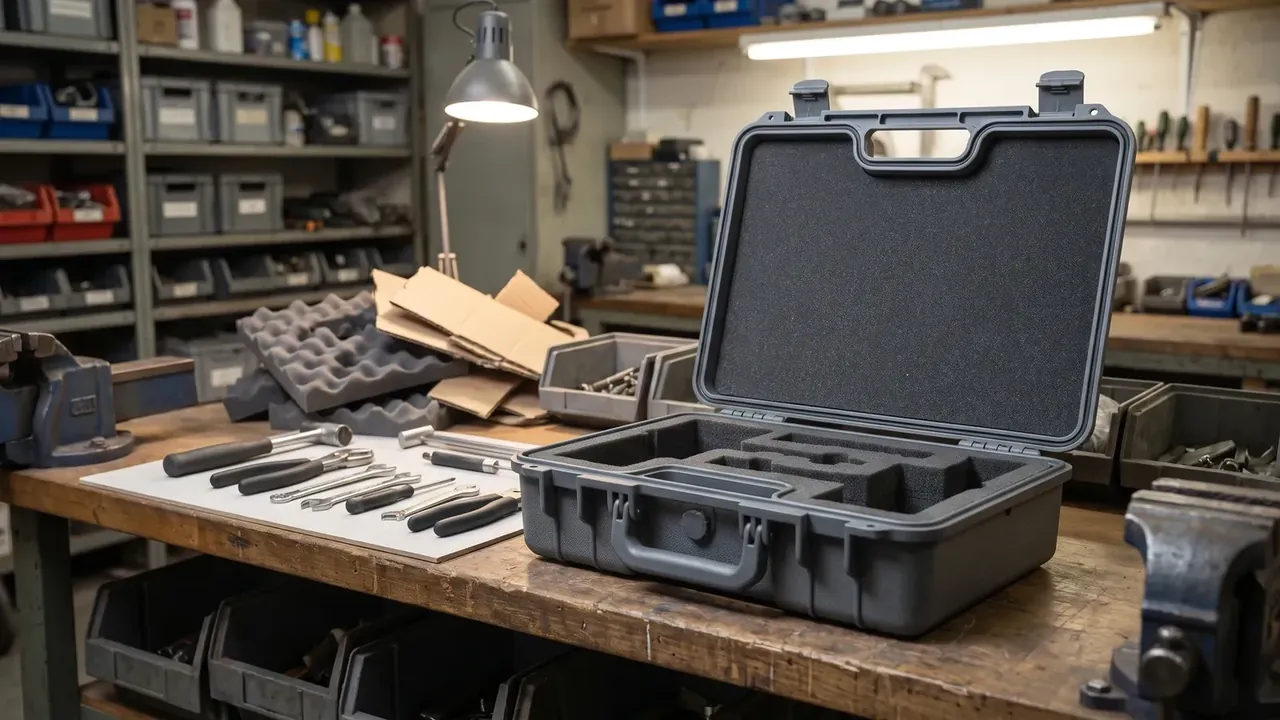
Hinges fail more quietly. A 4 mm pin in a PA66 bushing is rated 5000 cycles; a 3 mm pin falls near 2000, which a demo stand exhausts in a year.
| Robot mass | Latches | Hinge pin | Design cycles |
|---|---|---|---|
| Under 15 kg | 2 | 3 mm | 2000 |
| 15 to 25 kg | 2 | 4 mm | 5000 |
| 25 to 40 kg | 4 | 4 mm | 5000 |
| Above 40 kg | 4 | 5 mm | 8000 |
3. Foam Cavity Tolerance and Fit
In a robot packaging box, cavity tolerance matters more than foam thickness. Past 1 mm over the outline the unit shifts in transit; under 0.2 mm nobody can seat it without force.
The working figure is 0.5 mm per side, 0.8 mm on irregular contours. Specify 38 kg/m³ EVA: at 10% compression it grips and springs back. At 25 kg/m³ the same tolerance goes slack after three loadings.
Cut depth runs 8 mm under robot height: less and the lid stands proud, more and the unit rocks.
4. Carry Handle or Telescopic Trolley
Carry method for a robot packaging box splits at 25 kg. Under that, a handle opens fast and stores small; above it, add a trolley and wheels, or people drag the box and the four base corners wear through first.
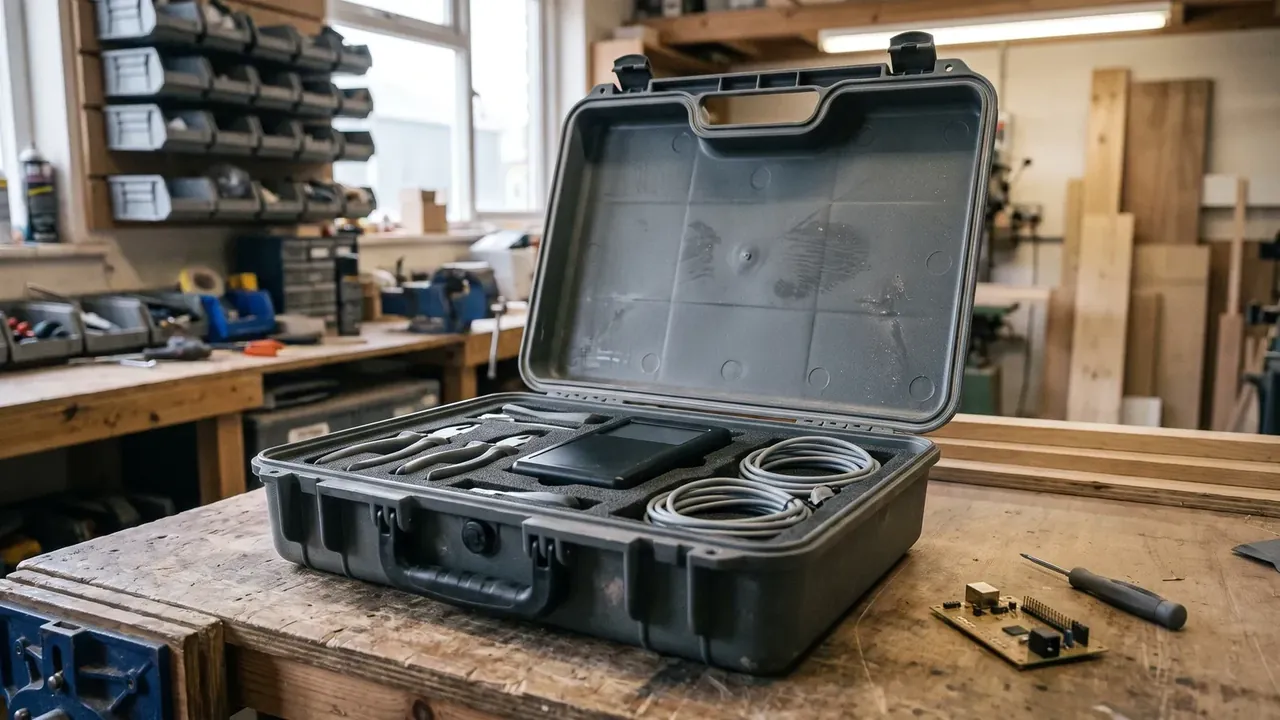
Wheel sets should be rated 30 kg with a 50 mm diameter. At 35 mm they catch on thresholds and torque at the trolley root climbs; mould the housing into the base.
The trolley also consumes cavity: a 600 mm body keeps only 520 mm usable, subtracted before the foam is cut.
5. Sampling Lead Time and Order Size
A robot packaging box sample takes 7 days: 3 for the box, 2 for CNC foam, 2 for fitting. That assumes cut foam; a steel foam tool pushes the sample to 18 days and adds tooling cost.
| Stage | Lead time | Quantity | Main cost |
|---|---|---|---|
| Hand sample | 3 days | 1 | Sample machining |
| First article | 7 days | 5 | Foam cutting, fitting |
| Small batch | 15 days | 50 | Tooling amortisation |
| Production | 25 days | 200 | Moulding and assembly |
Fifty pieces is the usual plant minimum; below it, tooling cost per unit rises steeply. Above 200 the price drops a step.
Approve the first article on three points: even gap around the closed lid, foam fit, latch feel. Any one needing a tool change pushes production back a week.
Conclusion
Format and latch decide structure; foam and delivery decide cost. A wrong format cannot be rescued by a finer insert, and a loose cavity defeats the best latch. Run the five tests in order and the sample passes first time, which is the point of testing a robot packaging box this way.
This article discusses only the container (case body) side of specifications and design intent, and does not cover any handling, loading or use of the contents.
Related Reading
- Injection moulded protective case selection and tooling limits
- OEM protective case tooling and branding process
- How foam inserts are installed and fixed
- Instrument case specifications and cavity sizes
Related Products
- 8 Series — Gun Cases; Military Equipment Cases; Camera Equipment Cases; Drone Cases; Watch Cases; Knife Cases; First Aid Cases; Electronics Equipment Cases
- WL8-2812 PP Gun Case — model WL8-2812
- All protective cases and toolboxes: 7 series, 158 models