

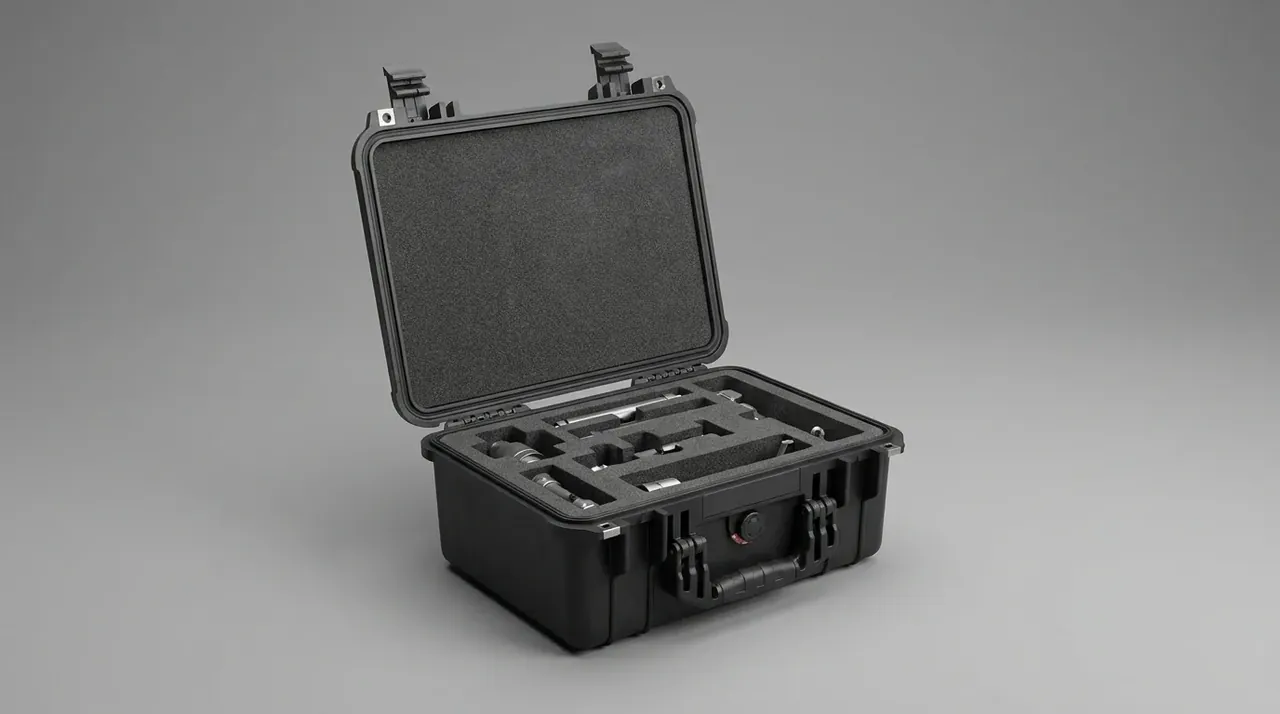
Quick answer: A Laboratory reagent bottle anti-breakage box holds displacement within 1.5 mm after a 1.0 m drop and seat acceleration below 4 g across 5–200 Hz.
Table of contents
- Three-point clamping layout of the Laboratory reagent bottle anti-breakage box
- Bottle-base suspension height and foam density
- Transmitted acceleration across the sweep band
- Bottle-position displacement measurement under drop impact
- Clamping-force decay after cycle life
- FAQ
1. Three-point clamping layout of the Laboratory reagent bottle anti-breakage box
The Laboratory reagent bottle anti-breakage box places 12 positions in two rows, each held by 3 contact points at shoulder and mid-body height, with a gap under the base. Outer size 520×400×270 mm and inner cavity 455×335×205 mm fix the usable area before the slot pitch is set.
A 3.8 mm wall shares stiffness between frame and lid. The 5.2 kg empty and 10 kg loaded figures set how far the base may flex, with most mass on the frame. JUNZHIJIA fixes the pitch before placing latches and hinges.
Contact points avoid the thin webs between positions. Rib width left after cutting governs grip; too narrow fails before the foam under a drop, too wide steals the neighbour's clearance. Each contact is kept small so foam can still rebound. The lid foam adds only light pressure and does not locate the bottle, which is left to the three base points. Opening the lid therefore leaves the datum unchanged. Ke Xin New Materials (Guangdong) Co., Ltd. numbers all 12 positions during sampling so a reading traces back to one slot.
| Bottle position spec | Value | Acceptance basis |
|---|---|---|
| Position count | 12 | Two rows, numbered one by one |
| Contact points | 3 per position | Shoulder and mid-body heights |
| Wall | 3.8 mm | Frame and lid share stiffness |
| Outer size | 520×400×270 mm | Sets usable area |
2. Bottle-base suspension height and foam density
The Laboratory reagent bottle anti-breakage box lifts the bottle base off the hard floor with a 30 mm pad. EVA density of 45 kg/m³ keeps rebound when empty and avoids bottoming out when loaded. A gap around the pad trims the shock peak before it reaches the seat.
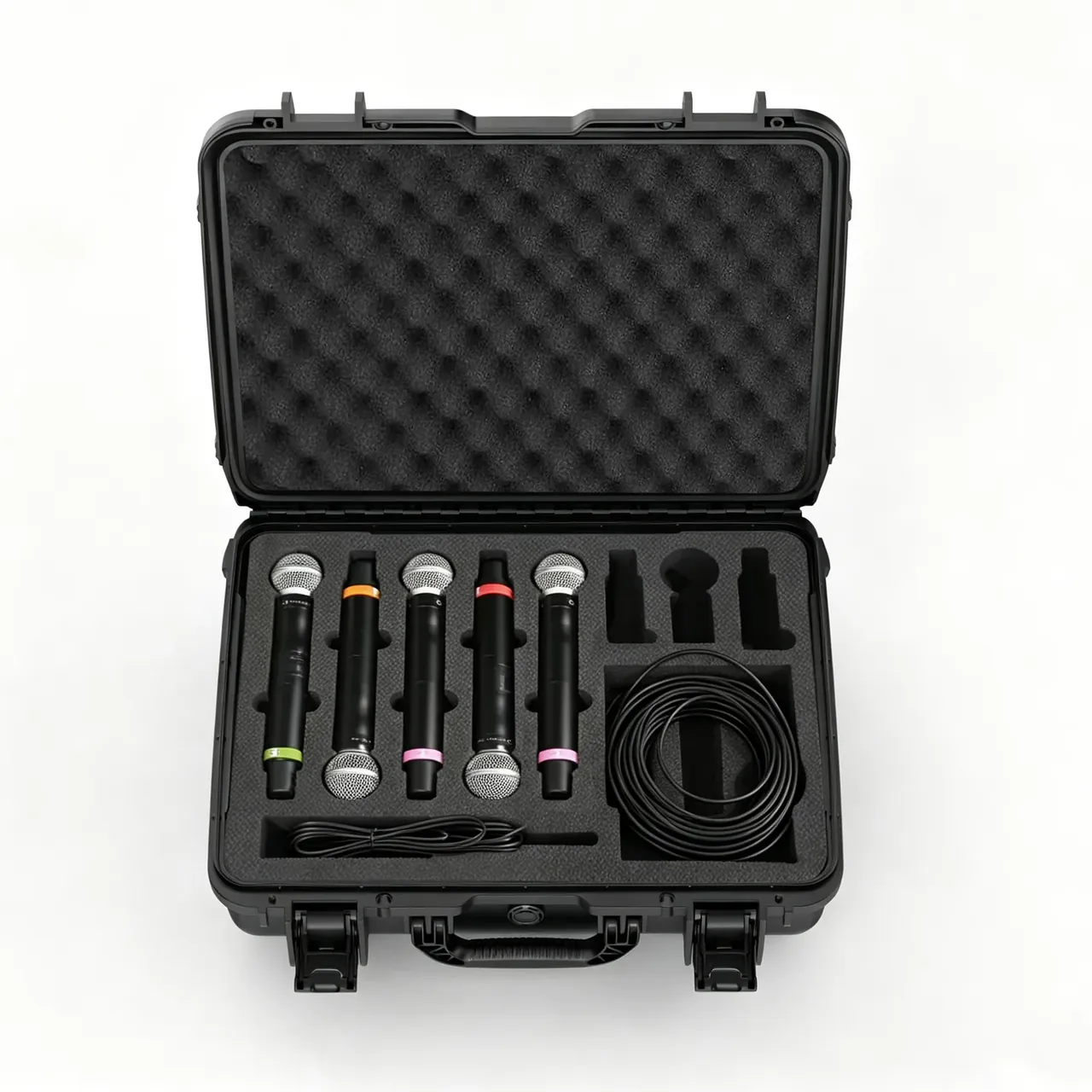
Height and density are read together. Raising height at fixed density lowers seat acceleration but grows sideways swing; below 30 mm the sweep tends to pass 4 g. Foam hardness drifts over −10 °C to 50 °C, so the sheet fixes the pair instead of one thickness.
The 4.8 kg between empty 5.2 kg and loaded 10 kg spreads across 12 positions. Whether the Laboratory reagent bottle anti-breakage box uses one pad or blocks depends on whether the ribs still join; a full pad rebounds evenly, blocks swap easily. Both are retested after 3000 cycles.
3. Transmitted acceleration across the sweep band
A 5 Hz to 200 Hz sweep covers handling excitation. The line is not that the shell avoids resonance but that seat acceleration stays ≤4 g, gauged at the seat-foam face. How the Laboratory reagent bottle anti-breakage box behaves depends on pad stiffness matching the three-point preload.
At low frequency the position moves with the case and transmissibility sits near 1; as frequency climbs the foam isolates and the value rises then falls. A spike means a contact was preloaded too lightly. The 5–200 Hz band is split into segments, each compared with the 4 g limit rather than one full-band maximum.
| Clamping stage | Parameter | Verification |
|---|---|---|
| Shoulder contact | 3 per position | Grip checked one by one |
| Pad suspension | 30 mm | Height before and after sweep |
| EVA density | 45 kg/m³ | Weighed against a sample |
| Sweep band | 5–200 Hz | Peak per segment |
The limit reads 4 g, not a looser band. Move the gauge and the reading moves.
4. Bottle-position displacement measurement under drop impact
A 1.0 m drop runs over six faces, the corner landing concentrating shock. The line is position displacement ≤1.5 mm, gauged between seat and base datums as a relative shift. For the Laboratory reagent bottle anti-breakage box this is the direct evidence that three-point clamping holds.
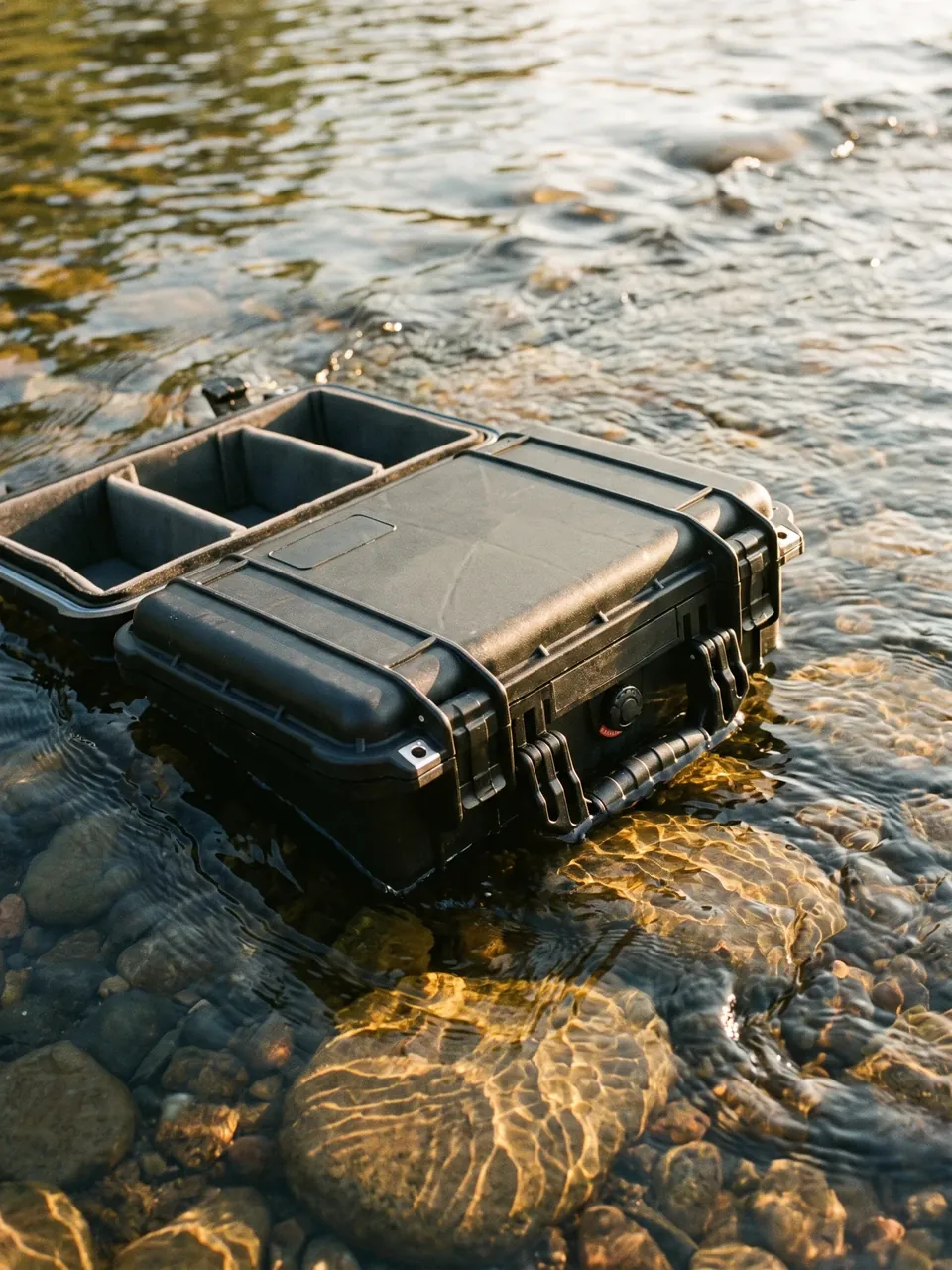
Displacement is read before and after the drop with one template. Over 1.5 mm, check contacts first, then the pad, then the 3.8 mm wall. The case mouth is marked IP65, and the gasket is inspected after the drop because a shifted seal removes the datum for later tests.
Drop and sweep cannot replace each other. The sweep reads acceleration under continuous 5–200 Hz excitation; the drop reads whether a position returns after one impact. Setting 1.5 mm beside 4 g shows whether 30 mm pad with 45 kg/m³ foam lands in a usable window.
| Transmitted value | Test condition | Limit |
|---|---|---|
| Position displacement | 1.0 m six-face drop | ≤1.5 mm |
| Transmitted acceleration | 5–200 Hz sweep | ≤4 g |
| Clamping-force decay | 3000 cycles | Displacement still ≤1.5 mm |
| Mouth seal | IP65 marking | No shift after drop |
5. Clamping-force decay after cycle life
Clamping force is remeasured after 3000 cycles to see if repeated compression killed the rebound. Each cycle presses and releases the liner; if decay still holds displacement within 1.5 mm, the Laboratory reagent bottle anti-breakage box is stable. Hardness already drifts from −10 °C to 50 °C, so the life test folds fatigue with temperature drift.
The reading lands on one position, logged for all 12 rather than averaged. If one drops first, its rib is usually too narrow or a contact was under-preloaded. JUNZHIJIA files each position and compares the two sets before and after 3000 cycles; a gap past the line sends the template back.
Life, drop and sweep are ordered because each changes the next one's start. Run 3000 cycles, then the 1.0 m drop, then the 5–200 Hz sweep, and 4 g and 1.5 mm describe the delivered state. Reversed, numbers look better but no longer match a used case.
Conclusion
The Laboratory reagent bottle anti-breakage box comes down to two lines: displacement ≤1.5 mm after a 1.0 m drop and seat acceleration ≤4 g over 5–200 Hz. Twelve positions, 3 contacts each, a 30 mm pad and 45 kg/m³ foam hold those lines; the 3.8 mm wall and IP65 mouth close the boundary. Ordering on retest values after 3000 cycles beats one factory reading. JUNZHIJIA and Ke Xin New Materials (Guangdong) Co., Ltd. file the spec position by position so readings trace to a slot.
Related Reading
- Laboratory glassware protective case selection
- Laboratory sample transit case specifications
- Laboratory sample transport case selection guide
- Laboratory instrument protective case structure
Related Products
- 8 Series — Gun Cases; Military Equipment Cases; Camera Equipment Cases; Drone Cases; Watch Cases; Knife Cases; First Aid Cases; Electronics Equipment Cases
- WL8-2812 PP Gun Case — model WL8-2812
- All protective cases and toolboxes: 7 series, 158 models