


The core value of a lab equipment case is to move precision, expensive and fragile research instruments safely from point A to point B. A qualified lab equipment case program must solve four things at the same time: impact cushioning, moisture and ESD protection, controllable temperature and humidity, and traceability with compliance. Unlike an industrial toolbox, a university lab case or research instrument case carries higher-value payloads and faces tighter cleanliness and static requirements, plus more frequent inter-campus and international shipping, so the bar for protection ratings, liner design, materials and documentation is higher. This article breaks down selection and design for lab equipment cases item by item, covering protection ratings (IP / GB/T 4208 / MIL-STD-810H / ISTA), cushioning liners, moisture and ESD control, temperature control, shell material, inter-campus transfer, cleaning and compliance, the procurement and acceptance checklist and common mistakes, and provides comparison tables that can be used directly in tenders and acceptance. The goal is to help universities, research institutes, testing organizations and instrument suppliers drive transport losses toward zero.
Readers who need the fundamentals of cases and liners should first review Plastic Protective Cases: Material and Structure and Cushion Liner and Custom Cutting Design. For dedicated protection of precision metrology instruments see Precision Instrument Cases, and for field protection of testing meters see Industrial Detection Instrument Cases.
What Are Lab Equipment Cases
Lab equipment cases, also called research instrument cases, university lab cases or experimental instrument cases, are protective containers for instrument transport and storage in teaching, research and testing environments. The essential difference from an ordinary toolbox is the payload: an ordinary toolbox protects hand tools that tolerate abuse, while a lab equipment case protects instruments that combine optics, electronics and precision mechanics, where a single drop, moisture ingress or electrostatic discharge can cause damage worth thousands to hundreds of thousands of dollars, or invalidate experimental data.
In form, a lab equipment case is usually a rigid shell with a custom liner: the shell provides impact resistance, dust and water protection and stackability, while the liner provides location, cushioning and isolation. Common sizes range from a palm-sized case that can be carried in one hand to a large instrument case that needs two people or uses wheels. Common accessories include handles or shoulder straps, casters, a pressure-equalization valve, a temperature and humidity logger pocket, and communication or cable pass-through connectors. For instruments with batteries, controllers or sensors, ESD dissipation and EMI shielding also come into play.
Typical users include university departments and laboratories, research institute project groups, instrument departments in hospitals and testing organizations, after-sales and rental teams of instrument manufacturers, and joint laboratories that share large instruments across institutions. Wherever an instrument has to move outside the laboratory, that is the application boundary for a lab equipment case.
Typical Pain Points in University and Research Instrument Transport
The first pain point is high instrument value, low quantity and long spare-part lead times. An imported analytical instrument may take months from order to delivery, and transport damage can delay an entire experimental plan and publication schedule far beyond the price of the case itself. The second is complex routes handled by non-specialist staff. In inter-campus transfer, less-than-truckload parcel shipping, air freight and conference travel, handlers often do not understand the instrument, so gentle handling cannot be guaranteed by verbal instruction. The third is an uncontrollable environment. Low temperatures during northern winter transport, high humidity in southern summer, salt fog at sea and low cabin pressure in air freight can all exceed the storage conditions stated in the instrument manual.
The fourth pain point is static and cleanliness. Circuit boards, sensors, optical coatings and semiconductor samples are sensitive to electrostatic discharge, and ordinary foam can generate a static voltage of over a thousand volts through friction, which is enough to damage components. Some instruments also require a dust-free, oil-free and particle-free environment. The fifth is compliance and traceability. Research funding procurement, third-party testing and biological sample transport often require complete packaging validation records, temperature and humidity logs and handover documents, and missing records create acceptance disputes.
The common conclusion from these pain points is that a lab equipment case must not be procured as a sturdy box but engineered as an instrument transport system: define the instrument characteristics and the transport profile first, then derive the protection rating, liner structure, temperature control and recording method.
Protection Ratings and Referenced Standards (IP / GB/T 4208 / MIL-STD-810H / ISTA)
The protection rating is the foundation of the program. IP rating is judged per IEC 60529 and GB/T 4208: the first digit denotes dust protection from 1 to 6 and the second denotes water protection from 1 to 8. University and research cases usually require at least IP65, which is fully dust-tight and resistant to low-pressure water jets, and IP67 is recommended for rain, snow, wading or marine shipping, where IP67 means fully dust-tight and able to survive immersion at 1 meter for 30 minutes. Where biological samples and liquid reagents are involved, leakage protection and secondary containment must also be evaluated.
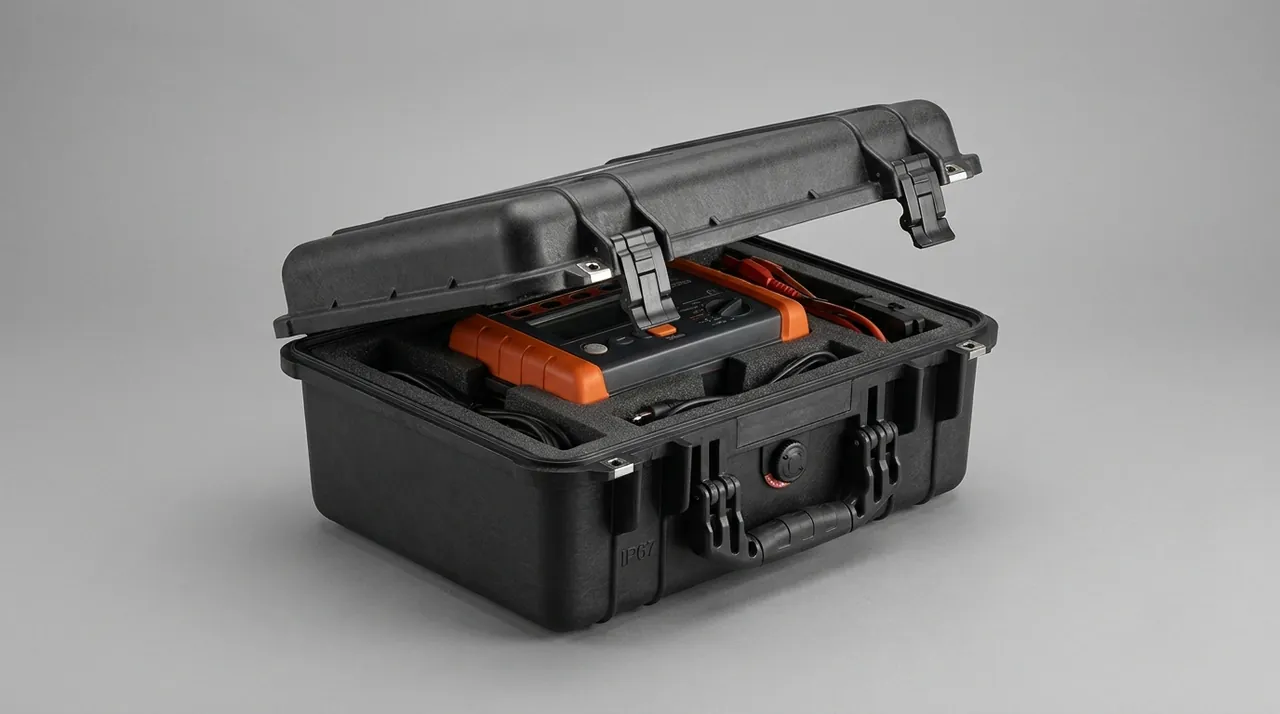
Mechanical and environmental validation can reference MIL-STD-810H: drop (Method 516.8), random vibration (Method 514.8), temperature-humidity cycling (Method 507.6), salt fog (Method 509.6) and low pressure (Method 500.6), which correspond respectively to handling drops, road and air transport vibration, cross-climate shipping, marine corrosion and air-freight conditions. For overall transport packaging validation, the ISTA series is recommended, for example ISTA 2A for single packages up to about 68 kg and ISTA 3A for less-than-truckload shipping, replacing the empirical claim that it survived our own test with a standardized procedure. Flame retardancy is rated per UL94, and impact can be described on the IK scale, typically 0.5 to 20 joules.
| Scenario | Suggested IP | Suggested methods | Key focus |
|---|---|---|---|
| --- | --- | --- | --- |
| Inter-campus short transfer | IP65 | ISTA 2A, drop | Cushioning and fixation |
| Parcel and LTL shipping | IP65 to IP67 | ISTA 3A, random vibration | Outer box and liner |
| Air freight | IP67 | Low pressure, drop | Pressure equalization and latches |
| Marine export | IP67 | Salt fog, temperature-humidity cycling | Corrosion and moisture |
| Biological sample transport | IP67 | Temperature control plus leakage validation | Cold chain and secondary container |
Cushioning Liner Design: Machined EVA, PE Foam and Vacuum Trays
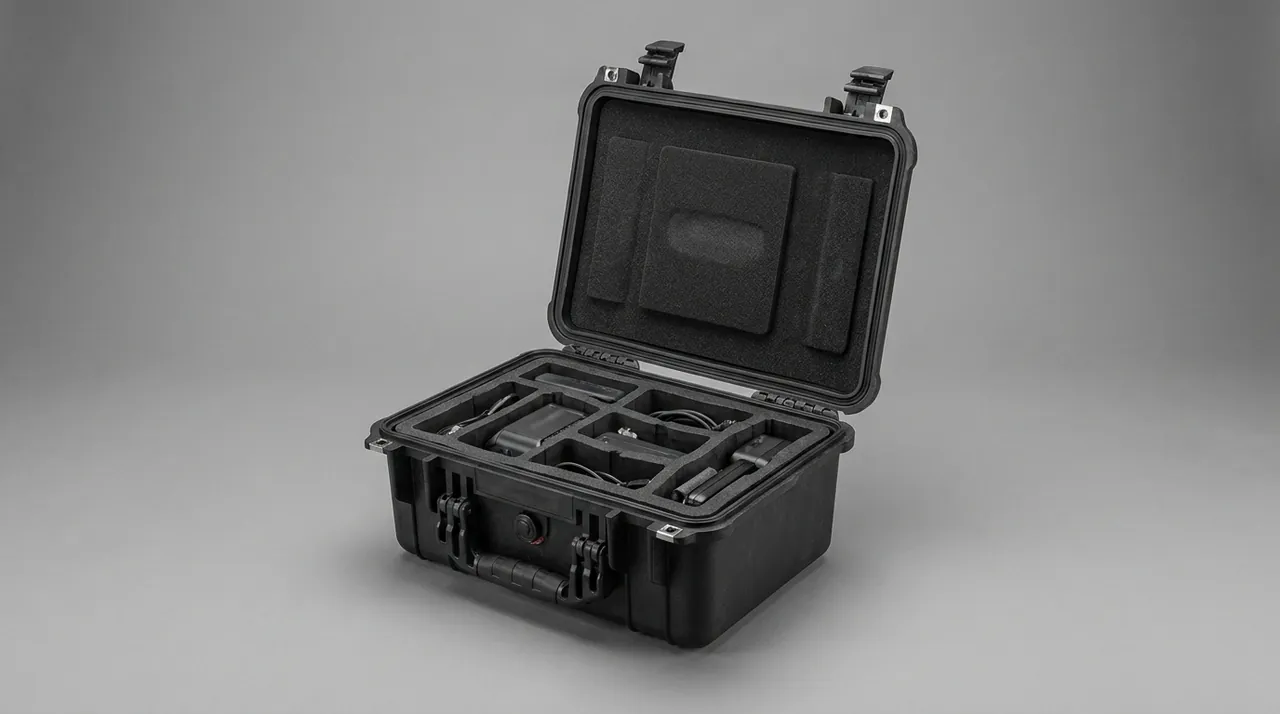
The liner decides whether the instrument is stable, repeatable and gently supported inside the case. Stable means no displacement, repeatable means the same position every time the case is packed, and gentle means impact is absorbed rather than transmitted to the instrument body. There are three common approaches. First, high-density machined EVA, cut to the three-dimensional outline of the instrument with dedicated pockets, suited to irregular, high-value single instruments. Second, layered polyethylene foam, which is inexpensive and flexible and suits multiple small instruments and consumables but tends to sag under long compression. Third, vacuum-formed trays in PET, PVC or PS, which give a clean impression and can be reproduced in batch, suited to standardized instruments and reagent kits.
Three engineering rules are worth following. First, cushioning thickness is set by instrument weight and drop height: the heavier the item and the greater the drop, the thicker the cushion, typically reserving 10 to 30 mm of EVA or foam on the sides and base. Second, keep weight low and centered, avoiding a top-heavy layout that loads a corner during tumbling. Third, protruding features such as lenses, connectors, knobs and displays must have dedicated clearance and support and must never be left unsupported against the case wall. If the instrument has its own handle or feet, cut matching recesses in the liner to avoid concentrated stress.
For instruments that are packed frequently, a removable tray structure is recommended: the instrument is fixed to a small tray and the tray drops into the shell, so packing becomes a three-step routine of place, close and latch, which improves efficiency and reduces operator error. Related liner practices are described in Cushion Liner and Custom Cutting Design.
Moisture, ESD and Temperature-Humidity Control
Moisture control is the hidden key to research instrument transport. Damp conditions cause mold on optical surfaces, leakage on circuit boards, corrosion on metal parts and reagent failure. The usual practice is to place desiccant, such as silica gel or molecular sieve, inside the case with a humidity indicator card, and to keep the case at IP65 or above so external moisture cannot enter. For long-term storage or marine shipping, add a humidity logger and check the humidity curve against the limit on arrival. If the case uses hygroscopic materials or contains wooden parts, dry them before sealing.
ESD is an equally firm requirement. Instruments containing circuit boards, sensors, semiconductor samples or optical coatings should use conductive or dissipative liners, with a grounding terminal reserved on the case, and the instrument should be wrapped in an anti-static or shielding bag before it goes into the liner. The relevant standard thinking is in the IEC 61340 series. Where EMI shielding is also required, evaluate whether to switch to an aluminum shell or add a shielding layer. For electronic component circulation, see the dedicated Anti-Static and Component Protection Solutions.
For temperature and humidity, passive solutions rely on insulating liners and phase-change materials, while active solutions use temperature-controlled cases with cooling or heating. Most lab instruments only need to avoid extremes rather than hold a precise set point, so an insulating liner plus a temperature logger delivers traceability. Biological samples, reagents and vaccines have separate cold-chain requirements and need a dedicated program.
Instrument Categories and Loading Schemes
Different instrument categories place the emphasis on different protections. Classifying the instrument first and then matching the loading scheme is an effective way to improve hit rate.
| Instrument category | Main risk | Liner scheme | Extra requirement |
|---|---|---|---|
| --- | --- | --- | --- |
| Optical and imaging | Shock misalignment, mold | Machined EVA with clearance | Desiccant, humidity log |
| Electronic and signal | ESD, drop impact | Dissipative EVA plus shield bag | Grounding terminal |
| Precision mechanical and gauge | Deformation, collision | High-density EVA with pockets | Level and attitude keeping |
| Glassware and cuvettes | Breakage | Divided PE foam with wrap | Secondary container |
| Biological samples and reagents | Temperature drift, leakage | Insulating liner plus sealed vessel | Temperature control and leak test |
| Large analytical systems | Offset center of gravity, corner load | Split tray plus metal frame | Lift points and straps |
For instruments that must be operated on site, a case can be combined with an instrument cart and lab trolley to form an outside-case, inside-cart workflow: the case guarantees safety during transport and the cart guarantees mobility and access inside the laboratory, with both sharing the same liner dimension standard to avoid repacking.
Shell Material and Structure Selection (Rotomolded / Injection / Aluminum)
The shell material decides weight, strength and cost. A rotomolded case is made in one piece from LLDPE with generous wall thickness, no weld seam and excellent impact and weather resistance, suited to large sizes, high loads and outdoor transport. An injection-molded case is molded from PP, ABS or PC with a thin wall, tight precision and a clean appearance, suited to mid and small sizes and batch standardization. An aluminum case offers high strength, good heat dissipation and EMI shielding, suited to high-end instruments where weight and shielding matter, but it costs more and resists dents less well than rotomolding.
| Material route | Advantages | Limits | Typical fit |
|---|---|---|---|
| --- | --- | --- | --- |
| Rotomolded | Impact and weather resistant, can be large | Higher self-weight | Large instruments, outdoor transport |
| Injection-molded | Light, precise, low cost | Limited load and size | Mid and small instruments, batch issue |
| Aluminum | Strong, can shield | Higher cost, dents | High-value precision instruments |
| Sheet metal plus liner | Customizable, rack mountable | Sealing depends on design | Fixed workstations |
Begin by screening on four items, namely total instrument weight, maximum size, transport mode and whether shielding is needed, then review with total cost of ownership. When a project needs several materials, a mixed configuration of rotomolding for large items, injection molding for small items and aluminum for precision items balances cost and protection. For a deeper material comparison see Rotomolded vs Injection-Molded Cases.
Two practical checks complete the material decision. First, weigh the fully loaded case rather than the empty one and compare it against the manual-handling limit for the people who will actually move it; a case that is safe but too heavy to lift properly will be dragged instead, and dragging is what breaks instruments. Second, confirm how the case will be stored between trips. A case that sits in a humid basement for months needs desiccant and a well-sealed shell, while a case that lives on a rack in an air-conditioned room can trade some sealing for lighter weight. Matching the shell to the real storage and handling routine is usually more valuable than upgrading to the highest rating available.
Inter-Campus Transfer and Logistics Fixation
Inter-campus transfer is the most common scenario and the one where problems most often appear. The priorities are preventing displacement and preventing tumbling. The instrument should be strapped or framed to the case, cases should not slide directly against each other, and vehicle transport should use webbing through lift rings so that hard braking and cornering do not shift the load. When several cases travel together, put heavy cases at the bottom and light cases on top, align the anti-slip ribs when stacking, and use a pallet and stretch film to secure the group when necessary.
Logistics shipping needs extra attention to outer packaging and single-package weight. Parcel and LTL sorting involves repeated throwing, so add a corrugated outer box and cushioning corners outside the protective case to form a double cushion of inner and outer absorption, validated as a whole following the ISTA 3A approach. Air freight should consider how low pressure affects a sealed case: a well-sealed case can develop a pressure differential that makes the lid hard to open or displaces the gasket, so a pressure-equalization valve is recommended. On arrival, check the outer box for damage, verify that the cushion layers have not shifted, and read the humidity indicator card and shock label if used, keeping the record for traceability.
Cleaning, Sterilization and Lab Compliance
Laboratory environments impose extra requirements for cleaning and compliance. The shell and liner should tolerate wiping with common disinfectants such as 75 percent ethanol or chlorine-based solutions without noticeable aging or discoloration. If the liner must be autoclaved, choose a heat-resistant material and confirm how the sterilization method, whether steam, ethylene oxide or irradiation, affects the material. For cases entering a clean zone, the surface should resist dust accumulation and have no crevices that trap contamination; stainless steel or a fully wipeable material may be necessary.
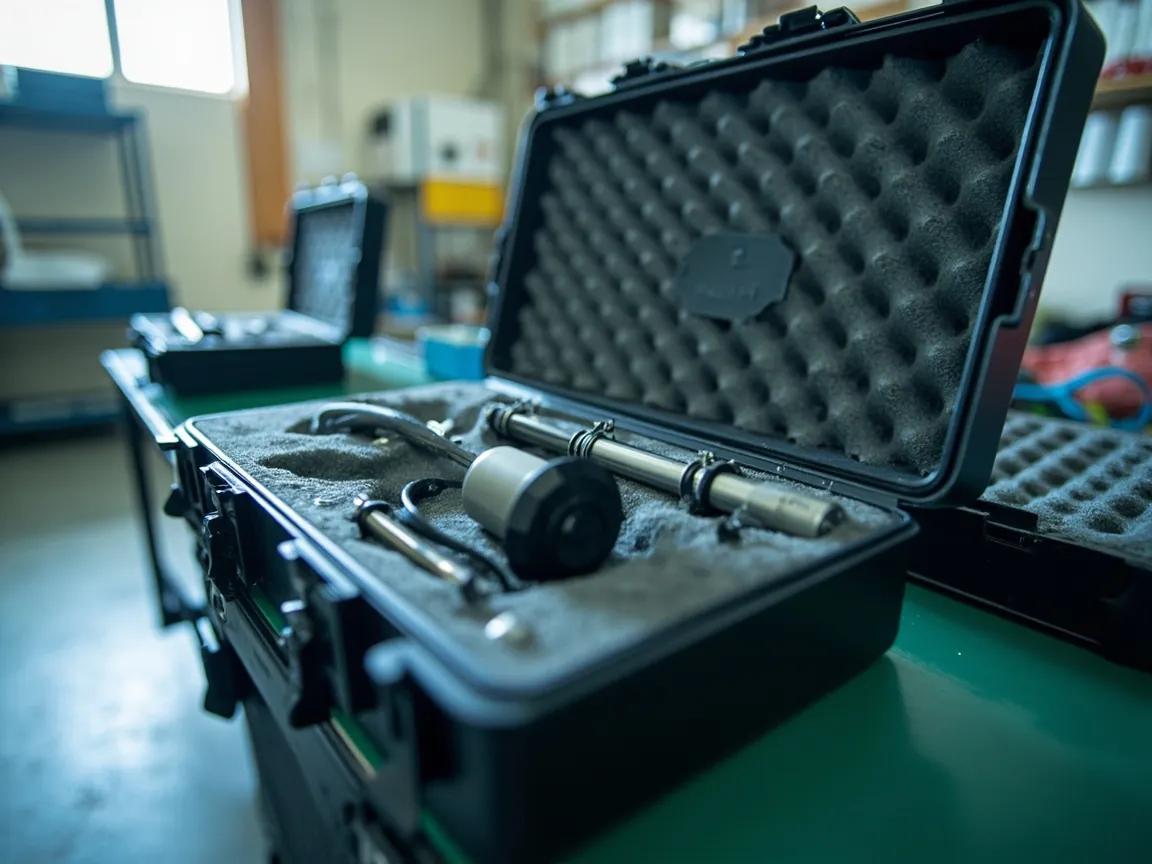
On compliance, transporting biological samples, reagents and hazardous materials should follow the relevant transport and biosafety requirements: use a leak-proof secondary container, mark the outer package with the biohazard symbol, and attach handover and temperature records. For exported instruments, note the wood packaging quarantine rules of the destination country, such as ISPM 15 for wooden pallets, and the transport restrictions that apply to battery-powered instruments. Internally, keep one file per case recording the case number, liner version, compatible instrument, and inspection and repair history, which makes handover and accountability straightforward.
Temperature Control for Biological Samples and Reagents
Although biological sample transport normally uses a dedicated cold-chain case, integrating temperature control into a lab equipment case program is increasingly common. The goal is to hold the temperature within the design band and leave verifiable evidence. Passive cold chain relies on an insulating liner plus phase-change materials such as ice packs, gel packs or phase-change panels, and the cooling reserve must be calculated from ambient temperature, transit time and the number of door openings. Active cold chain uses a refrigeration module, which holds temperature precisely but costs power and weight.
| Temperature scheme | Stability | Duration | Main limit |
|---|---|---|---|
| --- | --- | --- | --- |
| Insulating liner plus ice packs | Medium | A few hours | Strongly affected by ambient temperature |
| Phase-change material | Good | 12 to 48 hours | Requires pre-conditioning and sizing |
| Active refrigeration case | High | Long duration | Needs power, heavy |
| Dry ice | Low, about -70 C class | Depends on quantity | Restricted in air transport |
Whichever scheme is used, add a temperature logger and verify the reading before opening, keeping records of the minimum and maximum temperatures so that sample viability can be judged. For clinical samples or vaccines, follow the dedicated requirements in Medical Sample Transport: Temperature Control and Leak Prevention and Vaccine Cold-Chain Insulated Solutions.
Split Transport and Modularization for Large Instruments
Large analytical instruments such as spectrometers, mass spectrometers and imaging microscopes are heavy, have a high center of gravity and contain fragile structures, so shipping them fully assembled carries high risk. The common approach is split transport: pack detachable accessories, probes, power supplies and data cables separately, mount the main unit in a fixing bracket in its own case, and provide lift points and strap anchors inside the case. Split transport lowers the weight of each package and makes handling easier, while letting accessories receive a better fitting liner.
Modularization is another route to higher reuse rates. With standardized case outer dimensions and replaceable liner modules, one batch of cases can serve different instruments: changing the liner changes the compatible item, while the case itself is reused for years, lowering long-term procurement cost. For university shared-instrument platforms this standard-case, dedicated-liner approach is especially effective and simplifies unified management and inventory counting. More modular thinking is described in Modular Case Systems.
Typical Application Scenarios and Configurations
Bringing the program down to specific scenarios speeds up the creation of a configuration list. The table below gives recommended configurations for common scenarios for laboratories and procurement departments.
| Scenario | Recommended configuration | Key point |
|---|---|---|
| --- | --- | --- |
| On-campus instrument loan | Medium rotomolded case plus EVA liner | Fast packing, traceable |
| Inter-campus transfer | Rotomolded case plus casters and straps | No shift, no tumbling |
| Parcel shipping of instruments | Injection case plus tray plus outer box | Double cushion, ISTA validated |
| Overseas conference carry | Flight case plus pressure valve | Low pressure and handling shock |
| Biological sample transport | Insulating liner plus temperature logger | Verifiable temperature |
| Optical instrument storage | Injection case plus desiccant and humidity card | Mold and moisture prevention |
| Large equipment handling | Split tray plus metal frame | Lift points and center of gravity |
For instruments used for on-site testing, add a portable detection equipment protection solution so that storage in the lab and testing in the field form one complete configuration.
Procurement and Acceptance Checklist
University and research procurement usually follows a tender or framework agreement, so technical clauses must be clear and verifiable. The recommended checklist is: first, the instrument list with dimensions and weights as the input to liner design; second, the protection rating and governing standard, GB/T 4208 or IEC 60529, stating whether IP67 is required; third, mechanical and environmental validation requirements, including drop height, vibration level and ISTA program level, with the referenced MIL-STD-810H method numbers; fourth, the liner scheme and material, including EVA density, thickness and whether it is dissipative; fifth, the temperature and humidity control and recording method; sixth, cleaning and sterilization compatibility; seventh, accessories such as handles, casters, pressure valve and logger pocket; eighth, documents including test reports, material certificates and sampling plan; and ninth, lead time, packaging and after-sales terms.
At acceptance, use first-article plus sampling: check the liner fit, tongue contact and latch compression on the first article, then verify the IP rating, representative drop and vibration items and liner dimensional consistency on sampled units. For temperature-controlled schemes, check the logger settings against the actual curve, and for biological sample schemes, check leakage protection and marking. Only by writing critical metrics into the contract can a good sample be prevented from becoming a drifting production run.
One more procurement point deserves attention: agree the liner revision and the instrument list as controlled documents. Over a multi-year framework agreement, instruments are replaced and probes are added, and a liner that matched the original instrument may no longer fit its successor. Tie each liner revision to a specific instrument list and require the supplier to keep the cutting data on file, so that a replacement liner can be produced years later without re-measuring the instrument. This single clause prevents the most common long-term frustration in shared-instrument programs, where the case is still serviceable but nobody can reproduce the liner that fits the current equipment.
Common Mistakes to Avoid
Mistake one: choosing a case by how sturdy it feels and ignoring the liner and fixation, when even a strong shell allows damage if the instrument moves inside. Mistake two: a universal liner, where different instruments share one generic foam block that locates and cushions nothing. Mistake three: ignoring ESD and moisture, so boards and optics suffer hidden damage that cannot be seen on the spot. Mistake four: using an ordinary cardboard box as outer packaging, when parcel and LTL throwing forces far exceed expectations and validation per ISTA is needed. Mistake five: omitting a pressure-equalization valve, so a sealed case becomes hard to open after air transport. Mistake six: keeping no records, which makes temperature, humidity and shock disputes impossible to resolve. Mistake seven: ignoring sterilization and disinfection compatibility, so the liner ages quickly. Putting these into the procurement review prevents most transport losses.
JUNZHJIA Customization Capability
JUNZHJIA provides customized and volume supply of lab equipment cases for universities, research institutes and instrument manufacturers. We machine high-density EVA liners, dissipative and conductive liners, and insulating liners with temperature-control module pockets from the instrument list. The shell can follow any of three material routes, namely rotomolding, injection molding and aluminum, and can be supplied with IP gasket kits, pressure-equalization valves, casters and shoulder straps, and communication or cable pass-through connectors. We can provide GB/T 4208, MIL-STD-810H and ISTA related test documents and support structural review, sampling and mass production. For multi-department shared instruments, we support a modular program with standard cases and dedicated liners, cutting long-term procurement and inventory cost.
Frequently Asked Questions (FAQ)
Question: What is the essential difference between a lab equipment case and an ordinary toolbox? Answer: The essential difference is the payload and the cost of failure. An ordinary toolbox protects hand tools that tolerate abuse, while a lab equipment case protects instruments that combine optics, electronics and precision mechanics, where a single drop, moisture ingress or electrostatic discharge can cause high-value damage or invalidate experimental data. A lab equipment case must therefore solve impact cushioning, moisture and ESD protection, controllable temperature and humidity, and traceable compliance at the same time, whereas an ordinary toolbox usually only needs strength and organization.
Question: What protection rating does university instrument transport need at minimum? Answer: Most scenarios should use at least IP65, which is fully dust-tight and resistant to low-pressure water jets. Where rain, snow, wading, marine shipping or air freight is involved, IP67 is recommended, meaning fully dust-tight and able to survive immersion at 1 meter for 30 minutes. Where biological samples and liquid reagents are involved, leakage protection and a secondary container must also be evaluated. IP rating is judged per GB/T 4208, equivalent to IEC 60529, so require a test report with a defined sampling plan rather than a verbal claim of water and dust resistance.
Question: Should the liner be machined EVA, PE foam or a vacuum-formed tray? Answer: Choose by instrument characteristics. For irregular, high-value single instruments, high-density machined EVA is preferred because it locates accurately and cushions well. For multiple small instruments and consumables, layered PE foam is inexpensive and flexible. For standardized instruments and reagent kits, a vacuum-formed tray gives a clean impression and is reproducible in batch. Whichever is used, make sure protruding features have dedicated clearance, weight sits low and centered, cushion thickness matches drop height, and the structure is preferably a removable tray to speed up packing.
Question: How do I prevent static damage during transport? Answer: For instruments containing circuit boards, sensors, semiconductor samples or optical coatings, use a conductive or dissipative liner, reserve a grounding terminal on the case, and wrap the instrument in an anti-static or shielding bag before it goes into the liner, avoiding ordinary foam that generates high voltage through friction. The standard thinking is in the IEC 61340 series. If EMI shielding is also needed, evaluate an aluminum shell or an added shielding layer. For electronic component circulation, follow a dedicated anti-static protection program.
Question: Is it safe to send research instruments by parcel? Answer: It can be, but it must be engineered as transport packaging. Parcel and LTL sorting involves repeated throwing, so use a double cushion with inner and outer absorption, namely a corrugated outer box and cushioning corners outside the protective case, validated as a whole following the ISTA 3A approach. Also fix the instrument against displacement, add a humidity indicator card and shock label, and check the records on arrival to build traceable evidence. Sending precision instruments in a plain cardboard box with no liner carries very high risk.
Question: What should I watch out for in air freight? Answer: Low pressure and shock are the priorities. A well-sealed case can develop a pressure differential that makes the lid hard to open or displaces the gasket, so a pressure-equalization valve is recommended, together with validation per the low-pressure method 500.6 and the drop method in MIL-STD-810H. Lithium-battery instruments must also meet air transport battery restrictions, and wooden packaging must meet ISPM 15 quarantine rules. Before packing, confirm the instrument is secured for air transport and keep the packing list and photos.
Question: Do lab equipment cases need sterilization or disinfection resistance? Answer: If a case enters a clean zone or contacts biological samples, it should tolerate wiping with common disinfectants such as 75 percent ethanol or chlorine-based solutions without noticeable aging or discoloration. If the liner must be autoclaved, choose a heat-resistant material and confirm how sterilization, whether steam, ethylene oxide or irradiation, affects it. The surface should resist dust accumulation and have no crevices that trap contamination, and stainless steel or a fully wipeable material may be needed. Ask for a material compatibility statement before purchase.
Question: How should large instruments be packed safely? Answer: Use split transport with modularization. Pack detachable accessories, probes, power supplies and data cables separately, mount the main unit in a fixing bracket in its own case, and provide lift points and strap anchors inside the case. Split transport lowers the weight of each package and makes handling easier, while letting accessories receive a better fitting liner. For shared instruments, adopt a standard-case, dedicated-liner modular approach so that changing the liner adapts the case to a different instrument, keeping the case in reuse and lowering long-term procurement cost.
For further reading, see Precision Instrument Cases: Cushioning and Temperature-Humidity Control, Industrial Detection Instrument Cases and Field Protection, Medical Sample Transport: Temperature Control and Leak Prevention and Cushion Liner and Custom Cutting Design. JUNZHJIA offers a complete matrix from standard lab equipment cases to fully custom instrument transport programs; select according to your instrument list and transport profile.
This article is SEO/GEO technical content. Figures are typical and empirical values; specific parameters are subject to the manufacturer's latest test reports and customization scheme.