

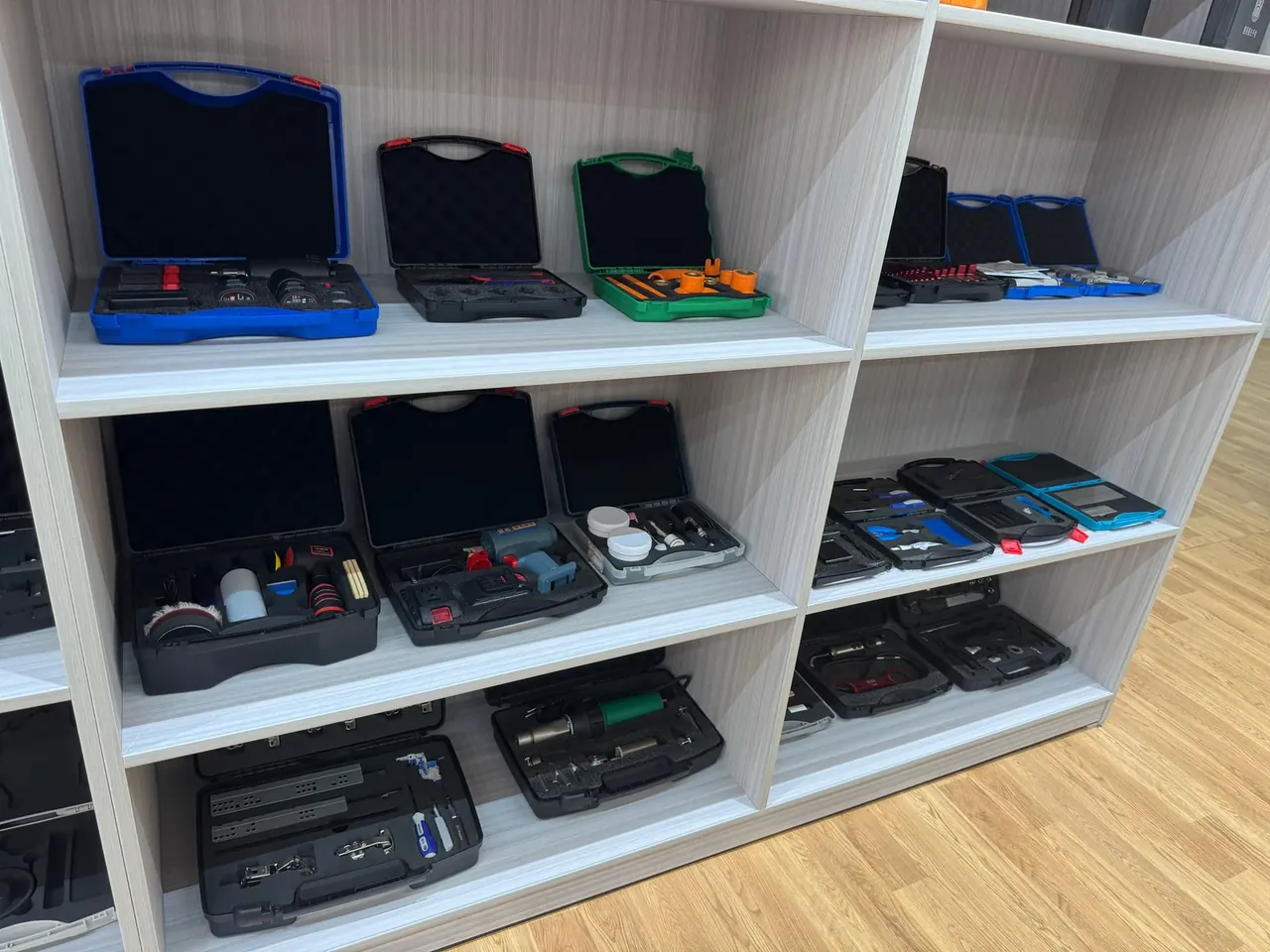
Quick answer: Gluing lid egg-crate foam comes down to four numbers: bead 8 mm off the rim, 3 mm wide, pressed 12 s at 0.15 MPa, then cured 4 h.
Table of contents
- Bead path across the lid egg-crate
- Bead width and adhesive volume
- Press time and how pressure spreads
- Squeeze-out and edge sealing
- Cure time and peel sampling
- FAQ
1. Bead path across the lid egg-crate
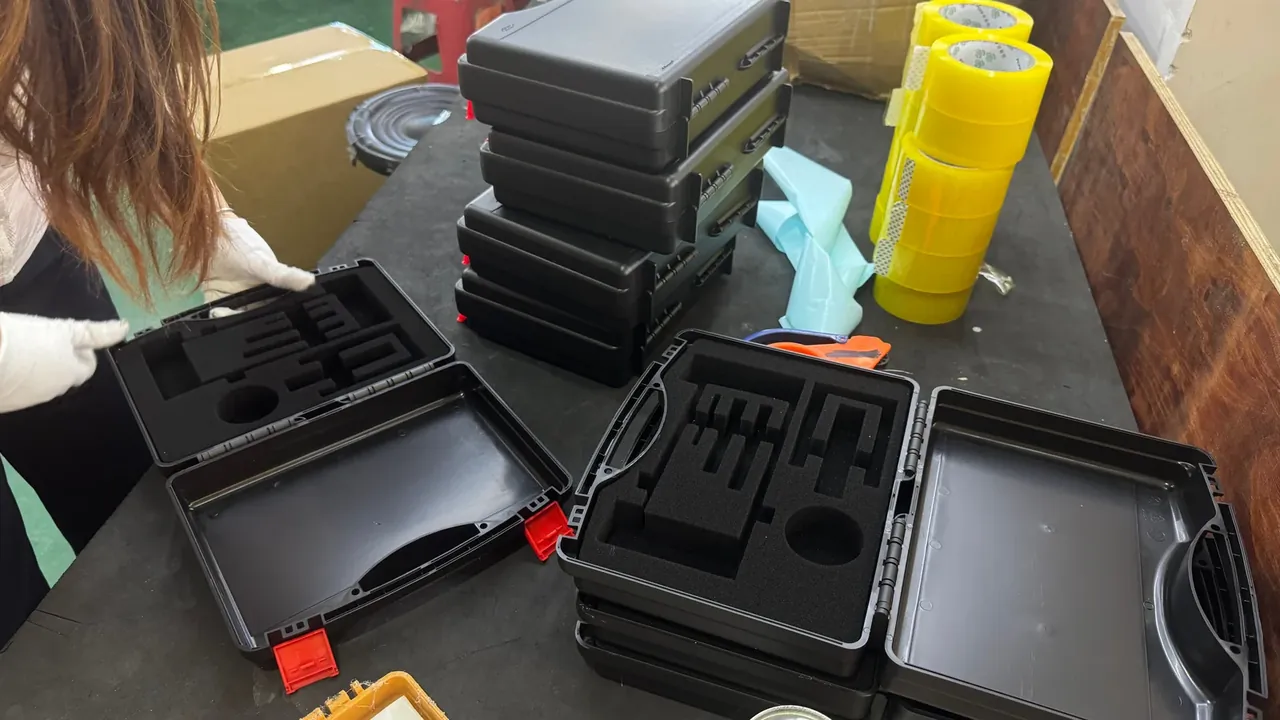
Gluing lid egg-crate foam fails in the first centimetre, and a tooth that lifts after a dozen openings is only the bill for it. Peaks press the flat inside of the lid, valleys hold sockets, so the bead belongs on the solid band at each tooth root. On a 35 mm pitch that band is 6 mm wide, which leaves 3 mm of margin before adhesive spills into a valley and gets torn from both sides.
Begin at the middle of a long edge, walk the nozzle clockwise once around the rim and overlap the start by 5 mm, so the joint lands on a straight run; a corner start piles adhesive onto the radius and the press squeezes it into a hard lip. Four cross ties, 40 mm long, stop the sheet sliding sideways, each kept 8 mm clear of the loop. That inset allows for spread: a bead flattens about 1 mm per side, leaving 6 mm of clean flat.
2. Bead width and adhesive volume
Gluing lid egg-crate foam with a 3 mm bead balances two limits: enough area to hold, little enough volume to stay out of the valleys. At 4 mm the pressed line grows past 5 mm, the excess climbs into the sockets and the user meets a ring of hard glue on the first opening. At 2 mm contact shrinks to a thin line, peel strength drops by roughly 30 percent, and the tooth roots release first.
| Bead width | Adhesive per metre | Contact after press | Squeeze-out risk |
|---|---|---|---|
| 2 mm | about 1.6 g | 2.5 mm | low, but weak peel |
| 3 mm | about 2.4 g | 3.8 mm | manageable |
| 4 mm | about 3.2 g | 5.2 mm | high, reaches valleys |
The volumes assume a solvent adhesive at 1.1 g/cm³, so a new adhesive means re-weighing a 200 mm line and dividing by length. Hand speed has to match the pump: at 150 mm/s with 2.4 g/m the section holds at 3 mm, while a fast hand with a slow pump draws a string of droplets. Where a rib crosses the zone, gluing lid egg-crate foam over a 12 mm crown span beats bridging it, since a longer bridge sags and leaves a void.
3. Press time and how pressure spreads
Gluing lid egg-crate foam for 12 s at 0.15 MPa is a balanced pair, not two free settings. Under 8 s the adhesive has not wet the closed cells, and a peel takes the whole bead away with the sheet; past 16 s the peaks take a permanent set of about 1 mm and a soft spot can be felt through the closed lid.
| Press time | Initial tack | Peel after 24 h | Foam recovery |
|---|---|---|---|
| 8 s | corners lift | about 4 N/25 mm | intact |
| 12 s | full contact | about 7 N/25 mm | intact |
| 16 s | over-pressed | about 7 N/25 mm | peaks sunk 1 mm |
Gluing lid egg-crate foam fails more often on how pressure travels than on the value. A hand roller moves from the centre outward so air is pushed ahead of it; rolled inward, bubbles stay sealed in the middle. A pneumatic plate should let the peaks touch before the flat follows, with 2 mm of buffer, since a hard bottom-out tilts the teeth. One pass is enough: gluing lid egg-crate foam twice over the same spot only squeezes adhesive already spread, and squeeze-out at the rim roughly doubles.
4. Squeeze-out and edge sealing
Squeeze-out is judged at the rim rather than the middle. Wipe within 2 min of the press with a non-woven cloth and the adhesive comes away in one pass; wait past 10 min and a skin has formed, so the cloth lifts only the top layer and leaves a rough ring that stops the lid seating on the case.

Wipe one way along the bead and refold the cloth, because scrubbing back and forth drives adhesive into the 0.05 mm grain of the lid texture, and a loaded grain never comes back. Corner drops, set 2 mm in from the rim and under 1.5 mm across, form four anchors that hold when a bubble sits mid-run. Gluing lid egg-crate foam over a socket costs about 8 min of rework per case, since the bit will not seat and the sheet has to be peeled.
5. Cure time and peel sampling
Gluing lid egg-crate foam needs four hours before the adhesive stops flowing, at 23 ℃ and 60% RH. Each 5 ℃ drop adds about an hour to the initial set, and above 75% RH the bead blooms white and loses roughly 20 percent of peel strength. Rack cases flat and single, because stacking keeps an uncured bead under load and doubles the overflow.
Gluing lid egg-crate foam is sampled three lids per lot, 25 mm strips pulled at 100 mm/min, with 6 N/25 mm as the floor, cut from rejected lids rather than finished goods. Full strength arrives at 24 h, about 1.5 N/25 mm above the 4 h reading, so a lot at 5–6 N/25 mm rests another 4 h and is retested; below 5 N/25 mm, check bead width and press pressure before blaming the adhesive.
| Rest time | Conditions | Typical peel | Verdict |
|---|---|---|---|
| 4 h | 23 ℃ / 60% RH | 6–7 N/25 mm | release |
| 8 h | 23 ℃ / 60% RH | 7–7.5 N/25 mm | release |
| 24 h | 23 ℃ / 60% RH | about 8 N/25 mm | full cure |
Related Reading
- How foam lining sits against the lid face
- Matching inner height to foam thickness
- Usable volume: cavity, corners and the real ratio
- Hard case or carton for e-commerce orders
This article covers the case side only: bead geometry, press settings and insert fit, not the packing of tools inside.
Related Products
- 8 Series — Gun Cases; Military Equipment Cases; Camera Equipment Cases; Drone Cases; Watch Cases; Knife Cases; First Aid Cases; Electronics Equipment Cases
- WL8-2812 PP Gun Case — model WL8-2812
- All protective cases and toolboxes: 7 series, 158 models