

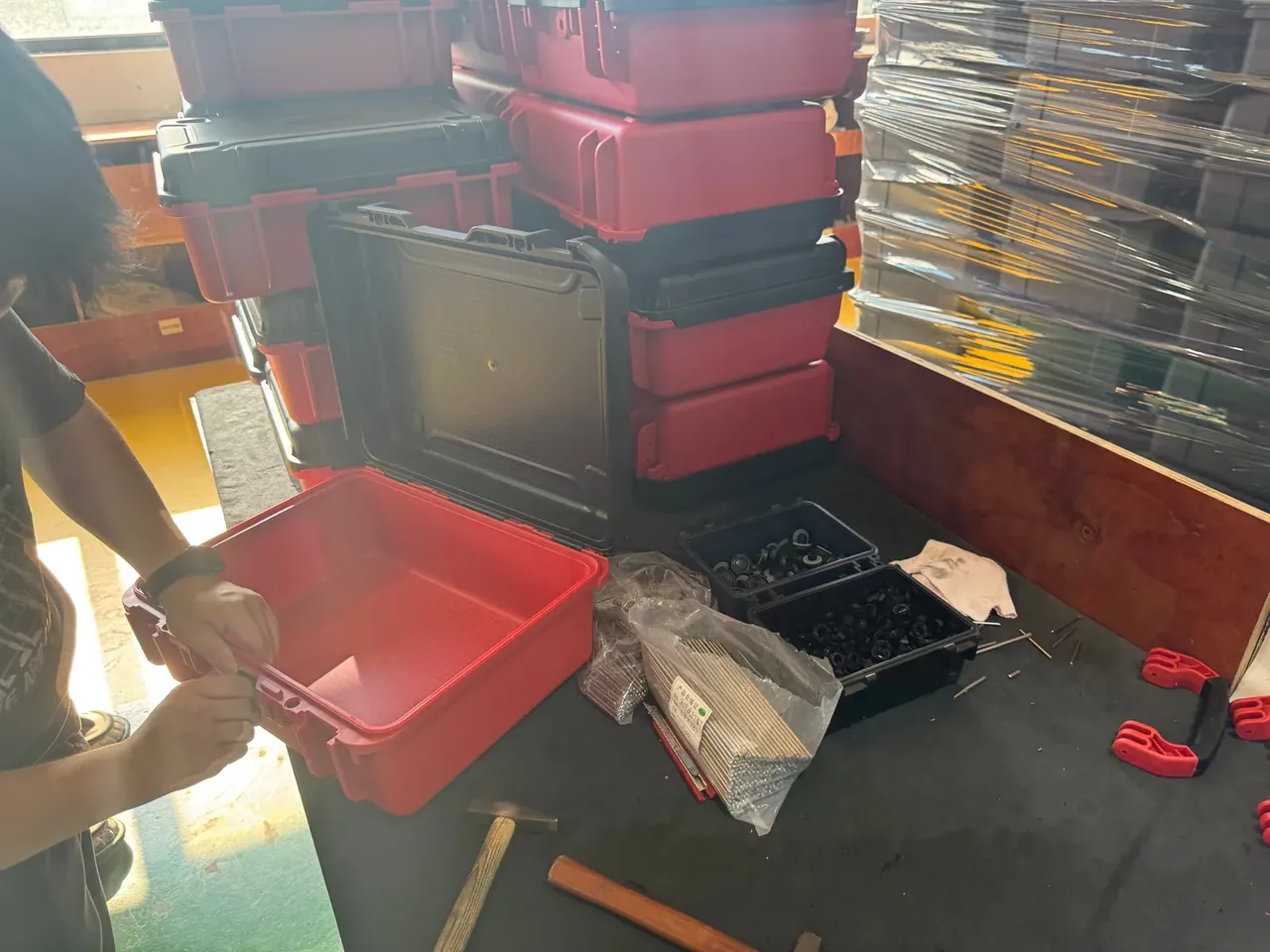
Quick answer: Lightweight Instrument Case Design fixes the wall band at 2.2-2.8 mm and ribs at 0.6 of the wall before the scale decides anything.
Table of contents
- Where the Wall Thickness Floor Sits
- Ribs as a Fraction of the Wall
- Resin Density and Equal-Volume Weight
- How Much Hardware and Liner Weigh
- Which Figures Drop First
- FAQ
1. Where the Wall Thickness Floor Sits
Three hundred grams have to come off somewhere, and only three places exist: wall thickness, ribs, hardware. Lightweight Instrument Case Design is not subtraction; the shell must still stand once the grams are gone.
The working band runs 2.2 to 2.8 mm against general wall practice of 2.0 to 3.5 mm. The overlap shows the floor: 2.8 down to 2.2 removes 0.6 mm, half the wall tolerance band already, and anything below that is eaten by moulding variation.
| Zone | Room to cut | Held by |
|---|---|---|
| Rim plane | little | the sealing face must stay flat under load |
| Mid side wall | plenty | only resists out-of-plane bending, ribs restore it |
| Latch seat | almost none | local point load, a thin wall cracks first |
| Hinge seat | little | cycle count is fixed, the root wears oval |
Cut by zone, never across the whole shell. The rim, the latch seat and the hinge seat fail first, so Lightweight Instrument Case Design often adds material there and takes it from elsewhere. The mid side wall is the one stretch that can give.
A second floor in Lightweight Instrument Case Design has nothing to do with strength: flow length. Below it the melt stops short of the far corner and the part short-shots where a drop lands.
2. Ribs as a Fraction of the Wall
Rib thickness is held at 0.6 of the wall, the ratio this family of parts settles on. The reason is cooling: both sides of a rib root are solid, so a thick root cools last, the surface shrinks first and a sink mark appears. At 0.6 the sink goes and most of the stiffness arrives.
Ribs change the load path, not the mass: the same weight as a ribbed section raises the second moment of area and cuts deflection. In Lightweight Instrument Case Design, converting the 0.6 mm taken from the wall into ribs beats plain thinning, because the material moves further from the neutral plane.
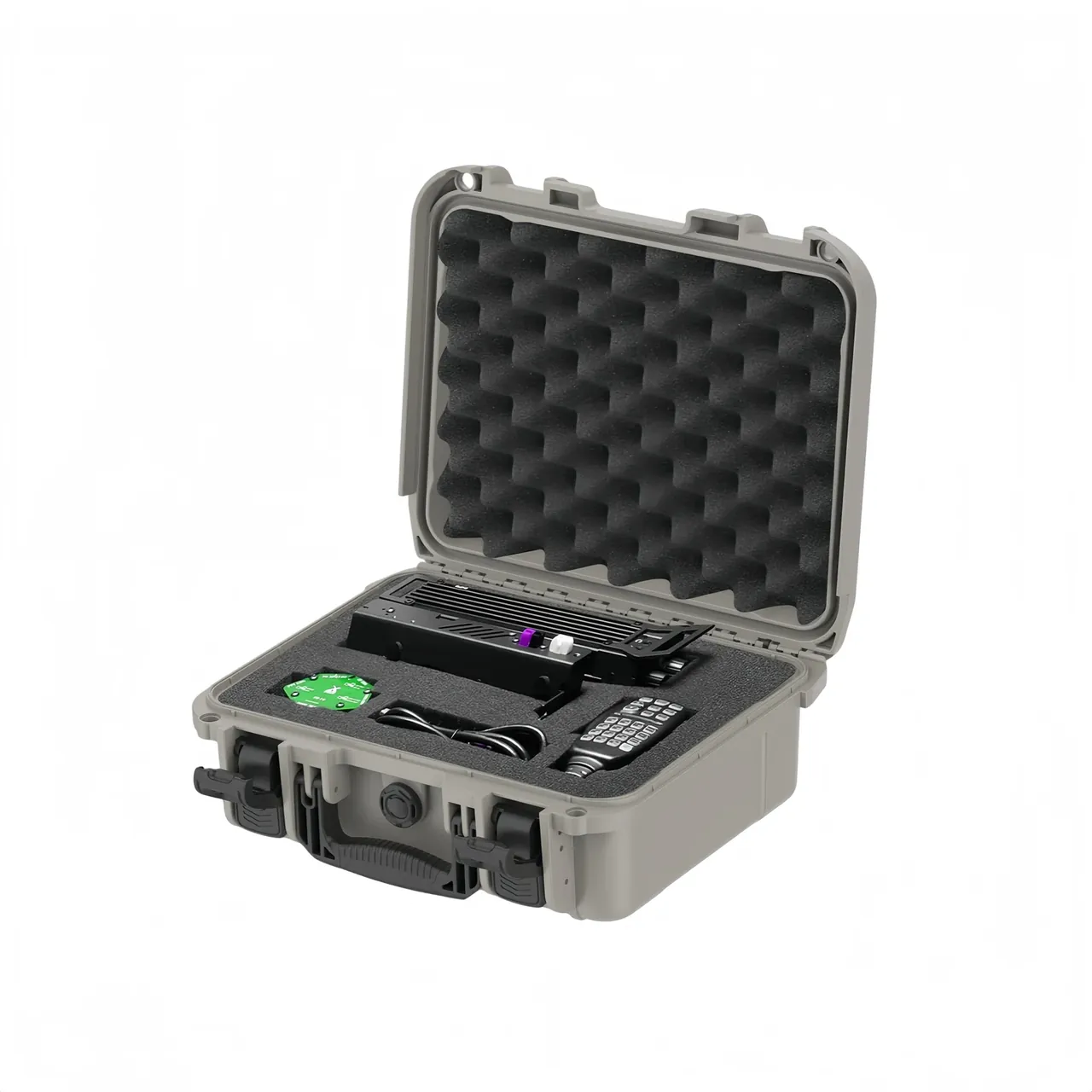
Direction follows the load. The base takes stacking pressure, so ribs run across the short span; the side wall takes squeeze and drop bulge, so ribs run vertically and tie top to bottom into one load line. Crossings are staggered, since a cross root is a local thickening where sink and stress start.
In Lightweight Instrument Case Design the rule that more ribs is better does not hold. Tight spacing makes venting and filling hard; tall ribs scuff the wall on ejection. Build the two or three ribs on the main axis first, then add secondary ones.
Wall and rib move as a pair: a wall cut is never repaid by rib thickness in the same proportion, which is why both belong in one tooling round.
3. Resin Density and Equal-Volume Weight
Resin density sets the weight floor for a given volume. PP sits at 0.90 to 0.91 g/cm³ and ABS at 1.04 to 1.06 g/cm³, roughly 15% apart. Same outline, same wall, and the swap alone changes the weight.
| Resin | Density | Equal-volume weight | Trade |
|---|---|---|---|
| PP | 0.90-0.91 g/cm³ | baseline | lower stiffness, softer surface |
| ABS | 1.04-1.06 g/cm³ | about 15% heavier | stiffer, brittle when cold |
Resin choice is not a scale reading. ABS delivers 100 to 400 J/m notched impact at 23 °C and 40 to 120 J/m at −20 °C, a fall steeper than the density gap. Weight saved with PP has to be bought back as rib stiffness, and stiffness bought with ABS is paid for in that 15%. Lightweight Instrument Case Design trades service temperature here, not resin grades.
Equal-volume weight estimates as outline volume times density times a solid factor set by rib spacing; guess the factor wrong and the figure drifts, which is why the scale beats the spreadsheet.
4. How Much Hardware and Liner Weigh
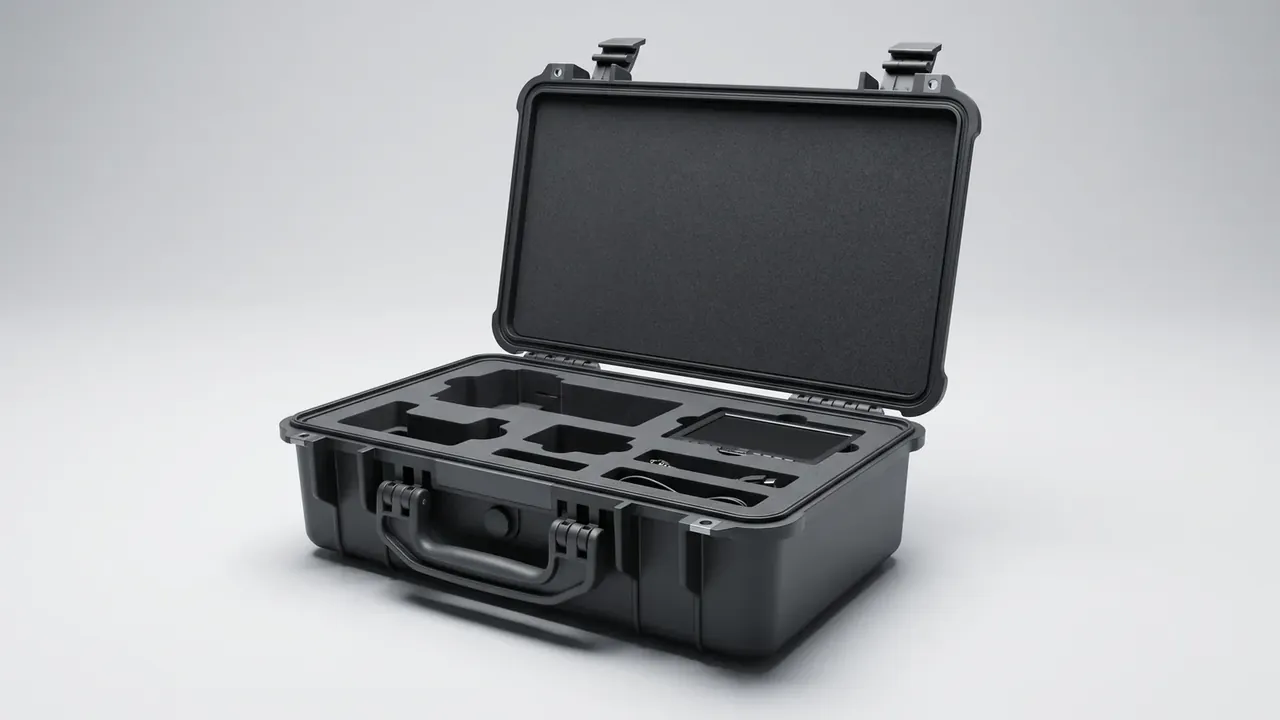
Hardware and liner hold 30% to 40% of total mass and usually get omitted. Latches, hinges, handle bosses, gasket and foam are individually light and collectively able to cancel every gram the shell gave up.
| Element | Share | What can move |
|---|---|---|
| Shell | 60%-70% | wall and ribs, the largest pool |
| Hardware | 15%-20% | retention sets the floor, change material only |
| Liner | 10%-20% | density and thickness, rebound decides |
Latch retention of 200 to 400 N and 20000 hinge cycles fix the hardware floor. At this layer Lightweight Instrument Case Design can change material and architecture, not shave the latch body.
The liner has more room than expected. EVA runs 25 to 45 kg/m³ and PU 30 to 60 kg/m³, so the same volume in the lower band saves nearly half the mass; the cost is compression set, and foam that collapses after one trip protects nothing.
A second liner effect: foam filling the interior lets the shell shrink, and a smaller outline drops shell mass and freight volume together. At the liner layer, Lightweight Instrument Case Design removes more than the foam's own weight.
5. Which Figures Drop First
In Lightweight Instrument Case Design the price of a weight cut arrives in order: stiffness, then local strength, then drop performance. Stiffness shows as a lid that dents under a thumb; local strength shows as a cracked latch seat or a torn hinge boss; drop performance surfaces last, because the corner keeps absorbing for a while.
A cut of 15% to 20% is the normal band, reached with zoned walls and added ribs. Beyond that the resin or the hardware has to move, and the cost lands on another figure. Every further gram is dearer than the one before.
Lightweight verdict: when a cut passes 25% and the shell shows a through-crack after a 1.2 m drop, the plan has crossed the line.
Reverse the checking order: drop first, stack second, weigh last. Once both tests pass, the scale means something; set the weight first and patch the structure after, and the tooling changes twice.
Related Reading
- Wall thickness against case weight, side by side
- Minimum wall and hinge for thin-wall shells
- How ribs are laid out inside a case
- Shell weight and tray count across tool cases
JUNZHIJIA
Related Products
- 8 Series — Gun Cases; Military Equipment Cases; Camera Equipment Cases; Drone Cases; Watch Cases; Knife Cases; First Aid Cases; Electronics Equipment Cases
- WL8-2812 PP Gun Case — model WL8-2812
- All protective cases and toolboxes: 7 series, 158 models