

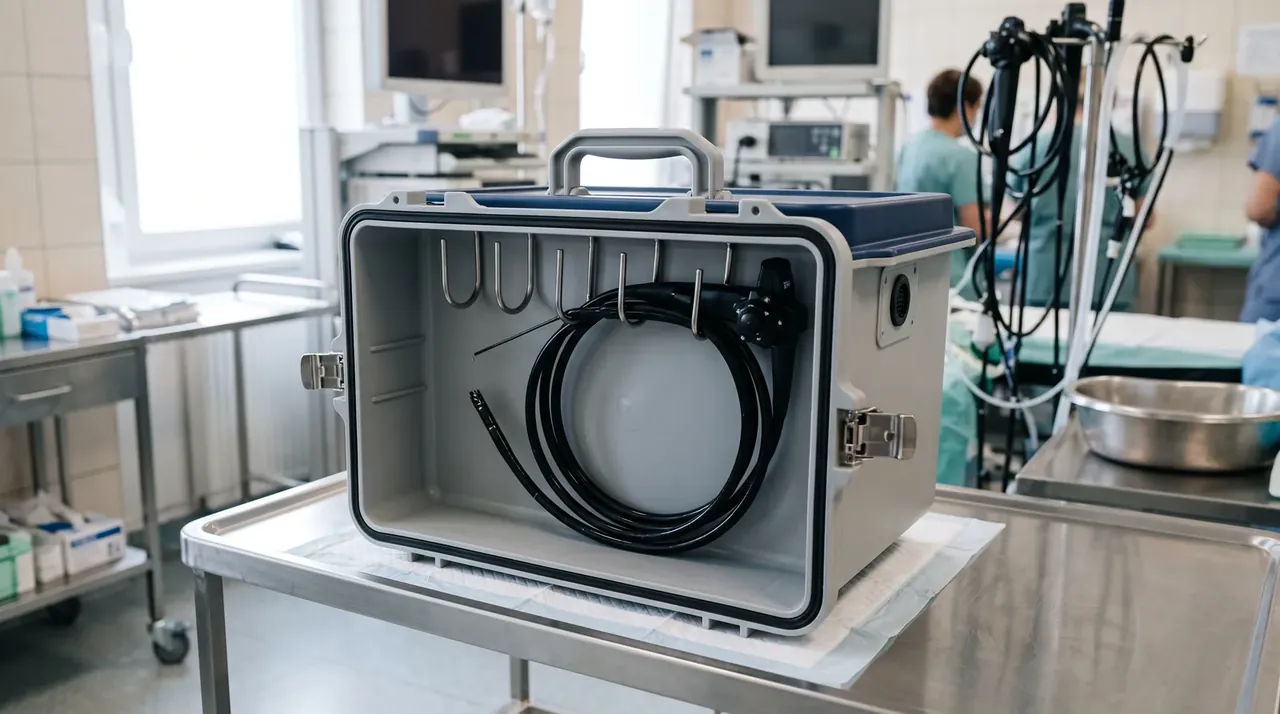
Quick answer:Lightweight Materials for Medical Cases begin with density and end with impact: PP sits at 0.90–0.92 g/cm³, ABS at 1.04–1.06, PC at 1.20 g/cm³. Notched impact runs 4–15, 15–35 and 60–90 kJ/m² in that same order, so swapping ABS for PP in one shell saves about 18% of mass while a 2.5 mm wall leans on ribs instead of the resin.
Table of contents
- Three routes to a lighter case
- PP against ABS by density and impact
- Where PC is overkill and what it costs
- An aluminium frame around PP panels
- Thinner walls paid back by ribs
- Brittle fractures below freezing
- FAQ
1. Three routes to a lighter case
A lighter case is not a shell moulded from a lighter grade. On a 12 L empty body, walls hold about half the mass and the hardware holds the rest, so Lightweight Materials for Medical Cases has three levers, not one.
Resin substitution buys the biggest drop and spends the most impact reserve. Ribbed thinning takes 10% to 20% out and keeps stiffness. Feature cutting drops the second lid skin and the metal corner wrap.
Order decides: drop height and payload first, wall section second, grade last. Reversed, ribs land on flat faces that never carried load and the mass barely moves.
2. PP against ABS by density and impact
For equal wall volume, PP at 0.90–0.92 g/cm³ is about 13% lighter than ABS at 1.04–1.06 g/cm³, the most quoted figure in this debate. It holds only where walls dominate: move the bending duty into an aluminium frame and the whole-case saving falls under 5%.
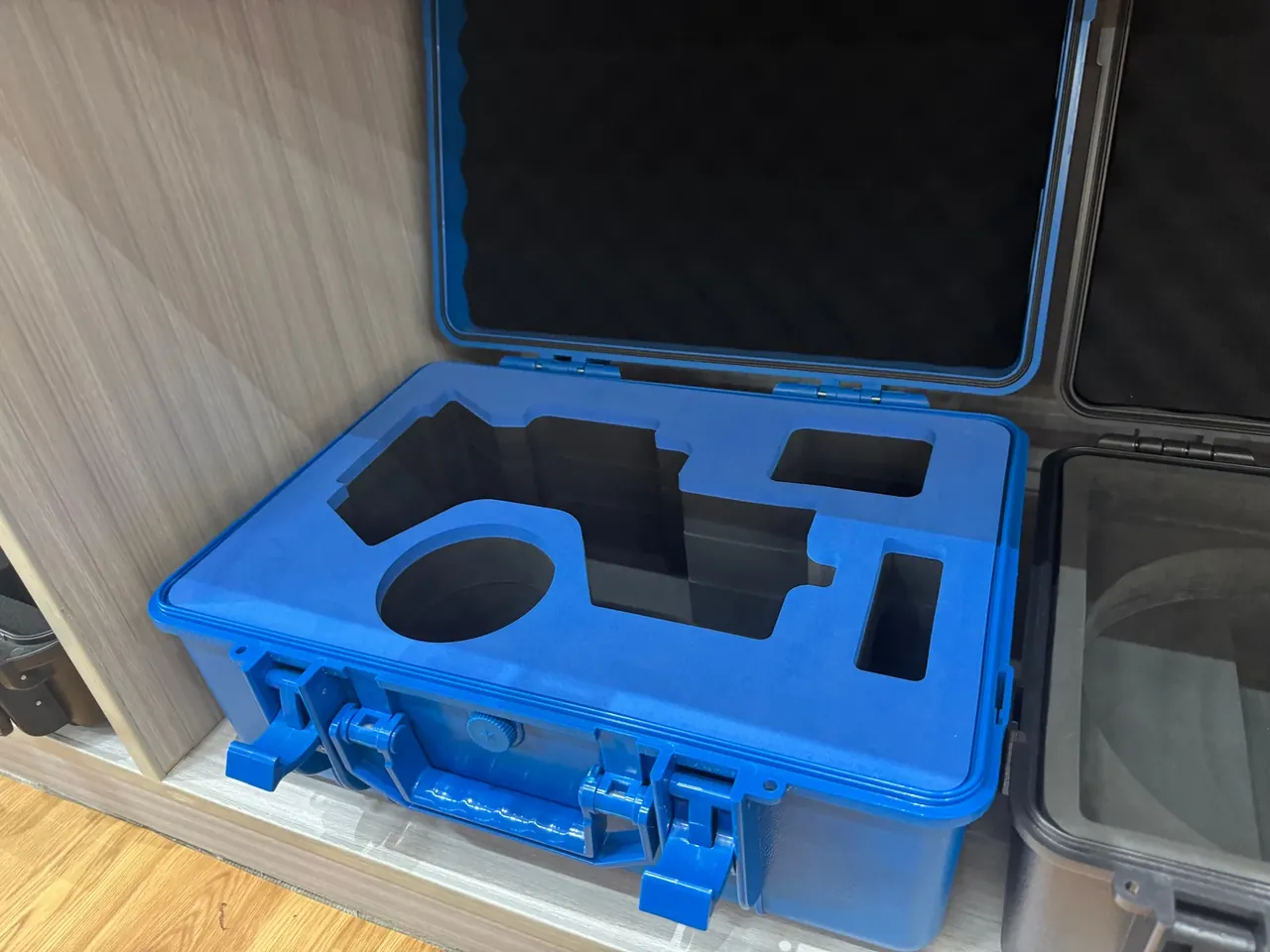
Notched impact separates the pair far more sharply. At 23 ℃ the PP figure is 4–15 kJ/m² against 15–35 kJ/m² for ABS, roughly a threefold reserve, and corners, latch seats and handle roots spend exactly that on the first drop.
Shrinkage sits on the same sheet: 1.0%–2.5% against 0.4%–0.7%. Past a 400 mm long side a PP shell needs an adjustable tongue allowance, or the lid gap runs tight at one end and hangs open at the other.
| What is compared | PP | ABS | PC |
|---|---|---|---|
| Density (g/cm³) | 0.90–0.92 | 1.04–1.06 | 1.20 |
| Notched impact at 23 ℃ (kJ/m²) | 4–15 | 15–35 | 60–90 |
| Notched impact at -20 ℃ (kJ/m²) | 2–4 | not quoted here | not quoted here |
| Mould shrinkage | 1.0%–2.5% | 0.4%–0.7% | 0.5%–0.7% |
| Indicative resin price | ¥8–12/kg | ¥14–22/kg | above ABS |
| Sensible location | walls, lid skin, large faces | latch seats, handle roots, corners | windows, clear thin parts |
Read the table by location: which face bends, which point takes the strike, then the grade.
3. Where PC is overkill and what it costs
PC returns 60–90 kJ/m², two to four times the ABS figure, at the highest density of the three, 1.20 g/cm³. A whole shell in PC carries more reserve than the duty asks and ends heavier than the ABS version, which is where the search for the strongest grade quietly reverses the goal.
The genuine need is narrow: windows, clear lids on small drug boxes, thin sections that must be stiff and see-through at once, where 0.5%–0.7% shrinkage holds flatness better than PP.
4. An aluminium frame around PP panels
In Lightweight Materials for Medical Cases the frame takes the bending and twisting duty and the PP panel only carries in-plane load and closes the volume, running at 2.5 mm or less because the frame holds long-side deflection.
Aluminium and PP differ in thermal expansion by roughly an order of magnitude, so keep rivet pitch under 80 mm and add an edge strip to share the movement out in short steps. The penalty is process: bending, anodising, drilling, a second panel tool, then assembly labour.
5. Thinner walls paid back by ribs
Going from 3 mm to 2.5 mm removes about 17% of the material, while bending stiffness follows the cube of thickness and falls to roughly 58% of the original. That gap is why the resin grade is only half the argument.
Ribs restore stiffness by cutting one large face into small fields at two to three times the wall in height, near 60 mm pitch. Sink marks, root stress and weld lines are the price; a 0.5 mm root radius keeps a stiffener from becoming a crack starter.
| Wall (mm) | Rib height (mm) | Rib pitch (mm) | Typical location | Watch out for |
|---|---|---|---|---|
| 3.0 | 6–9 | 70–80 | Long side walls | Heaviest, easiest to stiffen |
| 2.5 | 5–7.5 | 55–65 | Lid skin, large faces | Sink marks on the show face |
| 2.0 | 4–6 | 45–55 | Inner dividers, small lids | Needs corner protection |
6. Brittle fractures below freezing
At -20 ℃ the notched impact of PP falls to 2–4 kJ/m², a third to a half of its room-temperature floor. Cases travel between cold-chain transfer, winter vehicles and unheated stores, so the reserve tracks the temperature.
Failure looks different from a warm-workshop dent. A flat pale split opens along a rib root or a latch seat, and once it crosses the wall the sealing face is gone for good.
| Lowest service temperature | Wall grade | Load points | Insert response |
|---|---|---|---|
| Above 0 ℃ | PP acceptable | Thicker rib roots | Standard EVA |
| -10 ℃ to 0 ℃ | Ribbed PP | ABS inserts | Denser EVA |
| -20 ℃ and below | ABS or hybrid | Metal inserts, corner caps | Thicker cushion |
The insert belongs in the same sum. EVA holds 0.5%–6% compression set after 22 h at 70 ℃ under 25% compression, and it stiffens as temperature drops, so travel shortens and thickness has to buy the cushion back.
Related Reading
- How much lighter a plastic case is than a wooden crate
- Material demands of precision instrument cases
- Comparing medical case materials
- The volume gain from thin walls
Conclusion
Density sets the ceiling, impact sets the floor, and structure decides whether both are collectable at once. PP on the faces, ABS where the load lands, aluminium along the long side, and a 2.5 mm wall holds; swap resin without ribs and the saved grams return as a split corner.
This article covers the case side of the specification only, not the use or loading of the equipment inside.
Related Products
- 8 Series — Gun Cases; Military Equipment Cases; Camera Equipment Cases; Drone Cases; Watch Cases; Knife Cases; First Aid Cases; Electronics Equipment Cases
- WL8-2812 PP Gun Case — model WL8-2812
- All protective cases and toolboxes: 7 series, 158 models