

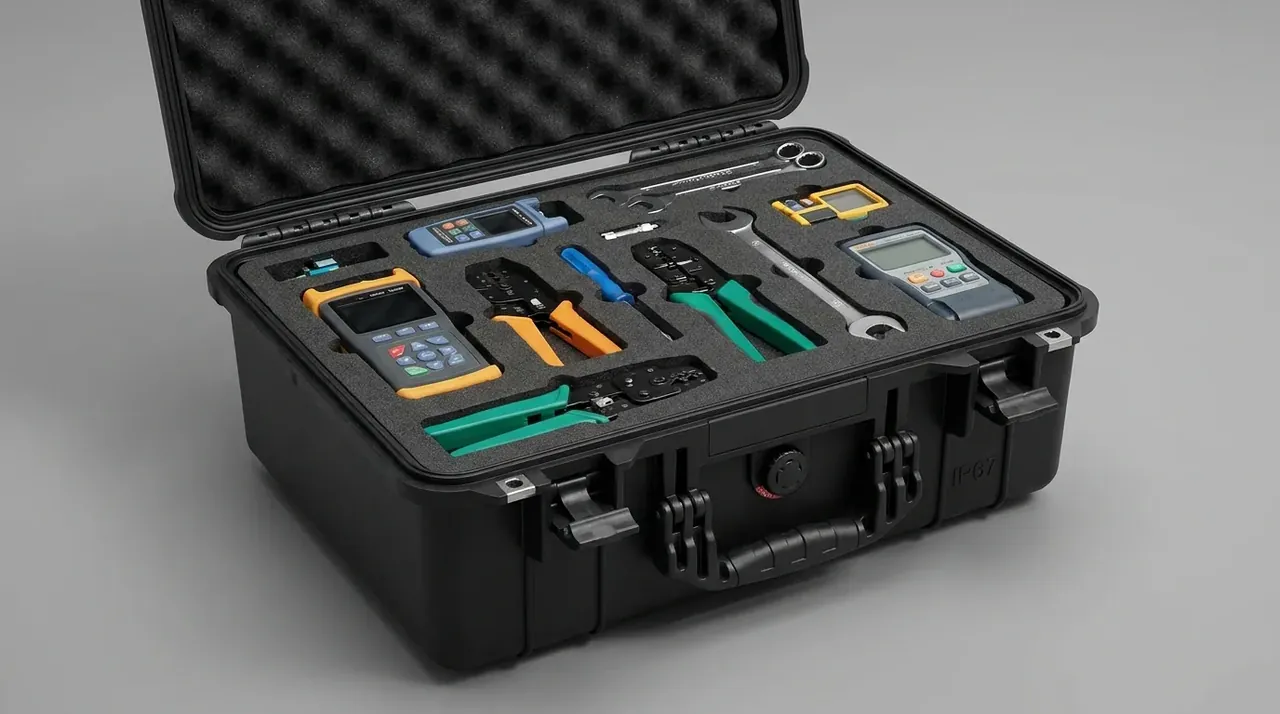
Quick answer: A Medical anti-static precision instrument case holds surface resistance near 1×10⁵ Ω on the shell against 1×10⁷ Ω on the insert, keeps drift under half a decade after 200 wipes with 75% ethanol, and stays below 0.1 Ω from earth terminal to shell through a 1 MΩ resistor.
Table of contents
- Shell resistance band of the Medical anti-static precision instrument case
- Discharge path through the insert
- Surface stability after disinfectant wiping
- Sealing and gaps for clean transfer
- Earth terminal and potential equalisation
- FAQ
1. Shell resistance band of the Medical anti-static precision instrument case
The compound carries 12% carbon-black masterbatch in a PP base, which puts shell surface resistance between 1×10⁴ and 1×10⁶ Ω, with 1×10⁵ Ω taken as the factory reference. Below 8% loading the masterbatch breaks into strings and leaves insulating patches above 10⁹ Ω; above 16% the melt index drops, thin walls short-shot, and the colour darkens enough to hurt identification in a clean area. Resistance is read at five points by four-probe method — lid centre, both long sides, base and beside the handle mount — and the highest reading may not exceed the lowest by more than five times.
Static build-up is capped at 100 V: a nylon cloth rubs the shell 20 times, the meter must stay under 100 V, and decay from 100 V to 10 V must finish inside 2 s. Those two figures track handling better than resistance does, because a case dragged across a trolley charges immediately.
| Item | Band | Verdict |
|---|---|---|
| Shell, five points | 1×10⁴–1×10⁶ Ω | Max/min ≤5 |
| Insert | 1×10⁶–1×10⁹ Ω | Discharge not blocked |
| Earth terminal | ≤0.1 Ω | Continuous to shell |
2. Discharge path through the insert
The insert is anti-static EPE held between 1×10⁶ and 1×10⁹ Ω, two decades above the shell, so charge bleeds slowly into the shell rather than dumping at once. A foam that discharges too fast can drive a momentary surge in dry air, which is worse for sensitive parts, while one that discharges too slowly lets charge pool in the pockets. A continuous 6 mm layer runs between pocket wall and base as the route to the shell, and once that layer is cut the insert becomes an island.
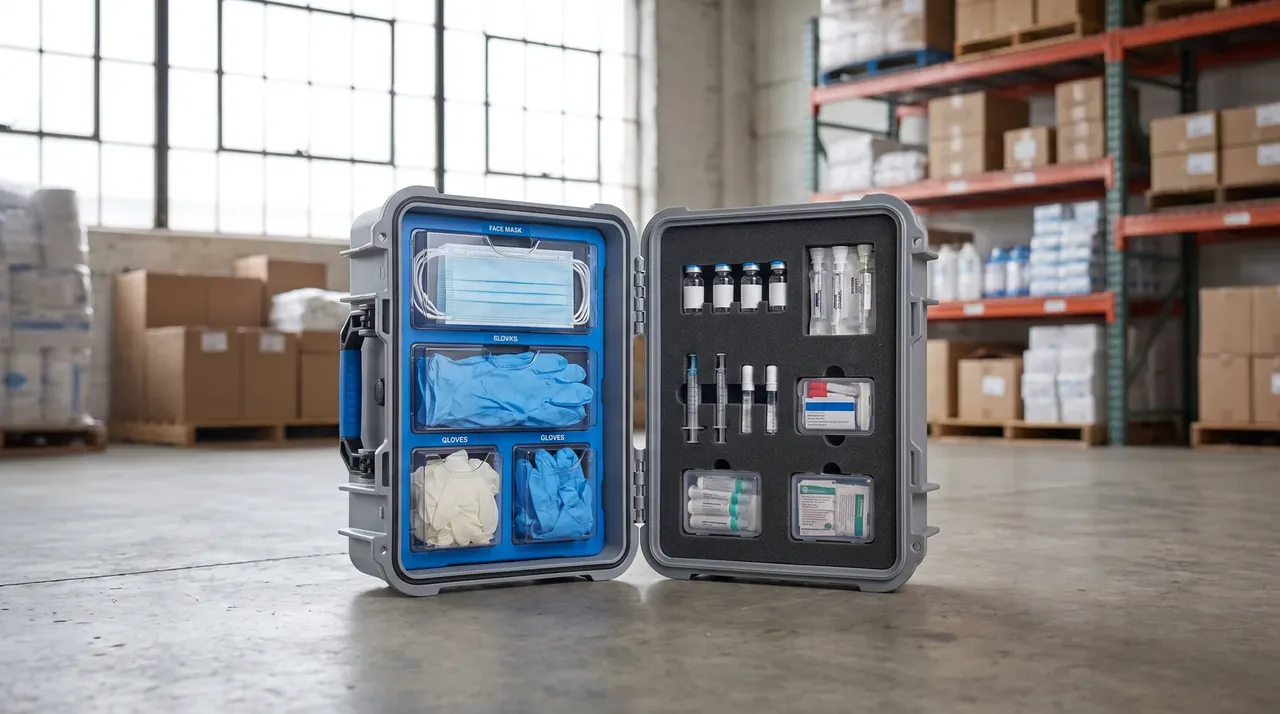
No conductive coating is applied, because a coating worn away by repeated handling jumps several decades locally and reads worse than bare foam. EPE density is set at 30 kg/m³; at 45 kg/m³ the anti-static agent migrates more slowly and surface resistance creeps toward 1×10¹⁰ Ω within six months.
3. Surface stability after disinfectant wiping
Two hundred wipes with 75% ethanol, one direction, 30 cm per stroke, 10 s between strokes for the solvent to flash off, then 2 h of rest before resistance is read again: drift must stay inside half a decade. Chlorine disinfectants attack the carbon-black system, whitening the surface after 50 wipes and pushing resistance from 1×10⁵ Ω to 1×10⁸ Ω, and a whitened patch powders under a fingernail — such a case should not return to a clean area. Hydrogen peroxide sits between the two, drifting about 0.8 decade over 100 wipes with no visible dulling.
Wiping trials run on flat panel only. Corners and the mouth land are left out because flow is most disturbed there and masterbatch distribution is least even, so a reading from those spots cannot stand for the whole case.
| Disinfectant | Wipes | Resistance change |
|---|---|---|
| 75% ethanol | 200 | ≤0.5 decade |
| Hydrogen peroxide | 100 | About 0.8 decade |
| Chlorine based | 50 | Rises to 1×10⁸ Ω |
4. Sealing and gaps for clean transfer
Spray testing follows an IP65 benchmark, with a double land at the mouth: the outer land stops water, the inner land stops dust, and a 1.5 mm relief groove sits between them. Closing gap between lid and shell is held under 0.4 mm, since dust rides the airflow once the gap opens, and fallout is kept under five particles per square decimetre. Every outside corner runs at R3 or more with no square grooves or blind holes, so wiping leaves no dead corner, and the hinges are concealed with no exposed pin to collect dust. The gap is re-read after 3000 open-close cycles, and a growth to 0.6 mm calls for a new gasket.

Gap and land are judged separately: the gap describes how lid meets shell, while the land describes whether both steps are intact, and a chipped land lets dust through however tight the gap looks.
5. Earth terminal and potential equalisation
One M4 stainless earth terminal sits in the side of the case, its seat moulded in one shot with the shell and machined to a 0.8 mm ring, tightened to 1.2 N·m. Resistance from terminal to any point on the shell stays under 0.1 Ω, read with a milliohm meter between terminal and base centre. A 1 MΩ resistor sits inside the terminal to limit discharge current on accidental contact while still letting static bleed away within 2 s.
The terminal is re-checked every six months, and the screw comes out to inspect the ring for dark oxide, which lifts resistance from 0.1 Ω past 2 Ω. The resistor is not removed on its own; it is replaced together with the terminal.
Conclusion
The Medical anti-static precision instrument case ties 1×10⁵ Ω shell resistance, a 1×10⁷ Ω insert, a 6 mm continuous discharge layer, half a decade of drift after 200 ethanol wipes, a 0.4 mm closing gap and 0.1 Ω at the terminal into one static and cleanliness chain on the case side. The six readings sit on the shell, the insert, the wipe bench, the spray rig and the milliohm meter, and none replaces another. The shop keeps 12% masterbatch, 30 kg/m³ insert density, 1.2 N·m torque and the six-month interval on one parameter sheet. All of it covers shell and insert specification only.
This article discusses the case side of the specification only and does not cover handling, loading or use of anything carried inside.
Related Reading
- Surface resistance and earthing of anti-static cases
- Cleaning and disinfecting case shells
- Choosing and bonding instrument case foam
- Specification items for custom instrument inserts
Related Products
- 8 Series — Gun Cases; Military Equipment Cases; Camera Equipment Cases; Drone Cases; Watch Cases; Knife Cases; First Aid Cases; Electronics Equipment Cases
- WL8-2812 PP Gun Case — model WL8-2812
- All protective cases and toolboxes: 7 series, 158 models