


Quick answer: A Long Weapon Case spec is a chain: load sets the cavity, the cavity sets the wall, deflection sets the ribs. Skip a link and you pay in kilos.
Table of contents
- Load and cavity size come first
- Wall thickness follows deflection, not habit
- Ribs break the long span at 180 mm
- Seals, latches and four tolerances
- Five hard lines to put on the drawing
- FAQ
1. Load and cavity size come first
A Long Weapon Case spec is a chain, not a grid: load sets the section, the section the wall, the wall the rib pitch and latch count.
Start with design load: weigh equipment, liner, fittings and straps, then add twenty per cent. Mid-size cases land between twelve and sixteen kilograms; past twenty kilos you need a different structure. Set the cavity between the furthest supporting faces, never the outside shell: wall, rib roots and bumper returns add four to nine millimetres. Stiffness rises with the cube of thickness, so a doubled load never doubles the wall.
| Design load | Wall | Rib height | Latches | Cavity length |
|---|---|---|---|---|
| up to 8 kg | 3.5 mm | 8 mm | 3 | under 700 mm |
| 8 to 16 kg | 5 mm | 12 mm | 4 | 700 to 1200 mm |
| 16 to 26 kg | 6.5 mm | 16 mm | 5 | 1200 to 1600 mm |
2. Wall thickness follows deflection, not habit
Set allowed deflection and work backwards. One five-hundredth of the span is standard: a one-metre span may sag two millimetres before the seal opens.
Leave process margin: walls vary by plus or minus 0.4 mm, so a 5 mm callout passes at 4.6 to 5.4 mm, and the stiffness check uses 4.6.
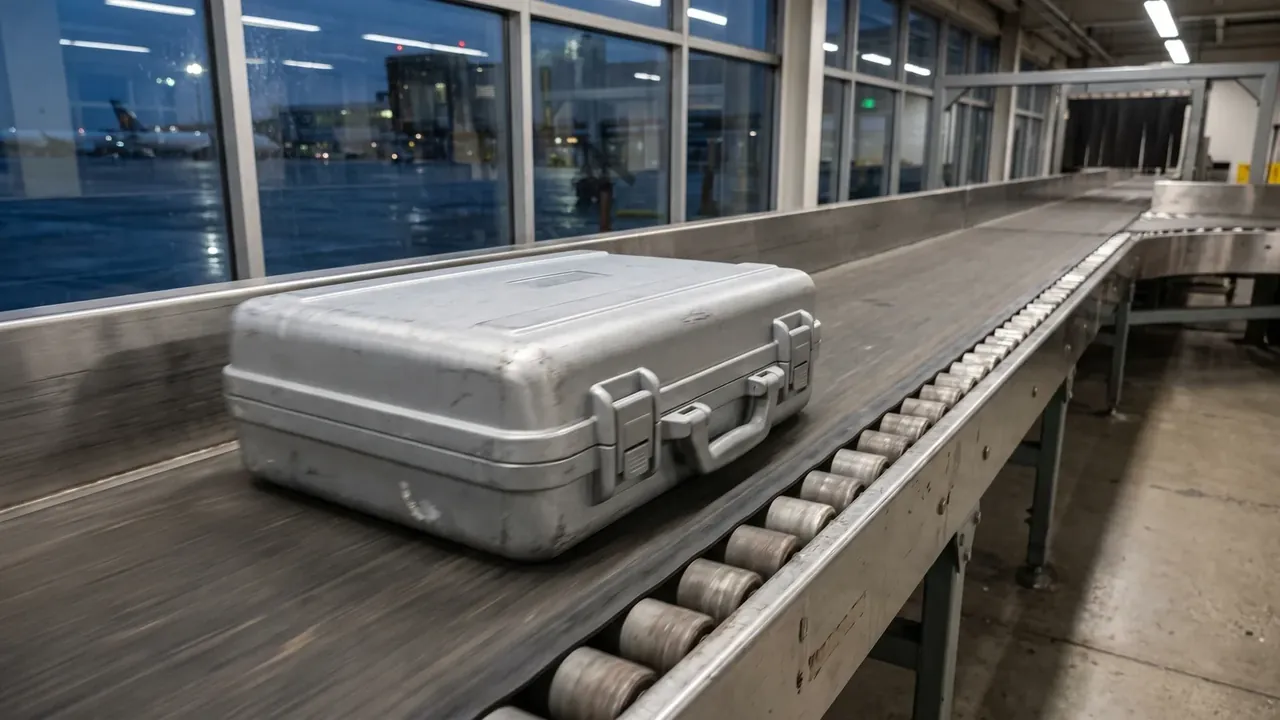
Temperature belongs in the same chain. At minus 30 °C polyethylene stiffens and loses toughness; at plus 65 °C it softens and creeps, which never springs back. Add 0.5 mm to the lid.
3. Ribs break the long span at 180 mm
Long cases fail on span, not wall: a flat panel crossing 1.2 m sags over four times as far as a short one under load.
- Rib height at 1.8 to 2.4 times the wall: lower stops resisting bending, higher tears on ejection
- R3 fillets at the root, since R2 concentrates stress where a drop test starts a crack
- No rib directly behind a latch, or the seal lifts instead of closing
- Remove 0.3 mm where cross ribs meet longitudinal ones, or shrink leaves a sink mark
- Stop ribs 6 mm short of the end wall for thermal growth
Dense ribs cannot rescue a wrong cavity: ten spare millimetres and they protect nothing.
4. Seals, latches and four tolerances
A gasket works on compression, not adhesive. Target twenty-five per cent squeeze: under twenty it will not return, over thirty it takes a set. The groove runs 0.8 mm wider than the section.
| Item | Target | Tolerance | What goes wrong |
|---|---|---|---|
| Gasket squeeze | 25% | plus or minus 5 points | slow return, dust ingress |
| Latch pitch | 400 mm max | plus 20 mm | lid flexes in transit |
| Lid to base offset | 1.5 mm | plus 0.5 mm | two hands to close |
| Hinge axial play | 0.3 mm | plus or minus 0.2 mm | stiff action, worn pin |
Latch count follows span, not length. Past 400 mm of unsupported lid the panel pumps and the gasket separates, so the case seems to leak water when it leaks air. Draw latches need 2 mm of take-up to bite.
5. Five hard lines to put on the drawing
Reinforced on a drawing leaves the toolroom guessing.
One: dimension the cavity from supporting faces, shell figure in brackets. Two: give the wall as nominal plus tolerance band and name nine measuring points, mid side, 100 mm from each end, rib root. Three: state rib height, pitch and fillet radius together.
Four: dimension latch and hinge holes from a common datum, since error compounds along a long case. Five: keep groove width, depth and squeeze on one line. Hit all five and the first sample fits.
Conclusion
A Long Weapon Case spec holds up when the load carries a factor, the cavity is measured from supporting faces, the wall comes from deflection and hot-case creep, and the rib pitch cuts the span. Each of those four closes off a revision on a Long Weapon Case programme.
This article discusses only the container (case body) side of specifications and design intent, and does not cover any handling, loading or use of the contents.
Related Reading
- How a Long Weapon Case differs from a general long case
- Cavity zones and support layout inside a Long Weapon Case
- Reading the specification sheet of a weapon storage cabinet
- Foam structure and wall thickness in shockproof cases
Related Products
- 8 Series — Gun Cases; Military Equipment Cases; Camera Equipment Cases; Drone Cases; Watch Cases; Knife Cases; First Aid Cases; Electronics Equipment Cases
- WL8-2812 PP Gun Case — model WL8-2812
- All protective cases and toolboxes: 7 series, 158 models