

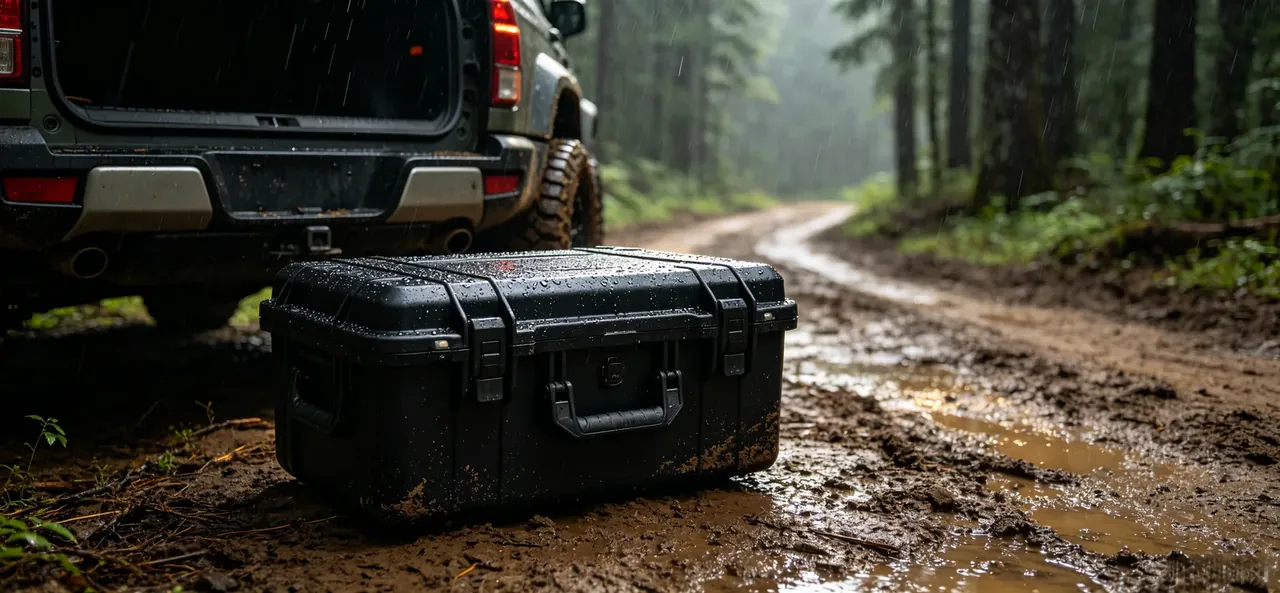
Quick answer: Rinse a marine ranch case within 24 hours of landing: 20 L in 3 minutes, then 4 hours at 40 °C, because 0.3 mm of salt lifts the seal lip.
Table of contents
- The 24-hour window after the case comes aboard
- What 0.3 mm of salt crust does to a seal lip
- Twenty litres, three minutes, and the return water
- Drying at 40 °C, away from the moulding shop door
- Inspection: 480 hours on 316, seven rust points on 304
- FAQ
1. The 24-hour window after the case comes aboard
A marine ranch case comes over the rail wearing a film of water at 3.5% salinity, or 35 g per litre. The film is gone in twenty minutes under a noon sun; the salt is not. It sits in the latch bores and along the seal channel, and three weeks later the lid drags.
Salt is an ion while wet and a crystal once dry. A crust keys into the moulded surface, so a rinse lifts only the top layer. The 24-hour line is common because inside it 20 L still dissolves the deposit.
| Immersion time | Salt crust, mm | Action on landing | Allowed delay, h |
|---|---|---|---|
| under 30 min | <0.05 | rinse once, wipe dry | 24 |
| 0.5–4 h | 0.05–0.15 | rinse, brush the channel | 12 |
| over 12 h | >0.30 | strip, desalt, assess the seal | 0 |
The bottom row gets skipped. A marine ranch case that soaked overnight looks damp at breakfast, but the channel crystallised in the dark, and forcing the lid down embosses the lip with dents that never spring back.
2. What 0.3 mm of salt crust does to a seal lip
An O-profile seal is 8 mm to 10 mm across the section, installed at 25% compression, so it is squashed by 2 mm to 2.5 mm. A 0.3 mm crust takes a fifth of the 1 mm sealing band. The crystal does not yield, so the lip stands open by a gap under 0.1 mm.

Strip the seal slowly. Walk a plastic wedge along the channel rather than lifting at the middle, since a mid-span pull stretches the profile by 2% to 3%. Soak it 10 minutes and brush along the lip.
The channel on a marine ranch case needs its own pass: about 2 m of groove on a 600 mm by 400 mm opening, and one wipe still leaves roughly 2 mL at the bottom. Letting that dry returns the salt. Roll a lint-free cloth into a 6 mm rope, press it through the perimeter, repeat dry.
3. Twenty litres, three minutes, and the return water
A rinse ends when the water leaving the marine ranch case says so. Twenty litres over three minutes suits 0.36 m² of projected area, judged in a white tray.
| Rinse volume, L | Rinse time, min | Return conductivity, µS/cm | Case size |
|---|---|---|---|
| 5 | 1 | 1200–1800 | 300×200×150 mm |
| 20 | 3 | 200–400 | 600×400×250 mm |
| 30 | 5 | <150 | 800×600×400 mm |
Mains water runs between 150 µS/cm and 400 µS/cm depending on source, so a fixed 300 µS/cm threshold is a poor rule. Return minus supply below 100 µS/cm means the salt is mostly gone; above 300 µS/cm, run another pass.
Keep pressure low: a 0.2 MPa shower head beats a 0.6 MPa lance that drives water into latch bores, where it takes ten times longer to leave. Work from the top down.
4. Drying at 40 °C, away from the moulding shop door
Drying empties the channel, the latch bores and the hinge seats; a dry skin means nothing. Four hours at 40 °C is the usual pairing. Above about 60 °C the shell softens and the lid opening loses shape; cut the time and the bores stay wet.
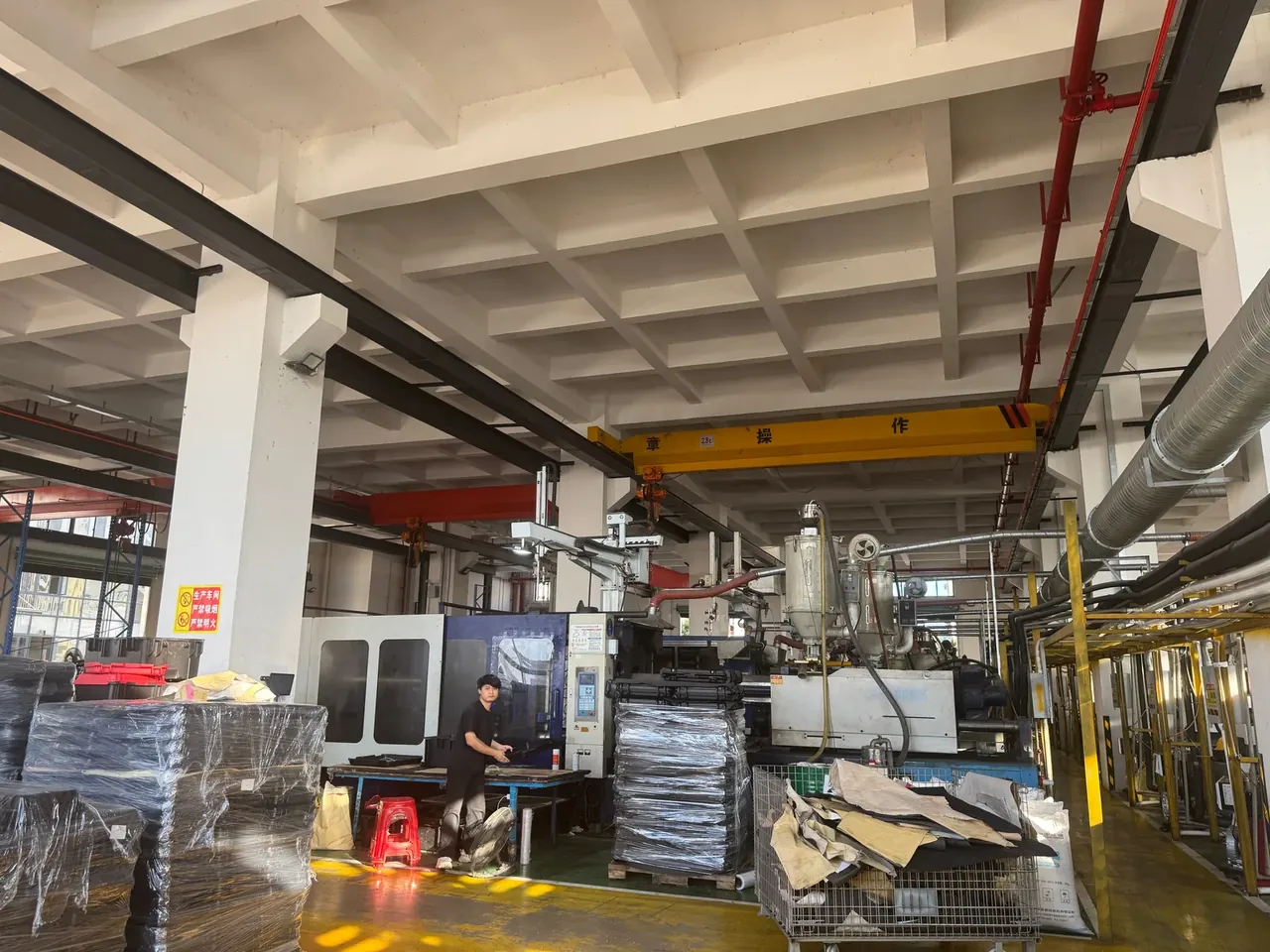
The worst place to dry a marine ranch case is the moulding shop doorway. Machines run, hoppers dry resin, and the air carries release-agent mist: warm and humid enough that an overnight stay leaves a film that makes grease slide off.
Touch three points instead of the whole case: the bottom of the channel, the inside of a latch bore, the joint between hinge seat and shell. If none feels cool it is dry; close the lid twice and listen for a gurgle.
Regrease every 30 days at 0.5 g, about half the first joint of an index finger, as a film and never a bead; a bead is squeezed inside on closing and turns into lapping paste. Hardware gets dry PTFE spray instead.
5. Inspection: 480 hours on 316, seven rust points on 304
Inspection runs down a list, not on impressions. A marine ranch case ordered with 316 stainless shows zero rust points after 480 hours of neutral salt spray; type 304 under the same exposure shows seven, all on the machined end faces of hinge and latch pins.
| Check item | Pass criterion | Tool | Interval |
|---|---|---|---|
| Seal lip | no embossing, 25% compression | caliper | 30 days |
| Hinge pin | turns freely, no red rust | visual and hand feel | 90 days |
| Hardware rust | zero on 316, at most 7 on 304 | magnifier | after 480 h spray |
Per-item criteria turn whether to replace into which part: a seal at 20% compression goes before it leaks, a spring that lost a fifth of its pull goes alone, a stiff pin is oiled before a bushing is discussed.
Conclusion
Maintenance after immersion is a sequence measured in hours: rinse inside 24 hours, judge the rinse on conductivity, pull 2 mL out of the channel, dry four hours at 40 °C, regrease 0.5 g every 30 days. A marine ranch case rarely loses its seal to salt fog; it loses it to crystals lifting the lip. Hold the 0.3 mm line and one seal lasts a year longer.
This article discusses only the case body and its design implications, not the handling, loading or use of anything inside it.
Related Reading
- Salt-spray hardware selection for marine engineering cases
- How to choose seal materials
- Long-term deployment of marine buoy instrument cases
- Salt spray and rinsing for fishing gear cases
Related Products
- 8 Series — Gun Cases; Military Equipment Cases; Camera Equipment Cases; Drone Cases; Watch Cases; Knife Cases; First Aid Cases; Electronics Equipment Cases
- WL8-2812 PP Gun Case — model WL8-2812
- All protective cases and toolboxes: 7 series, 158 models