

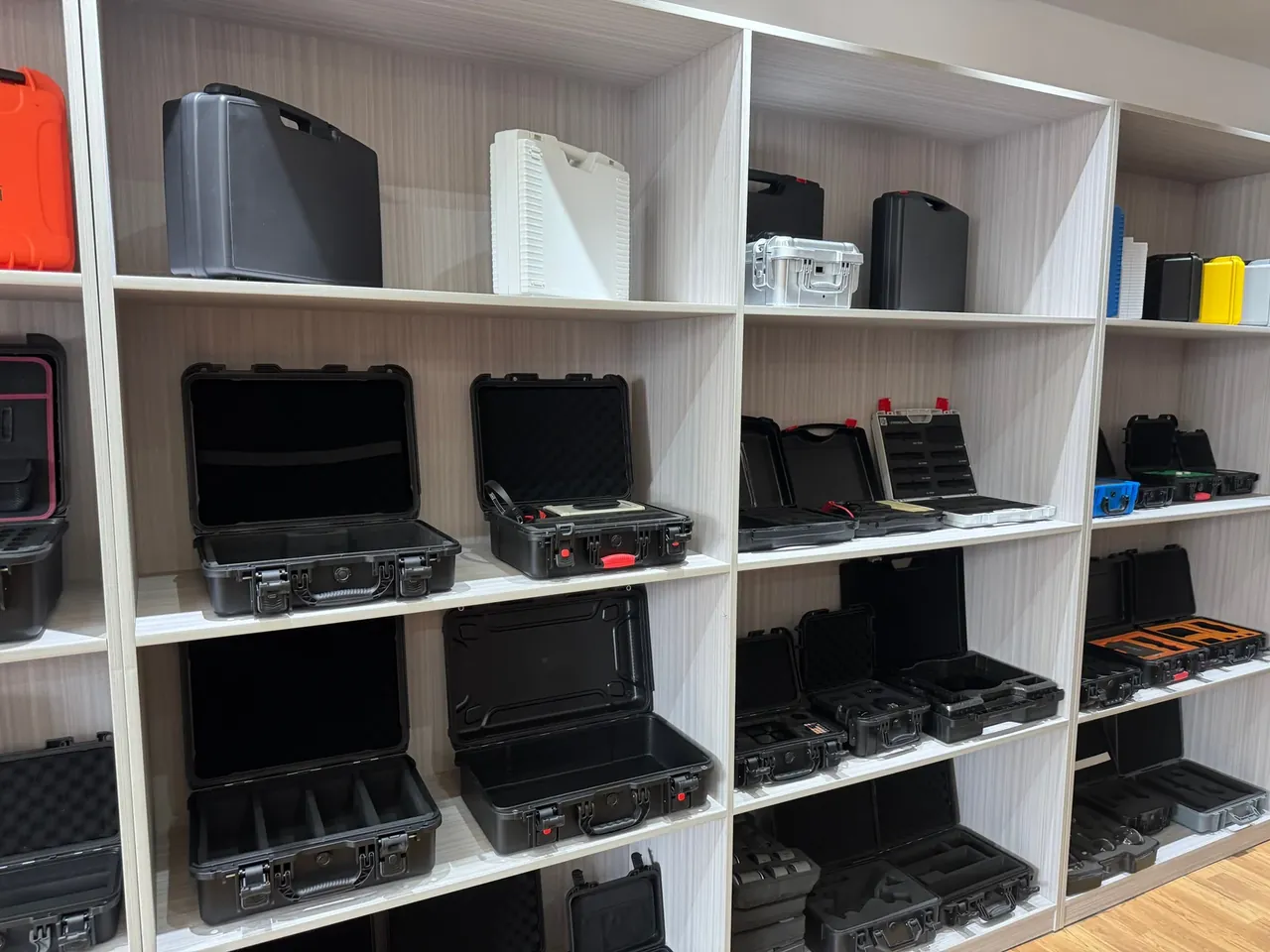
Quick answer:A Mechanical Parts Transit Case fails on the empty return leg, not the loaded one, so a 2.0–2.5 mm wall must take a four-high stack.
Table of contents
- What the line-feed run asks of the body
- Stacking and reach at the line-side buffer
- Why the empty return leg breaks first
- Rinsing out trapped cutting fluid
- Trips, wear and the replacement interval
- FAQ
1. What the line-feed run asks of the body
Four trips a day, and the leg that wears a box out is not the one carrying parts. The feed leg looks light: the radius stays under 300 m, the forklift stops at the shop door, and a cart carries the box the rest of the way. What it fixes is the skeleton of the Mechanical Parts Transit Case.
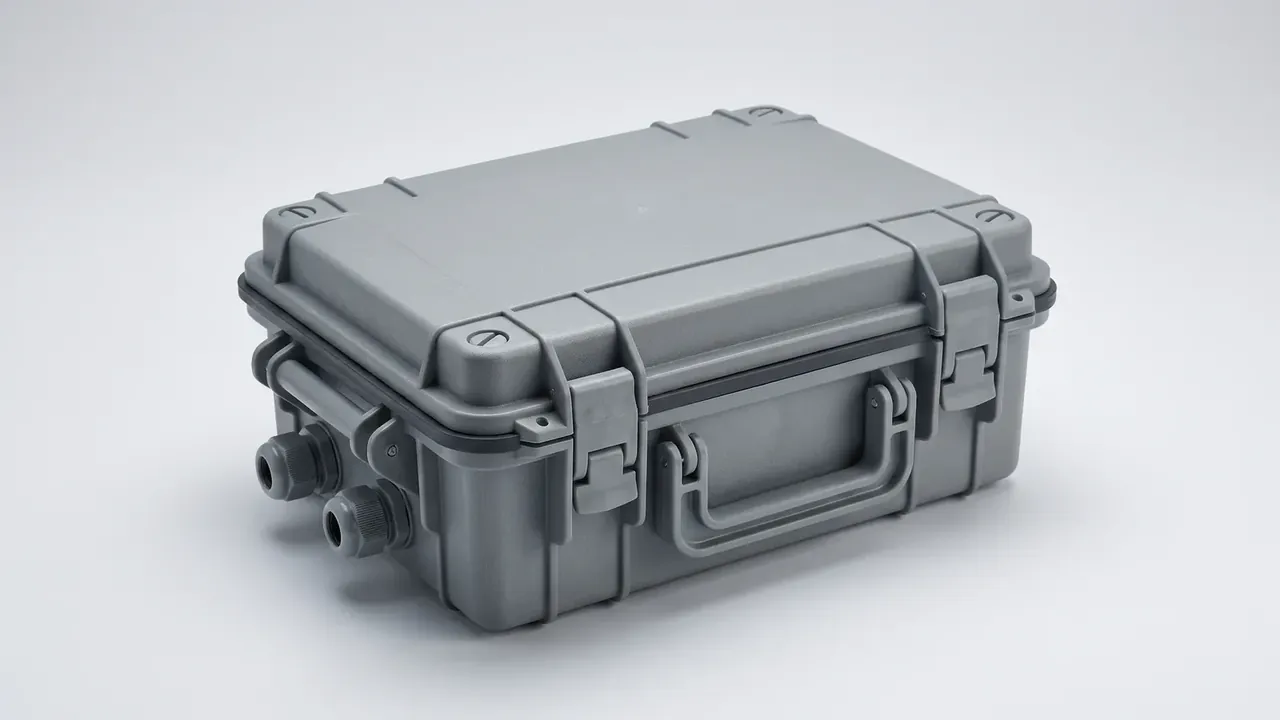
A loaded box runs at 15 kg against a tare of 2.5–4.0 kg, and the load never splits evenly across four corners. The instant one person lifts it, two opposite corners take close to the whole weight. The 2.0–2.5 mm wall of a Mechanical Parts Transit Case holds that while the base ribs run continuous and the handle root keeps a generous fillet.
Identification belongs to this leg as much as strength. Three part numbers ride one cart, and a label one slot off sends a box to the wrong cell, so the lid keeps a flat patch clear of ribs where a walking operator reads it without turning the box over.
| Loop leg | Load | Where force lands | First part to fail |
|---|---|---|---|
| Feed to line | Full, close to 15 kg | Base, handle root | Fillet at the handle root |
| Line-side buffer | Full, four high | Lid face, locating lip | Lid face crushed from above |
| Empty return | Empty, dumped at random | Corners, latch seats | Corner split, latch ear torn |
2. Stacking and reach at the line-side buffer
A buffer beside the line is a square metre or two, so boxes only fit when they stack. Four high is the working height and 15 kg per layer is the ceiling, which puts 45 kg on the lid of the bottom Mechanical Parts Transit Case.
What keeps the column straight is the locating lip, a raised ring on the lid dropping into a matching groove on the base. Shift it one position and the upper box rests on a single wall, with the mark concentrated in one corner.
The reach pattern decides which way the lid opens. An operator lifts it one-handed from the aisle and the lid has to stay where it is put; a hinge rated at 20,000 cycles holds through interference between pin and bore. Lifting the third lid of a four-high stack puts the hand above shoulder height, which is where a falling lid gets caught with the head.
A box emptied on the upper layer must not stay in place. An empty body sitting on a full one reads as full to the next shift, and the discovery costs a stop the line has to make up.
3. Why the empty return leg breaks first
The return leg of a Mechanical Parts Transit Case moves empties, which sounds easy and is where damage concentrates. Boxes get pushed back, thrown onto carts and stacked at the aisle mouth to wait, with nobody watching how they land.
Force at a corner is concentrated. A loaded box that drops spreads its weight across the base; an empty one puts nearly the whole body mass on one corner, and a 2.0 mm wall has no room to give. The first crack is a few millimetres long and looks harmless, then the next drop runs it along the weld line.
Scrap rule: after 800 consecutive trips, a corner crack longer than 10 mm retires the box, and no glue repair may return it to the line.
Glue is rejected because patch and shell shrink differently. ABS moulds at 0.4%–0.7% and an adhesive layer moves far more than that, so the two pull against each other and the seam becomes the next crack origin. Once the split reaches the three-way junction of a corner, the Mechanical Parts Transit Case loses a step of stiffness and its lid face sags under four layers.
| Corner crack | Where it sits | Action |
|---|---|---|
| Under 10 mm | One wall, edge not crossed | Log it, keep running |
| Over 10 mm | Past the edge or into the junction | Scrap, pull from the loop |
| Any length with whitening | Whole corner gone pale | Scrap, sample the batch |
4. Rinsing out trapped cutting fluid
Returning boxes carry cutting fluid in the base. When the water in an emulsion evaporates, a tacky oil film is left behind, and the next batch picks it up as an extra wash step before machining.
Rinse water for a Mechanical Parts Transit Case runs at 40–60 °C. Cooler water leaves the emulsion on the wall; hotter water softens the shell, because ABS deflects at 80–105 °C under 1.82 MPa and a 2.0 mm wall suffers within months near that ceiling.
Draining means inverting the box, since moulded stiffening grooves hold water when it sits upright. Trapped water mixed with unrinsed fluid grows a slippery layer that takes a whole stack down when a grip goes.
A rinsed Mechanical Parts Transit Case goes back by part number, label outward, lid left ajar to air. Close it wet and the moisture stays inside overnight, the hinge pin stiffens, and the first operator of the shift opens a box smelling of old coolant.
5. Trips, wear and the replacement interval
At 250 working days and four trips a day, a Mechanical Parts Transit Case logs about 1,000 trips a year, which puts the 800–1500 trip range between eight and eighteen months on the calendar.
Replacement runs by batch, never box by box. Units in service together wear together, so they retire together and the stack height stays even. Mix old and new and the old lid is already dished, the new box sits crooked, and four layers lean by a hand's width at the top.
Trip counts belong on a wear-resistant label by the latch, so remaining life is read rather than guessed — the arrangement JUNZHIJIA ships on this body. A swap also costs the half hour of stopped line and the relabelling that follows it.
Related Reading
- Combine harvester parts case: loading for a field swap
- Bearing and gearbox case: pockets and support for heavy parts
- Protective case or carton: two loading logics for e-commerce
- Usable volume in a case: what the corners take away
Related Products
- 8 Series — Gun Cases; Military Equipment Cases; Camera Equipment Cases; Drone Cases; Watch Cases; Knife Cases; First Aid Cases; Electronics Equipment Cases
- WL8-2812 PP Gun Case — model WL8-2812
- All protective cases and toolboxes: 7 series, 158 models