

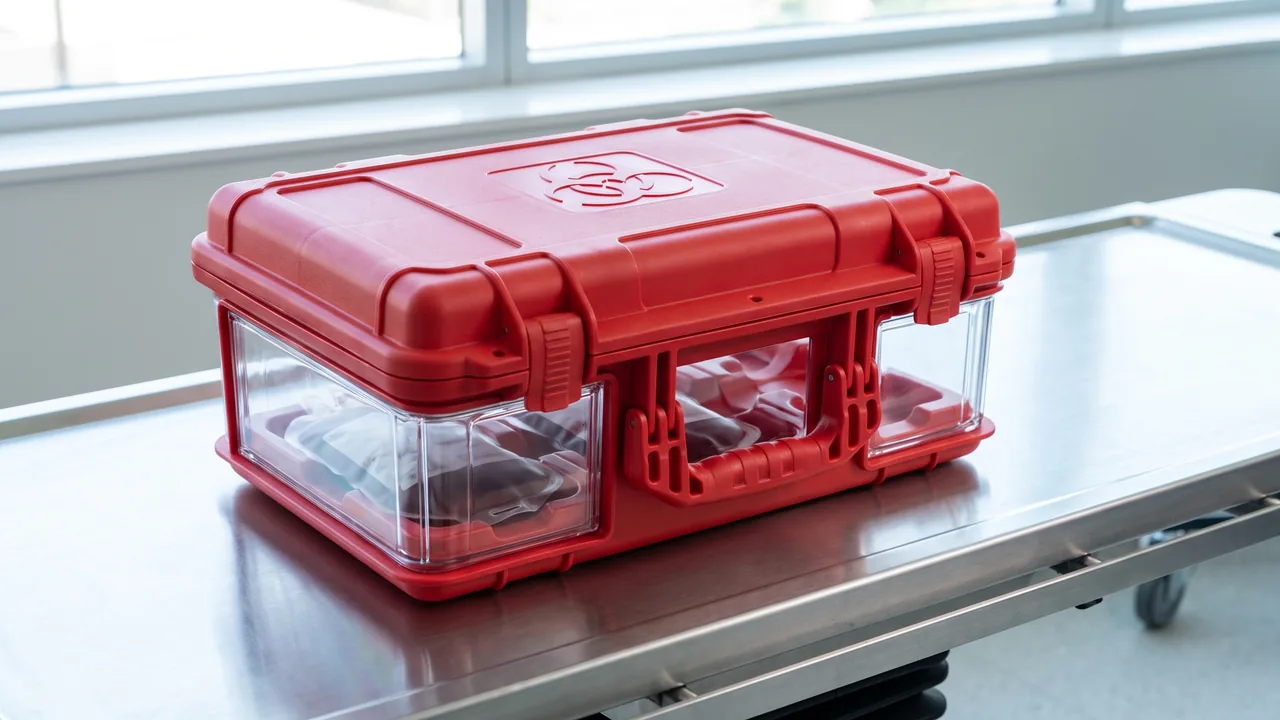
What separates a medical case most sharply from an ordinary protective case is that the objects it serves enter a sterile-to-contaminated cycle. Instruments leave the sterilizer sterile, pass through transport, unpacking, use, and recovery, and finally arrive in a state that requires reprocessing. The case must carry that whole chain without breaking sterility, without being destroyed by disinfectants or high temperature, and without hiding the item the user needs at that moment. This dual demand of protection plus reprocessability makes material choice, insert design, and cleaning method different from any general transport container.
This article approaches the subject from the design and manufacturing side of protective containers. It covers instrument zoning, material compatibility with sterilization methods, the constraints that autoclave and chemical disinfection impose on case and insert, the relationship between single-use sterile barriers and the case, sealing and cleanable design, temperature module integration, instrument location, sharps isolation, marking and traceability, and inspection and reprocessing. Method references in this article are cited as test methods; they are not a statement of certification. JUNZHIJIA's experience on these programs is to establish the sterilization method before discussing case material, because once the method is fixed, the usable material range narrows quickly.
How a Medical Case Differs from an Ordinary Protective Case
An ordinary protective case aims to deliver its contents intact, and its job largely ends at delivery. A medical case has a longer chain: after delivery it passes through unpacking, instrument removal, contaminated recovery, cleaning and disinfection, and repacking, and each step can introduce new damage or contamination. Three additional constraints follow.
The first is cleanliness. Inner and outer surfaces must tolerate repeated wiping or washing, without crevices, recesses, or coarse texture where organic residue can collect, because residue degrades subsequent disinfection. The second is sterilization. Whether the case itself enters the sterilizer depends on the workflow: if instruments are sterilized before packing, the case only needs to resist disinfectant wiping, whereas if the whole tray and insert are sterilized together, case and insert materials must survive the sterilization cycle. The third is traceability. Medical supplies carry higher demands for batch, expiry, and usage-state records, so the case must offer a place for marking and records rather than only containment. General medical container requirements appear in Medical Equipment Boxes and Instrument Boxes for Specialty Transport.
Instrument Zoning by Sterilization Workflow and Order of Use
Zoning in a medical case can follow either the sterilization workflow or the order of use. For most clinical settings the sensible approach overlays the two: separate first by sterilization state, then arrange within each layer by order of use. Separating by state means sterile items and contaminated or awaiting-reprocessing items sit apart physically, which matters especially in emergencies, when time pressure tempts people to drop a used instrument back into its original slot.
Arranging by order of use drives efficiency. In an emergency scenario, airway management items come first, then circulatory support and hemorrhage control, then dressing and immobilization. If the internal arrangement follows that sequence, the operator works layer by layer instead of hunting. Zoning usually works together with instrument trays: grouping like instruments on one tray lets the tray go in and come out as a unit, which both speeds handling and reduces the chance of instruments moving inside the case.
Zoning should also plan for empty slots. After opening, a medical case develops obvious gaps, and those gaps are themselves status signals: the empty compartment indicates which item has been taken out. Making the gaps readable means every position carries a clear name label and tray and case share the same zoning numbers. This empty-slot visualization cuts counting time on site and makes omissions visible at repacking.
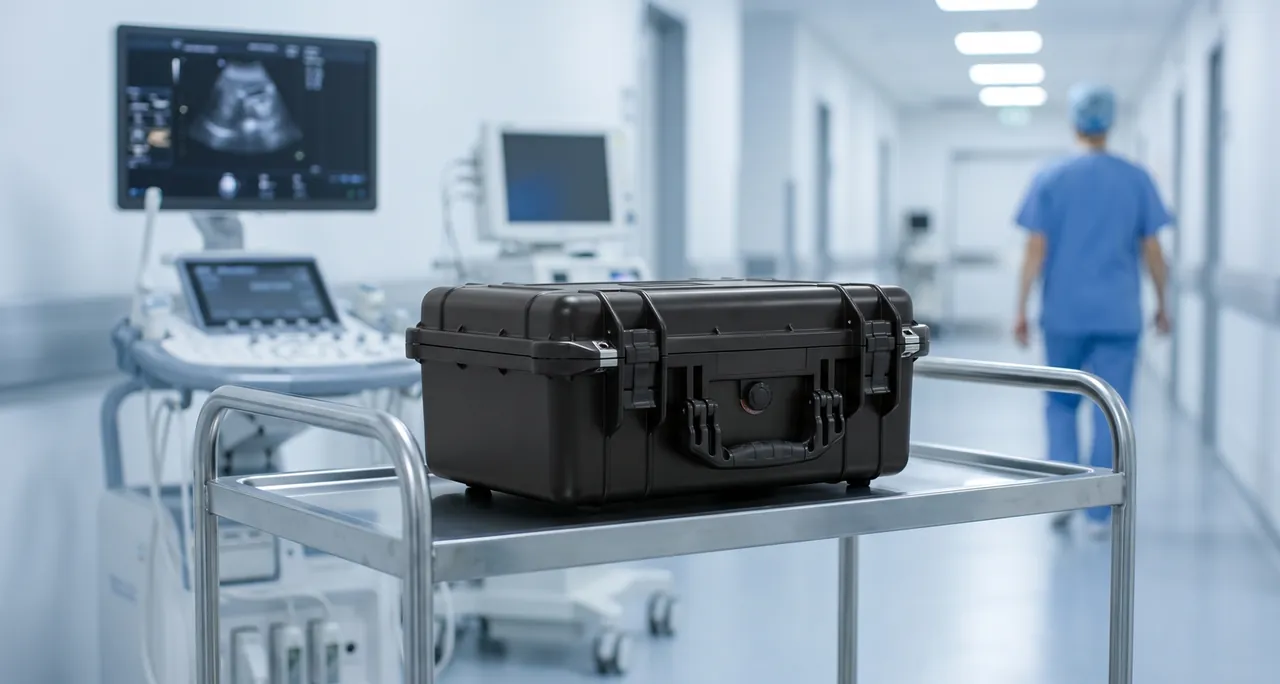
Material Compatibility with Sterilization Methods
Material choice begins with the sterilization method. Common methods include steam autoclave, ethylene oxide, hydrogen peroxide low-temperature plasma, and irradiation, and each imposes completely different requirements. Steam autoclave applies high temperature, high humidity, and a pressure cycle at once, demanding the most in heat resistance, hydrolysis resistance, and dimensional stability. Ethylene oxide runs cooler but raises residue concerns. Hydrogen peroxide plasma imposes specific demands on oxidative stability and material compatibility. Irradiation can cross-link or degrade certain polymers.
Case material is usually weighed among three families: stainless steel resists autoclave conditions and many disinfectants with long life but high weight and cost; aluminum is lighter after surface treatment, but chemical resistance depends on coating integrity; engineering plastics and composites can be formulated for good chemical resistance, yet their temperature ceiling is usually below metal, and long high-temperature humid cycling can age them. Insert compatibility matters equally: some foams shrink, harden, or crumble after repeated steam cycles, and residue from some materials can affect sterilant penetration.
The practical engineering approach is to state, for each case, which sterilization methods and how many cycles it tolerates, and to write that onto the technical file and the case marking rather than labelling it vaguely as sterilizable. Where one case must face several methods, choose material against the harshest of them and verify that the others cause no irreversible change. Instrument transport and protection requirements are covered in Medical Instrument Cases: Device Transport and Protection.
What Autoclave Sterilization Demands of Case and Insert
Steam autoclave sterilization constrains the case in three ways: thermal distortion, seal failure, and insert aging. Thermal distortion shows as warping or dimensional change after repeated hot cycles, degrading lid fit. Seal failure shows as gaskets hardening, cracking, or taking a permanent set under high temperature, humidity, and pressure cycling, losing their resilience. Insert aging shows as foam shrinkage, surface crumbling, or moisture that is hard to dry out.
Thermal distortion is countered by controlling thermal expansion and structural stiffness. The case frame should avoid materials that approach their softening point near the sterilization temperature, and ribs and box construction raise stiffness so thermal stress does not concentrate at one point. For schemes where the whole case enters the sterilizer, the case usually needs a vent path so steam can enter and leave, because otherwise the pressure difference across the shell during heating and cooling applies a significant structural load.
Gasket selection must distinguish two situations. If the case goes into the sterilizer, the gasket must be rated for hot steam and repeated pressure cycling; some schemes remove the gasket or use a demountable seal during sterilization and refit it afterwards, sparing the seal the harshest conditions. If the case never enters the sterilizer and only receives disinfectant wiping, the gasket range widens considerably. For inserts, prefer materials that dry quickly after wetting and change dimension little over cycles, and design the insert so it can be removed for separate cleaning and drying. Component protection thinking for autoclave hardware appears in Autoclave Sterilizer Cases: Chamber and Door Seal Component Protection, and standards for instrument transport under repeated hot humid cycling in Field Medical Cases and Combat First-Aid Kits: Protection and Temperature-Control Standards.
Chemical Disinfectants and Chemical-Resistant Material Selection
Chemical disinfection is the routine surface treatment for medical cases, and common agents include chlorine-releasing compounds, peroxides, quaternary ammonium compounds, and alcohols. Their aggressiveness varies widely. Chlorine compounds corrode some metals strongly and cause pitting. Peroxides oxidize certain elastomers noticeably. Alcohols are relatively mild for most materials but can swell some coatings. Quaternary ammonium compounds are usually mild but limited in cleaning power.
A practical rule is to verify against the disinfectants actually used rather than judging against a generic medical environment. Metal parts should favour stainless steel, with restrictions or post-wipe rinsing where chlorine compounds are used frequently. Engineering plastics should be chemical-resistant grades, confirmed by immersion or repeated wiping tests that check appearance, dimensions, and mechanical properties stay within allowance. Coatings and marking layers are easily overlooked, yet ink loss not only impairs identification but the shed ink is itself contamination.
Structural design often affects chemical resistance more than the material does. Liquid trapped in crevices, threads, and riveted joints extends contact time and worsens attack, while joints designed as drainable slopes or sealed connections cut local corrosion risk markedly. Surface roughness affects disinfectant residue after wiping: the smoother the surface, the less residue and the more repeatable the disinfection. Procurement should request a compatibility statement covering the material and the disinfectants in common use, together with a clear list of agents to avoid.
The Relationship Between Single-Use Sterile Barriers and the Case
In sterile assurance, a medical case is usually not the primary barrier but the carrier and organizer. The real barrier is typically the instrument's own single-use sterile packaging or a sterile tray cover. Understanding this division matters, because it defines the design focus: the case need not, and usually cannot, maintain a sterile cavity after opening. Its job is to keep the sterile barrier from being punctured, crushed, or wetted, and to provide an orderly, cleanable working space once open.
Internal design must therefore avoid everything that can damage sterile packaging. Sharp retention hardware, coarse insert surfaces, and excessively tight fit can pierce or abrade packaging. Residual moisture inside forms condensation on the outside of packaging, and prolonged condensation compromises package integrity. Repeated stacking crushes the air space within the package. The sound approach places a flexible layer between instrument and packaging, avoids water-trapping corners inside the case, and uses locating structure to limit relative movement in transit.
Where a sterile field must be established on site, the case can be designed so that opening it creates a temporary work surface, for example using the inside of the lid as a flat top. Such designs need a cleanable, structurally stable surface and must clearly distinguish sterile-side from contaminated-side usage zones. Where the case also carries samples or reagents, temperature control and leak prevention come into play, as described in Emergency Transport Cases and Blood Collection Boxes: Temperature-Control and Protection Specs.
Sealing and Cleanability: From Protection Rating to Washable Design
Sealing serves two purposes in a medical case. The first is keeping water and dust out to protect instruments and packaging. The second is keeping liquids in, preventing leakage that would cause environmental or cross-contamination. The design requirements differ: ingress protection turns on the gasket and compression system, while leak prevention also turns on case joints, drain provision, and closure reliability.
Cleanability and sealing are naturally in tension. Better sealing makes internal venting and drainage harder, so residual water after cleaning is harder to remove, while drainage openings can become ingress paths. The usual balance is to keep the case sealed in normal closed use while providing thorough drying through openable drain features or a removable insert in the cleaning state. For frequently cleaned settings, an insert that comes out for separate washing is far more practical than one fixed inside.
Cleanable design also covers surfaces and fittings. The exterior should be flat and wipeable, avoiding grooves and decorative recesses. Handles and latches should be easy to wipe and should not create hard-to-reach dead zones. Caster mounting areas collect debris and should be shaped for cleaning. For high-cleanliness settings, a replaceable liner film or isolation bag inside the case protects the parts that are hardest to clean, since it is replaced rather than repeatedly washed. General approaches to protection ratings and seal selection in protective containers provide useful reference.
Container-Level Integration of Refrigeration and Temperature Modules
Some medical cases must hold a defined temperature band for samples, reagents, blood products, or temperature-sensitive drugs. At the container level, the available measures are reserving a dedicated bay for the temperature module, reducing the case's own heat transfer, limiting temperature loss when the lid opens, and providing a place for temperature monitoring. The aim is to slow temperature change rather than replace dedicated cold-chain equipment.
A dedicated bay is the first step. Separating the module from ambient-temperature contents keeps cooling capacity from being spent on irrelevant items and keeps condensation away from them. Thermal performance usually comes from an insulating liner or sandwich construction, with extra sealing at the bay mouth to reduce losses when the lid opens. Where ambient-temperature items are accessed frequently, a separate small door for the temperature bay lets users avoid opening the controlled cavity, which extends hold time considerably.
Provision for temperature monitoring is easily neglected. Sample and reagent transport usually needs a temperature record, and without a fixed mounting point the logger moves around in transit or is shielded and records inaccurately. A fixed sensor cradle inside the bay plus an external data-reading window or label position solves this. Condensate management matters too: temperature differences form condensation on the bay wall and on instruments, so an absorbent structure or replaceable desiccant at the bay floor keeps liquid off packaging.
Instrument Trays and Inserts: Location Without Displacement
The instrument tray is the core organizing unit inside a medical case. Fixing instruments to a tray by purpose allows the whole tray to be handled and sterilized as a unit and simplifies counting and traceability. Tray material must match the sterilization method: metal trays resist autoclave conditions but are heavy, while engineering-plastic trays are lighter but tolerate hot cycling less well, so selection follows the method and the frequency of use.
The insert beneath the tray provides cushioning and location. Its design is close to that of a general protective case, with two extra limits: material must be cleanable or disinfectant-tolerant, and it must not hold moisture long enough to support microbial growth. Highly absorbent foam therefore needs care, or an outer waterproof layer. Location is best achieved by combining rigid limiters as the primary means with flexible cushioning as support, confining tray movement to a small band while avoiding rigid parts pressing directly on instruments.
Anti-displacement also requires an interface between tray and case. A tray held only by its own weight shifts over rough roads and strikes the case wall. Common practice adds locating bosses or recesses between tray base and case so the tray is constrained horizontally, with a retainer or a cushioning block inside the lid limiting vertical bounce. For trays handled frequently, the interface should allow one-person operation, or it will be skipped in practice.
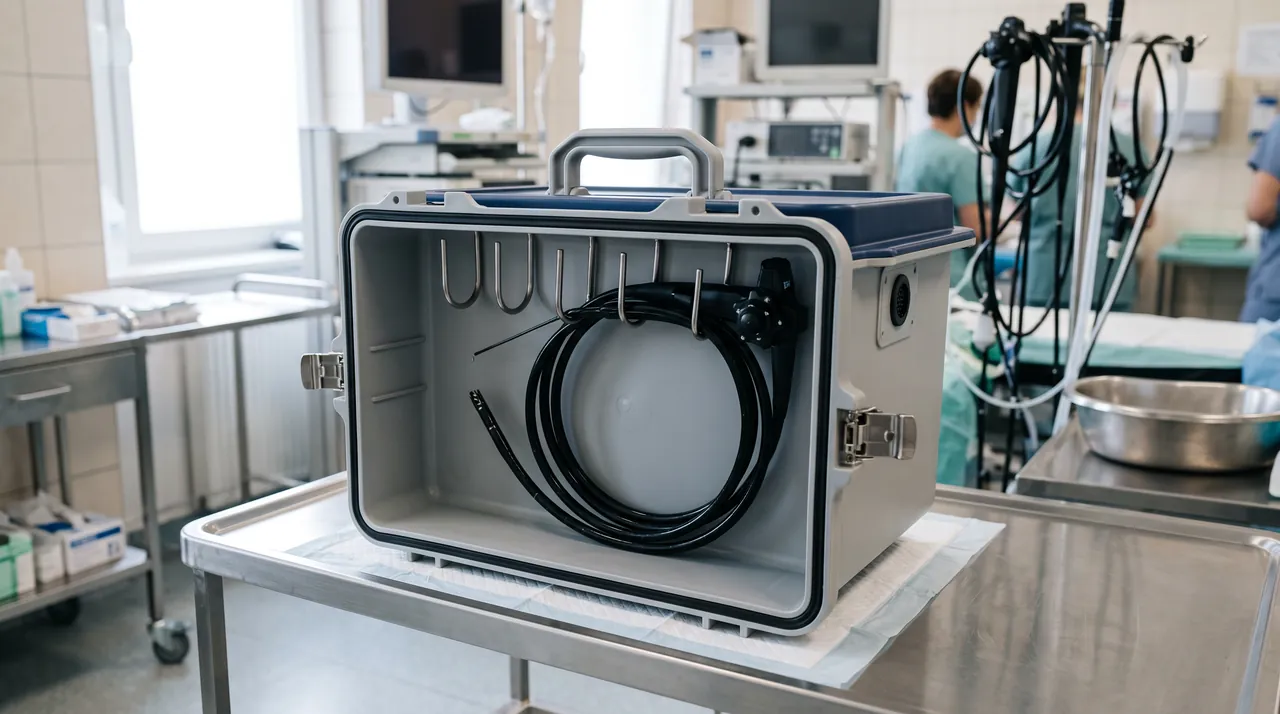
Isolating Sharps and Contaminated Items
Sharps and used contaminated items are the highest-risk elements of medical case design, and the principle is physical isolation plus an unambiguous one-way flow. Sharps belong in a dedicated puncture-resistant container with a fixed position in the case, easy to reach and easy to remove, with a rigid barrier between it and other equipment so nothing is punctured in transit.
Contaminated item containment aims to prevent leakage and cross-contamination. Single-use bags or containers for contaminated material should be fixed in a dedicated zone that can be sealed or closed off, so nothing spills onto other equipment in transit. To support one-way flow, the layout should let the sequence of sterile retrieval, use, and contaminated disposal follow a non-crossing path, reducing turns and reaching steps for the operator.
Isolation must also be cleanable. The contaminated zone is usually the hardest place to clean, so the structure should avoid crevices and hard-to-reach corners and allow the whole section to be removed for washing. Where marking is needed to separate the zones, colour or graphic coding on the sterile and contaminated sides is more effective under time pressure than text. Field requirements for equipment access and protection appear in What Are the Requirements for a Medical Emergency Equipment Case: Protection and Fast Access in Pre-Hospital Care, with general configuration logic in First Aid Kit Case and MEDCHEST: Configuration Standards.
Marking, Traceability, and Batch Management
Marking on a medical case carries three categories of information: the case itself, the contents, and the state. Case information covers name, identifier, protection rating, and accepted sterilization methods. Content information covers the inventory and zoning numbers. State information covers the sterile expiry date, the date of the last sterilization, and usage status. These categories should occupy clearly separated areas so they never obscure one another.
For traceability, a practical method is to give the case a unique identifier and maintain the link to its contents list. That identifier supports history when the case is serviced or its insert replaced, and it prevents case-to-list mismatches when several cases are in use at once. For programs that record sterilization cycles, a record card slot or QR label position on the case lets every sterilization and use be logged without relying on verbal handover.
Marking material itself must tolerate sterilization and disinfection. Adhesive labels lift under hot humid cycling, and the residue left behind harms both appearance and cleanliness. The robust approach uses laser marking, a metal nameplate, or a validated weather-resistant label, with the position decided at design stage so it is not wiped or soaked repeatedly. Where identification in low light matters, luminous or high-contrast marking helps, but its stability under disinfection must be verified in the same way.
Inspection, Acceptance, and Reprocessing
Acceptance of a medical case adds sterilization- and cleaning-related items to the usual structural checks. Structurally, verify dimensions, frame and ribs, hinges and latches, and evenness of seal compression. Functionally, check tray location, insert handling, drainage and drying features, handles, and casters. Sterilization-related items include verifying material compatibility with the intended method, the resilience of the gasket after a sterilization cycle, and the dimensional stability of the insert after cycling.
Reprocessing is best validated by actual use. Using the disinfectants and sterilization method the case will really see, run a number of cycles and check appearance, dimensions, and function, recording the number of cycles regarded as acceptable. For wear items such as inserts and gaskets, define replacement criteria, for example a gasket that has hardened or whose compression marks do not recover, or an insert showing clear shrinkage or crumbling. Acceptance should also confirm that the accompanying documents include material statements, sterilization compatibility, cleaning method, and maintenance interval.
The reprocessing routine itself needs design. If cleaning and repacking depend on specific tools or space, the delivery documents should say so. If different sterilization methods require different gasket configurations, provide a configuration table. Writing the process requirements down protects long-term usability better than delivering a case alone. Instrument transport and container protection criteria are covered in the medical instrument and sample transport references cited above.
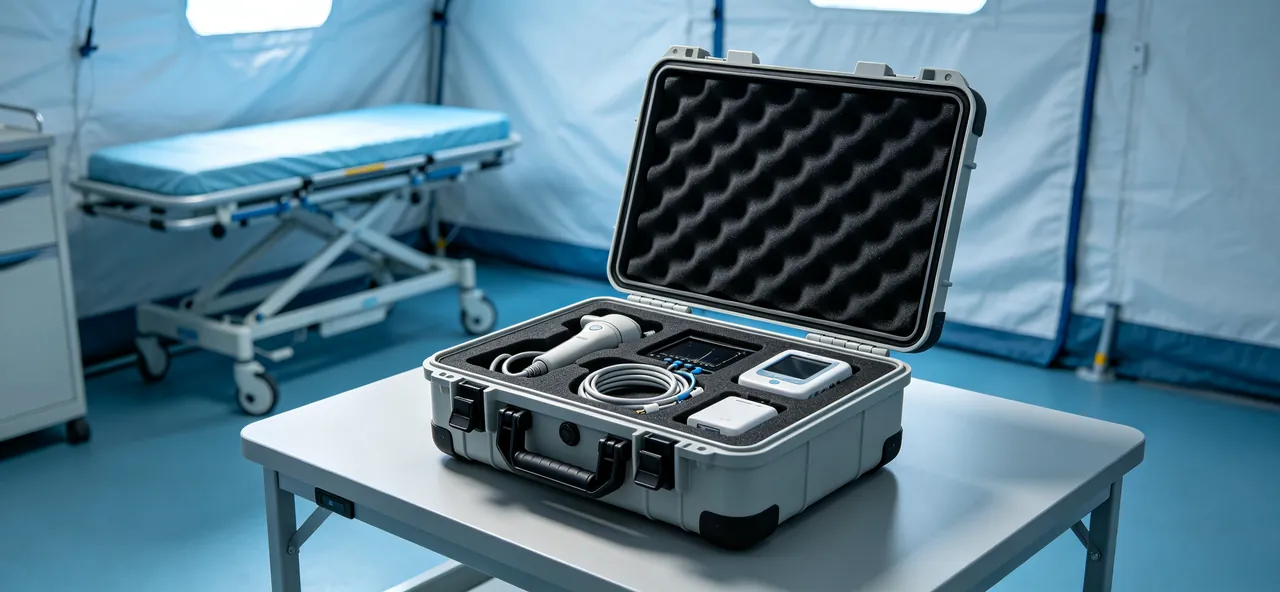
Common Failure Modes and Procurement Pitfalls
Several failure modes are characteristic. Gasket aging is the first: protection falls and moisture appears inside, usually because repeated hot cycling or disinfectant attack has reduced resilience, prevented by specifying sterilization-tolerant gasket material and a replacement interval. Insert dimensional change follows: instrument location loosens or trays become hard to fit, usually because the material absorbed moisture or shrank after hot cycling, prevented by choosing dimensionally stable material and ensuring the insert can dry completely.
Surface coating failure appears as blistering, flaking, or discoloration, usually from prolonged disinfectant action or improper cleaning, prevented by selecting material against the actual disinfectants and avoiding strong solvents. Instrument tray deformation follows thermal stress in sterilization cycling or stacking load, prevented by choosing tray material matched to the method and controlling the number of stacked layers. Marking loss comes from labels that cannot tolerate disinfection, prevented by using weather-resistant marking processes.
Five procurement pitfalls stand out. The first is discussing material before establishing the sterilization method; the correct order is method and disinfectant first, then compatible material, or the result is a handsome case that deforms the first time it enters a sterilizer. The second is treating sterilizable as a single vague attribute; methods differ enormously, so the accepted method, cycle count, and parts requiring replacement must be explicit. The third is neglecting insert cleanability, since absorbent foam that cannot dry carries microbial risk, so inserts should be removable, washable, and dryable. The fourth is neglecting sharps and contaminated zones, whose absence of dedicated cleanable provision degrades hygiene and increases risk. The fifth is neglecting marking and traceability, which should be settled at design stage rather than patched afterwards.
Closing Perspective: Carrying Sterility Through the Chain
The value of a medical case is that it carries a sterile state from the sterilizer all the way to the point of use and returns contaminated material safely to reprocessing. Zoning makes retrieval and counting direct. Material compatibility lets the case survive heat and disinfectants. Trays and inserts keep instruments in place. Sealing and cleanable design keep contamination controllable. Temperature control and isolation give special items dedicated care. When these elements work together, the case becomes not merely a container but a dependable step in a clinical process. JUNZHIJIA's habit on such programs is to make sterilization method, disinfectant type, and reprocessing routine part of the design inputs, because those three decisions define the boundary of what the case can ultimately do.
Frequently Asked Questions
Q: Can a medical case go into an autoclave as a whole, and what conditions must it meet? A: Feasibility depends on three things: case material, seal construction, and venting. On material, the frame and insert must survive repeated sterilization temperature and high humidity; metals usually qualify, while engineering plastics and composites need heat- and hydrolysis-resistant grades verified across the intended cycle count for dimensional and mechanical stability. On sealing, the gasket is the most fragile element in whole-case sterilization; some schemes specify steam-rated gasket material, and others remove the gasket or use a demountable seal before the cycle and refit it afterwards, sparing the seal the harshest conditions. On venting, a completely sealed case entering the sterilizer develops a marked pressure difference across the shell during heating and cooling, imposing structural load, so a path that lets steam enter and leave and condensate drain is needed, provided it does not compromise the normal protection rating. Even when all three are satisfied, the technical file and case marking should state the accepted sterilization methods and cycle counts rather than a vague sterilizable claim.
Q: How should case material be matched to sterilization methods, and what constraints does each method impose? A: Matching starts with the method, then works back to material, never the reverse. Steam autoclave applies high temperature, high humidity, and a pressure cycle simultaneously, demanding the most in heat resistance, hydrolysis resistance, and dimensional stability, so metal construction is usually preferred and plastic parts need specific heat-resistant grades. Ethylene oxide runs cooler but calls for attention to sterilant and residue compatibility with the contents and to aeration time for desorption. Hydrogen peroxide low-temperature plasma imposes specific demands on oxidative stability, and some elastomers and coatings change under repeated exposure. Irradiation cross-links or degrades certain polymers, so material behaviour at the target dose must be confirmed. Beyond the sterilization method, daily disinfectants must be checked too, since chlorine compounds, peroxides, quaternary ammonium compounds, and alcohols differ greatly in aggressiveness. The practical engineering approach lists, for each case, the accepted sterilization methods, the usable disinfectants, and the permitted cycle count, and puts all three into the technical file and the marking so users know where the limits are.
Q: How should insert material be chosen for a medical case, and does water absorption create a risk? A: Insert selection must satisfy cushioning, location, disinfection tolerance, and dryability together, and water absorption does deserve serious attention. Highly absorbent foam is hard to dry internally after repeated cleaning, and prolonged dampness supports microbial growth while the material gradually loses resilience. Priority should go to materials with low absorption, fast drying, and small dimensional change across disinfection cycles, with a design that lets the insert be removed as a unit for separate washing and drying rather than staying fixed in the case. Where a highly absorbent material is needed for cushioning, an outer waterproof layer or a removable sleeve lets it be taken out and washed after use. Location should not rely solely on insert material; a combination of rigid limiters carrying the primary location and flexible material providing cushioning keeps instruments in place even when the material changes dimension slightly over cycles. Finally, define replacement criteria for the insert, such as clear shrinkage, crumbling, or failure to recover after compression.
Q: Sealing and cleanability conflict in a medical case — how should the balance be struck? A: The conflict is real: better sealing makes internal venting and drainage harder so residual water is harder to remove, while drainage openings can become ingress paths. The practical balance separates the design by state. In normal closed use the case should stay reliably sealed, keeping external liquids and particles out and internal liquids in. In the cleaning and drying state, thorough drying is achieved through openable drain features, a removable insert, and openable vent positions. One case then satisfies both states without compromising either. Making the hard-to-clean parts replaceable is another effective idea: a replaceable liner film or isolation bag inside the case is exchanged rather than repeatedly washed, which lowers cleaning difficulty and reduces residue risk. The design should also keep cleaning practical, avoiding crevices, deep grooves, and hard-to-reach corners, making handles and latches easy to wipe, and shaping caster mounting areas so debris does not collect. Verifying the balance in practice means running a full clean-and-dry cycle on the actual case and then checking for residual moisture before the next pack, rather than assuming the design works.
Q: How should instrument trays and inserts be designed to hold position while allowing frequent handling? A: The goal is to fix instruments to the tray and the tray to the case without sacrificing handling speed. A common division of labour has the tray locating the instruments and the insert cushioning and limiting the tray. Inside the tray, slots, retainers, or elastic fixtures keep instruments from moving, so the tray can be handled and sterilized as a unit. Between tray and case, locating bosses, recesses, or rails constrain horizontal movement, while a retainer or a cushioning block inside the lid limits vertical bounce. For frequent handling, the tray needs clear grip points that one person can use, and the interface should allow some operating tolerance so minor errors do not prevent proper seating. Tray material must match the sterilization method: metal resists autoclave conditions but is heavy, while engineering plastic is lighter but tolerates hot cycling less well. The insert should come out easily for cleaning and form a flexible transition between tray and case, reducing rigid contact with instruments. After design, run a packing drill with real instruments and confirm the steps and timing fit the on-site rhythm.
Q: How should sharps and used contaminated items be handled inside the case, and what structural issues matter? A: The principle is physical isolation plus a clear one-way flow. Sharps belong in a dedicated puncture-resistant container with a fixed position in the case, easy to reach and remove, separated from other equipment by a rigid barrier so nothing is punctured in transit. Used contaminated items go into single-use bags or containers fixed in a dedicated zone that can be sealed or closed off, preventing spillage onto other equipment. To support one-way flow, the layout should let sterile retrieval, use, and contaminated disposal follow a non-crossing path, reducing turns and reaching, which matters greatly under time pressure. Structurally, the contaminated zone is usually the hardest to clean, so it should avoid crevices and hard-to-reach corners and allow removal for washing or direct replacement. For marking, colour or graphic separation between sterile and contaminated zones is more intuitive in an emergency than text. Where the case also carries samples or reagents, leak prevention and temperature control must be considered so contaminated material and samples do not affect each other.
Q: How should marking and traceability work, and can labels survive disinfectants and heat? A: Marking should carry case information, content information, and state information, laid out in clearly separated areas so nothing obscures anything else. Case information covers name, identifier, protection rating, and accepted sterilization methods. Content information covers the inventory and zoning numbers. State information covers the sterile expiry date, the last sterilization date, and usage status. For traceability, a practical approach gives the case a unique identifier linked to its contents list, providing a basis for servicing, insert replacement, and troubleshooting, and preventing mismatches when several cases are in use. Marking durability is easily neglected: adhesive labels lift under hot humid cycling and disinfectant wiping, and the residue harms cleanliness. The robust approach uses laser marking, a metal nameplate, or a validated weather-resistant label, with the position fixed at design stage so it is not repeatedly soaked or scrubbed. For batch-managed programs, a record card slot or QR label position lets every sterilization and use be logged on the case itself.
Q: What should acceptance of a medical case check specifically in relation to sterilization? A: Sterilization-related items should sit alongside the usual structural checks rather than replacing them. On material compatibility, confirm the accepted range of the case and insert materials for the intended sterilization method, ideally by running actual cycles and observing changes in appearance, dimensions, and mechanical properties. On sealing, check whether the gasket still recovers its resilience after the specified number of sterilization or disinfection cycles and whether the compression system remains effective. On inserts, confirm dimensional change after repeated cycles stays within allowance and that the insert dries completely. Functionally, also check tray location stability, drainage and venting features, and latch closing reliability after cycling. Acceptance should use the actual disinfectants and sterilization method for a cycle trial and record the acceptable cycle count and replacement criteria, such as a gasket that has hardened, compression marks that do not recover, or an insert that has clearly shrunk or crumbled. On documentation, request material statements, sterilization compatibility, cleaning method, and maintenance interval, and confirm they match the case marking so users do not follow the wrong procedure.
Q: What are the most common mistakes when procuring a medical case? A: Five dominate. First, discussing material before establishing the sterilization method; the correct order is method and disinfectant first, compatible material second, or the result is a case that looks right and fails the first time it enters a sterilizer. Second, treating sterilizable as a single vague attribute when methods differ enormously in temperature, humidity, and medium, so the accepted method, permitted cycle count, and parts requiring replacement must be explicit. Third, neglecting insert cleanability, because absorbent material that cannot dry internally carries microbial risk, so inserts must be removable, washable, and dryable. Fourth, neglecting sharps and contaminated zones, whose lack of dedicated cleanable provision degrades hygiene and increases handling risk over time. Fifth, neglecting marking and traceability, since clinical settings manage batches and expiry dates closely, so the marking scheme and record positions belong in the design stage. Writing these requirements into the technical specification and carrying them into acceptance costs far less than fixing them later.