

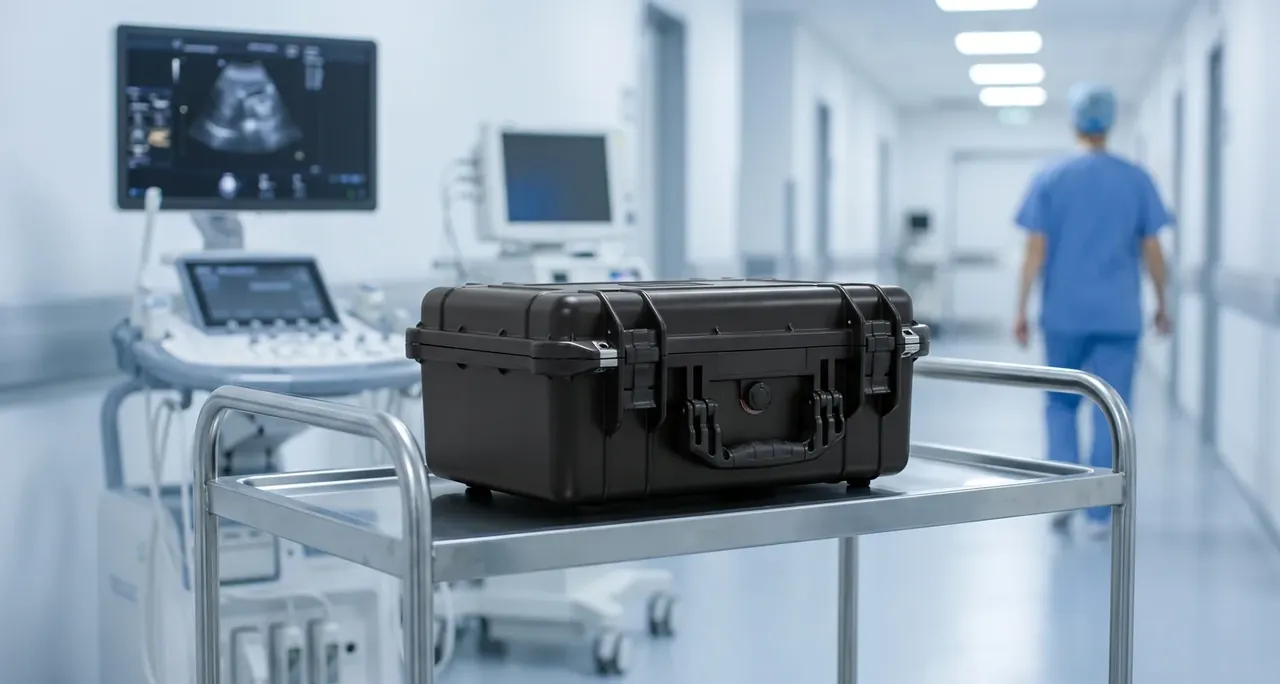
Quick answer: Medical Consumables Transit Case cost sits on the return leg, so load factor, 5-high stacking and a 60 C wash decide the cycle.
Table of contents
- Load factor on the run from central stores to the ward
- Stacking and four-colour marking at the ward holding bay
- Where empty shells go after the point of use
- Wash temperature against material tolerance
- Cycle count and the write-off line
- FAQ
1. Load factor on the run from central stores to the ward
A shell that comes back is an asset, and its cost lands on every trip home rather than on the purchase order. The first number to get wrong is load factor: 45 litres of volume carrying 120 items, sealed while a fifth of the cavity is still free, then returning empty and still occupying a trolley slot and a share of the lift. By volume, 78 percent is ordinary; below seven tenths the trip count climbs.
Packing matters more than the shell itself. Standing long dressing packs on edge along a Medical Consumables Transit Case wall fits roughly a tenth more than laying them flat, while mixing two departments in one shell forces a full sort at the far end and eats the saving in labour. An outside footprint of 600 x 400 x 320 mm lines up with a 600 mm trolley depth, so no half-bay is wasted.
| Packing method | Items per shell | Load factor | Sorting at the ward |
|---|---|---|---|
| Flat stacking | About 90 | Roughly 65% | Tip out and count each item |
| Long items on edge with banded bundles | 120 | Roughly 78% | Lift a bundle, count fast |
| One department per shell, no mixing | 105 | Roughly 72% | Straight to the shelf |
2. Stacking and four-colour marking at the ward holding bay
The holding bay decides how a Medical Consumables Transit Case is loaded in compression. At 5 high, the bottom unit carries the four above it, and a rim without a rib bows within months. A Medical Consumables Transit Case lid is dished with two cross ribs so lids nest on rims and a five-high stack stays square; a sixth layer is where reach height and compression both stop being sensible.
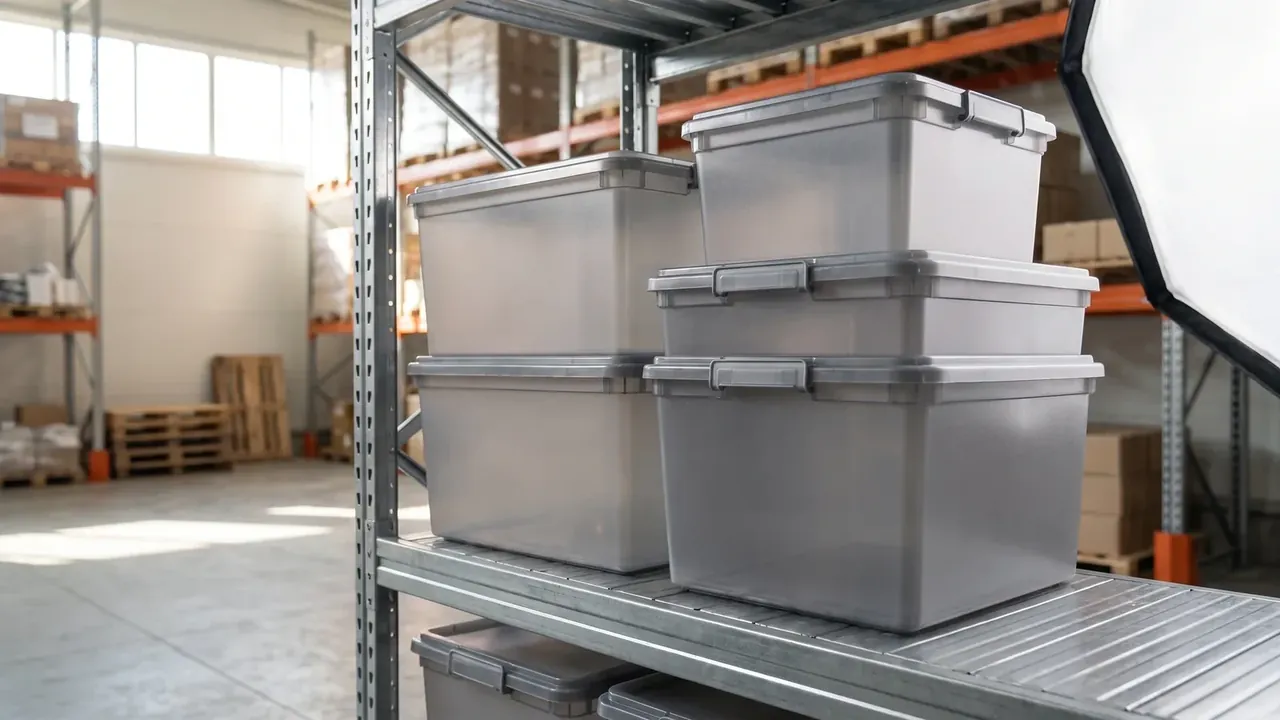
Four-colour marking keeps the return leg in order. One batch is split by use, blue for infusion supplies, green for dressings, yellow for laboratory consumables, grey for general non-sterile items, with colour confined to a side plate rather than moulded in, so a change of use is a change of plate. Plates slide into a slot on the rim and stay put through the wash.
Bay markings beat labels. Paint a footprint for each shell, one frame to one position, so a case on its line is in the right place; each colour owns a stretch of floor. When space runs short, add racking rather than doubling two colours into one frame.
3. Where empty shells go after the point of use
Empty units travel the reverse route: cleared at the point of use, pushed to the ward bay, then back to central stores on the next delivery run. A 7 day return cycle means one loop a week, most of it spent in transit. The fleet a hospital needs is therefore set by how many Medical Consumables Transit Case units are tied up along the chain.
Breaks in that chain usually start with convenience. A Medical Consumables Transit Case emptied at the bedside is parked at the end of a corridor and claimed by nobody two days later; the ward bay fills with loaded shells, so empties wait outside. Once out of the loop, a Medical Consumables Transit Case is just a plastic box taking up floor, and stores read the shortage as demand while the missing units sit in a corridor.
| Handover point | Who takes it | When | What to check |
|---|---|---|---|
| Point of use cleared | Ward nurse on shift | Immediately after use | No residue, plate in place |
| Ward bay | Department stores clerk | Before shift end | Colour position, inside the line |
| Return run | Central stores driver | Next morning | Empty count matches the issue sheet |
| Wash intake | Decontamination team | Day of arrival | First pass for cracks and distortion |
4. Wash temperature against material tolerance
Washing is what separates a returnable shell from a disposable carton, and it is also where the shell ages fastest. A 60 C cycle of 10 minutes with a mild detergent is the common hospital setting, and going hotter narrows the material choice: PP takes water above 100 C, while HDPE distorts when held above 60 C for long, so two shells washed at the same temperature can differ by years of service.
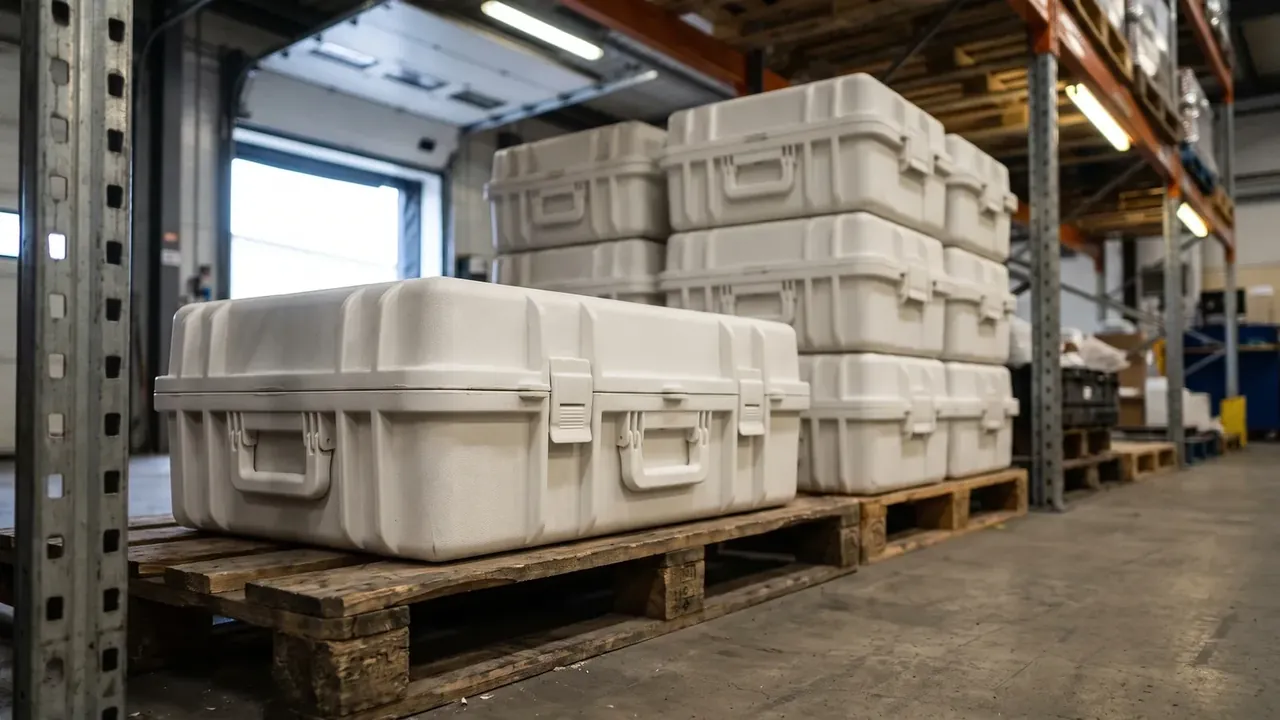
Water uptake and scuffing are the slow problems. ABS mouldings take up 0.2 to 0.45 percent of their mass in 24 hours, and repeated wetting and drying walks the dimensions; a scratch raised by a steel scourer holds the rinse water and detergent film that the next load of consumables picks up. Soft brushes only, never a metal scraper.
Drying is the step most often skipped. Stand a washed Medical Consumables Transit Case on edge to drain, because the four base corners hold water longest, and run a hand under the floor before stacking. Lidding a damp Medical Consumables Transit Case looks tidy in the store and greets the next user with a smell.
5. Cycle count and the write-off line
Service life is counted in trips, not years. A batch rated for 1200 cycles, at one loop a week and fifty loops a year, should last a long while on paper; in practice the annual loss runs near 3 percent, concentrated in knocks, overloading and wash temperature drift. Put the count on the shell itself, inkjet or a wash-resistant label, never in an office notebook.
A batch verdict follows: after 1200 cumulative cycles, a batch showing base cracks or rim distortion beyond 3 mm leaves the loop as a whole. The line is drawn per batch rather than per unit, since material, mould and wash conditions are shared. Retired units go to waste collection or scrap, never back into sterile consumables.
A rule only works with records. Give every batch an ID, log the first issue date at intake, have the wash team note temperature and anomalies weekly, and the year-end review names the batch to retire. Half the life-cycle cost of a Medical Consumables Transit Case is bought with the order; the other half is saved in those notes.
Related Reading
- Zoning and transfer in endoscope cleaning transit boxes
- Cold chain box temperature zones and phase change packs
- How medical cases are used across hospital departments
- Hard cases against cartons for e-commerce despatch
Related Products
- 8 Series — Gun Cases; Military Equipment Cases; Camera Equipment Cases; Drone Cases; Watch Cases; Knife Cases; First Aid Cases; Electronics Equipment Cases
- WL8-2812 PP Gun Case — model WL8-2812
- All protective cases and toolboxes: 7 series, 158 models