

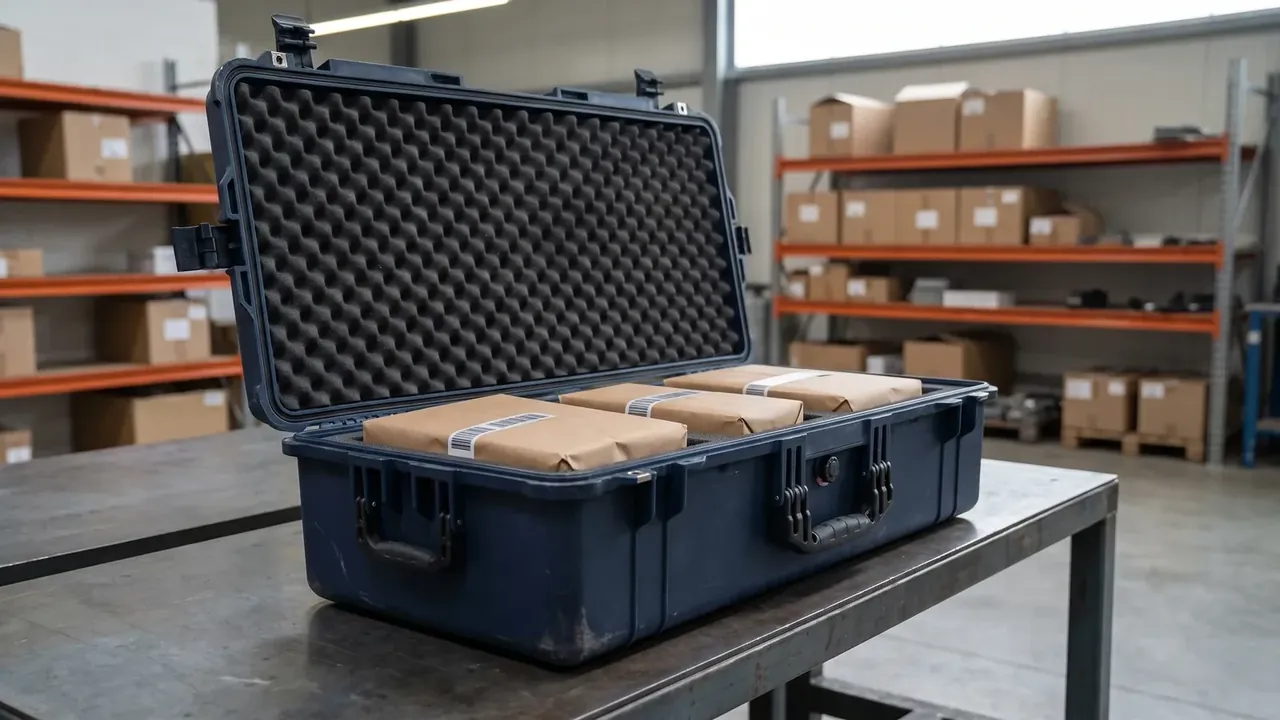
Quick answer: Medical defibrillator monitor portable hard case holds compression set under 8% with a 4.9 mm groove and 105 mm lid ribs across 12 thermal cycles.
Table of contents
- Seal groove of the Medical defibrillator monitor portable hard case
- Lid rib spacing
- Compression set after twelve thermal cycles
- Box-mouth pressure drop on re-test
- Groove setting for the portable batch
- FAQ
1. Seal groove of the Medical defibrillator monitor portable hard case
Cycle after cycle, how far a compressed gasket springs back is settled largely by groove depth and rib pitch. The Medical defibrillator monitor portable hard case carries a continuous machined groove around the mouth, cut 4.9 mm deep, with two beads seated at 20% squeeze. Too shallow and the bead is crushed until its resilience collapses; too deep and the lid never presses it far enough to hold mouth pressure.
| Groove grade | Depth | Spring-back after first squeeze | Lid contact |
|---|---|---|---|
| Shallow | 4.3 mm | Low | Over-tight |
| Setting | 4.9 mm | Even | Uniform |
| Deep | 5.5 mm | High | Loose |
An envelope of 540x380x200 mm, a 475x325x145 mm cavity and 4.4 mm wall stock leave only a thin web under the groove floor, so a cutter biting too deep breaks through. Four latches deliver 375 N each; a rivet too close dents the bead and one too far leaves the long side under-seated.
2. Lid rib spacing
The lid is not a flat plate; a grid of ribs sits behind it at 105 mm spacing. On the Medical defibrillator monitor portable hard case this grid crosses at the latch seats, so latch force lands on the ribs before spreading around the mouth. Widen the spacing and the lid center goes soft, bowing under heat and kneading the gasket; tighten it and the 5.1 kg empty shell gains weight.
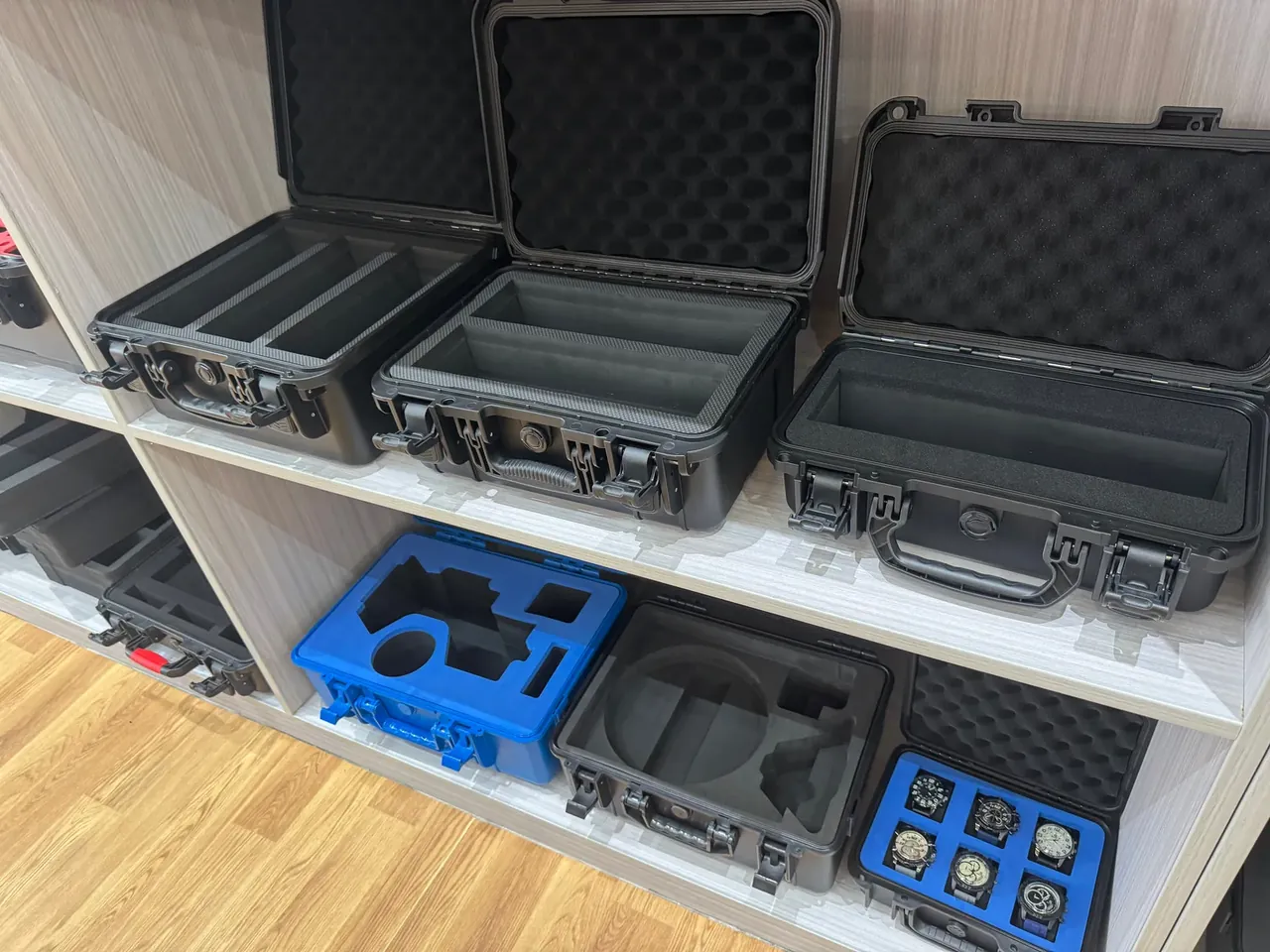
Under a 12 kg load the lid presses along a different line, and ribs far from a latch transmit force late, so closing gaps show at the corners first. The 4300 open-close count is a durability baseline for hinge and latches and also reveals blanched rib roots. The Medical defibrillator monitor portable hard case drawing ties rib height to the 4.4 mm wall and rounds every rib root to avoid a stress trap.
3. Compression set after twelve thermal cycles
Twelve swings between -10 C and 50 C are the whole thermal history this rig gives the shell. Each cold leg stiffens the bead, each hot leg swells the lid slightly, and the squeeze that will not come back is compression set. The Medical defibrillator monitor portable hard case takes its reading only after the twelfth cycle, not from a flattering mid-run number or the first reading out of the box.
| Cycle index | Accumulated set | Mouth gap after re-warm | Rig action |
|---|---|---|---|
| Cycle 1 | Baseline | within 0.30 mm | Log baseline |
| Cycle 4 | Small rise | within 0.33 mm | Continue |
| Cycle 8 | Mid rise | within 0.36 mm | Continue |
| Cycle 12 | Setting reading | within 0.38 mm | Sample and judge |
A set of 8% or less is the margin left to sealing on the case side; past it the bead cannot recover its section and mouth decay follows. Lids ribbed at 105 mm hold the rise flatter while shallow-groove samples climb fastest. Between cycles the Medical defibrillator monitor portable hard case rests at room temperature and readings are logged only after re-warm, so thermal expansion is not mistaken for permanent set.
4. Box-mouth pressure drop on re-test
Once the twelfth cycle ends, the shell rests at room temperature and moves to the decay rig, a stage called the re-test. The Medical defibrillator monitor portable hard case is fed a slight pressure through the mouth, held at a set value, and the drop over 10 min is read against a limit of 0.24 kPa / 10 min. Decay and set are a pair: if the bead cannot spring back, air leaves through the gap first.
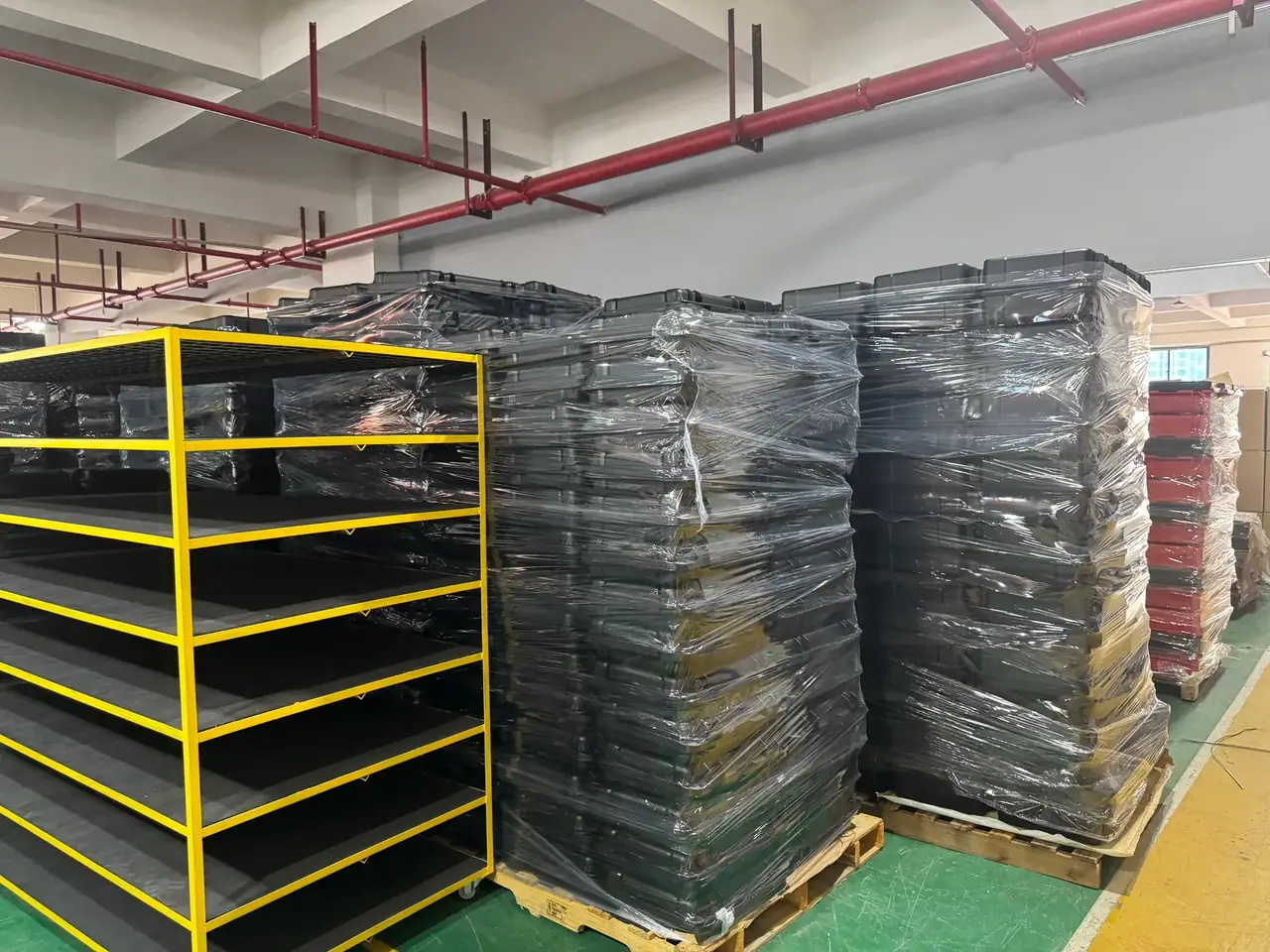
Nothing is swapped for the re-test: no fresh bead, no re-torqued latch, just the same shell that ran the cycles, so the number belongs to groove and ribs together. Benchmarking to the IP66 method names the pressure-hold and spray rig used by the Medical defibrillator monitor portable hard case, not a certificate the shell already holds.
5. Groove setting for the portable batch
Stack the tables and the Medical defibrillator monitor portable hard case keeps a single groove setting for its portable batch: the shallowest grade whose set after the twelfth cycle still stays at or under 8%; shallower grooves are reassigned to a non-sealed spec. Shallow wins because a short squeeze stroke needs less lid pressure, so 375 N from each of four latches is enough.
| Set reading | Disposition | Re-check |
|---|---|---|
| up to 8% | Portable batch | Mouth decay |
| 8% to 10% | Hold as sample | Re-warm gap |
| over 8% | Non-sealed | Appearance and rivets |
The setting is issued together with 105 mm rib spacing and 20% squeeze, and changing any one sends the Medical defibrillator monitor portable hard case back through all 12 cycles rather than filling in by interpolation. Production drawings admit only these rows, and shallow samples stay as records rather than entering the batch. Once locked, cutter feed and tool change intervals follow the same grade.
Conclusion
The sealing margin of a Medical defibrillator monitor portable hard case lives not in the gasket but in the balance of a 4.9 mm groove and 105 mm rib spacing on the case side. Twelve thermal cycles put set and mouth decay on the bench together, where the numbers speak and the reject line looks only at the twelfth round. JUNZHIJIA writes the portable-batch setting into the drawing and does not pick samples on the fly; holding these case-side dimensions and checks matters more than watching what goes inside.
Related Reading
- Carrying Cases: Portable Structure & Everyday Handling Protection
- Medical Case: Instrument Zoning and Sterilization Compatibility
- ABS Waterproof Equipment Box Acceptance Standards
- Portable medical emergency equipment safety box
Related Products
- 8 Series — Gun Cases; Military Equipment Cases; Camera Equipment Cases; Drone Cases; Watch Cases; Knife Cases; First Aid Cases; Electronics Equipment Cases
- WL8-2812 PP Gun Case — model WL8-2812
- All protective cases and toolboxes: 7 series, 158 models